Shibata Castle Completion Guide: Japan’s only remaining three-shachi (fish-shaped shell sign in Chinese mythology), history and highlights of famous castle forts
Shibata Castle is located in Shibata City, Niigata Prefecture, and is a flat castle fort located in one area, and is commonly known as “Iris Castle” by locals. Shibata Castle is one of Japan’s 100 most famous castles, and is a rare example of a castle built during the Edo period, among which many have been designated as nationally important cultural treasures. It has a unique T-shaped box with three-piece shachi, the only one of its kind in Japan. Details of the main text: A detailed explanation of Shibata Castle’s needs, comprehensive history, architectural charm, and transportation methods beyond the bright spots.
History of Shibata Castle: From the time of war to the time of war
Shibata clan era and Shibata Shigeie rebellion
The origin of Shibata Castle is not entirely clear, but it is generally known that it was originally the residence of the Shibata clan. During his time in the war, the Shibata clan’s strength was the same as that of Uesugi’s father, Long Kei.
The most important incident in the history of Shibata Castle is the “Shibata Shigeie Rebellion” of 1581 (Tensho 9). Shibata Shigeie was a vassal of the Uesugi clan, and Kageyoshi Uesugi was appointed after the death of others who rebelled against raising an army. Seven years after the rebellion ended, in 1587 (Tensho 15), Shibata Castle was conquered by Uesugi Keiyoshi, and Shibata Shigeie was killed. After this, Shibata Castle was owned by Mr. Uesugi.
Mr. Mutsuguchi’s construction work exhibition
The current leader of Shibata Castle is Hidetoshi Muzuguchi, the chief lord of the Shibata clan. In 1598 (3rd year of the reign), Hideyoshi, the vassal, was given 60,000 koku by Hidetoshi Mutsuguchi, and he moved to the Shibata domain. In the following year, the new construction department began to win, and the construction of Shibata Castle was completed.
The construction of Shibata Castle was a long process, and was finally completed in 1654, during the reign of Nobutanao Muguchi, the third feudal lord. Approximately 270 years later, during the Meiji Restoration, the Mutsuguchi family lived in this castle, and the Shibata clan was the administrative center of the production, and the political establishment was in the midst of the search for political peace. The Shibata clan was a feudal lord family with a total of 100,000 koku (Japan’s birthplace), and was a member of a local feudal lord family who held direct positions and held direct positions during the Meiji period.
Shibata Castle during the Meiji period and after the new era
After the Meiji period and the beginning of the Meiji era, Shita Castle Fortress was established, and Shibata Joya was an exception. This is what happened in the inner city, the main gate of the inner city, and the corner tower of the two castles. Designated as a Nationally Important Cultural Property in 1963.
Part of the Yuyu area was occupied by the Shibata Army, which was operated by the Japanese military, and the public was released. Unfortunately, the three-level pagoda and Tatsumi Pagoda were renovated in 2004, so now we have completed the construction of Shibata Castle Park, which is a pleasure for local residents and visitors.
Shibata Castle architectural features Japanese architecture
Geographical location of Sakuhan Ichiza Plains Castle Fortress Wfu Bureau
A typical mountain fortification is different, Shibata Castle was built on the plains, work and politics are centered on harmony, transportation convenience is the main factor to consider. The Kaji River river in the northern part of the castle fort was formed outside the castle. From the fort to the center of the castle tower, to the north is the old castle tower, to the south is the second castle tower, and to the south is the third castle tower.
This type of cloth station and completed defense and effectiveness, the immediate use is the plains fort, and the borrowed castle is a solid defense. The castle town has also been completely opened, and the castle town of Shibata City has been established. ### Beautiful stone wall Yoko wall
Shibata Castle’s stone tombs were built using the famous “Kirihagi” technique. This is one of the most exquisite stonemasonry techniques, careful attention to detail, general stone masonry processing, and a perfect combination. Various techniques are used to prepare Shibata Castle’s stone mounds for an aesthetically pleasing appearance.
The special feature of the author is the beautiful wall, which is famous for its black and white beauty. The wall is constructed in a variety of ways, with flat tiles installed on the wall, filled with silt, and has excellent fire resistance and durability. During the construction of Shibata Castle, the walls of the castle were used, and the fort was honored and beautiful.
The only three-tiered castle tower in Japan that has one troupe and three troupes.
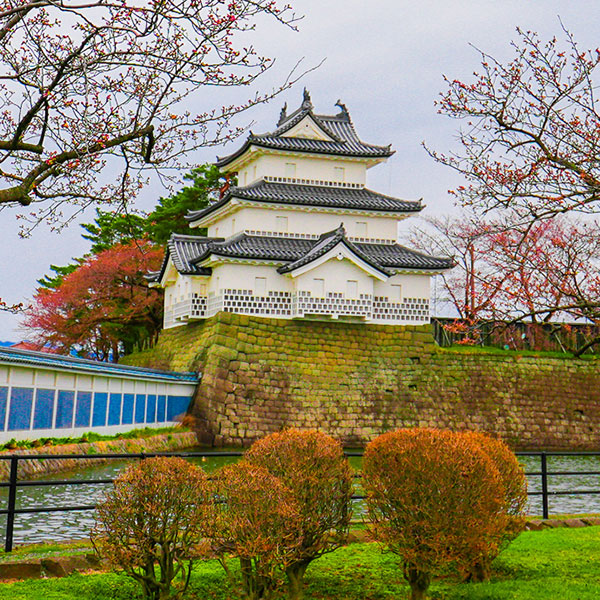
Shibata Castle Saiaki’s special attack is the three-layered castle tower, which is the only one in Japan with a T-shaped roof, a box and a three-sided square tower. In practice, the castle tower is the guardian deity of the castle fort, and it is also the symbol of Shibata Castle.
Usually, during the construction of a castle fort, the two ends of the main building are left behind after the formation of the Shachi (a fish-shaped creature in myth). Of course, Shibata Castle’s three-tiered castle tower has a T-shaped house with an additional structure, so there is a three-tiered castle tower with decorations on the top. This unique design gives Shibata Castle a unique architectural style.
The three-level castle tower was repaired in 2004, and was moved to the Japan Automobile Museum, so there was no legal access to the interior. However, it is more than acceptable for its unique appearance. The three-tiered corner tower with a view of one side of Chaitian Castle Park, the scenery is especially spectacular.
National Important Cultural Purchase: Zhengmen and Hara Nihama Corner Tower
Main gate
The main gate is a well-preserved construction from the Edo era, and is designated as a nationally important cultural treasure. It is a square tower-style castle gate with a square tower, a square tower, and a square tower.
The castle gate is the main entrance to Shibata Castle, where the lord of the castle enters and exits, and all kinds of officials enter. The black wall of the castle gate is exquisitely decorated and beautifully decorated, and the site is in perfect condition, which is a characteristic of the construction of the castle fort during the Edo period. Penetrating the gate, the Buddha was placed in the samurai society at the time.
Ninomaru Kakuro (Hara)
An important cultural purchase is the Ninomaru Kakuro (Hara). This corner tower is also a rare construction, and the structure of the two layers is very rare.
The corner tower is an important cornerstone during the defense of the fort, and it is a transparent sentry, and it is also a defense base. The Ninomaru Corner Tower (original) is an important historical document, and the concept of construction technology and defense at the time of its expansion. The construction of the fort in Niigata during the Edo period, and the historical history of the castle in Niigata.
Tatsumi Kakuro
Tatsumi Kakuro and Sanrei Kakuro were first established in 2004 and completed in 2004. Tatsumi Kakurou because of its position in the eastern direction of the castle tower (in the direction of Tatsumi) and its name.
After the restoration, the Tatsumi Tower was unreachable, and the original three-tiered pagoda was built by Hiroya Nagata, but it was understood that it was an important construction in the defense system of Shibata Castle. The restoration work has been carried out faithfully in Japanese historical documents, and the image of people’s imagination of Shibata Castle during the Edo period has been completed.
The Tatsumi Tower is located within the park, but visitors are allowed to visit the park without any legal restrictions.
Seasonal charm of Shibata Castle Park
Spring: Famous Victories
Shibata Castle Park is a famous historical site in Shibata City. Every year in spring, there are about 300 types of Yoshino trees in the city, and the number of beautiful Yoshino trees grows at the same time.
The white wall of the fort building, the Japanese black, gray mud, and light powder-colored oak flowers intersect and shine, and the construction is a magnificent scenery, attracting many visitors. In front of the main gate, the lily flowers and trees on the riverside of the city are the hot spot of the gate. At night, when the cherry blossoms and cherry blossoms passed by, the light was shining brightly, and when the curtain came down, the sight of the wandering people as the cherry blossoms opened.
The best time to visit is usually from early April to mid-April, with periodic events such as “Shibata Castle Ruins Park Garden Flower Festival”.
Summer: Green intention and ancient castle soei development
In the summer, the Shibata Castle Park Park was green in nature, and the white walls and green leaves were reflected in the light, and the picture book was composed of a fresh, new, and modern picture book. The scenery of the castle towers reflected on the river surface, clear and refreshing, this is the ideal season for walking around.
Autumn: Red leaves and ancient construction
In autumn, the colors of the trees in the park are scattered, the red leaves and the old castle are reflected, and the screen looks like a picture of a beautiful and beautiful man. Silver apricots and tree leaves are yellow and red, and the white elevation of the silver apricot is compared to the beauty of the white elevation.
Winter: Shibata Castle with white snow
Heavy winter snowfall in Niigata, Shibata Shiroya always covered with white snow. A beautiful ink painting of a castle fort covered in pure white and completely covered with snow. In particular, it has a three-layered castle tower with three pheasants (fish-shaped deities in Japanese mythology) and a white snow cover, and a different charm.
In winter, there are few visitors to Shibata Castle, and it is the best time to enjoy the beauty of the castle.
Shibata Castle selected from Japan’s top 100 famous castles
Shibata Castle was selected by the Japan Castle Fortress Association as one of Japan’s 100 most famous castles (ranked 31st). A thorough review of the fort’s historical history, construction and cultural history, and thorough confirmation that Shibata Castle is a representative Japanese fort.
For those who love to visit Japan’s 100 Famous Castles, Shibata Castle is a must-visit place. Its unique three-layered pagoda, three pheasants (fish-shaped shrines in Japanese mythology), and its unique construction make it an interesting place for tourists to visit.
Japan’s 100 Famous Castle Seals Japanese Castle Fortress Card
Seal of Shibata Castle, a collection of Japan’s 100 Famous Castles. Seals can be purchased within Shibata Castle Park and at the Shibata City Visitor Information Center (in front of JR Shibata Station). Outside of the time when the envoy is in the park, it is also possible to buy the customer information center in front of the car station, which is very convenient.
In addition to this, Shibata Castle’s “Castle Fortress Card”. This is a small collection of citadel pictures, basic information and historical information, and a deep favorite of citadel enthusiasts. You can purchase from Shibata City Visitor Information Center and other locations.
Castle Fortress Seal Song
In recent years, the seal of the castle fort has been engraved with the reception of Etsu and Etsu, and the seal of the castle fort with Shibata Joya. The castle fort seal is made as a commemorative item for visiting the castle, and the Shibata castle seal has the unique design of a pheasant (a fish-shaped creature in Japanese mythology).
The fort seal is located in Shibata City Tourist Information Center, and the shipping time is usually 300 days. A limited edition seal that can be used at certain times to visit the site.
Shibata Josuke points and recommended points
Chengmen Entrance Fortress
When I visited the Shibata Castle ruins park, I entered the main gate while building it, and the main gate was a nationally designated important cultural property. At the time of the battle, when the warriors penetrated the castle, the warriors of the warrior society of the Jiang Dynasty were able to penetrate the Buddha.
Before entering the park, I took a short look at the flowers, and the beauty of the visit to the sea was completed.
The best spot of the three-storied pagoda
The three-storied pagoda is located within the self-propelled facility, but is not open to the outside, but is an absolutely beautiful spot within the park. Due to its advantageous position on the banks of the river, the city has a clear and clear view of its unique structure, which makes it a three-sided pheasant (fish-shaped creature in mythology).
In Chengguang, the white wall of the tower tower is glowing, and it is an ideal photographic background. The towers are reflected in the city and the scenery above the river is also invisible.
欣赏石墙之美
Shibata Castle’s stone burial mound is a masterpiece of the “Kirihagi” technique. Walking along the coast of the castle, the stonework technique of finely detailed stonework can be seen from a short distance.
The stone wall around the main gate and the corner tower of the second circle of Wahara has been preserved in perfect condition, and the stone masonry techniques of the Jiang era have been preserved in perfect condition.
Castle Fortress
Shibata Castle’s fort was built with a mirror facing the river. In the wind, the waves are static in the sun village, and the corner tower and the stone wall are in the riverside of the city.
As you walk along the riverside of the castle, you can see the beautiful scenery from every angle, reflecting the interaction between the fort and the water.
Transportation and basic information about Shibata Castle
Riding the car
From JR Shibata Station
- JR Joetsu Main Line, Shibata Station
- Travel time from the station is approximately 20 minutes (approximately 1.5 km)
- This is a castle town park that gives you a feeling of excitement as you walk.
Jizabaji
- Shibata City Green Shop “Metal Shop” sitting in front of Shibata Station
- At the bus stop at “Shibata Castle Ruins Park”.
Car route
Departing from the expressway
- Exit from Kiyoro Shibata IC on the Japan Sea East North Expressway, approximately 15 minutes by car
- Exit the Niitsu IC on the Usen-Etsu Expressway, take National Highway 460, approximately 40 minutes by car.
Car stop information
- Shibata Castle Park Park: 10 regular cars, 5 large cars
- Shibata Ina station: 163 cars (approximately 5 minutes from Shibata Castle)
- Parking fee: No fee
Opening time gate vote
Opening time
- April to November: 9:00 a.m. to 5:00 p.m.
- December to March: Closed door (accessible outside)
Closing date
- Shuichi (as for Shuichi, the next day)
- New Year’s holiday (December 28th to January 3rd)
Key vote
- Indemnity
-Assuming no demand
Lien system
Shibata City Tour Guide
- Site: 3-3-3 Chuocho, Shibata City, Niigata Prefecture: 957-8686
- Phone: 0254-22-3101
Shibata City Tour Guide Center
- Site: JR Shibata Station
- Phone: 0254-26-6789
- Business hours: 9:00 am to 6:00 pm
View points around Shibata Castle
Shimizu Garden Japanese Footsteps
It took about 10 minutes to walk from Shimizu Garden to Shibata Castle, and it was a walking garden, on the former site of the residence of the Muguchi family, the lords of the Shibata domain. Designated nationally famous historical sites, seasonal scenery and people. The building of the footbridge is a rare building and has been preserved to look like a samurai residence from the Edo era.
Ichishima Takutei
Ichishima Residence is one of the largest private residences in Japan, and is also an important cultural legacy, and has developed into the lifestyle of wealthy farmers in the Shibata area. The main building, the garden in the palace and the palace, is very rich.
Tsukisa Onsen
The hot springs are located in Shibata City, Niigata City, and the name of the hot spring water is green and clear. It takes about 20 minutes to get there by car, which is a hot spring destination for exploring the castle fort.
Precautions for visiting Shibata Castle
Restricted access to private facilities
The castle tower of Shibata Castle is the castle grounds of the Japanese military’s Shibata Army, and the interior of the three-tiered fire tower or Tatsumi fire tower. The annual meeting of the Army is closed to the public on the following public release date, but you can only visit inside, but usually only outside.
The prerequisite is that it will be released on a public basis in the public domain, and that you will be able to enjoy the experience.
Seasonal clothing
Heavy snowfall in winter in Niigata. Before winter, you must carry warm clothes and slippers. Summer hot and humid, read the book and carry a hat, drink water.
Thank you for the photo
There is a limit on the number of people who can access the site upon arrival. If you are not allowed to visit the prohibited areas, please refrain from visiting the area.
Recommended tour time
I had a good time exploring Shibata Castle Park, and it took about 1-2 hours. A short trip to the city center to explore nearby clear water gardens with young players.
Shibata Castle’s history and culture
Shibata Castle is not a tourist attraction, and it also occupies an important position in the history of Japanese castles.
Complete beauty of Hirahara Castle
During the time of the construction of Shibata Castle, the time of the war, the time of the war, and the time of the crossing, it was a successful fusion of defense and administration, and the plains castle was established. Leishan Castle arrived at Plains Castle, and during the war, changes and peace changes occurred during the war, and Shibata Castle remained in perfect condition.
Local history review
Shibata Castle and Shibata City have been running for over 400 years. The construction of Shibata City has brought about the development of the castle town, the design history of the castle center since its arrival, and the integrated historical scenery of the castle town that has been formed.
Construction technology work
Shibata Castle exhibit shows the construction techniques of the Edo era, including the “Kirihagi” stone burial mound, and the three pheasant-like three-tier pagoda that has been installed since the sea wall. In particular, the unique three-tiered pagoda is a unique feature of Japanese castle fort construction.
Overview: The full charm of Shibata Castle
Shibata Castle is a castle fort with a very large number of tourist attractions, and is the only one in Japan with a three-tier tower, and the tower has a three-layered crest, which is unique at this time. In addition, inside the castle fort, there are many historical treasures preserved, such as the castle gate Wawara Ninomaru Corner Tower, which has been designated as a nationally important cultural treasure. The scenery of the park within the castle fort is beautiful in all seasons, and the people who flow with them forget and forget.
Works include one of Japan’s 100 most famous castles, Shibata Castle, castle fortress enthusiasts, history building enthusiasts, photography enthusiasts, and the four seasons’ beautiful scenery enthusiasts.
Shibata Castle is a sight that brings together different groups of people, and there is no doubt that those who love castles, those who love building history, those who love photography, those who love beautiful scenery in the four seasons, and those who enjoy visiting Tokyo in the past. If you have a chance to visit Niigata, you must visit Shibata Castle, which has a unique charm and 400 years of history. Each season in Shibata Castle, the capital appears with different faces: the spring sky blooms, the summer sky blooms, the green leaves bloom in the autumn sky, the red leaves bloom in the autumn sky, the winter sky shines with white snow—a world filled with historical romanticism in a constant series of events.