Shakujii Castle (Tokyo) Complete Guide: From the Toshima Clan’s Residence to a Metropolitan Park
Shakujii Castle, a valuable historical site that preserves the remnants of a medieval castle within Tokyo’s 23 wards, is now a popular metropolitan park. However, this site was once an important base for the Toshima clan, who controlled the Shakujii River basin. This article provides a comprehensive guide to this valuable cultural asset, from the history of Shakujii Castle to detailed remains, the latest archaeological findings, and visiting information.
Overview of Shakujii Castle
Shakujii Castle was a Japanese castle located in Shakujiidai, Nerima Ward, Tokyo, and is designated as a Tokyo Metropolitan Historic Site. Built on a plateau approximately 40 meters above sea level, between the Shakujii River and Sanpoji Pond, it functioned as the residence of the Toshima clan, who held power in the Shakujii River basin from the late Heian period to the Muromachi period.
Currently, the central part of the castle site is developed as part of the Tokyo Metropolitan Shakujii Park, and the earthworks and dry moats of the main enclosure (inner enclosure) remain in good condition. Within the urbanized 23 wards of Tokyo, this is an extremely valuable historical site where visitors can actually see the remains of a medieval and Sengoku period castle.
Basic Information
- Location: 1-chome, Shakujiidai, Nerima-ku, Tokyo
- Castle Structure: Hilltop Castle
- Construction Period: Estimated to be mid-to-late Kamakura period (late 13th century to early 14th century)
- Builder: Toshima clan
- Main Lords: Successive heads of the Toshima clan
- Year of Abandonment: Bunmei 9 (1477)
- Designated Cultural Property: Tokyo Metropolitan Historic Site (Classification changed from historical site to historic site on June 9, 2011)
- Current Status: Tokyo Metropolitan Shakujii Park
History and Background of Shakujii Castle
Rise of the Toshima Clan and Construction of Shakujii Castle
While there are no clear historical records regarding the construction period of Shakujii Castle, archaeological investigations and historical research suggest that it was built during the mid-to-late Kamakura period (early 1300s).
The Toshima clan was a samurai group descended from the Kanmu Taira clan. From the late Heian period, they expanded their power from their base in Toshima District, Musashi Province (present-day Kita, Toshima, Nerima, and Itabashi wards of Tokyo). Initially, their base was Hiratsuka Castle (present-day Kita Ward), but it is believed they built Shakujii Castle as a new base in this strategically important location along the Shakujii River.
Shakujii Castle was a strong fortress utilizing the natural water source of Sanpoji Pond and the natural moat of the Shakujii River, and it functioned as a military and political center in the Toshima clan’s expansion.
The Toshima Clan’s Golden Age
During the Muromachi period, the Toshima clan maintained their power as a powerful samurai group in Musashi Province, while serving under the Uesugi clan, the Kanto Kanrei (governor of the Kanto region). Shakujii Castle served as the Toshima clan’s base and played a central role in governing their territory.
The Toshima clan’s territory was vast, centered around the Shakujii River basin and encompassing present-day Nerima, Itabashi, Kita, and Toshima wards, forming a network of castles and fortifications with multiple branch castles. Shakujii Castle served as its core, functioning as a political, military, and economic center.
The Nagao Kageharu Rebellion and the Fall of Shakujii Castle
The most important event in the history of Shakujii Castle was its fall in 1477. In that year, the Nagao Kageharu Rebellion broke out in the Kanto region, and the Toshima clan became involved in this rebellion, leading to conflict with Ota Dokan, a vassal of the Ogigayatsu Uesugi clan.
The lord of the castle at the time was Toshima Yasutsune (Toshima Kageyuzaemon-no-jo), and he was attacked by the forces led by Ota Dokan. According to historical documents such as the “Ota Dokan Letter,” Dokan captured Hiratsuka Castle (the Battle of Egota-Numabukurohara) in April 1477, and then besieged Shakujii Castle. Toshima Yasutsune resisted by holding out in Shakujii Castle, but the castle eventually fell. According to legend, Toshima Yasutsune and his daughter, Teruhime, threw themselves into Sanpoji Pond (however, the historical accuracy of this legend has been questioned).
With the fall of the castle, the Toshima clan’s power rapidly declined, and their rule over the Shakujii River basin came to an end.
Shakujii Castle After its Fall
After the fall of Shakujii Castle, this region came under the control of Ota Dokan, and later became part of the Later Hojo clan’s sphere of influence. It is believed that the castle lost its function and gradually fell into disuse.
During the Edo period, this area became a farming village, and the area around Sanpoji Pond became known as a scenic spot. While the castle’s earthworks and dry moats remained as topographical features, their historical significance was gradually forgotten.
Modern Era: Protection as a Historic Site and Park Development
Since the Meiji era, as Tokyo’s urbanization progressed, the historical value of the Shakujii Castle ruins was re-recognized. In the early Showa period, the area around Sanpoji Pond was designated a scenic area, protecting it from development.
In 1959 (Showa 34), the Shakujii Castle ruins were designated a Tokyo Metropolitan Government Historic Site, and protection as a cultural property began. Later, on June 9, 2011 (Heisei 23), its classification was changed from Historic Site to Historic Site, recognizing its higher cultural value.
Currently, the castle ruins are developed as part of the Tokyo Metropolitan Shakujii Park, and the earthworks and dry moats of the main enclosure are preserved within a protective fence. Every November during Tokyo Cultural Heritage Week, the interior of the ruins, normally restricted to the public, is specially opened to the public, attracting many history enthusiasts.
Changes in Some Conventional Wisdom and Recent Research
The historical understanding of Shakujii Castle has been changing due to recent research.
The Historical Facts of the Teruhime Legend
The legend of Toyoshima Yasutsune and his daughter Teruhime throwing themselves into Sanboji Pond is widely known locally, but it is not mentioned in any reliable historical records from that period. It is highly likely that this legend was formed after the Edo period, and it has been suggested that it is a later fictionalized story rather than historical fact.
The Later Life of Toyoshima Yasutsune
Traditionally, Toyoshima Yasutsune was believed to have died in battle or committed suicide when Shakujii Castle fell. However, recent research suggests that he may have survived after the castle’s fall and served the Odawara Hojo clan. Some historical records contain descriptions that suggest the whereabouts of the Toyoshima clan head after the castle’s fall, indicating that it may not have been a complete annihilation.
Re-examination of the Castle’s Construction Period
Traditionally, the castle was believed to have been built in the late Kamakura period. However, based on the results of archaeological excavations and analysis of unearthed artifacts, the actual construction period may be even earlier. However, most of the existing remains are thought to date from the Muromachi period.
Structure of Shakujii Castle
Shakujii Castle is a medieval flatland castle that skillfully utilized the natural terrain. Built on a plateau between the Shakujii River and Sanboji Pond, it possessed a robust structure that leveraged natural defensive lines.
Location and Topography Utilization
The plateau on which Shakujii Castle was built is a tongue-shaped plateau, bordered by the Shakujii River to the north and Sanboji Pond to the south, with an elevation of approximately 40 meters. This plateau was higher than its surroundings, giving it a military advantage.
Sanboji Pond is a natural pond formed by spring water, serving as an important water source for the castle and also functioning as a defensive line to the south. The Shakujii River flows along the north side of the plateau, also acting as a natural moat.
Arrangement of Enclosures
Shakujii Castle is believed to have had a multi-enclosure structure centered around the main enclosure (inner enclosure). Currently, only the main enclosure remains are clearly identifiable, but it has been suggested that multiple other enclosures may have existed in the surrounding area.
Main Enclosure (Inner Enclosure)
The main enclosure is the central part of the castle, and the earthworks and dry moat remain well-preserved. It measures approximately 70 meters east-west and 60 meters north-south, surrounded by earthworks. This main enclosure is thought to be the core area where the lord’s residence and important facilities were located.
Outer Enclosure
It is presumed that an outer enclosure surrounded the main enclosure, but many remains have been lost due to urbanization. Archaeological excavations and analysis of old maps suggest the possibility of multiple enclosures existing to the north and west of the main enclosure.
Structure of the Earthworks
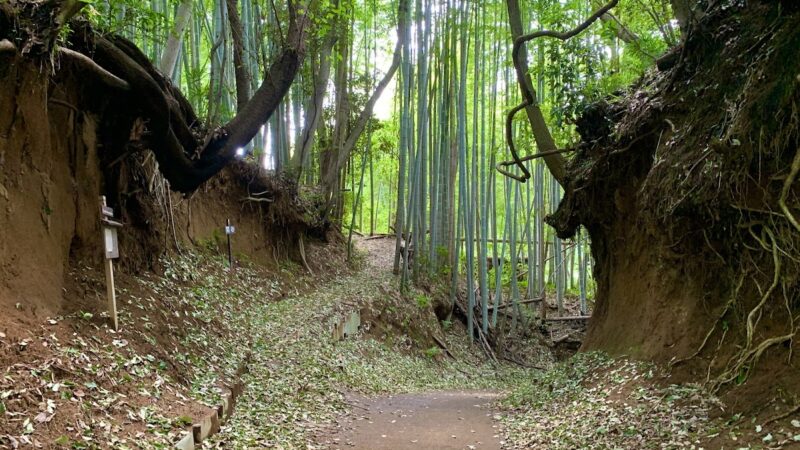
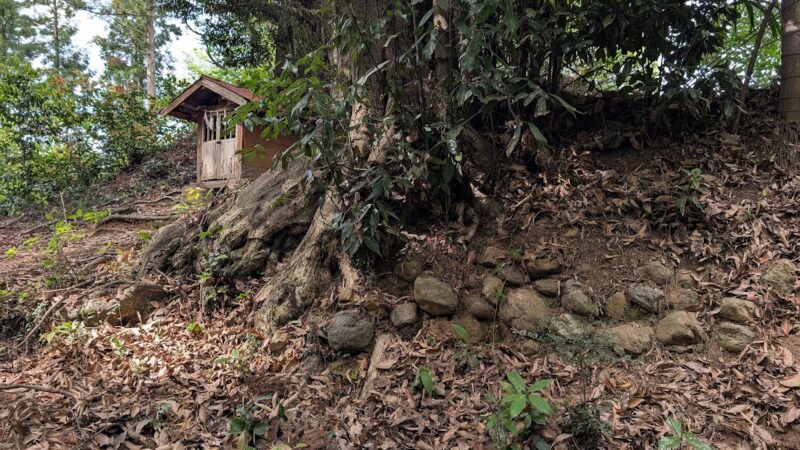
The earthworks surrounding the main enclosure are the most important remains of Ishigami Castle. The remaining earthworks are approximately 3-4 meters high and about 10 meters wide at the base.
The earthworks were constructed by piling up soil excavated from the plateau’s natural ground, and it is possible that the rammed earth construction method (a method of compacting soil in layers) was used. Excavations in 2000 unearthed an iron knife from the lower layer of the earthwork embankment, providing important information for understanding the castle’s construction period and methods.
It is believed that a fence or wall was constructed on top of the earthwork, enhancing its defensive function.
Structure of the Dry Moat
A dry moat surrounds the outside of the main enclosure and remains in good condition today. Excavations have revealed the scale of the dry moat at the time.
- Moat Width: Approximately 11.6 meters
- Moat Bottom Width: Approximately 3 meters
- Depth: Approximately 6.1 meters (estimated restoration value)
The dry moat visible today is shallower than it was at the time due to years of sedimentation, but it still maintains a depth of approximately 3-4 meters. The cross-section of the dry moat is an inverted trapezoid (box moat), a typical shape for medieval castles.
The dry moat is believed to have completely surrounded the main enclosure, but currently, only the eastern and northern sections are clearly visible. The western and southern sections are unclear due to changes in the terrain.
Entrance/Exit
Regarding the location of the entrance/exit to the castle, since no clear remains exist, this remains speculative. Based on the general structure of medieval castles, it is believed that the main enclosure had at least one or two entrance/exit points.
Based on the terrain and the arrangement of remains, it has been suggested that the main gate (Ote-guchi) may have been located on the northwest side of the main enclosure.
Castle Town and Related Facilities
It is estimated that the area surrounding Shakujii Castle consisted of residences for the castle lord and his retainers, temples and shrines, and residential areas for merchants and artisans. Sanboji Temple played an important role as the family temple of the Toshima clan.
Furthermore, it has been suggested that there may have been a collection point for goods utilizing water transport along the Shakujii River, suggesting that Shakujii Castle functioned not merely as a military facility, but as a political, economic, and cultural center of the region.
Archaeological Materials and Excavation Results
Multiple archaeological excavations have been conducted at the Shakujii Castle site, yielding important archaeological materials.
Excavation in 2000
The excavation conducted in November 2000 yielded significant results in clarifying the structure of Shakujii Castle.
Main Results
- Clarification of the structure and construction method of the earthworks
- Excavation of an iron knife from the lower layer of the earthwork embankment
- Determination of the size of the dry moat (estimated to be 11.6m wide, 3m wide at the bottom, and 6.1m deep)
- Acquisition of clues regarding the construction period of the earthworks
The iron knife excavated from the lower layer of the earthwork embankment is thought to be an artifact related to rituals such as the ground-breaking ceremony at the time of castle construction, and is a valuable resource for understanding the construction rituals of medieval castles.
Excavated Artifacts
Artifacts from various periods have been excavated at and around the Shakujii Castle site. Medieval Artifacts
- Earthenware (Haji-type pottery)
- Ceramics (Seto, Tokoname ware, etc.)
- Iron Products (knives, nails, etc.)
- Stone Products (whetstones, etc.)
These artifacts provide clues to the life and culture of the period when Shakujii Castle was in operation. In particular, the origin and age of the excavated ceramics suggest that the Toshima clan possessed a wide-area trade network.
Future Research Issues
Many aspects of the Shakujii Castle site remain unclear.
- Extent and structure of the outer fortifications
- Specific extent and structure of the castle town
- More accurate determination of the construction period
- Specific location and structure of the Toshima clan’s residence
- Traces of battle at the time of the castle’s fall
Further excavations and historical research are expected to reveal the complete picture of Shakujii Castle.
Current Ishigami Castle Ruins: Visitor Information
Development as Tokyo Metropolitan Ishigami Park
The Ishigami Castle ruins are currently developed as part of Tokyo Metropolitan Ishigami Park. The park boasts a rich natural environment centered around Sanpoji Pond, and offers various attractions besides the castle ruins.
Main Park Facilities
- Sanpoji Pond: A natural pond fed by spring water, a popular spot for bird watching.
- Ishigami Pond: An artificial pond where boating is possible.
- Wildflower Observation Garden
- Furusato Culture Center Annex (Former Uchida Residence)
Visiting the Castle Ruins
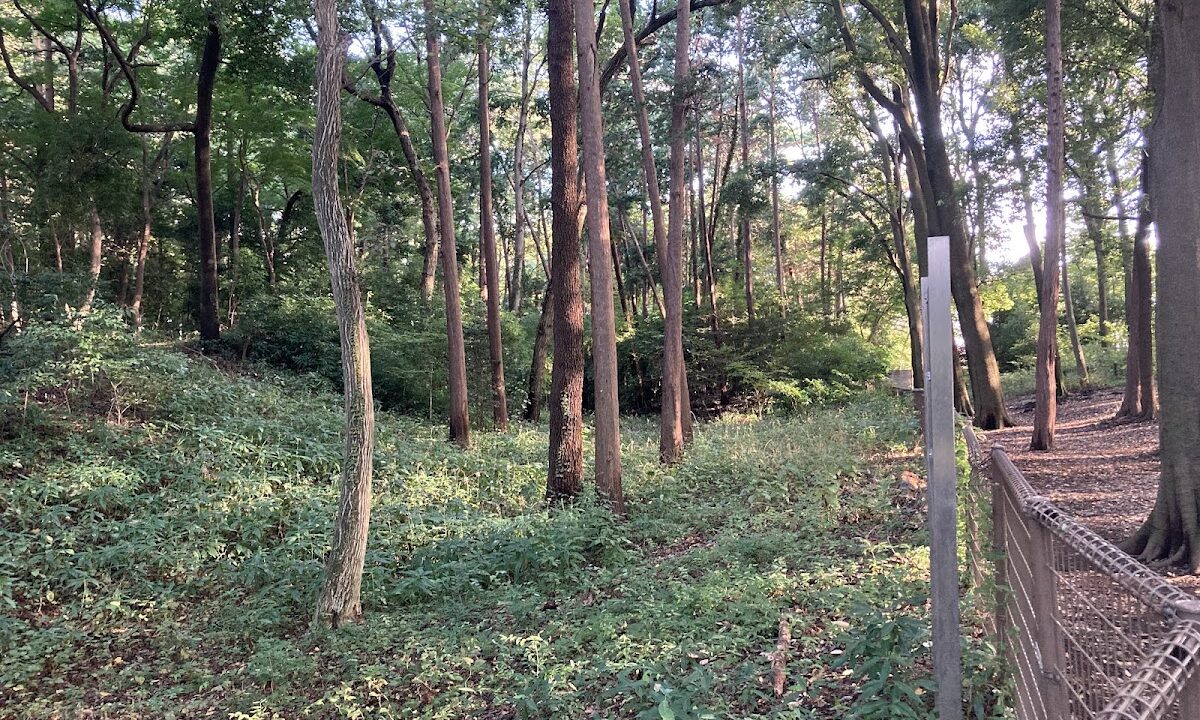
The main enclosure of Ishigami Castle is protected as the “Castle Site Area” within the park. The earthworks and dry moats are surrounded by protective fences, and viewing is usually from the outside.
Points to Note During Your Visit
- Main Enclosure Earthworks: You can see earthworks 3-4 meters high from behind the fence.
- Dry Moat: A deep dry moat remains outside the earthworks.
- Information Boards: Information boards explaining the castle’s history and structure are installed.
Special Opening (Tokyo Cultural Heritage Week)
During “Tokyo Cultural Heritage Week,” held every November, the interior of the ruins, normally off-limits, is specially opened to the public. This is an opportunity to actually stand on top of the earthworks and at the bottom of the dry moat, experiencing the grandeur of a medieval castle up close.
During the special opening, explanations are provided by cultural property officials from Nerima Ward and local historians, allowing you to learn more about the history and structure of Shakujii Castle.
Access Information
Access by Train
- Get off at Shakujii-koen Station on the Seibu Ikebukuro Line, approximately 7 minutes on foot.
- Exit the station’s central exit (south exit) and head towards Shakujii-koen Park.
Access by Bus
- Get off at the Shakujii-koen bus stop (Seibu Bus, Kanto Bus).
Access by Car
- Approximately 20 minutes from Nerima IC on the Kan-Etsu Expressway.
- Parking: Shakujii-koen First Parking Lot (paid, 41 spaces), Second Parking Lot (paid, 18 spaces)
Opening Hours
- Always open (however, entry to the castle ruins is usually not permitted).
Admission Fee
- Free
Related Historical Sites in the Surrounding Area
Here are some nearby historical sites you might want to visit along with the Shakujii Castle ruins.
Sanboji Temple
A Shingon Buddhist temple located very close to Shakujii Castle, it was the family temple of the Toshima clan. There are historical sites related to the Toshima clan within the temple grounds.
Shakujii Hikawa Shrine
This shrine was revered by the Toshima clan and has long been a place of worship as the guardian shrine of Shakujii.
Nerima City Shakujii Park Furusato Culture Museum
This museum introduces the history and culture of Nerima Ward and has exhibits related to Shakujii Castle and the Toshima clan (approximately 15 minutes on foot from the park).
Cultural Value of Shakujii Castle
Valuable Medieval Castle Remains in an Urban Area
The greatest value of the Shakujii Castle ruins lies in the fact that the remains of a medieval castle are preserved in excellent condition within the urbanized 23 wards of Tokyo. It is extremely rare in Tokyo to find basic defensive structures such as earthworks and dry moats still existing in their original form.
Historical Site Telling the Story of Medieval Kanto History
Shakujii Castle was the stage for important historical events in the rise and fall of samurai groups in the Kanto region during the Muromachi period, particularly the conflict between Ota Dokan and the Toshima clan. This castle site possesses high historical value as a valuable historical site that concretely tells the story of the political and military history of the Kanto region during the medieval period.
Value as an Educational and Research Resource
The Shakujii Castle site is highly valued academically as a subject for medieval castle research and archaeological investigation. Furthermore, because it allows visitors to actually see a medieval castle site despite being located in an urban area, it plays an important role as a place for history education.
Local elementary and junior high schools utilize the Shakujii Castle site for local history lessons, providing children with a valuable opportunity to learn about local history.
Efforts for Preservation and Utilization
Protection Measures by Tokyo Metropolitan Government and Nerima Ward
The Shakujii Castle site is a Tokyo Metropolitan Government-designated historical site and is protected under the Cultural Properties Protection Law. Nerima Ward works in cooperation with the Tokyo Metropolitan Government to preserve and manage the remains.
The main enclosure is surrounded by a protective fence, and conservation work to prevent the collapse of earthworks and dry moats is carried out regularly. Tree management and grass cutting are also carefully carried out to avoid affecting the remains.
Public Awareness Activities
Nerima Ward conducts various public awareness activities to promote awareness of the historical value of the Shakujii Castle ruins.
- Special public viewing during Tokyo Cultural Heritage Week
- Guided tours by volunteer guides
- Installation of information boards and explanatory signs
- Information dissemination through brochures and websites
- Exhibitions at the Shakujii Park Local History Museum
Collaboration with the Community
Local history research groups and volunteer groups are actively involved in the preservation and utilization of the Shakujii Castle ruins. These groups continue their activities to protect and pass on the region’s historical heritage through activities such as explaining the site to visitors and cleaning the castle ruins.
Points to Note When Visiting Shakujii Castle
Cooperation in the Protection of the Remains
The Shakujii Castle ruins are a valuable cultural property. Please note the following points when visiting.
- Unauthorized entry into the protective fence is prohibited.
- Do not climb on or touch the earthworks or dry moats.
- Please take all your trash with you.
- Collecting plants or feeding animals is prohibited.
Best Time to Visit and Attire
As Shakujii Castle Ruins is an outdoor historical site, the ease of visiting varies depending on the weather and season.
Recommended Time
- Spring (March-May): Beautiful fresh greenery and mild weather.
- Autumn (October-November): Beautiful autumn foliage, and special openings during Tokyo Cultural Heritage Week.
Attire
- Comfortable walking shoes (some areas have uneven footing).
- Hat and hydration in summer.
- Warm clothing in winter.
Summary: Historical Significance of Shakujii Castle
Shakujii Castle is a historical site with multifaceted value as a valuable medieval castle ruin remaining in the heart of Tokyo. As the base of the Toshima clan, a powerful samurai group in the region, and as the stage for the dramatic historical event of its fall to Ota Dokan, this castle holds a significant place in the history of the Kanto region during the Middle Ages.
Currently, the site of Shakujii Castle, now a popular Tokyo Metropolitan Shakujii Park, is carefully protected as a cultural property. The clear remains of earthworks and dry moats allow us to imagine the castle’s appearance from over 500 years ago and reflect on the history of that time.
In rapidly urbanizing Tokyo, the preservation and transmission of such historical heritage is crucial for maintaining the region’s historical identity. Shakujii Castle remains, as a precious witness to history connecting the past and present, will continue to speak to us for many years to come.
When visiting Shakujii Park, be sure to also visit the castle ruins and experience the romance of medieval history. Especially during the special public viewing period of Tokyo Cultural Heritage Week, it offers a rare opportunity to experience the interior of the remains, which are usually inaccessible.
References and Related Information
For those who wish to learn more about Shakujii Castle, please refer to the following facilities and materials.
Facilities
- Nerima City Shakujii Park Furusato Culture Museum: Permanent exhibition on Shakujii Castle and the Toshima clan
- Nerima City Library: Related materials available in the local history section
Main References
- “History of Nerima City”
- “Medieval Castles and Residences of Tokyo” (Tokyo Metropolitan Board of Education)
- “Ota Dokan” (Various research books)
- “Research on the Toshima Clan” (Regional history research book)
Related Websites
- Nerima City Official Homepage (Cultural Property Information)
- Tokyo Metropolitan Board of Education (Cultural Property Information)
- Tokyo Cultural Property Week Official Website
Shakujii Castle ruins are a treasure trove of history close to us. We hope this article will be helpful for your visit to Shakujii Castle and your history studies.