Onoji Castle (Machida City, Tokyo) Complete Guide: A Hilltop Castle with Kamakura Period Remains and the Legend of Ono no Komachi
What is Onoji Castle?
Onoji Castle is a medieval hilltop castle located in Onoji-cho, Machida City, Tokyo. Also known as Yuido Castle, it is a castle built on a hill approximately 90 meters high, and its remains, such as baileys, earthworks, and dry moats, are still well-preserved.
Despite being only about 30 kilometers from central Tokyo, it is a valuable historical site that conveys the appearance of a castle from the Kamakura period to the Sengoku period, attracting attention from castle enthusiasts and history buffs. A small shrine stands in the main enclosure, and the “Komachi Well,” associated with the legend of Ono no Komachi, still exists nearby.
History of Onoji Castle
Construction and the Oyamada Clan
Onoji Castle is believed to have been built during the Jōan era (1171-1174) at the end of the Heian period. The builder was Oyamada Arishige, the second son of Chichibu Shigehiro, who resided in Oyamada Manor and adopted the name Oyamada.
Onoji Castle was built as a branch castle of Oyamada Castle (Shimo-Oyamada-machi, Machida City). Oyamada Castle was the base of the Oyamada clan, and Onoji Castle functioned as an important branch castle, playing a part in its defense network. It is said that Oyamada Jirō Shigeyoshi, the son of Oyamada Arishige, resided as the castle lord and ruled the area.
The Oyamada clan was a samurai group that served as retainers of the Kamakura Shogunate and was based in Tama District, Musashi Province. The construction of Onoji Castle is thought to have had strategic intentions: to expand the influence of the Oyamada clan in this region and to secure transportation routes connecting Kamakura with various other areas.
The Nagao Kageharu Rebellion and the Fall of the Castle
Onoji Castle first appears on the historical stage during the “Nagao Kageharu Rebellion,” which occurred in 1476 (Bunmei 8) during the late Muromachi period.
This rebellion was an incident in which Nagao Kageharu, a powerful vassal of the Kanto Kanrei Uesugi clan, rebelled against his lord. At that time, the area around Onoji Castle was part of the Ogigayatsu Uesugi clan’s territory, and Onoji Castle and Oyamada Castle functioned as one of the strongholds of both the Ogigayatsu Uesugi and Yamanouchi Uesugi clans.
Nagao Kageharu’s forces attacked Uesugi strongholds throughout the Kanto region one after another. Oyamada Castle fell after a fierce attack, and it is believed that Onoji Castle was similarly captured by the Nagao forces. This battle dealt a major blow to Onoji Castle.
The Sengoku Period and the Oishi Clan
After the Nagao Kageharu Rebellion, the Sengoku period began, and it appears that the area around Onoji Castle became the territory of the Oishi clan. The Oishi clan were powerful local lords in Musashi Province and were incorporated into the sphere of influence of the Later Hojo clan.
However, detailed historical records regarding Onoji Castle during this period are scarce, and specific usage and whether or not it underwent renovations remain unclear. It is presumed that with the end of the Sengoku period, Onoji Castle ceased to function as a military facility and was abandoned.
Structure and Remains of Onoji Castle
Layout and Arrangement
Onoji Castle is built on a hill located west of Banshoji Temple. It is a flatland castle utilizing relatively gentle terrain, and its layout skillfully takes advantage of the natural topography.
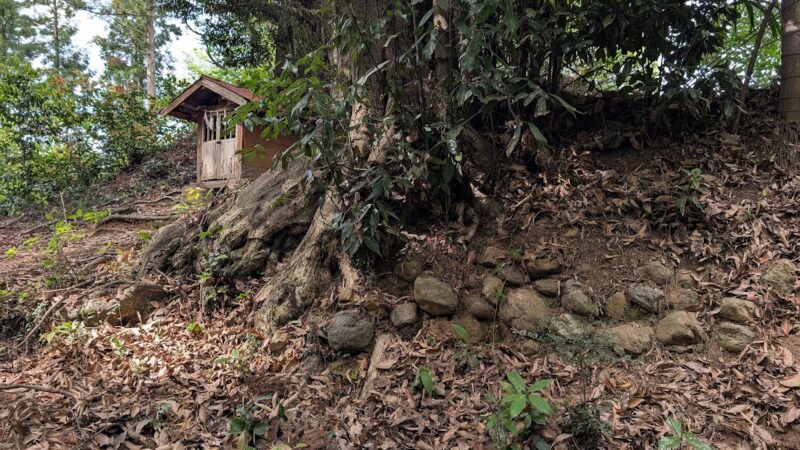
The main enclosure (honmaru), which is the center of the castle, is where a shrine currently stands. Multiple enclosures are arranged around the main enclosure, exhibiting a typical structure of a medieval castle. The castle grounds are estimated to be approximately 150 meters east-west and 100 meters north-south, indicating that, despite its small size, it possessed sufficient functionality as a subsidiary castle.
Remains of Earthworks
The most noteworthy remains at Onoji Castle are the earthworks. The earthworks remaining in the northwestern part of the main enclosure retain much of their original form. Although only about 1-2 meters high, they are clearly visible.
These earthworks served as a defensive structure for the castle, preventing enemy intrusion. It is believed that fences or walls were built on top of the earthworks, further strengthening the castle’s defenses. Even today, the shape of the earthworks remains clearly visible, making them valuable resources for understanding the defensive structure of medieval castles.
Dry Moats and Enclosures
Remnants of dry moats also remain at Onoji Castle. Dry moats are moats that do not contain water, and they served to separate enclosures and restrict enemy intrusion routes.
Multiple enclosures have been identified, arranged in a stepped pattern around the main enclosure. Each enclosure is strategically placed, utilizing the elevation differences of the terrain, demonstrating ingenuity in enhancing defensive efficiency. Cut slopes (artificially carved steep slopes) can be seen at the boundaries of the enclosures, allowing visitors to appreciate the construction techniques of medieval castles.
Shrine in the Main Enclosure
Currently, a small shrine stands in the main enclosure. This shrine serves as a place of worship for the local community and plays a role in the preservation of the castle site. The area around the shrine is relatively flat, allowing one to imagine the former main keep.
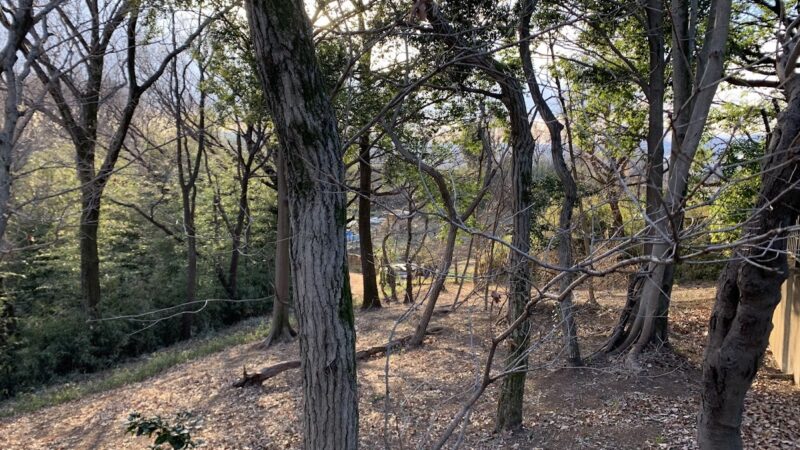
From the shrine grounds, one can overlook the surrounding terrain, gaining an understanding of the castle’s location and defensive advantages.
The Legend of Ono no Komachi and Komachi Well
The Legend of Ono no Komachi
A legend surrounding Onoji Castle remains, concerning Ono no Komachi, a poet known from the Heian period. Ono no Komachi is famous as one of the Six Poetic Geniuses, known for her beauty and talent, but there are various theories about her later years.
The place name Onoji itself is said to originate from a road connecting the “Ono” area, which was the capital of both Sagami and Musashi provinces, and there are theories suggesting a connection to Ono no Komachi.
The Legend of Komachi’s Well
A well called “Komachi’s Well” still exists at the Onoji Castle ruins. The following legend is associated with this well:
It is said that when Ono no Komachi suffered from an eye disease, she washed her eyes with the water from this well, and her illness was immediately cured. Because of this legend, Komachi’s Well has been revered in the region as a miraculous well and has been carefully preserved.
The well still remains today and attracts the attention of visitors to the castle ruins. Komachi’s Well is not merely a place of legend; it is also thought to have played an important role as a water source for the castle. Securing a water source was a matter of life and death for medieval castles, and there is no doubt that this well supported the castle’s functions.
The Kamakura Ancient Road and Onoji
A Key Point on the Kamakura Ancient Road
The site where Onoji Castle was built was an important point along the Kamakura Ancient Road. The Kamakura Ancient Road is a general term for the road network connecting Kamakura, where the Kamakura Shogunate was located, with various regions, functioning as a major artery for politics, military affairs, and economics.
The Kamakura Ancient Road passing through Onoji was one of the routes connecting Musashi Province (present-day Fuchu City, Tokyo) and Kamakura, and was frequently traveled by samurai and merchants. Onoji Castle was built in a strategic location to control this important transportation hub, playing a crucial role in monitoring and defending the road.
Remnants of the Ancient Road Today
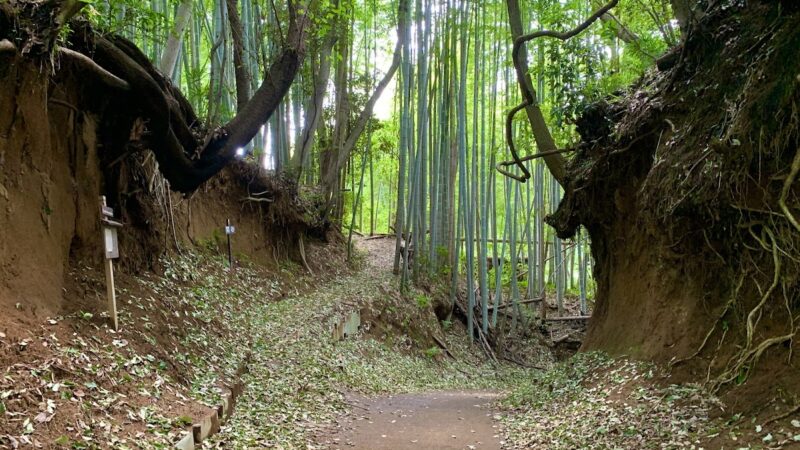
Even today, traces of the Kamakura period can be found scattered around Onoji. Along the ancient road, remnants of cut-throughs and earthen bridges remain, allowing us to imagine what the transportation route was like in those days.
When visiting Onoji Castle, combining it with a stroll along the Kamakura Old Road will allow you to experience history more deeply. Information boards are placed along the path, creating an environment suitable for historical walking.
Access to Onoji Castle
Access by Public Transportation
Onoji Castle can be accessed using public transportation.
If using the Keio Line or Odakyu Line:
- Take a Kanagawa Chuo Bus from Keio Tama Center Station or Odakyu Tama Center Station
- Get off at the “Ogibashi” bus stop and walk for approximately 10 minutes.
If using the JR Yokohama Line:
- Take a Kanagawa Chuo Bus from JR Machida Station
- Get off at the “Ogibashi” bus stop and walk for approximately 10 minutes.
It is also possible to access the castle on foot from Keio Tama Center Station, a journey of approximately 30-40 minutes. Since you can enjoy the scenery of the Kamakura Old Road along the way, walking is recommended for those with ample time.
Access by Car
The following routes are convenient for access by car:
- Approximately 15 minutes from the Inagi IC on the Chuo Expressway
- Approximately 25 minutes from the Yokohama-Machida IC on the Tomei Expressway
However, there is no dedicated parking lot around the castle ruins, so we recommend using the parking lots of nearby public facilities or public transportation.
Precautions When Visiting
Onoji Castle Ruins are adjacent to a residential area, and part of it is private property. Please note the following points when visiting:
- Be considerate of the residents’ lives and observe quietly
- Do not trespass on private property
- Always take your trash with you
- Do not damage or remove any remains
- Be considerate of your surroundings when taking photographs
Highlights of Onoji Castle
Observing the Earthworks and Enclosures
When visiting Onoji Castle, first carefully observe the earthworks in the northwestern part of the main enclosure. You will be impressed that the earthworks, built approximately 800 years ago, still remain. By examining the height, width, and shape of the earthworks, you can understand the castle construction techniques of the time.
The arrangement of the baileys is also a point of interest. By observing the changes in terrain from the main bailey to the surrounding baileys, you can see the castle’s defensive structure.
Exploring Komachi Well
Komachi Well, associated with the legend of Ono no Komachi, is a must-see spot when visiting the castle ruins. By observing the structure of the well and the surrounding environment, you can appreciate the importance of water sources in medieval castles.
View from the Main Bailey
From the area around the shrine in the main bailey, you can overlook the surrounding terrain. By considering why the castle was built in this location and what topographical advantages it offered, you can understand the ingenuity of the castle’s location selection.
Traces of Dry Moats
The traces of dry moats remaining within the castle grounds are also not to be missed. Although some parts are now filled in, you can infer the location of the dry moats from the undulations of the terrain.
Related Historical Sites in the Surrounding Area
Oyamada Castle
Oyamada Castle (Shimo-Oyamada-cho, Machida City), the main castle of Onoji Castle, was an important fortress serving as the base of the Oyamada clan. Currently, it is the grounds of Daizenji Temple, and remnants such as earthworks remain. Visiting it together with Onoji Castle allows you to understand the Oyamada clan’s castle network.
Banshoji Temple
Banshoji Temple, located very close to Onoji Castle, is a temple deeply connected to the castle. It is believed to have functioned as a family temple for the castle lord and local people, allowing you to experience a historical atmosphere.
Historical Sites Related to the Kamakura Road
Historical sites related to the Kamakura Road are scattered around Onoji. By visiting the pass, signposts, and old Jizo statues, you can experience what the medieval transportation route was like.
Preservation and Utilization of Onoji Castle
Current Preservation Status
Onoji Castle ruins are carefully preserved by local residents as a valuable medieval castle site remaining in Tokyo. The shrine in the main enclosure is maintained as a place of worship for the community, which in turn contributes to the preservation of the ruins.
While the earthworks and baileys remain in relatively good condition, some parts are affected by weathering and vegetation. Appropriate preservation management is required going forward.
Utilization in History Education
Onoji Castle is also utilized as a site for local history education. Local elementary and junior high schools provide opportunities for students to visit Onoji Castle as part of their local history studies.
Furthermore, guided tours and study sessions are held for castle enthusiasts and history lovers, offering opportunities to tour the castle ruins while listening to explanations from experts.
Future Challenges
The following points are considered future challenges in the preservation and utilization of Onoji Castle:
- Detailed surveying and recording of the remains
- Clarification of the castle’s structure through archaeological excavations
- Improvement of explanatory signs and information boards
- Development of viewing paths
- Establishment of a cooperative system with local residents
By addressing these challenges, Onoji Castle will become a place that conveys the value of history to more people.
The appeal of visiting Onoji Castle
Experiencing a medieval atmosphere near the city center
The greatest appeal of Onoji Castle is that, despite being close to central Tokyo, you can actually see and touch the remains of a medieval castle. A space where you can feel the breath of history unfolds, different from modern Tokyo with its towering buildings.
Small but impressive remains
Onoji Castle is not a large-scale castle, but the remains such as earthworks and baileys are clearly preserved, making it a very easy example to understand the structure of a medieval castle. Even beginners to castles can easily identify the remains, and it will be a great opportunity to deepen your interest in history.
Legends and Romance
Onoji Castle is characterized by its blend of historical facts, legends, and romance, including the legend of Ono no Komachi and the Komachi Well. This narrative aspect makes visiting the castle ruins even more memorable.
Combining with a Stroll Along the Kamakura Old Road
Combining a visit to Onoji Castle with a stroll along the Kamakura Old Road allows for a full day of in-depth historical exploration. Numerous other historical sites are scattered along the road, making for a fulfilling historical walk.
Summary
Onoji Castle (Machida City, Tokyo) is a valuable castle ruin that conveys the history from the Kamakura period to the Sengoku period. Built by the Oyamada clan, it played an important role as a branch castle of Musashi Province until its fall during the Nagao Kageharu Rebellion.
The remaining earthworks, baileys, and dry moats are valuable resources for understanding the structure of medieval castles. Furthermore, it is a historical site of high historical and cultural value, due to its connection to the Komachi Well of the Ono no Komachi legend and the Kamakura Old Road.
Located close to central Tokyo, yet offering a tranquil setting to experience history, Onoji Castle is a recommended destination not only for castle enthusiasts but for anyone interested in history. Why not make it your destination for a weekend historical stroll?
A visit to Onoji Castle will allow you to truly appreciate how rich medieval history still thrives in Tokyo. Standing before the ruins and reflecting on the lives of people who lived approximately 800 years ago will be a valuable experience for us living in the present day.