Complete Guide to Omigawa Castle (Chiba Prefecture) | The Residence of the Aihara Clan and Historical Remains of the Sengoku Period
What is Omigawa Castle?
Omigawa Castle is a medieval castle located in Omigawa, Katori City, Chiba Prefecture. It was built on a peninsula-shaped plateau jutting out into the inland sea formerly known as “Katori no Umi,” on a hill approximately 40 meters above sea level. The Aihara clan, a branch of the Chiba clan, used it as their residence for generations, and it functioned as an important base in Shimosa Province.
Currently, it is maintained as Omigawa Castle Mountain Park, a place of relaxation for citizens, but remnants of earthworks, dry moats, and earthen bridges from the Sengoku period remain in good condition in some parts. For castle enthusiasts, it is one of the essential historical sites for understanding medieval castles in Chiba Prefecture.
History of Omigawa Castle
Construction and the Aihara Clan
There are various theories regarding the construction period of Omigawa Castle, but the widely known tradition is that it was built by Aihara Tomohide during the Kenkyu era (1190-1199). The Aihara clan was a branch of the Chiba clan, which held power in Shimosa Province from the late Heian period to the Kamakura period.
There is also a theory that the Aihara clan’s ancestor was Taira no Yoshikane, the uncle of Taira no Masakado, suggesting an ancient historical connection in this region. The Aihara clan based themselves in Omigawa and, for generations, resided in this castle while acting as a branch of the Chiba clan.
Invasion by the Satomi Clan during the Eiroku Era
Omigawa Castle first appears on the historical stage during the Eiroku era of the Sengoku period. From 1560 to the Eiroku era, the Satomi clan, based in Awa Province (present-day southern Chiba Prefecture), launched an invasion of Shimosa Province.
During this time, Masaki Tokitada, a senior retainer of the Satomi clan, attacked Omigawa Castle. In 1561 (some sources say 1561), Masaki Tokitada invaded Shimosa Province in response to Uesugi Kenshin’s (Nagao Kagetora’s) campaign in the Kanto region, and Omigawa Castle was also attacked.
The place where Masaki Tokitada established his camp at this time was called “Hashimukai Jinya,” and it corresponds to the current location of Omigawa Elementary School. The Aihara clan is said to have resisted by holding out in Omigawa Castle.
Toyotomi Hideyoshi’s Siege of Odawara and the Fall of Omigawa Castle
The greatest turning point for Omigawa Castle was Toyotomi Hideyoshi’s siege of Odawara in 1590. At this time, Aihara Toshitane, the head of the Aihara clan, sided with the Hojo clan along with his lord, Chiba Shigetane, and rushed to Odawara Castle to fight against the Toyotomi army.
However, when Odawara Castle fell, Omigawa Castle was also attacked and fell in conjunction with it. This marked the end of the Aihara clan’s rule over Omigawa. The history of the Aihara clan as the castle’s residence, which had lasted for approximately 400 years since the Kenkyu era, came to an end here.
Matsudaira Ietada’s Entry into and Abandonment of Omigawa Castle
After the Siege of Odawara, Matsudaira Ietada, a retainer of Tokugawa Ieyasu, entered Omigawa Castle and made it his residence for a time. Matsudaira Ietada was a senior retainer of the Tokugawa family since the Mikawa period and contributed to the establishment of the Tokugawa clan’s rule after their entry into the Kanto region.
However, Omigawa Castle was abandoned in 1601 (Keicho 6). This is thought to be part of the castle reorganization policy accompanying the establishment of the Edo Shogunate. After its abandonment, the castle ruins were left neglected for a long time and gradually returned to nature.
Structure and Layout of Omigawa Castle
Location and Topography
Omigawa Castle is located on a hill stretching north-south, facing the Tone River (formerly the Katori Sea), approximately 1 kilometer south of Omigawa Station on the JR Narita Line. The plateau, approximately 40 meters above sea level, was a strategically important location overlooking the surrounding lowlands, controlling the Tone River system, a vital waterway for water transport.
This terrain was a peninsula-shaped plateau jutting out into the inland sea known as “Katori no Umi” in the Middle Ages, a natural stronghold surrounded by water on three sides. While the original landscape has been lost due to changes in the Tone River’s course and land reclamation, it is clear that the castle was positioned to control both water and land routes.
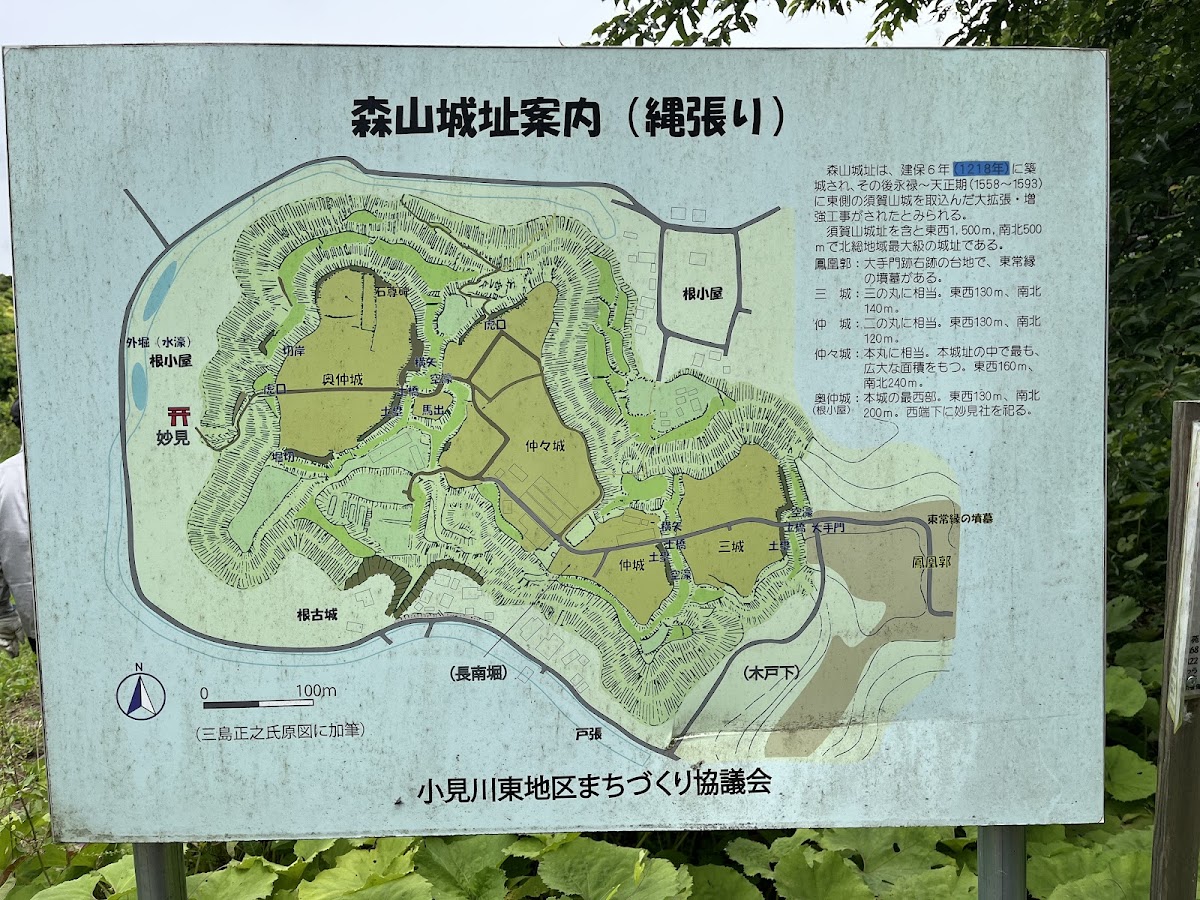
Main Enclosure and Bailey Layout
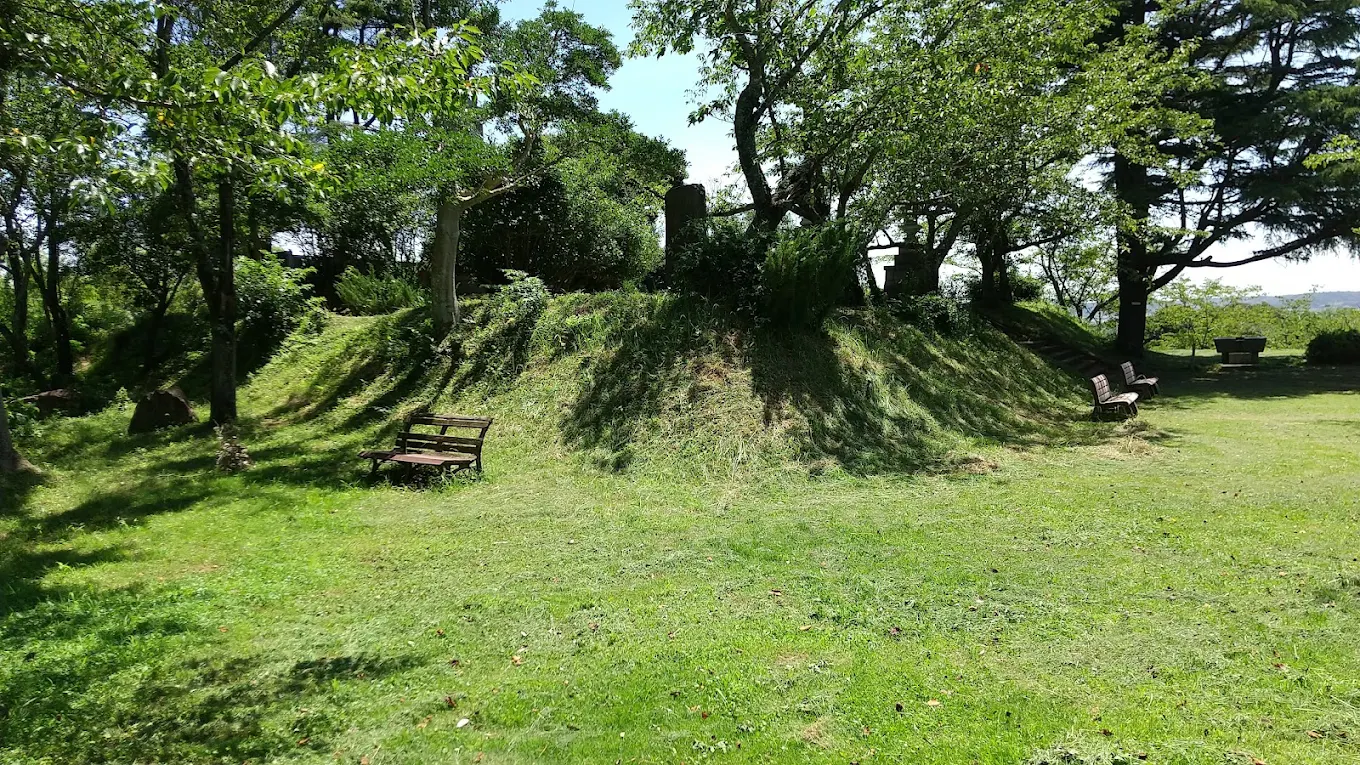
The main enclosure (honmaru) of Omigawa Castle corresponds to the location where the memorial tower now stands. From here, one could see the surrounding area well, indicating its function as the central part of the castle. Multiple baileys were arranged around the main enclosure.
The northern bailey is now a water treatment plant and is thought to have served to protect the northern edge of the castle grounds. Additionally, a keyhole-shaped burial mound exists to the south, suggesting it may have also been part of the castle grounds. The incorporation of burial mounds as part of the castle structure is not uncommon in medieval castles.
Earthworks and Dry Moats
The greatest highlight of Omigawa Castle is the earthworks and dry moats from the Sengoku period that still remain today. While some parts have been altered during the development of the castle park, the remains are preserved in good condition in some sections.
The earthworks were built to surround the baileys, preventing enemy intrusion and serving as a base for defensive fire from within the castle. The height varies depending on the location, but in the relatively clearly remaining sections, one can appreciate the castle-building techniques of the time.
The dry moats were dug to demarcate the baileys and enhance defensive capabilities. The dry moats at Omigawa Castle are of the “dry moat” type, which do not hold water, a typical structure for castles on plateaus. The depth and width vary depending on the location, but they are valuable remains for understanding the castle defense system of the Sengoku period.
Earthen Bridges
Some earthen bridges connecting the baileys also remain. The earthen bridge was a passage created by leaving some earth unexcavated to cross the dry moat. While ensuring movement within the castle, it also served as a strategically important defensive point. When enemies attacked, this narrow earthen bridge would likely have been the site of fierce battles.
Highlights of Omigawa Castle
Omigawa Castle Hill Park
The current site of Omigawa Castle has been developed into “Omigawa Castle Hill Park,” a place of relaxation for local residents. Walking paths are maintained within the park, allowing visitors to enjoy the castle ruins while appreciating the changing seasons.
In spring, cherry blossoms bloom, making it a popular spot for cherry blossom viewing. From the park’s elevated area, you can enjoy a panoramic view of the Tone River and the town of Omigawa, allowing you to imagine the scenery seen by the former castle lords.
Observation Points for Castle Remains
For castle enthusiasts, observing the remaining earthworks and dry moats is the greatest attraction. Because it’s a park, it’s difficult to grasp the entire layout of the castle at the time, but the following points are worth noting.
Observation of Earthworks: By observing the height and shape of the earthworks remaining around the main enclosure, you can understand the castle’s construction techniques and defensive philosophy. Particular attention may be paid to curves and corners, where defensive ingenuity can be observed.
Depth and Width of Dry Moats: The size of the dry moats is an important indicator of the castle’s defensive strength. Deeper and wider moats make enemy intrusion more difficult. The dry moats of Omigawa Castle exhibit a typical scale for the Sengoku period.
Arrangement of Enclosures: By observing the arrangement of enclosures centered around the main enclosure, you can understand the overall layout plan of the castle. The skillful use of terrain is characteristic of medieval castles.
Memorial Tower and Viewpoint
The memorial tower standing in the main enclosure was erected to commemorate those who died in battle and contributes to the historical atmosphere of the castle ruins. From the area around this memorial tower, you can enjoy a good panoramic view, appreciating the castle’s advantageous location.
On a clear day, you can enjoy a panoramic view of the Tone River, the scenery on the opposite bank, and the townscape of Omigawa, truly appreciating its past as a vital water transport hub.
Access and Visiting Information for Omigawa Castle
Access by Train
It’s approximately a 30-minute walk from JR Narita Line’s “Omigawa Station.” The path from the station to the castle ruins is a gentle uphill slope, allowing you to enjoy a historical stroll. Along the way, you’ll pass through the old townscape of Omigawa, experiencing the atmosphere of a castle town.
Access by Car
Omigawa Castle Park has ample parking, making it convenient to access by car. It’s approximately 20 minutes from the Higashi-Kanto Expressway’s “Daiei IC” or about 15 minutes from the “Sawara-Katori IC.” For car navigation, it’s recommended to enter “Omigawa Castle Park” or “Omigawa, Katori City.”
Visiting Hours and Notes
The park is always open and you can visit freely. The average visit takes about 30 minutes to an hour, but if you want to carefully observe the castle ruins, it’s a good idea to allocate a little more time.
While the park is well-maintained, there are some steep slopes and steps, so we recommend wearing comfortable shoes. Also, don’t forget insect repellent in the summer and warm clothing in the winter.
Nearby Attractions
When visiting Omigawa Castle, exploring the surrounding historical sites will give you a deeper understanding of the region’s history.
Hashimukai Jinya Site (Omigawa Elementary School): This is where Masaki Tokitada set up camp during his attack on Omigawa Castle. Although it is now an elementary school, understanding its historical significance allows you to imagine the battle that took place there.
Omigawa Townscape: The town of Omigawa, which prospered from water transport on the Tone River, retains old merchant houses and storehouses, preserving the atmosphere from the Edo period to the modern era.
Katori Shrine: Known as the Ichinomiya (first-ranked shrine) of Shimosa Province, Katori Shrine is located about 20 minutes by car from Omigawa. It has been a center of worship since ancient times, and it is believed that the Chiba and Aihara clans also revered it.
Omigawa Castle and the Chiba Clan
The Chiba Clan’s Position in the Territory
The Chiba clan was a powerful family that held sway primarily in Shimosa Province from the late Heian period to the Sengoku period (Warring States period). Their base was Chiba Castle (present-day Chiba City), but the family dispersed throughout Shimosa Province, establishing their control in various locations.
The Aihara clan, a branch of the Chiba clan, controlled the area centered around Omigawa. Omigawa, controlling water transport in the Tone River system, was an important base within the Chiba clan’s territory, and it is believed that the Aihara clan was entrusted with its defense.
The Turmoil of the Sengoku Period and the Chiba Clan
With the arrival of the Sengoku period, the Chiba clan became embroiled in conflicts with surrounding forces. The conflict with the Satomi clan of Awa Province was particularly intense, and the attack on Omigawa Castle by Masaki Tokitada during the Eiroku era was part of this conflict.
Ultimately, the Chiba clan chose to submit to the Hojo clan, which led to their downfall during Toyotomi Hideyoshi’s siege of Odawara. The Aihara clan also joined the Hojo side along with their lord, the Chiba clan, and disappeared from the historical stage along with Omigawa Castle.
Cultural Value of Omigawa Castle
Importance in the Study of Medieval Castles in Shimosa Province
Omigawa Castle occupies an important position in research as a typical example of a medieval castle in Shimosa Province. As a castle of the Chiba clan, it is a valuable example that demonstrates the characteristics of castle construction techniques and layout.
In particular, the well-preserved earthworks and dry moats from the Sengoku period are invaluable for understanding the castle construction techniques of that time. Although some alterations have been made due to its conversion into a park, the basic structure has been preserved, and its academic value is considered high.
Significance in Local History
Omigawa Castle is an indispensable historical site when discussing the history of the Katori region. As the residence of the Aihara clan, it served as the center of the region for approximately 400 years, forming the core of its regional identity.
Even today, it is a popular spot for citizens as Omigawa Castle Park, and is utilized for local history education and as a tourist resource. Every year, guided tours and lectures are held by local history enthusiasts, demonstrating its importance as a regional historical heritage site.
Future Preservation and Utilization of Omigawa Castle
Preservation Status of the Remains
While the remains of Omigawa Castle receive some protection through its transformation into a park, further preservation measures are desired. Earthworks and dry moats are susceptible to gradual changes due to erosion from wind and rain, and changes in vegetation.
Regular surveys, confirmation of preservation status, and necessary preservation work are future challenges. Efforts are needed to pass on this valuable historical heritage to future generations with the cooperation of local residents and castle enthusiasts.
Utilization as a Tourism Resource
Omigawa Castle is one of Katori City’s important tourism resources. Efforts are underway to enhance its appeal as a castle park while also conveying its historical value.
By installing information boards, explaining the remains, and creating brochures, efforts are being made to create an environment where visitors can easily understand the castle’s history and structure. Furthermore, the issuance of castle stamps is also being carried out to encourage visits from castle enthusiasts.
Utilization of Digital Technology
In recent years, the use of digital technology for castle restoration and information dissemination has attracted attention. For Omigawa Castle, the creation of CG restoration drawings and the recreation of its appearance in its heyday using AR applications are worth considering.
Such efforts can convey the castle’s appeal to younger generations and increase their interest in history.
Summary
Omigawa Castle functioned as an important base in Shimosa Province for approximately 400 years, from its construction during the Kenkyu era to its abandonment in Keicho 6 (1601). The Aihara clan, a branch of the Chiba clan, resided at this castle for generations. After enduring the turmoil of the Sengoku period, it withdrew from the historical stage with Toyotomi Hideyoshi’s siege of Odawara.
Currently, it is maintained as Omigawa Castle Park, where remnants of the Sengoku period, such as earthworks, dry moats, and earthen bridges, remain. Standing on the hill overlooking the Tone River, one can imagine the view seen by the former castle lords and feel the romance of history.
With good access and ample parking, it’s an easily accessible castle site. It’s a historical site that those interested in medieval castles in Chiba Prefecture or the history of the Sengoku period should definitely visit. Exploring the old townscape of Omigawa and surrounding historical sites in conjunction with this visit will allow for a deeper understanding of the region’s history.