Nozaki Castle (Daito City, Osaka Prefecture) Complete Guide: The History and Highlights of a Mountain Castle that Flourished as an Outpost of Iimoriyama Castle
What is Nozaki Castle?
Nozaki Castle was a Japanese castle located in Nozaki, Daito City, Osaka Prefecture. It was a mountain castle with its main enclosure situated on the summit of a mountain 114.4 meters above sea level, behind Jigenji Temple (Nozaki Kannon). It was built on a strategically important point, a protruding ridge on the eastern branch of Mount Iimoriyama.
It was an important base from the time of the Hatakeyama clan, the shugo (military governor) of Kawachi Province. Later, when Miyoshi Nagayoshi made Iimoriyama Castle his residence, it served as an outpost (branch castle) and played a part in the defense network of Iimoriyama Castle. Currently, walking trails have been developed, and it is visited by many hikers and castle enthusiasts as a hiking course.
History of Nozaki Castle
Construction and the Hatakeyama Clan Era
There are no clear records regarding the construction period or builder of Nozaki Castle, and many details remain unknown. However, it is presumed to have been built by the Hatakeyama clan, who served as the governor of Kawachi Province during the Muromachi period.
The “Daijoin Jisha Zatsuji-ki” (Records of Miscellaneous Matters of Daijoin Temple and Shrines) contains a description that in 1499 (Meio 8), Hatakeyama Naosuke holed up in Nozaki Castle, and Hatakeyama Yoshitoyo attacked him. This was part of an internal conflict within the Hatakeyama clan (a succession dispute within the Kawachi Hatakeyama clan), and is a valuable historical document showing that Nozaki Castle, along with Wakae Castle, functioned as an important military base.
The Miyoshi Clan and the Iimori Castle Era
During the Sengoku period, when Miyoshi Nagayoshi came to control Kawachi and Settsu provinces with Iimoriyama Castle (Iimori Castle) as his base, Nozaki Castle played an important role as a branch castle. Located on the eastern edge of Mount Iimoriyama, Nozaki Castle is believed to have functioned as a defensive stronghold against invasions from the east and as a lookout point overlooking the Osaka Plain.
During the time of Miyoshi Nagayoshi (1560s), a defensive network centered around Iimoriyama Castle was established, and it is highly probable that Nozaki Castle was renovated and strengthened as an outpost to solidify the eastern defenses.
Abandonment and Present State
From the Tensho era (1573-1592) onward, with the expansion of Oda Nobunaga’s power and Toyotomi Hideyoshi’s unification of Japan, Nozaki Castle’s military role is thought to have been lost. While the exact date of its abandonment is unknown, it is presumed that it had already lost its function as a castle by the end of the Tensho era.
Currently, the castle ruins are protected as a historical site by Daito City and are located along the hiking trail from Nozaki Kannon to Iimoriyama Castle. The remains are well-preserved, and it is a constant source of visits from castle enthusiasts and history buffs.
Structure and Layout of Nozaki Castle
Location and Topography
Nozaki Castle is a mountain castle with its main enclosure located on the summit of a mountain at an elevation of 114.4 meters. Situated on a point where the eastern spur of Mt. Iimori juts out toward the plains, it features a multi-enclosure layout with enclosures arranged along a long, narrow ridge running east to west.
Jigenji Temple (Nozaki Kannon) is located at the foot of the mountain, suggesting a close relationship between the castle and this temple. Utilizing the narrow plains, it was a natural stronghold, a strategic point combining convenient transportation and defensive capabilities since ancient times.
Major Remains
Main Enclosure (Main Enclosure)
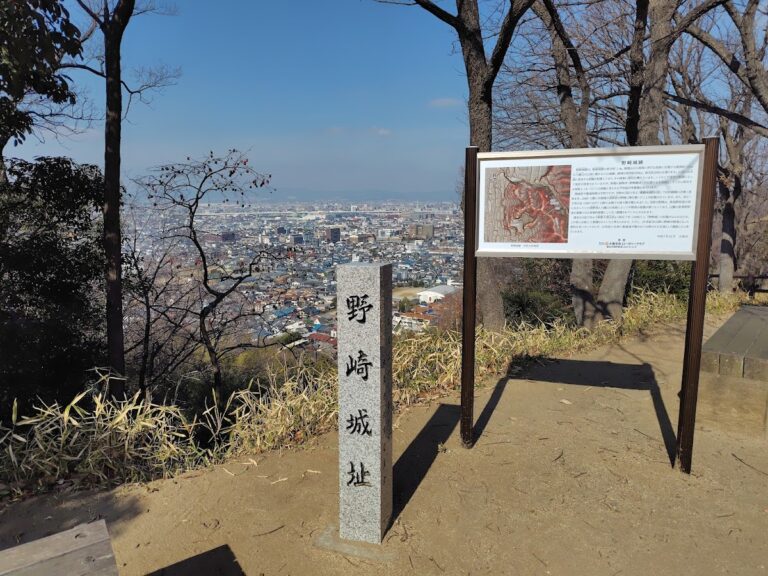
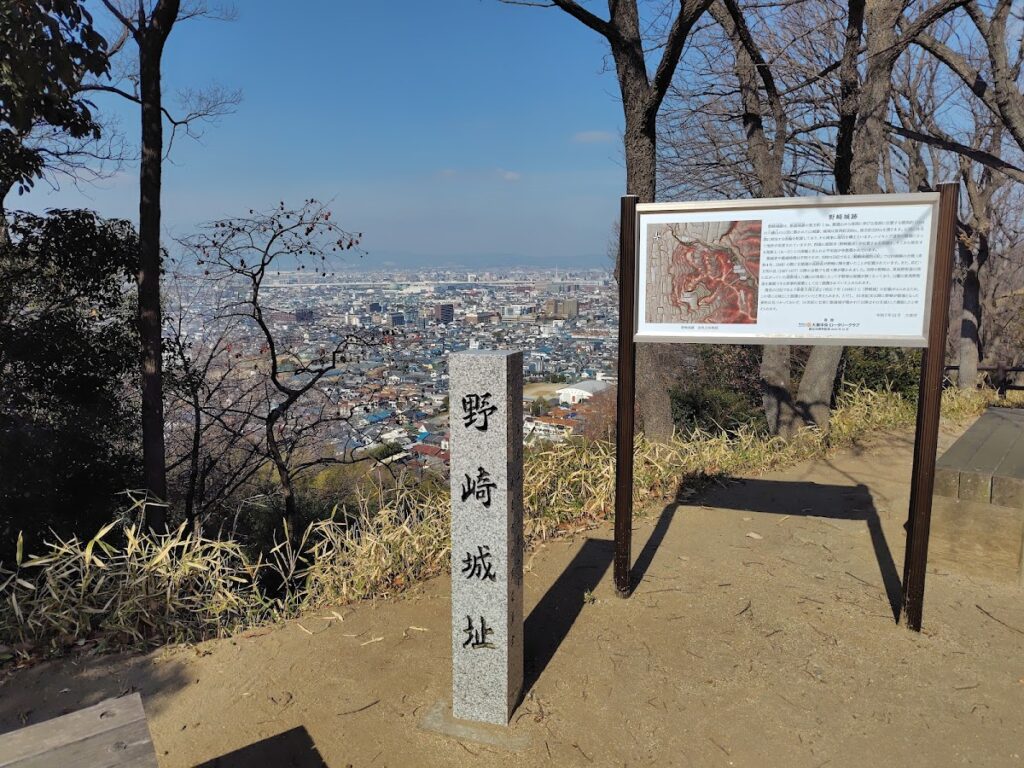
The main enclosure, built on the mountaintop at an elevation of 114.4 meters, is clearly identifiable as a leveled area. Although now overgrown with trees, the shape of the enclosure remains well-preserved. The view from the main enclosure is exceptional, offering a panoramic view of the Osaka Plain, from Abeno Harukas in Osaka City to northern Osaka, to the south.
Moat
A moat can be seen at the back (west side) of the main enclosure. This is a defensive structure designed to prevent enemy incursions from the ridge, and is a characteristic feature of mountain castles. While the moat is of medium size, it remains clearly visible and is an important structure for understanding the defensive structure of Nozaki Castle.
Enclosures
Along the hiking trail from Nozaki Kannon, several enclosure remains can be seen. These are leveled areas arranged in terraces, scattered along the approximately 10-minute climb to the main enclosure. Each enclosure is relatively small, but their arrangement allows for an understanding of the defensive function of a mountain castle.
Stone Monument and Sign
A stone monument marking “Nozaki Castle Ruins” is installed at the castle site, allowing visitors to confirm that it is a castle site. Furthermore, as it is maintained as a walking path, stairs and rest areas are provided.
Highlights of Nozaki Castle
Breathtaking View
The greatest highlight of Nozaki Castle is the magnificent view from the main enclosure. Offering a panoramic view of the Osaka Plain, on a clear day you can see Abeno Harukas and Osaka Castle to the south, and the Kitasetsu Mountains to the north. This view truly makes you appreciate why Nozaki Castle was considered such an important surveillance point.
During the Sengoku period, the castle lord and soldiers would have monitored enemy movements from this location and transmitted information to the main Iimori Castle. Even today, it’s a valuable spot where you can experience its strategic value.
Connection to Iimori Castle
Nozaki Castle is located along the hiking trail to Iimori Castle, allowing you to visit both castles at once. Iimori Castle is an important castle selected as one of the Continued Top 100 Japanese Castles and is known as the residence of Miyoshi Nagayoshi.
Walking the trail from Nozaki Castle to Iimori Castle allows you to understand the relationship between the branch castles and the main castle, and the structure of the defense network firsthand. For history buffs, it’s a valuable opportunity to experience the castle system of the Sengoku period.
Historical Connections with Nozaki Kannon
Jigenji Temple (Nozaki Kannon), located at the foot of the mountain, is a famous temple known for the “Nozaki Pilgrimage” during the Edo period. It is believed to have had deep ties to the history of Nozaki Castle, and considering the relationship between the castle and the temple is an interesting point.
Before climbing to the castle, visiting Nozaki Kannon and looking up at the castle ruins from the temple grounds allows you to enjoy the historical landscape where the castle and temple are integrated.
Castle Stamp
In recent years, Daito City has produced a castle stamp to promote the Nozaki Castle ruins. Collecting castle stamps, which are currently booming among castle enthusiasts, is also an enjoyable activity. The castle stamp’s design commemorates Nozaki Castle’s role as an outpost of Iimori Castle.
Access and Ascent Route
Access by Train
Use JR Gakken Toshi Line “Nozaki Station”
- Get off at JR Gakken Toshi Line “Nozaki Station” and walk for about 15 minutes to reach Nozaki Kannon (Jigenji Temple)
- From Nozaki Kannon, hike the mountain trail for about 10-15 minutes to reach Nozaki Castle Ruins (Main Enclosure)
Notes:
- There are no coin lockers at Nozaki Station, so it is recommended to leave large luggage beforehand or visit with minimal equipment.
- The path from the station to Nozaki Kannon is flat and passes through a residential area.
Access by Car
There is parking for visitors around Nozaki Kannon. However, it can get crowded on holidays and during peak seasons, so it is recommended to use public transportation.
Ascent Route
Recommended Route: Ascent from Nozaki Kannon
- Nozaki Mairi Park: Located on the way from Nozaki Station to Nozaki Kannon. There are restrooms, so please use them before climbing to the castle.
- Nozaki Kannon (Jigenji Temple): There are restrooms on the temple grounds. After visiting the temple, head to the trailhead at the back.
- Hiking Trail: Climb the well-maintained walking path and stairs. There are scattered remnants of castle baileys along the way.
- Nozaki Castle Ruins (Main Bailey): Arrive in about 10-15 minutes. There is a stone monument and a rest area.
- Moat: You can see the moat if you proceed to the back of the main bailey.
If you are traversing to Iimori Castle
A hiking course is maintained from Nozaki Castle to Iimori Castle. The required time is about 40-60 minutes. The most common descent route is towards Shijonawate Shrine.
Points to Note When Visiting the Castle
- Attire: As it is a mountain castle, comfortable clothing and non-slip shoes (trekking shoes recommended) are necessary.
- Hydration: Especially in summer, bring plenty of water to prevent heatstroke.
- Toilets: Use the toilets at Nozaki Mairi Park and Nozaki Kannon before climbing the castle. There are no toilets at the castle ruins.
- Estimated Time: Allow approximately 1.5 to 2 hours round trip from Nozaki Station.
- Season: Spring and autumn are the best times to visit. Summer is hot, and winter has early sunsets, so caution is advised.
Nearby Attractions
Iimori Castle (Iimoriyama Castle)
Iimori Castle, which can be reached by traversing from Nozaki Castle, is an important castle selected as one of the Continued Top 100 Japanese Castles (No. 161). It is known as the residence of Miyoshi Nagayoshi and a base from which he controlled the Kinai region. Visiting both Nozaki Castle and Iimori Castle allows you to experience the castle network of the Sengoku period.
Jigenji Temple (Nozaki Kannon)
This ancient temple has been cherished as “Nozaki Mairi” since the Edo period. It is especially bustling with visitors during the Nozaki Mairi (Muenkyo memorial service) in May. The temple grounds contain many historical buildings and cultural assets, making it well worth a visit in conjunction with a visit to the castle ruins.
Nozaki Mairi Park
Located between Nozaki Station and Nozaki Kannon, this park is convenient for resting and using the restrooms. In spring, the cherry blossoms are beautiful, making it a popular spot for local relaxation.
Shijonawate Shrine
This shrine can be visited on the way down from Iimori Castle. It enshrines Kusunoki Masayuki, a samurai from the Nanboku-cho period, and is a place of great historical value.
Model Course for Visiting Nozaki Castle
Half-Day Course (Nozaki Castle Only)
- 9:00 Arrive at JR Nozaki Station
- 9:15 Nozaki Mairi Park (Restroom Break)
- 9:30 Arrive at Nozaki Kannon Temple and pay your respects
- 9:45 Begin climbing to the castle from the trailhead
- 10:00 Arrive at Nozaki Castle Ruins and explore
- 10:30 Begin descending
- 11:00 Return to Nozaki Kannon Temple
- 11:30 Arrive at JR Nozaki Station
Full-Day Course (Nozaki Castle + Iimori Castle Traverse)
- 9:00 Arrive at JR Nozaki Station
- 9:30 Begin climbing to the castle from Nozaki Kannon Temple
- 9:45 Arrive at Nozaki Castle Ruins and explore
- 10:15 Beginning the traverse towards Iimori Castle
- 11:00 Arrive at Iimori Castle and tour
- 12:00 Lunch break
- 13:00 Beginning the descent towards Shijonawate Shrine
- 14:00 Arrive at Shijonawate Shrine and pay respects
- 14:30 Arrive at JR Shijonawate Station
Evaluation and Appeal of Nozaki Castle
Evaluation as a Castle
Nozaki Castle is not a large-scale castle, but it is a historically valuable mountain castle that played an important role as a subsidiary castle of Iimori Castle. The remains are well-preserved, and the layout of the moats and baileys allows us to learn about the structure of a Sengoku period mountain castle.
On castle information websites such as “Kojodan,” it has received high ratings from many castle lords (visitors), particularly for its magnificent views and the appeal of visiting it together with Iimori Castle.
Photo Spots
- View of the Osaka Plain from the Main Enclosure: Recommended for photos on sunny days
- Stone Monument at Nozaki Castle Ruins: A classic photo spot to commemorate your visit
- Moat: A record of the mountain castle’s defensive structures
- View of the Castle Ruins from Nozaki Kannon: Expressing the relationship between the castle and the temple
- View from the Hiking Trail: Seasonal natural beauty
A Mountain Castle Enjoyable Even for Beginners
Nozaki Castle is an easily accessible castle for beginners, as the climb is short (approximately 10-15 minutes) and the walking trails are well-maintained. While it’s possible to traverse to Iimori Castle, visiting Nozaki Castle alone is enough to fully experience the charm of a mountain castle.
The presence of stairs and rest areas makes it an attractive destination for families and seniors.
Historical Significance of Nozaki Castle
Hatakeyama Clan’s Rule of Kawachi Province and Nozaki Castle
During the Muromachi period, Nozaki Castle was an important base for the Hatakeyama clan, who served as the governors of Kawachi Province, overlooking the Kawachi Plain. The fact that it was the site of a conflict between Hatakeyama Naosuke and Hatakeyama Yoshitoyo indicates that this castle was not merely a small fort, but a strategically valuable fortress.
It is believed that, along with Wakae Castle, it played a crucial role in maintaining the Hatakeyama clan’s power as a base for protecting the eastern part of Kawachi Province.
The Miyoshi Regime and the Iimori Castle Network
During the time when Miyoshi Nagayoshi made Iimori Castle his base, Nozaki Castle functioned as part of the Iimoriyama Castle defense system. By centering Iimori Castle and arranging multiple subsidiary castles around it, a wide-area defense network was constructed.
Nozaki Castle played a role in monitoring and defending the eastern invasion route, and was an important military base supporting the Miyoshi regime’s control of the Kinai region. It has also been suggested that the castle may have been strengthened by renovators during this period. ### Preservation and Utilization in Modern Times
Daito City is working to preserve and utilize the Nozaki Castle ruins as a local historical asset. The creation of castle stamps and the development of walking trails are examples of efforts to utilize the castle ruins as a tourist resource and to pass on the region’s history to future generations.
It is gaining recognition among castle enthusiasts, and detailed information is available on apps and websites such as “Nippon Castle Tour.”
Summary
Nozaki Castle (Daito City, Osaka Prefecture) is a mountain castle built on a mountaintop at an altitude of 114.4 meters. From the time of the Hatakeyama clan to the time of the Miyoshi clan during the Sengoku period, it functioned as an important military base in Kawachi Province. It played a role in strengthening the eastern defenses as an outpost of Iimori Castle, and the panoramic view of the Osaka Plain still captivates visitors today.
With its easy access (only 10-15 minutes from Nozaki Kannon), well-maintained walking trails, and a traverse route to Iimori Castle, it offers attractions that can be enjoyed by both beginners and advanced mountain castle enthusiasts. Combining historical value with natural beauty, Nozaki Castle is a hidden gem in Osaka Prefecture and a castle well worth visiting.
Easily accessible from Nozaki Station, it’s an ideal spot for weekend hikes and historical exploration. Visiting it along with Iimori Castle will provide a valuable experience of the castle network of the Sengoku period.