

Nishimonai Castle, Ugo Town (Akita Prefecture): A Thorough Explanation of the Complete Picture of the Medieval Mountain Castle and the History of the Onodera Clan
Located in the Nishimonai district of Ugo Town, Ogachi District, Akita Prefecture, Nishimonai Castle is a medieval mountain castle known as the residence of the Onodera clan, who ruled the Ogachi region from the Kamakura period to the Sengoku period. Boasting one of the largest scales in the prefecture, covering a total area of 23 hectares (approximately the size of four Komachi Stadiums), it functioned as a natural fortress protected by the Nishimonai River and sheer cliffs.
Currently, Nishimonai in Ugo Town is nationally known as the location of the “Nishimonai Bon Odori” dance festival, a nationally designated Important Intangible Folk Cultural Property and a UNESCO Intangible Cultural Heritage. The history of the Onodera clan, lords of Nishimonai Castle, is deeply intertwined with the origins of this Bon Odori dance.
History of Nishimonai Castle
Construction and the Entry of the Onodera Clan
Nishimonai Castle is said to have been built in 1277 by Onodera Michinao. Michinao, the second son of Onodera Tsunemichi, who entered Ogachi County in the early Kamakura period, was stationed in Nishimonai as a defense against the Yuri region, which is the origin of the castle. Later, Michinao adopted the name Nishimonai and expanded his power from this base.
The Onodera clan was a powerful samurai family based at Inaniwa Castle, and Nishimonai Castle functioned as a branch castle of Inaniwa Castle. From the Muromachi period to the Sengoku period, the Onodera clan reigned as the rulers of the Ogachi region, and Nishimonai Castle played an important role as the political and military center of the area.
The Prosperity and Rule of the Onodera Clan
Nishimonai Castle was a mountain castle built on a cliff along the Nishimonai River, characterized by its defensive structures that skillfully utilized the natural terrain. The castle grounds included a main enclosure, a second enclosure, a third enclosure, and other defensive structures such as dry moats, earthworks, and steep slopes.
Under the rule of the Onodera clan, the Nishimonai region experienced economic development. During the Sengoku period, a castle town was formed, and it also functioned as a post town on the Honjo Highway. This period of prosperity formed the cultural foundation of Nishimonai later on.
The Fall of Nishimonai Castle and the Downfall of the Onodera Clan
A turning point in the history of Nishimonai Castle came in 1595 (Bunroku 4). During the time of the 8th lord, Onodera Hizen-no-kami Shigemichi, his relationship with the head of the family, Onodera Yoshimichi, lord of Yokote Castle, deteriorated after he sheltered his son-in-law, Yajima Goro Mitsuyasu. Taking advantage of this internal conflict within the Onodera clan, Mogami Yoshiaki, lord of Yamagata Castle, launched an invasion. Shigemichi refused Yoshiaki’s request for troops and chose to surrender to Mogami Yoshiaki. Subsequently, in 1601 (Keicho 6), the Onodera Shigemichi family was destroyed, and Nishimonai Castle was abandoned.
This tragic history is said to be one of the origins of the Nishimonai Bon Odori dance. The “Bon memorial dance,” performed by former retainers who settled in the area to commemorate their lord, is considered one of the origins of the Nishimonai Bon Odori dance that continues to this day.
Structure and Characteristics of Nishimonai Castle
Castle Layout and Scale
Nishimonai Castle is a medieval mountain castle with a vast castle area of 23 hectares, boasting one of the largest scales in Akita Prefecture. The castle was built on a hill approximately 150 meters above sea level on the east bank of the Nishimonai River, and its defensive design made maximum use of the natural terrain of the river and cliffs.
The castle grounds were broadly composed of groups of enclosures, including the main enclosure (Honmaru), the second enclosure (Ninokuruwa), and the third enclosure (Sanokuruwa), each separated by earthworks and dry moats. The Honmaru was located at the highest point of the castle, offering a panoramic view of the town of Nishimonai and the surrounding area.
Characteristics of Defensive Structures
The defensive structures of Nishimonai Castle exhibit a typical structure of a medieval mountain castle. The main defensive structures included the following:
Dry Moats: Deep dry moats were dug between the enclosures, serving to prevent enemy intrusion. Traces of some dry moats can still be seen today.
Earthworks: Earthworks were built around the enclosures, functioning as defensive walls. The height of the earthworks varied depending on the location, but they were built higher and thicker in important areas.
Cliffs: These were artificially carved steep slopes that made it difficult for enemies to climb. At Nishimonai Castle, they were combined with natural cliffs to form an effective defensive line.
Gate Entrances: The gate entrances to the castle were considered weak points in defense and were therefore heavily fortified. It is believed that some had complex structures, such as square-shaped gate entrances.
Main Gate Site and Thirteen Mounds
The main gate site, the front entrance to the castle, was located where the former Nishimonai Elementary School now stands. An information board and a stone monument marking the gate site stand here, allowing us to imagine the castle’s former grandeur.
Within the castle grounds are thirteen mounds known as “Thirteen Mounds.” These can be seen by climbing the mountain path behind the elementary school and are important historical sites that tell the history of Nishimonai Castle. There are various theories about the origin of Thirteen Mounds, including that they were built to mourn those who died in battle, or that they were religious facilities established to protect the castle.
Highlights and Current Status of Nishimonai Castle
Access and Route to the Castle
The route to Nishimonai Castle begins on a slope west of the former Nishimonai Elementary School building. Climbing this slope leads to a signpost marking the “Nishimonai Castle Entrance,” marking the start of the main castle grounds.
The hiking trail is well-maintained, making it easily accessible for history enthusiasts and castle fans. However, due to the undulating terrain characteristic of medieval mountain castles, comfortable shoes and clothing are recommended.
Preservation of the Remains
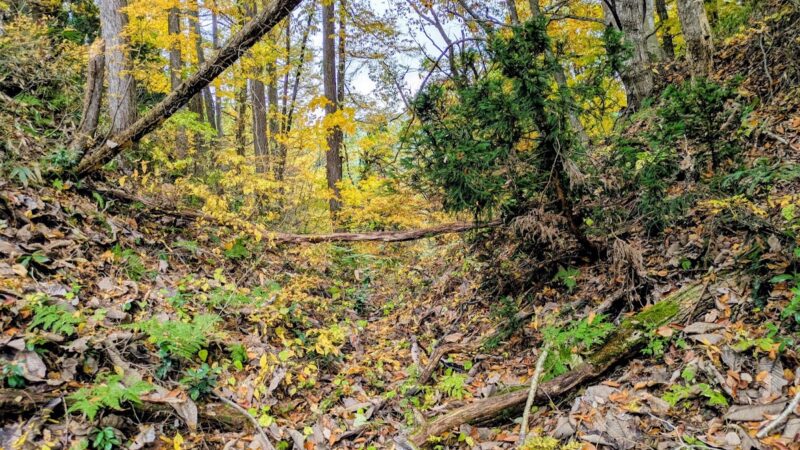
Even after more than 700 years since its construction, the remains of Nishimonai Castle are preserved in relatively good condition. In particular, the layout of the baileys, traces of dry moats, and parts of the earthworks are clearly visible, making them valuable resources for learning about the structure of medieval mountain castles.
Walking within the castle grounds, one can appreciate the sheer scale of the castle at the time and the ingenious use of the terrain in its layout. The view from the main enclosure is magnificent, and you will understand why the Onodera clan used this location as their base to rule the Ogachi region.
Value as a Historic Site
Nishimonai Castle is recognized as a historical site of high historical and academic value, due to its large scale and excellent state of preservation among medieval mountain castles in Akita Prefecture. It attracts attention from castle researchers and history enthusiasts, and occupies an important position in the study of medieval castle history in the Tohoku region.
History and Culture of the Nishimonai Region
Geographical Characteristics of Nishimonai
Nishimonai is a large district in Ugo-machi, Ogachi-gun, Akita Prefecture, with the postal code 012-1131. It has developed as the political, economic, and cultural center of Ugo-machi. Geographically, it is located in the southern part of the Yokote Basin, and is known as a particularly rich agricultural area within the Yokote Basin, which is said to be the largest basin in Japan.
The Nishimonai River flows through the region, and blessed with abundant water resources, agriculture, mainly rice cultivation, has flourished here since ancient times. During the Sengoku period, it flourished as a castle town, and during the Edo period, it prospered as a post town on the Honjo Highway and as a merchant town where wealthy landowners gathered.
Relationship with the Nishimonai Bon Odori
Nishimonai is nationally famous as the host city of the “Nishimonai Bon Odori,” one of Japan’s three major Bon Odori festivals. This Bon Odori has a history of approximately 700 years and was registered as a UNESCO Intangible Cultural Heritage in 2022.
There are several theories about the origin of the Nishimonai Bon Odori, but one of the main theories is its relationship with the Onodera clan, the lords of Nishimonai Castle. There are two main theories regarding the origin of the Nishimonai Bon Odori festival: one suggests that during the Shoō era (1288-1293), a Buddhist monk named Minamoto no Chika enshrined Zaō Gongen (present-day Nishimonai Ontake Shrine) and had the dance performed on the shrine grounds as a prayer for a bountiful harvest; the other suggests that after the downfall of the Ono-dera Shigemichi family, lords of Nishimonai Castle, in 1601, former retainers who had settled in the area performed a dance for the deceased on the grounds of Hōsenji Temple to commemorate their lord, and this dance merged with the original Bon Odori.
The Nishimonai Bon Odori, held annually from August 16th to 18th, is characterized by dancers wearing traditional garments such as patchwork and indigo-dyed clothing, gracefully dancing to a unique musical accompaniment. In 1981, it was designated a National Important Intangible Folk Cultural Property and is highly regarded as a traditional cultural event possessing high artistic merit.
Facilities and Sightseeing in Nishimonai
Nishimonai Bon Odori Hall: This facility screens introductory videos about the Nishimonai Bon Odori dance and displays traditional garments such as hanui and indigo-dyed costumes. It’s a place where you can experience its charm even outside of the Bon Odori season.
Bon-yado U: This “cultural exchange facility with accommodation” themed around the Nishimonai Bon Odori dance recently opened. It’s attracting attention as an accommodation facility where you can experience the culture of Obon and Bon Odori.
Michi-no-Eki Ugo “Hanui no Sato”: This facility features a restaurant where you can enjoy Nishimonai soba, a specialty of Ugo Town, as well as a direct sales store for agricultural products, a cafe, and a gelato shop, offering a comprehensive experience of the region’s charm.
Ugo Town’s Specialty Products and Culture
Nishimonai Soba
Nishimonai soba is one of Ugo Town’s representative specialty products. This region has a long history of soba cultivation and is known as a producer of high-quality soba. Nishimonai soba noodles are characterized by their fragrant aroma and firm texture, and can be enjoyed at local soba restaurants and roadside stations.
Ugo Beef
Ugo Town is also known for its beef cattle farming, producing the branded beef “Ugo Beef.” Raised in a rich natural environment, Ugo Beef boasts excellent meat quality and is highly regarded both within and outside the prefecture.
Hanui Culture
The Hanui costumes used in the Nishimonai Bon Odori dance are unique garments made by sewing together scraps of old kimono fabric. This Hanui culture embodies the traditional Japanese value of cherishing things and is highly valued culturally. Currently, efforts are being made to pass on the techniques of Hanui costume making.
The Onodera Clan and the Medieval History of the Ogachi Region
The Origins and Expansion of the Onodera Clan
The Onodera clan was a prestigious samurai family descended from the Fujiwara Hokke (Northern Fujiwara House). The Onodera clan traces its ancestry to Onodera Tsunemichi, who entered Ogachi County in the early Kamakura period. Based at Inaniwa Castle, they controlled the entire Ogachi region. Tsunemichi’s second son, Michinao, was assigned to Nishimonai and built Nishimonai Castle, extending the Onodera clan’s influence to the entire Ogachi County.
From the Muromachi period to the Sengoku period, the Onodera clan grew into a powerful daimyo in southern Dewa Province, controlling a wide area of the Senboku region at its peak. They established a strong system of control, centered around Inaniwa Castle and strategically placing branch castles such as Nishimonai Castle and Yuzawa Castle.
The Turmoil of the Sengoku Period and the Onodera Clan
With the arrival of the Sengoku period, the Onodera clan became embroiled in conflicts with surrounding daimyo. Their relationships with the Nanbu, Mogami, and Akita clans, in particular, were complex, resulting in a situation of alternating alliances and conflicts.
The conflict between Onodera Shigemichi, lord of Nishimonai Castle, and Onodera Yoshimichi, head of the main family, in 1595 (Bunroku 4), led to the weakening of the entire Onodera clan. Mogami Yoshiaki’s invasion, taking advantage of this internal strife, significantly reduced the Onodera clan’s power.
In 1601 (Keicho 6), following the distribution of rewards after the Battle of Sekigahara, Onodera Yoshimichi was dismissed from his position. This marked the end of the Onodera clan’s rule over the Ogachi region, which had continued since the Kamakura period, and Nishimonai Castle was abandoned.
Research and Study of Nishimonai Castle
Archaeological Investigation
Several archaeological investigations have been conducted on Nishimonai Castle. Surveys conducted from the Showa era to the Heisei era resulted in the creation of detailed layout maps of the castle, revealing the arrangement of baileys and the structure of defensive facilities.
These investigations have revealed that Nishimonai Castle was not merely a mountain castle, but a large-scale, systematically designed fortress. In particular, the structure of multiple baileys arranged in a stepped fashion and the effective establishment of defensive lines are noteworthy as evidence of the high level of castle-building technology of the time.
Nishimonai Castle as Seen Through Historical Documents
Historical documents concerning Nishimonai Castle are scattered throughout, including the *Oshu Eikei Gunki* and the *Akita-han Kazo Monjo*. These documents provide information about the castle’s construction period, successive lords, scale, and surrounding political situation.
In particular, the conflict between Onodera Shigemichi and Mogami Yoshiaki, and the circumstances leading to the castle’s fall, are recorded in multiple documents, making them important sources for understanding the political situation in southern Dewa Province at the end of the Sengoku period.
Important Points to Note When Visiting Nishimonai Castle
Access Method
To access Nishimonai Castle, take the Ugo Kotsu bus from JR Ou Main Line Yuzawa Station for approximately 25 minutes, get off at the “Nishimonai” bus stop, and then walk for approximately 15 minutes. By car, it takes approximately 15 minutes from the Jumonji Interchange on the Yuzawa-Yokote Expressway.
There is a signpost near the former Motonishi Elementary School, which marks the starting point for the climb to the castle. Parking space is limited, so consider using public transportation.
Equipment and Precautions for Visiting
Since Nishimonai Castle is a mountain castle, the following equipment is recommended for the climb:
- Comfortable walking shoes (trekking shoes, etc.)
- Comfortable clothing
- Drinking water
- Insect repellent (summer)
- Rain gear (unstable weather)
The castle grounds include steep slopes and areas with uneven footing, so extra caution is needed, especially in rainy weather or winter. Furthermore, since there is a possibility of encountering wild animals such as bears, it is recommended to avoid visiting alone and instead visit in groups.
Best Season for Visiting
The best time to visit Nishimonai Castle is from spring to autumn, around April to November. May, with its fresh greenery, and October, with its vibrant autumn foliage, are particularly beautiful and highly recommended.
Visiting during the Nishimonai Bon Odori festival in mid-August allows you to experience traditional culture deeply connected to the history of the Onodera clan, in addition to visiting the castle ruins.
Nishimonai Castle and Surrounding Historical Spots
Nishimonai Ontake Shrine
This shrine is dedicated to Zaō Gongen, considered one of the origins of the Nishimonai Bon Odori festival. It is said to have been founded during the Shōō era (1288-1293) by a Buddhist monk named Minamoto no Chikara, and is an indispensable place when discussing the history of Nishimonai.
Hosenji Temple
This temple is said to be where former retainers who settled in the area after the fall of the Onodera clan performed a dance to commemorate their lord. It is a historically important site, considered one of the origins of the Nishimonai Bon Odori dance.
Inaniwa Castle Ruins
This is the site of Inaniwa Castle, the Onodera clan’s base. As the main castle of Nishimonai Castle, visiting both together provides a deeper understanding of the Onodera clan’s rule.
Summary: Historical Significance of Nishimonai Castle
Nishimonai Castle served as an important base for the Onodera clan, who ruled the Ogachi region from the Kamakura period to the Sengoku period, and has a history spanning approximately 320 years. As a medieval mountain castle with a total area of 23 hectares, one of the largest in the prefecture, it is a valuable historical site that conveys the castle-building techniques and strategic thinking of the time to the present day.
The castle’s history came to an end with the invasion of Mogami Yoshiaki at the end of the Sengoku period, but the memory of the Onodera clan remains vividly in the Nishimonai area. In particular, the fact that the story of the Onodera clan and their former retainers has been passed down to the present day in the form of the Nishimonai Bon Odori dance is a fine example of the richness of Japanese history and culture.
Currently, the Nishimonai Castle ruins are preserved as an important historical site in Ugo Town, attracting history enthusiasts and castle fans. Visiting the castle ruins allows visitors to learn about the structure of a medieval mountain castle and reflect on the history of the Ogachi region during the time when the Onodera clan ruled.
When visiting the town of Nishimonai, in addition to visiting the castle ruins, experiencing the rich culture that has continued since the time of the Onodera clan, such as the Nishimonai Bon Odori dance and local specialties, will provide a deeper historical experience.

-800x450.png)