Negoro Castle (Wakayama Prefecture) Complete Guide: A Thorough Explanation of the Monk Warrior Fortress and the History of Negoro-ji Temple
What is Negoro Castle?: A Unique Religious City Where Temple and Castle are Integrated
Negoro Castle, located in Iwade City, Wakayama Prefecture, is an extremely unique structure in the history of Japanese castles. Unlike typical samurai castles, it developed as a temple-fortress centered around Negoro-ji Temple, the head temple of the Shingi Shingon sect.
At its peak in the late Muromachi period, it boasted 450 monastic buildings (some sources say 2,700), and, backed by a vast economic power of 720,000 koku of temple land, formed a major religious city with a monk warrior army of over 10,000 known as the Negoro-shu. This scale was comparable to that of a Sengoku daimyo (feudal lord) of the time, and it functioned as an important political and military base in Kii Province.
The defining characteristic of Negoro Castle lies in its structure, where religious and defensive facilities are seamlessly integrated. While serving as a fortress to defend the outer perimeter of Negoro-ji Temple, it was more than just a defensive structure; it also functioned as living quarters, a training ground, and a military base for warrior monks.
History of Negoro Castle and Negoro-ji Temple: From Rise to Destruction and Reconstruction
Founding Period: Kakuban Shonin and the Birth of the Shingi Shingon Sect
The history of Negoro-ji Temple dates back to 1132 (Tensho 2), at the end of the Heian period. It began when Kakuban Shonin, a monk from Mount Koya, aspired to reform the doctrines of Shingon Buddhism and established Daidenpo-in and Mitsugon-in within Mount Koya.
However, Kakuban Shonin’s reform movement led to conflict with the conservative faction of Mount Koya, and in 1140 (Hoen 6), he was forced to leave Mount Koya. Afterward, he moved to Toyofuku-ji Temple in Naga District, Kii Province (present-day Iwade City, Wakayama Prefecture), and established the teachings of the Shingi Shingon sect from this base.
After the death of Kakuban Shonin, the sect continued to develop under the guidance of his disciples, and in 1288 (Shoo 1), Abbot Raiyu renamed Toyofuku-ji Temple to Negoro-ji Temple, and full-scale construction of the temple complex began. This is the origin of the present-day Negoro-ji Temple and Negoro Castle.
Muromachi Period: Development as a Religious City
Entering the Muromachi period, Negoro-ji Temple rapidly expanded its influence. From the 15th to the 16th centuries, it developed branch temples not only within Kii Province but also throughout the Kinai region, growing into a powerful religious force.
During this period, Negoro-ji Temple transformed from a mere religious facility into a center of politics, economy, and military affairs. It managed vast temple lands and engaged in commercial activities, accumulating immense wealth. Furthermore, they organized a group of warrior monks called the Negoro-shu, maintaining a military force for self-defense.
Notably, the Negoro-shu were highly skilled in the manufacture and use of firearms. Immediately after firearms were introduced to Tanegashima, Negoro-ji Temple actively adopted firearm manufacturing technology, producing high-quality matchlock guns known as “Negoro muskets.” With over 10,000 warrior monks armed with firearms, the Negoro-shu became a military force that could not be ignored during the Sengoku period.
Negoro Castle at its Peak: The Reality of a Great Religious City
At its peak in the mid-16th century, Negoro Castle, centered around Negoro-ji Temple, truly resembled a major city. Numerous monastic buildings lined the grounds, housing not only monks but also artisans, merchants, farmers, and people from various social strata.
The castle’s defensive capabilities were also robust; earthen ramparts and moats surrounded the temple grounds, and watchtowers and gates were strategically placed. These defensive structures served as fortresses to protect the outer perimeter of Negoro-ji Temple, playing a crucial role in preparing for attacks from external enemies.
Economically, the temple flourished, and backed by its enormous income of 720,000 koku (a unit of land measurement), it undertook the construction of magnificent temple buildings and cultural activities. The lacquerware craft known as Negoro-nuri also developed during this period.
The Tragedy of 1585: Toyotomi Hideyoshi’s Invasion of Kishu
The fate of Negoro Castle was sealed by Toyotomi Hideyoshi’s invasion of Kishu in 1585 (Tensho 13).
As Hideyoshi’s unification of Japan progressed, the Negoro people began to act as an anti-Hideyoshi force. In the Battle of Komaki and Nagakute in 1584 (Tensho 12), they sided with the combined forces of Tokugawa Ieyasu and Oda Nobuo, clearly demonstrating their opposition to Hideyoshi.
In response, in March 1585, Hideyoshi dispatched a large army to Kishu with his younger brother, Hashiba Hidenaga, as commander-in-chief. The Negoro sect resisted using firearms, but were defeated by the overwhelming difference in military strength.
Hideyoshi’s army set fire to Negoro-ji Temple, burning down most of the temple buildings. This complete destruction reduced almost all of the more than 450 monks’ quarters to ashes, dealing a devastating blow to Negoro Castle as a major religious city. Miraculously, the Konpon Daito (Great Pagoda), now designated a National Treasure, escaped destruction.
Edo Period: Reconstruction with the Support of the Kishu Tokugawa Family
In the Edo period, Negoro-ji Temple began its path to reconstruction with the support of the Kishu Tokugawa family. When Tokugawa Yorinobu, the tenth son of Tokugawa Ieyasu, became the lord of the Kishu domain, he supported the reconstruction of Negoro-ji Temple, and a portion of the temple’s land was returned to the temple.
Between the 17th and 18th centuries, the main temple buildings, including the main gate, main hall, and ascetic’s hall, were rebuilt. However, they fell far short of their former scale, and the temple never regained its former glory as a major religious city.
Although affected by the anti-Buddhist movement of the Meiji era, it maintained its status as the head temple of the Shingi Shingon sect, a position it holds to this day.
Structure and Highlights of Negoro Castle
National Treasure: Konpon Daito (Great Pagoda)
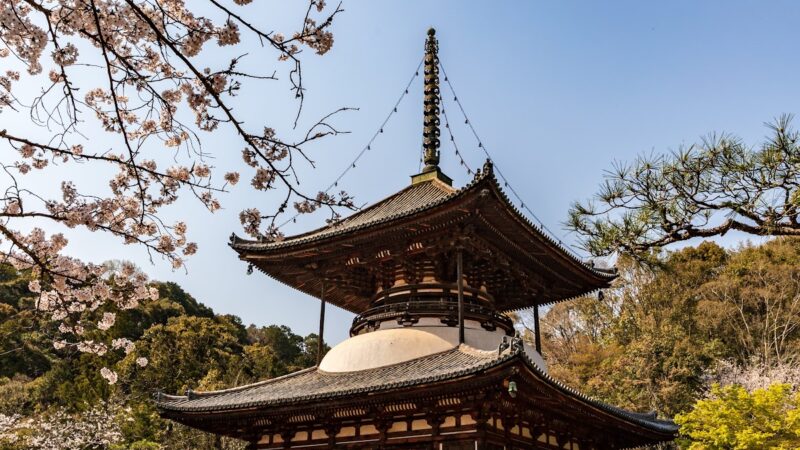
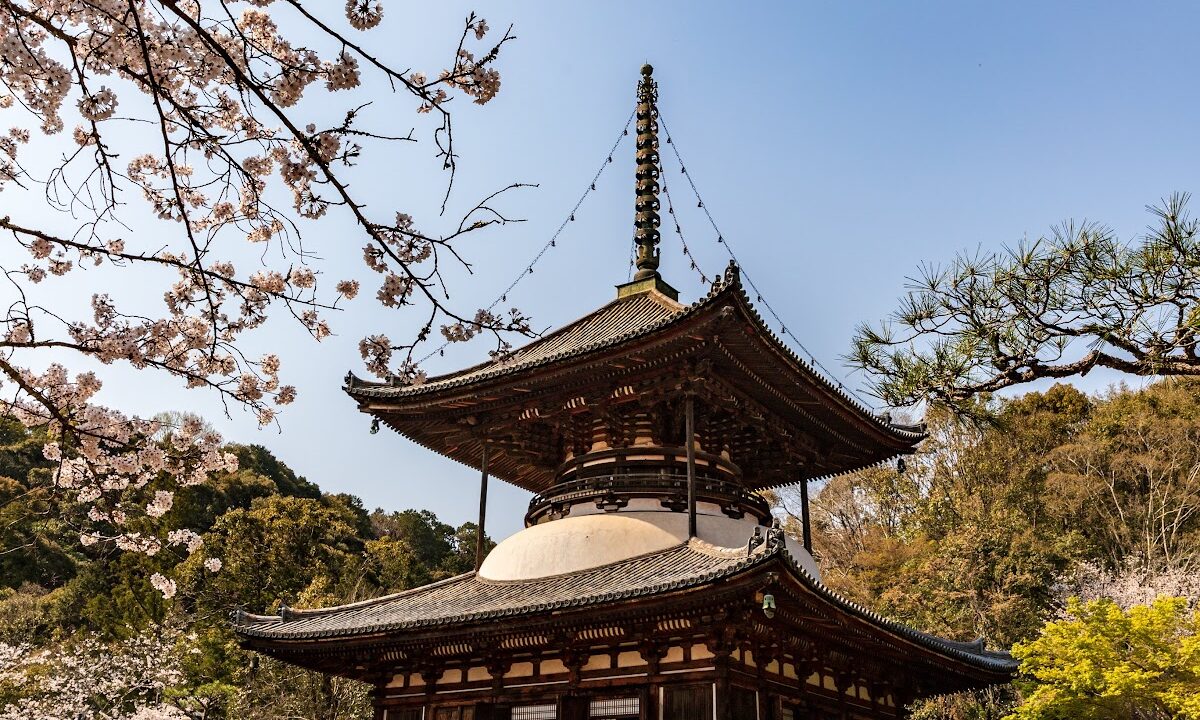
When visiting Negoro Castle, the Konpon Daito, a designated National Treasure, is an absolute must-see. Construction began in 1496 (Meio 5) and was completed in 1547 (Tenbun 16). This magnificent pagoda boasts a height of approximately 40 meters.
Miraculously surviving the fires of the Tensho era, the Konpon Daito is a masterpiece showcasing the pinnacle of Muromachi period architectural technology and is known as one of the largest existing pagodas in Japan. The vermilion-painted exterior exudes a unique character that has aged beautifully, overwhelming visitors.
Inside, a statue of Dainichi Nyorai (Vairocana Buddha) is enshrined, and the walls were once adorned with vividly colored murals (though these are now peeling). Architecturally, it possesses a unique style that blends Japanese and Chinese (Zen Buddhist) styles, occupying an important position in architectural history.
Daimon (Important Cultural Property)
The Daimon, the main gate of Negoro-ji Temple, was rebuilt in 1643 (Kanei 20) during the Edo period and is designated as an Important Cultural Property. It is a three-bay, single-entrance gatehouse, a representative example of architecture from the reconstruction period supported by the Kishu Tokugawa family.
Passing through the Daimon, the approach continues to the Konpon Daito (Great Pagoda), allowing one to feel the remnants of the temple’s former religious city.
Main Hall (Daidenpo-do)
The Main Hall is the central building of Negoro-ji Temple and houses the important cultural property, the three principal images (Dainichi Nyorai, Kongosattva, and Sonshobutsucho). As a training hall for transmitting the most important rituals of Shingon Buddhism, it continues to play an important religious role.
Although it is a reconstruction from the Edo period, its dignified appearance conveys the prestige of the head temple of the Shingi Shingon sect.
Komyō Shingon-den
The Komyō Shingon-den is an important building known as the place where Kakuban Shonin expounded on the merits of the Kōmyō Shingon mantra. It attracts worshippers as the center of the Kōmyō Shingon faith, which forms the foundation of Negoro-ji Temple’s teachings.
Gyōja-dō
The Gyōja-dō, which enshrines En no Gyōja, the founder of Shugendō, is also an important building of Negoro-ji Temple. It is a relic that demonstrates Negoro-ji Temple’s deep connection not only to Shingon Esoteric Buddhism but also to Shugendō.
Shōtendō and Aizen-in
Shōtendō is a hall dedicated to Kankiten (a Buddhist deity), and attracts worshippers seeking business prosperity and matchmaking. Aizen-in is a building said to have been the residence of “Suginobō,” a general of the warrior monks during the Nanboku-chō period, and is a valuable historical site that conveys the history of the Negoro sect.
Castle Remains: Earthworks and Moats
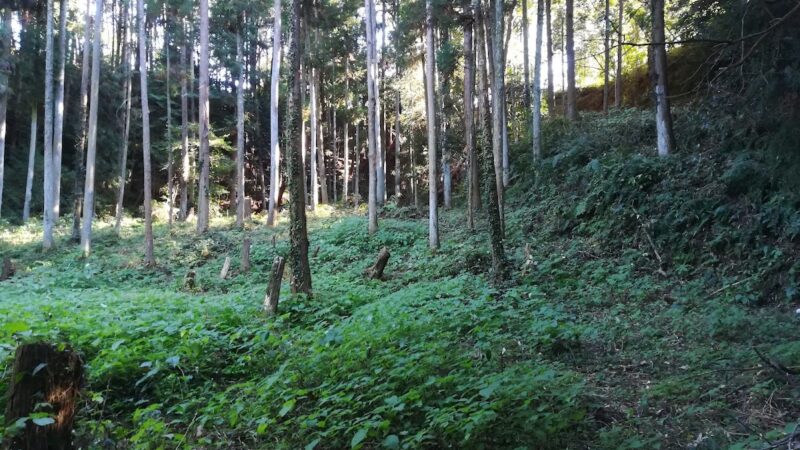
Besides the temple architecture, the castle remains are also a highlight. Traces of earthworks remain around the temple grounds, giving a glimpse into the scale of the former defensive facilities. Furthermore, traces of moats can be found in some areas, indicating that Negoro-ji was not merely a religious facility, but a castle equipped with military defensive functions.
Observing the topography of the Negoro-ji temple grounds reveals a defensive design that skillfully utilizes the natural terrain. These are unique features of Negoro Castle, a fusion of Muromachi period castle technology and temple architecture.
Negoro Lacquerware: A Traditional Craft Nurtured by Negoro-ji Temple
Negoro lacquerware is an indispensable craft when discussing Negoro Castle and Negoro-ji Temple. Negoro lacquerware is characterized by its unique appearance; as it is used, the red lacquer wears away, revealing the black base, creating a distinctive patina.
Originally, it was made as everyday tableware for the monks of Negoro-ji Temple, featuring a simple design that emphasized practicality. However, its rustic beauty became beloved by tea masters, and it came to be highly valued as tea ceremony utensils.
Currently, artisans who carry on the tradition of Negoro lacquerware are active in Iwade City, and their works can be seen at facilities around Negoro-ji Temple. Negoro lacquerware continues to thrive as a cultural heritage of Negoro-ji Temple.
Negoro-shu and Firearms: The True Image of a Monk-Warrior Group
The Negoro-shu is a general term for a group of monk-warriors based at Negoro-ji Temple. At its peak, the Negoro-shu numbered over 10,000, and their military power was comparable to that of a Sengoku-period daimyo (feudal lord).
The most distinctive feature of the Negoro-shu was their superior skill in the manufacture and use of firearms. When firearms were introduced to Tanegashima in 1543, Negoro-ji Temple quickly adopted the technology and, with its own modifications, developed the “Negoro firearm.” The Negoro firearm was highly accurate and durable, making it in demand by various Sengoku-period daimyo.
The Negoro-shu were not merely an armed group; they were also highly educated monks. They combined religious training with military discipline, possessing both intellect and martial prowess. In this respect, they differed from other religious forces such as the Ikkō-ikki.
After suffering a devastating blow during Toyotomi Hideyoshi’s invasion of Kishū, many of the Negoro-shu scattered throughout Japan, and their firearms technology spread across the country. It can be said that the Negoro-shu’s technology greatly contributed to the development of Japanese firearms culture.
Access and Tourist Information
Location
2286 Negoro, Iwade City, Wakayama Prefecture
Access Methods
Access by Train
- Approximately 10 minutes by Wakayama Bus bound for “Negoro-ji Temple” from JR Wakayama Line “Iwade Station,” get off at the last stop.
- Approximately 40 minutes by Wakayama Bus bound for “Negoro-ji Temple” via “Iwade Station” from Nankai Electric Railway “Izumisano Station.”
Access by Car
- Approximately 20 minutes from Hanwa Expressway “Sennan IC”
- Approximately 5 minutes from Keina-Wa Expressway “Iwade-Negoro IC”
- Approximately 60 minutes from Osaka city center
Parking
- Free parking available (approximately 100 cars)
- Temporary parking is also available during peak seasons such as cherry blossom season.
Visiting Information
Visiting Hours
- 9:00 AM – 4:30 PM (Last entry at 4:00 PM)
Admission Fee
- Adults: 500 yen
- Junior and Senior High School Students: 300 yen
- Elementary School Students: 200 yen
Closed Days
- Open all year round (may be closed for memorial services, etc.)
Nearby Facilities
Negoro Historical Museum
Located next to Negoro-ji Temple, this guidance facility provides detailed information about the history of the historical site. It features a diorama recreating Negoro-ji Temple in its heyday, as well as exhibits of excavated artifacts, making it ideal for deepening your understanding of Negoro Castle and Negoro-ji Temple.
Iwade City Folk Museum
This museum introduces the history and culture of Iwade City, and also exhibits local traditional crafts, including Negoro lacquerware.
Negoro-ji Temple Garden
A beautiful garden selected as one of Japan’s 100 Best Gardens, where you can enjoy the scenery of each season.
Estimated Visiting Time
Approximately 1-2 hours is needed to visit the main sights of Negoro-ji Temple. If you plan to thoroughly explore the temple grounds, including the Negoro Historical Museum, allow approximately three hours.
Seasonal Highlights: Famous Cherry Blossom and Autumn Foliage Spots
Negoro-ji Temple is a famous cherry blossom viewing spot, registered on the “Famous Cherry Blossom Castles Tour.” Approximately 7,000 cherry trees are planted on the temple grounds, transforming the area into a sea of pink in spring. The contrast between the Konpon Daito pagoda and the cherry blossoms is particularly breathtaking, attracting many photographers.
The best time to see the blossoms is usually from late March to early April. During this period, the “Negoro-ji Cherry Blossom Festival” is held, drawing large crowds of visitors.
The autumn foliage is also magnificent, with the maple and ginkgo trees on the grounds changing color from mid- to late November. The interplay of the vermilion Konpon Daito pagoda and the autumn leaves offers a different charm than the spring cherry blossoms.
The fresh green season is also beautiful; the Konpon Daito pagoda, surrounded by lush green trees, presents a vibrant and life-affirming sight.
Negoro Castle and Surrounding Castles
Wakayama Prefecture has many castles remaining besides Negoro Castle.
Wakayama Castle
Wakayama Castle, which flourished as the residence of the Kishu Tokugawa family, is located about 30 minutes by car from Negoro Castle. Its keep has been restored, and it is a representative castle of Wakayama Prefecture.
Saika Castle (Saginomori Betsuin)
This was the base of the Saika clan, who often clashed with the Negoro clan. It is an interesting point of comparison as a castle of a religious force with a different character from Negoro Castle.
Ota Castle
This was the residence of the Ota clan, a powerful local lord of Kii Province. Like Negoro Castle, it has a history of falling during Toyotomi Hideyoshi’s invasion of Kii Province.
Visiting these castles together will allow you to gain a deeper understanding of the complex power dynamics in Kii Province during the Sengoku period.
Summary: What Negoro Castle Tells Us Today
Negoro Castle, a unique entity where a temple and a castle were integrated, occupies an important position in the history of Japanese castles. The fact that a religious force possessed formidable military and economic power, forming an autonomous city, speaks to the diversity of Japanese society during the transition from the medieval to the early modern period.
Cultural assets, including the National Treasure Konpon Daito pagoda, are valuable legacies that convey the prosperity of the past. Furthermore, the traditional craft of Negoro lacquerware continues to carry on the cultural richness of Negoro-ji Temple to the present day.
Despite experiencing the tragedy of the entire temple complex being burned down by Toyotomi Hideyoshi, Negoro-ji Temple was rebuilt during the Edo period and continues to function as the head temple of the Shingi Shingon sect. Its resilience demonstrates the strength and continuity of Japanese religious culture.
When you visit Iwade City in Wakayama Prefecture, be sure to visit Negoro Castle and Negoro-ji Temple to experience their magnificent history and culture. The imposing presence of the national treasure, the Great Pagoda, the weight of history that permeates the tranquil grounds, and the beautiful nature that changes with the seasons—all of these elements contribute to the charm of Negoro Castle.