
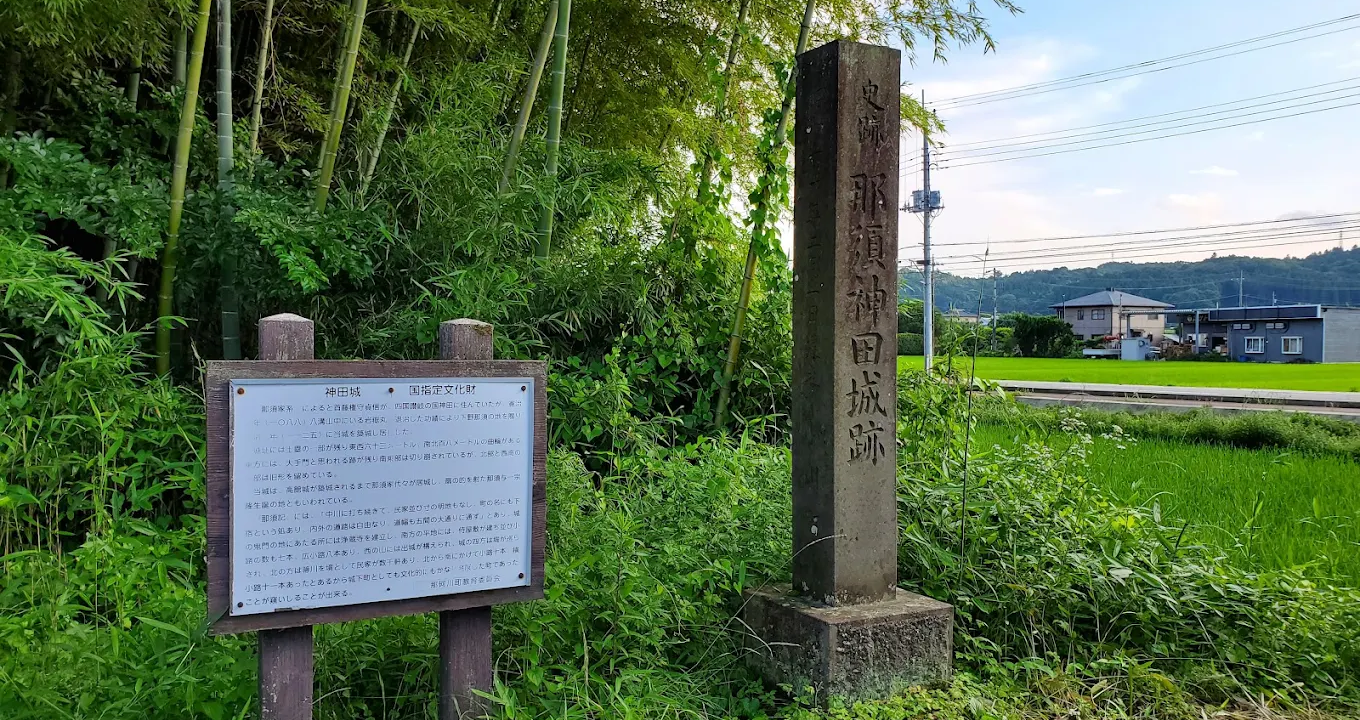
Nasu Kanda Castle (Tochigi Prefecture) Complete Guide: Birthplace of Nasu Yoichi and a National Historic Site – Medieval Castle Ruins
What is Nasu Kanda Castle?
Nasu Kanda Castle is a castle site located in Miwa, Nakagawa-machi, Nasu-gun, Tochigi Prefecture, dating from the late Heian period to the Kamakura period. Also known as Nasu Castle and Miwa Castle, it was designated a National Historic Site on July 6, 1984.
This castle, said to be the birthplace of Nasu Yoichi Munetaka, a master archer known for the “Fan Target” incident in the Genpei War, was built in 1125 (Tenji 2) by Fujiwara no Sukeie (Sudo Gon-no-kami Sadayoshi), the ancestor of the Nasu clan. As one of the earliest residences of the Nasu clan, it is a historically important site that functioned as the base of the Sudo clan (later the Nasu clan) for four generations.
Currently, the site is maintained as “Nasu Kanda Castle Ruins Park,” and it preserves the typical “square single-enclosure” form of a medieval castle in excellent condition, making it a valuable cultural asset that conveys the appearance of a samurai residence in eastern Japan.
History of Nasu Kanda Castle
Construction of the Castle and the Establishment of the Nasu Clan
The history of Nasu Kanda Castle dates back to 1125 (Tenji 2), at the end of the Heian period. Fujiwara no Sukeie, said to be the grandson of Fujiwara no Nagaie, the sixth son of Fujiwara no Michinaga, was granted Nasu County in Shimotsuke Province for his achievements in suppressing rebels, and descended to the province as the county magistrate.
Sukeie, also known as Sudo Gon-no-kami Sadayoshi, became the ancestor of the Nasu clan. He built Kanda Castle as his residence, and this area was also the central region of ancient Nasu. The ruins of the Nasu government office are also located nearby, suggesting that it was an important administrative and military center from ancient to medieval times.
The Nasu Clan’s Castle Era
Kanda Castle served as the residence of the Sudo clan (Nasu clan) from the first head, Fujiwara no Sukiie (Sudo Gon-no-kami Sadayoshi), to the fourth head, Sudo Sukekiyo. During this time, the Nasu clan grew into a powerful samurai group in northern Shimotsuke Province.
Of particular note is the era of the second head, Nasu Munesuke. Nasu Yoichi Munetaka, who followed Minamoto no Yoshitsune and brilliantly shot an arrow at the fan target displayed on a Taira ship during the Battle of Yashima in 1185, is said to have been born at Kanda Castle. Yoichi’s exploits are described in detail in the “Tale of the Heike,” and he remains one of the most famous archers in Japanese history.
Relocation to Inazumi Castle and Abandonment of Kanda Castle
During the time of the sixth head, Nasu Munesuke, the Nasu clan built a new castle, Inazumi Castle, and moved their base of operations. Later, the Nasu clan moved their residence further to Takadate Castle. Kanda Castle was abandoned following this relocation, but without undergoing major alterations, the remains of the medieval castle were preserved in excellent condition.
Structure and Remains of Nasu Kanda Castle
Castle Size and Form
Nasu Kanda Castle is a residence site exhibiting a rectangular shape, measuring approximately 117 meters north-south and 66 meters east-west (some documents state 130 meters east-west and 162-170 meters north-south). This size is among the largest of medieval castles in Tochigi Prefecture.
The castle’s form is a common structure for medieval castles called a “square single-enclosure type,” possessing a simple yet robust defensive system with a single enclosure surrounded by earthworks and a moat. As a typical example of a residence of eastern Japanese warriors from the late Heian period to the Kamakura period, it is a site of high academic value.
Features of the Earthworks
The greatest highlight of Kanda Castle is the massive earthworks surrounding the site. The earthen rampart has the following characteristics:
- Base width: Approximately 10 meters
- Upper width: Approximately 2 meters
- Height: Approximately 5 meters
This earthen rampart was built to surround the residence on all four sides, demonstrating the high level of technical skill and strong defensive awareness of the time. The upper part of the rampart was wide enough for people to walk on, allowing samurai to move around for lookout and defense.
Even today, most of the earthen rampart remains in good condition, and it is possible to actually climb onto it and overlook the entire castle. The view from the rampart will be a valuable experience that allows you to imagine the landscape that the samurai of that time saw.
Remains of the dry moat (water moat)
A dry moat surrounds the outside of the earthen rampart. In particular, the moat on the north and south sides is approximately 10 meters wide and is well-preserved, suggesting the possibility that it was once a water moat.
The moat, along with the earthworks, was a crucial element of the residence’s defensive system. It not only physically prevented enemy intrusion but also had a psychological deterrent effect. Even today, the depth and width of the moat can be appreciated, allowing visitors to learn about the realities of medieval castle defense.
Conditions within the Enclosure
Currently, most of the area within the enclosure is used as rice paddies. This reflects the changes in land use after the castle’s abandonment, but conversely, it means that the remains were spared from large-scale development and destruction.
While some parts of the earthworks on the west side have been leveled to create residential land, the overall state of preservation of the remains is extremely good. It is believed that the residence, warehouses, and stables were located within the enclosure at that time.
Relationship between Nasu no Yoichi and Kanda Castle
Who was Nasu no Yoichi Munetaka?
Nasu no Yoichi Munetaka was a samurai of the late Heian period, a master archer who played an active role in the Genpei War as a retainer of Minamoto no Yoshitsune. The name “Yoichi” is said to originate from the fact that he was the youngest of 11 siblings (the 11th).
The “Fan Target” at the Battle of Yashima
In the Battle of Yashima in 1185 (Genryaku 2), when the Taira clan challenged Yoichi to shoot a fan target displayed on a ship, Minamoto no Yoshitsune nominated Nasu Yoichi. Yoichi successfully accomplished the extremely difficult feat of shooting an arrow through a fan propped up on a ship amidst rough waves.
This anecdote is described in detail in the *Tale of the Heike* and is one of the most famous scenes in Japanese war chronicles. The scene where Yoichi prays “Namu Hachiman Daibosatsu” from horseback before releasing the arrow is a famous scene often performed in Noh and Kabuki plays.
Connection to Kanda Castle
The legend that Nasu Yoichi was born at Kanda Castle is deeply rooted in the region. The legend is considered historically consistent because it coincides with the period when Yoichi’s father, Nasu Taro Suketaka (Sudo Sukekiyo), resided at this castle.
When visiting Kanda Castle, reflecting on the young samurai who was born and raised here and later achieved great feats that left their mark on Japanese history will deepen your appreciation of the ruins.
Significance of National Historic Site Designation
Nasu Kanda Castle Ruins were designated a National Historic Site on July 6, 1984 (Showa 59). This designation has the following significance:
Value in Medieval Castle Research
Kanda Castle has extremely high academic value as a typical example of a residence of eastern Japanese samurai from the late Heian period to the early Kamakura period. The basic form of a medieval castle, a square single-enclosure structure, is well-preserved, making it a valuable resource for studying the castle structure of that time.
Excellent Preservation of the Remains
The fact that the remains have been preserved without undergoing large-scale development after the castle’s abandonment enhances its value as a cultural property. The clear retention of major defensive structures such as earthworks and moats, making it easy to imagine the castle’s appearance at the time, was highly praised.
Fundamental Materials for Nasu Clan Research
As an early base for the Nasu clan, who wielded power in northern Shimotsuke Province, this site is indispensable for studying the establishment and development of the Nasu clan. Its connection to the historically famous figure Nasu Yoichi also enhances its value as a historical site.
Highlights of Nasu Kanda Castle Ruins Park
Walking the Earthworks
Now that the park has been developed, visitors can actually walk on the earthworks. Climbing the earthworks allows you to overlook the entire castle complex and experience its square, single-enclosure structure. The view from the 5-meter-high earthworks offers a valuable opportunity to relive the perspective of the samurai of that time.
Experiencing the Depth of the Moat
The moats, especially on the north and south sides, are remarkably well-preserved, allowing for close observation of their depth and width. Looking up at the earthen ramparts from the bottom of the moat, you can truly appreciate the strength of this defensive system.
The Size of the Enclosure
Looking out over the interior of the enclosure, now a rice paddy, reveals the sheer scale of the residence. You can imagine what kind of buildings were arranged within this space, approximately 66 meters east-west and 117 meters north-south.
Information Boards and Signs
Information boards are installed throughout the park, allowing you to learn about the history and structure of Kanda Castle. The connection to Nasu Yoichi and the history of the Nasu clan are also explained in detail.
Access Information
Access by Public Transportation
Train and Bus:
- Get off at Karasuyama Station on the JR Karasuyama Line
- Take the Tono Kotsu bus bound for Bato Bus Depot
- Get off at the Miwa bus stop and walk for approximately 5 minutes.
Public transportation is limited, so it is recommended to check the timetable in advance.
Access by Car
From the Tohoku Expressway:
- Approximately 30 minutes from Yaita IC via National Route 461
- Approximately 40 minutes from Nasu IC via Prefectural Road 28
Parking:
There is parking space near the castle ruins (spaces are limited, so caution is advised during busy times).
Address
Miwa Yogai, Nakagawa-machi, Nasu-gun, Tochigi Prefecture
Visiting Information
Opening Hours & Fees
- Visiting Hours: No specific restrictions (open as a park at all times)
- Admission Fee: Free
- Closed Days: None
Estimated Visiting Time
If you wish to thoroughly examine the remains, allow approximately 30 minutes to 1 hour. This is an estimate including time to walk around the earthworks, read the explanatory signs, and take photographs.
Precautions for Visitors
- Some areas within the castle grounds are private property (rice paddies), so caution is required when entering.
- When walking on the earthen ramparts, please watch your step.
- The ground can become slippery during and after rain.
- Toilet facilities are limited, so it is recommended to use the restroom beforehand.
Nearby Tourist Attractions
Nasu Government Office Ruins
Near Kanda Castle are the ruins of the Nasu Government Office, the site of the ancient Nasu County government, demonstrating the importance of this region from ancient to medieval times.
Inazumi Castle Ruins
The ruins of Inazumi Castle, the next residence of the Nasu clan after they moved from Kanda Castle, are also located in Nakagawa Town and are a must-visit spot for tracing the history of the Nasu clan.
Nasu Yoichi Folklore Museum
In Otawara City is the Nasu Yoichi Folklore Museum, which introduces the achievements of Nasu Yoichi, allowing visitors to learn in detail about Yoichi’s life and the Battle of Yashima.
Nakagawa-machi Bato Hiroshige Museum
This museum primarily exhibits the works of Utagawa Hiroshige, and its architecture, designed by Kengo Kuma, is also a highlight. It can be visited in conjunction with a visit to Kanda Castle.
Nasu Kanda Castle Photo Spots
Recommended Photo Spots
- Panoramic View from Outside the Earthwork: Photographing the earthwork across the moat conveys the scale of the defensive structure.
- Inside the Enclosure from the Top of the Earthwork: Looking down from the top of the earthwork reveals the castle’s structure well.
- Looking Up at the Earthwork from the Bottom of the Moat: This creates a powerful photograph emphasizing the depth of the moat and the height of the earthwork.
- Combining the Information Board with the Remains: Useful for documentary photography.
Best Season for Photography
- Spring: The fresh green of the earthwork is beautiful.
- Autumn: The autumn foliage creates picturesque photos with the surrounding mountains.
- Winter: Snow-covered earthworks create a fantastical atmosphere.
How to Enjoy Visiting Nasu Kanda Castle
Experience the Romance of History
The greatest appeal of visiting Kanda Castle is the opportunity to reflect on the lives of samurai from eastern Japan during the late Heian period and early Kamakura period. Imagine the world of samurai over 800 years ago in this place where Nasu Yoichi may have spent his childhood.
Learn about the Structure of Medieval Castles
This is a valuable opportunity to observe the basic castle structure of a square-shaped single enclosure firsthand. You can deepen your understanding of how earthworks and moats served their defensive functions by actually walking around.
Relax in a Quiet Environment
Located in the quiet rural area of Nakagawa Town, the Kanda Castle ruins are charming for their unspoiled atmosphere, untouched by tourism. Spend time strolling leisurely and feeling the weight of history.
Summary
Nasu Kanda Castle (Nakagawa Town, Tochigi Prefecture) is the site of a residence from the late Heian period, known as the birthplace of Nasu Yoichi, and is a valuable cultural property designated as a National Historic Site. The earthworks and dry moats remain in excellent condition, preserving the typical square, single-enclosure structure of a medieval castle.
Built in 1125 by Fujiwara no Sukeie (Sudo Gon-no-kami Sadayoshi), the ancestor of the Nasu clan, this castle served as the residence of the Nasu clan for four generations. It is a valuable historical site that conveys the image of a stronghold for eastern Japanese warriors.
As one of the largest castle ruins in Tochigi Prefecture, and as a place associated with the historically famous Nasu Yoichi, it is a highly worthwhile spot for history and castle enthusiasts. Now developed as Nasu Kanda Castle Ruins Park, it is easily accessible to everyone, allowing visitors to observe the remains up close and immerse themselves in the historical romance of the medieval period.
Nasu Kanda Castle is indispensable for understanding the history of northern Shimotsuke Province. Be sure to visit and experience the atmosphere of this place where Nasu Yoichi was born and raised.
--765x450.png)

