Complete Guide to Nagoya Castle | History, Highlights, Access, and the Main Palace – A Thorough Explanation
Nagoya Castle is a representative Japanese castle, known as a symbol of Nagoya City, Aichi Prefecture. The golden shachihoko (mythical fish-like creature) shining atop the castle tower is nationally famous as an icon of Nagoya, and is also affectionately known as “Kinkojo” (Golden Shachihoko Castle) or “Kinjo” (Golden Castle).
This article thoroughly explains the charm of Nagoya Castle, from its historical background to its highlights such as the main palace and castle tower, access methods, visitor information, and even the ongoing wooden restoration project.
History of Nagoya Castle
Background of Construction and Tokugawa Ieyasu’s Strategy
Construction of Nagoya Castle began in 1610 (Keicho 15) by order of Tokugawa Ieyasu. Following his victory at the Battle of Sekigahara (1600), Ieyasu decided to build a new castle in Nagoya as the final step in unifying Japan. His objectives were to monitor the daimyo of western Japan and establish a military base.
Ieyasu appointed his ninth son, Tokugawa Yoshinao, as the lord of the Owari Domain, and designated Nagoya Castle as the residence of the Owari Tokugawa family. As the head of the three Tokugawa branches, the Owari Tokugawa family played a crucial role in supporting the Tokugawa shogunate throughout the Edo period.
Construction under the “Tenka Fushin” System
The construction of Nagoya Castle was carried out under the “Tenka Fushin” system. This system involved mobilizing daimyo from across the country to carry out the construction work, with over 20 daimyo, primarily from western Japan, participating, including Kato Kiyomasa, Fukushima Masanori, and Kuroda Nagamasa. This Tenka Fushin system also included political intentions to weaken the economic power of the daimyo and confirm their loyalty to the shogunate.
Construction of the castle progressed at an astonishing speed. The main keep was completed in 1612 (Keicho 17), and the entire castle complex was nearly finished by 1615 (Keicho 20). The completed Nagoya Castle boasted the largest total floor area of any castle in history, a magnificent keep, and a splendid main palace, making it a splendid castle often considered the pinnacle of modern castle architecture.
From Nagoya Castle to Nagoya Castle
On the site of the current Nagoya Castle, there was a castle called “Nagoya Castle” from the Muromachi period. This castle is said to have been built by Imagawa Ujitoyo, and later seized by Oda Nobuhide (father of Oda Nobunaga), becoming the residence of the Oda clan. There is a theory that Oda Nobunaga was born at this Nagoya Castle.
After Oda Nobunaga moved to Kiyosu Castle, Nagoya Castle was abandoned. However, Tokugawa Ieyasu recognized the strategic importance of the site and built Nagoya Castle.
Nagoya Castle in the Edo Period
Throughout the Edo period, Nagoya Castle functioned as the residence of the Owari Tokugawa family, who held a domain of 620,000 koku. Nagoya, the castle town, developed as a center of commerce and culture, serving as a strategic point connecting the Tokaido and Nakasendo roads.
Nagoya Castle also served as accommodation for the shogun during his visits to Kyoto; the third shogun, Tokugawa Iemitsu, stayed there in 1634 (Kanei 11). The Joraku-den (Shogun’s Hall) in the Honmaru Palace was a specially constructed space for welcoming the shogun.
Destruction by War and Post-War Reconstruction
In 1930 (Showa 5), Nagoya Castle received the honor of being designated as the first National Treasure among castle architecture. Many of its structures, including the main keep, the smaller keep, and the Honmaru Palace, were recognized as National Treasures, receiving the highest regard as a Japanese cultural property.
However, Nagoya Castle suffered catastrophic damage in the Nagoya air raid on May 14, 1945 (Showa 20). Most of the main buildings, including the main keep, smaller keeps, and the Honmaru Palace, were destroyed by fire, and many national treasures were lost. Fortunately, three turrets—the northwest corner turret, the southwest corner turret, and the southeast corner turret—and three gates—the Omote-Ninomon Gate, the former Ninomaru East Ninomon Gate, and the Ninomaru Ote-Ninomon Gate—survived the war and are now designated as important cultural properties.
After the war, thanks to the enthusiasm of the citizens of Nagoya, the keep was rebuilt in 1959 (Showa 34). This rebuilt keep is made of steel-framed reinforced concrete, faithfully reproducing its pre-fire appearance from the outside, while the interior was renovated to function as a museum. The golden shachihoko (mythical fish-like creatures) were also placed once again atop the keep, reviving as a symbol of Nagoya.
Highlights of Nagoya Castle
The Castle Tower and Golden Shachihoko
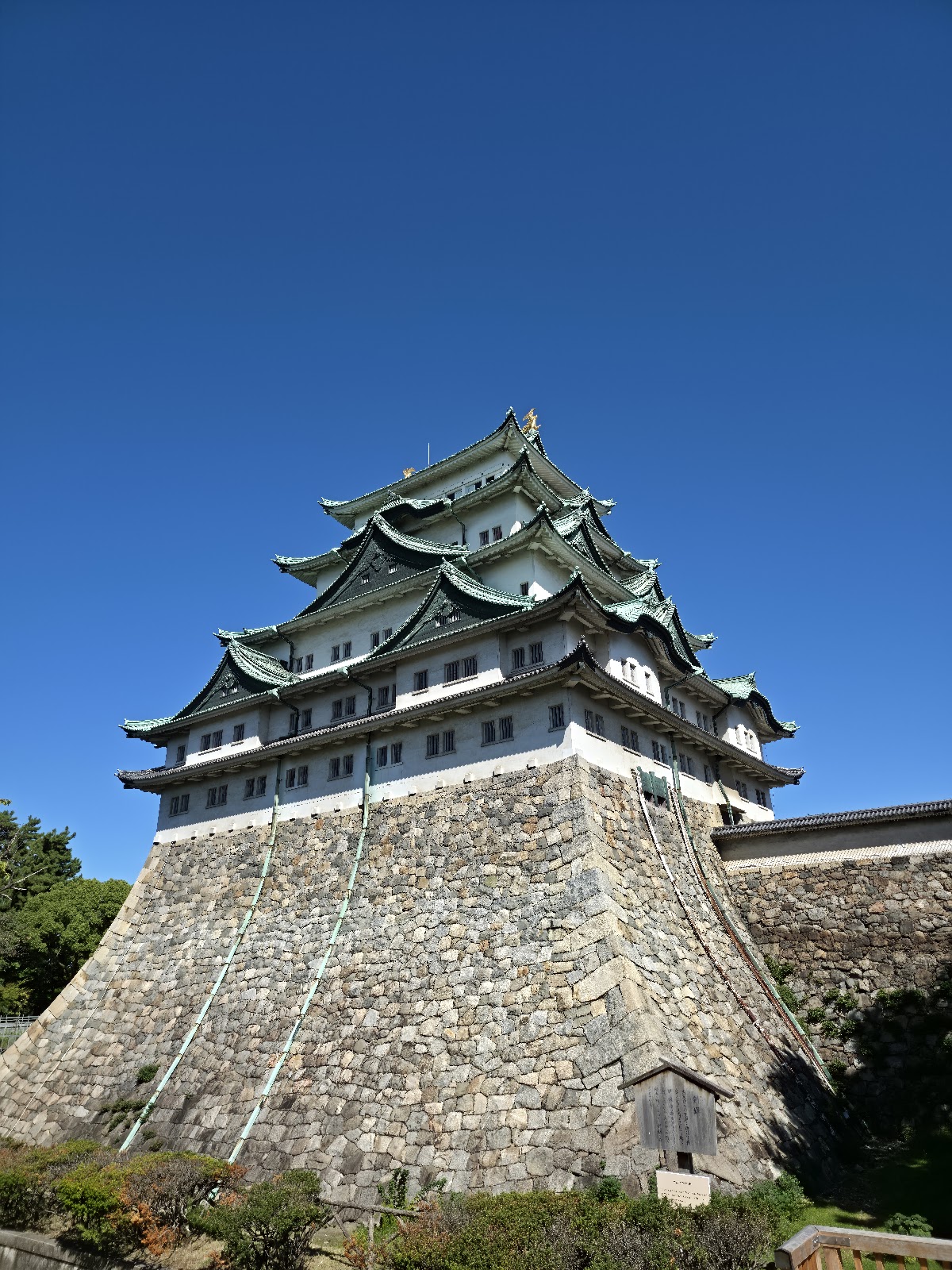
The castle tower, the greatest symbol of Nagoya Castle, is a connected-style tower consisting of a large tower approximately 48 meters high and a smaller tower approximately 24 meters high. On the roof of the large tower shines golden shachihoko, approximately 2.6 meters high and weighing approximately 1.2 tons (for a pair).
These golden shachihoko have been the most distinctive feature of Nagoya Castle since its construction, symbolizing the authority of the Tokugawa family and the prosperity of the Owari domain. The current golden shachihoko were created during the 1959 reconstruction and are made using 18-karat gold.
The interior of the castle tower has been renovated into a museum, displaying valuable materials, armor, and works of art related to the history of Nagoya Castle and the Owari Tokugawa family. However, due to earthquake-resistant concerns, entry to the castle tower is currently restricted, and a wooden reconstruction project is underway.
Honmaru Palace
The Honmaru Palace is a particularly noteworthy structure within Nagoya Castle. Completed in 1615 (Keicho 20), the Honmaru Palace served as the residence and administrative center of the feudal lord and was known for its magnificent and opulent screen paintings and carvings.
The Honmaru Palace, destroyed by fire during the war, began restoration work in 2009 (Heisei 21) and was fully restored in 2018 (Heisei 30). The restoration aimed to faithfully reproduce Edo-period construction methods and materials as much as possible, based on photographs taken before the fire, measured drawings, and surviving preliminary sketches of the screen paintings.
The restored Honmaru Palace consists of the following areas:
Entrance Hall and Main Study: A public space where the feudal lord met with his retainers, lavishly decorated with screen paintings by Kano school artists.
Audience Room: Used as a venue for more formal audiences.
Joraku-den: The most formal space for receiving the Shogun, particularly lavishly decorated. The sliding screen paintings include national treasure-class murals such as Kano Tan’yu’s “Plum, Bamboo, and Birds in Snow.”
The murals in the main palace are primarily gold-leafed murals, with each room featuring a different theme. They are highly regarded as the pinnacle of Kano school painting from the early Edo period.
Important Cultural Property Turrets and Gates
The three turrets that survived the war are valuable cultural assets that convey Edo period architectural techniques:
Northwest Corner Turret (Kiyosu Turret): Said to have been relocated from Kiyosu Castle, it is a magnificent three-story, three-tiered turret.
Southwest Corner Turret (Hitsuji-Saru Turret): A two-story, two-tiered turret, a beautiful structure built on top of a stone wall.
Southeast Corner Turret (Tatsumi Turret): Located in the southeast of the main enclosure, it occupies a strategically important position. Furthermore, the three gates are designated as Important Cultural Properties and retain the characteristics of Edo period castle architecture.
Ninomaru Garden
Ninomaru Garden is a daimyo garden built by Tokugawa Mitsutomo, the second lord of the Owari Domain. Although part of it was lost in wartime, restoration and maintenance are underway based on archaeological excavations, allowing visitors to enjoy the Edo period garden style.
It is a pond-centered strolling garden, offering beautiful scenery throughout the seasons, and attracts many tourists, especially during the cherry blossom season in spring and the autumn foliage season.
Value as a National Scenic Spot and Special Historic Site
Nagoya Castle was designated a National Special Historic Site in 1952 (Showa 27). Special Historic Site is the highest designation given to historically significant sites in Japan, demonstrating the high historical and cultural value of Nagoya Castle.
It is also selected as one of Japan’s Top 100 Castles, making it a must-see spot for castle enthusiasts and history buffs.
Maru Gokura Castle Treasure Museum (Gokura Castle Treasure Museum)
Within Nagoya Castle is the Maru Gokura Castle Treasure Museum, which opened in 2021 (Reiwa 3). This facility is a museum that houses and displays valuable cultural artifacts passed down through Nagoya Castle.
It houses over 1,000 items, including screen paintings that survived the war, art objects, armor, and furnishings related to the Owari Tokugawa family. In particular, it offers a rare opportunity to view some of the screen paintings (originals) from the main castle palace and items designated as Important Cultural Properties up close.
The exhibits are regularly changed, and special exhibitions are held according to the season and theme, so there are new discoveries to be made with each visit.
Overview and Progress of the Wooden Restoration Project
Nagoya City is proceeding with the “Nagoya Castle Tower Wooden Restoration Project,” which involves dismantling the current steel-reinforced concrete castle tower and restoring a historically accurate wooden tower.
Objectives of the Wooden Restoration
The main objectives of this project are as follows:
- Enhancement of Cultural Property Value: By restoring the castle tower to be more historically accurate using Edo period architectural techniques and materials, its value as a cultural property will be enhanced.
- Passing on Traditional Techniques: This will provide an opportunity to pass on traditional wooden architecture techniques to the next generation.
- Enhancing Attractiveness as a Tourist Resource: As a genuine wooden castle tower that can be proudly presented to the world, it will become an attractive facility that draws tourists from both Japan and abroad.
Current Progress
The wooden restoration project is progressing in stages, facing various challenges. In particular, there are technical and institutional challenges that need to be addressed, such as barrier-free access, the development of disaster prevention equipment, and balancing cultural property value with modern safety standards. The city of Nagoya is proceeding with the project carefully, taking into account the opinions of experts and specialists. The latest progress and future schedule are updated regularly on the official Nagoya Castle website.
Access and Transportation Information
Access by Train
Public transportation is the most convenient way to access Nagoya Castle:
Meijo Subway Line
- Get off at “Shiyakusho” Station, 5-minute walk from Exit 7
Tsurumai Subway Line
- Get off at “Asamacho” Station, 12-minute walk from Exit 1
From Nagoya Station, the most common route is to take the Higashiyama Subway Line to “Sakae” Station, transfer to the Meijo Line, and get off at “Shiyakusho” Station. The journey takes approximately 20 minutes.
Access by Bus
City Bus
- Take the bus bound for “Sakae” from Nagoya Station and get off at “Nagoya Castle Main Gate” bus stop.
- Multiple routes are available, including the “Main Line 2”.
Sightseeing Route Bus “Me-guru”
- This sightseeing bus circulates around major tourist spots in Nagoya City and also stops at Nagoya Castle.
Access by Car
Using the Expressway
- Approximately 8 minutes south from the “Kurokawa” exit on the Nagoya Expressway Route 1 Kusunoki Line.
- Approximately 5 minutes north from the “Marunouchi” exit on the Nagoya Expressway Inner Ring Road.
Parking
- Main Gate Parking Lot (Paid): Capacity for 308 regular cars.
- Ninomaru East Parking Lot (Paid): Bus only.
Parking can get crowded on holidays and during peak tourist seasons, so using public transportation is recommended.
Visitor Information & Opening Hours
Opening Hours
Normal Period
- 9:00 AM – 4:30 PM (Last entry to Honmaru Palace and Maru-Mikura Castle Treasure Museum is 4:00 PM)
*Hours may change depending on the season and events. Please check the official website for the latest information.
Closed Days
- December 29th – December 31st
- January 1st (Only the Shinomaru and Nishinomaru areas may be open)
Admission Fees
Individual Rates
- Adults: 500 yen
- Junior High School Students and Younger: Free
Group Rates (30 or more people)
- Adults: 400 yen
Annual Passport
- Adults: 2,000 yen (Recommended for those visiting 4 or more times a year)
*Residents of Nagoya City aged 65 and over can enter for 100 yen upon presentation of a senior citizen’s pass, etc.
*Visitors with a disability certificate and up to two accompanying persons are admitted free of charge.
Waiting Times for Entry
Because Honmaru Palace is a popular tourist spot, there may be waiting times for entry, especially on holidays and during peak tourist seasons (such as the cherry blossom season in spring, Golden Week, and the autumn foliage season).
Tips for avoiding crowds:
- Weekday mornings are recommended.
- It’s relatively less crowded right after opening (9:00-10:00).
- Crowds tend to ease after 14:00.
The official website may provide real-time crowd information, so we recommend checking it before your visit.
Events & Latest Information
Nagoya Castle hosts a variety of events throughout the year:
Regular Events
Nagoya Castle Spring Festival (Late March – Early May)
- A spring festival held to coincide with the cherry blossom season
- Nighttime openings and illuminations are also held
- Approximately 1,000 cherry trees adorn the castle grounds
Nagoya Castle Summer Festival (August)
- Enjoy nighttime openings, Bon Odori dances, fireworks, and more
Nagoya Castle Autumn Festival (October – November)
- Chrysanthemum exhibition and autumn foliage illuminations
- Performances of traditional arts are also included
Cultural Events
Matchlock Gun Demonstration
- A demonstration of matchlock guns recreating the era of Tokugawa Ieyasu
- Held regularly (check the official website for dates)
Nagoya Hospitality Samurai Team
- Performances by a samurai team dressed as Tokugawa Ieyasu, Oda Nobunaga, and other historical figures
- Demonstrations and commemorative photo opportunities are held daily within the castle grounds.
Special Openings
Normally closed turrets and buildings are sometimes specially opened to the public for a limited time. This is a rare opportunity, so be sure to check the official website and social media for the latest information.
Surrounding Facilities and Area Guide
Nagoya Noh Theater
Located adjacent to the east side of Nagoya Castle, the Nagoya Noh Theater is a facility equipped with an authentic Noh stage. Noh and Kyogen performances are held regularly, allowing visitors to appreciate traditional Japanese performing arts. The building itself is beautiful and well worth a visit.
Kinshachi Yokocho
Near the main gate and east gate of Nagoya Castle is “Kinshachi Yokocho,” which opened in 2018. It features a row of restaurants and souvenir shops specializing in Nagoya cuisine, making it a popular spot for tourists.
Yoshinao Zone (Main Gate side): An area where long-established, renowned shops are gathered.
Muneharu Zone (East Gate side): An area where modern, trendy restaurants are gathered.
Enjoy Nagoya specialties such as hitsumabushi, miso katsu, kishimen, and tebasaki.
Meijo Park
Meijo Park, located north of Nagoya Castle, is a vast urban park. With well-maintained walking paths, lawns, and flowerbeds, it serves as a place of relaxation for citizens. Beautiful cherry blossoms in spring and autumn leaves in fall make it ideal for jogging and picnics.
Nagoya Castle Trivia
History of the Golden Shachihoko
The golden shachihoko of Nagoya Castle have been remade several times. Records indicate that the first golden shachihoko used the equivalent of 1,940 Keicho-era gold coins. During the Edo period, there were incidents of gold theft, and at the end of the Edo period, due to the domain’s financial difficulties, some of the gold on the shachihoko was even removed.
The current golden shachihoko (mythical fish-like creatures) are the third generation, created during the castle’s reconstruction in 1959. Made with 18-karat gold, the pair uses approximately 88 kg of pure gold.
Markings on the Stone Walls
Nagoya Castle’s stone walls bear numerous “markings” that serve as identifiers for the various daimyo (feudal lords) who participated in its construction. When strolling through the castle grounds, paying attention to the stone walls reveals a variety of markings. These marks, used to identify the stones transported by each daimyo, are an element that evokes a sense of historical romance.
The Pinnacle of Early Modern Castles
Nagoya Castle is considered the “pinnacle of early modern castles.” This signifies the perfected form of castle architecture, where military defense, a symbol of political authority, and comfortable living spaces are highly integrated.
While defensive ingenuity is evident throughout, such as the height of the stone walls, the depth of the moats, and the placement of the turrets, the lavish decorations of the main palace reflect a political intention to demonstrate the authority of the Tokugawa family.
Summary
Nagoya Castle is a representative Japanese castle built by Tokugawa Ieyasu, and a valuable cultural asset that conveys the history and culture of the Edo period. Despite the tragedy of being destroyed by fire during wartime, it was restored through the enthusiasm of the citizens and continues to evolve today.
From the keep with its gleaming golden shachihoko (mythical fish-like creatures), the magnificent Honmaru Palace, the important cultural properties of the turrets and gates, and the precious collections of the Maru-no-Mikura Castle Treasure Museum, there are countless sights to see. With the wooden restoration project underway, Nagoya Castle is poised to write a new page in its history.
When visiting Nagoya, be sure to take your time to explore Nagoya Castle and experience the depth of its history and culture. You can also enjoy the scenery and events that change with the seasons, so you’ll discover something new every time you visit.
For the latest opening hours and event information, please check the official Nagoya Castle website and enjoy a fulfilling visit.