Complete Guide to Mikadani Castle (Yamabe District, Nara Prefecture) | Highlights of the Nanboku-cho Period Mountain Castle Remains and Reconstructed Watchtower
What is Mikadani Castle?
Mikadani Castle is a medieval mountain castle located in Mikadani, Yamazoe Village, Yamabe District, Nara Prefecture. It is a single-enclosure hill castle believed to have been built during the Nanboku-cho period, situated on a hill approximately 430m above sea level with a relative height of approximately 20m. Known as the residence of the Mikadani clan, it is a valuable historical site that preserves a typical form of medieval castle in Yamato Province.
Mikadani Castle is the only medieval castle site in Nara Prefecture with a reconstructed architectural section, and is highly valued as a castle site of extremely high historical significance. Currently, it is carefully maintained by local residents, and a reconstructed watchtower has been found, making it a valuable place to experience the appearance of a medieval mountain castle.
History of Mikatani Castle
Background of Construction and Yamato Province during the Nanboku-cho Period
The exact construction date of Mikatani Castle is uncertain, but based on the structure of the castle and the characteristics of its remains, it is estimated to have been built during the Nanboku-cho period (mid to late 14th century). During this period, Yamato Province was in a complex political situation, with temple and shrine forces centered around Kofuku-ji Temple intertwined with samurai groups.
In Yamato Province during the Nanboku-cho period, Daijoin and Ichijoin, head temples of Kofuku-ji Temple, wielded considerable power, and many samurai groups were under their command. The Mikatani clan is believed to have been one of these samurai groups connected to Kofuku-ji Temple.
The Mikatani Clan and the Castle’s Role
Mikani Castle functioned as the residence of the Mikatani clan. The Mikatani clan were local lords based in Yamabe District, Yamato Province, and are believed to have served as border guards (sakimori) for Daijoin Temple of Kofuku-ji Temple. Historical documents such as the “Kofukuji Zatsujiki” and “Yamato Province Medieval Mountain Castles” mention the name of Mikatani Higo-no-kami, indicating the influence of the Mikatani clan in this region.
It is believed that the castle functioned not only as a military base but also as a center of regional control, i.e., as a residence. Its location on a hillside is a typical characteristic of medieval castles, combining habitability in peacetime with defensive capabilities in times of conflict.
Late Muromachi to Azuchi-Momoyama Period
In the late Muromachi period, the Tsutsui clan rose to prominence in Yamato Province. Records in the “Kofukuji Zatsujiki” indicate that Mikatani Castle functioned as an outpost related to the Tsutsui clan’s transfer to Iga Province during the time of Tsutsui Junkei. During the Tensho era (1573-1592), when Tsutsui Junkei entered Koriyama Castle at the command of Oda Nobunaga and proceeded with the unification of Yamato Province, it is presumed that Mikatani Castle was also incorporated under the control of the Tsutsui clan.
It is believed that Mikatani Castle was abandoned after the reorganization of Yamato Province under the Toyotomi regime.
Mikatani Castle’s Layout and Structure
Characteristics of a Single-Enclosure Castle
Mikagani Castle is a single-enclosure castle. A single-enclosure castle is a type of castle consisting only of a main enclosure (honmaru), a feature commonly seen in mountain castles from the Nanboku-cho period to the early Muromachi period. Compared to the complex enclosure layouts of Sengoku period castles, it has a simpler structure, but this is precisely why it retains much of its original appearance.
The main enclosure measures approximately 40m east-west and 30m north-south, a standard size for a medieval local lord’s residence. Defensive facilities are arranged around this main enclosure.
Defensive System with Earthworks and Moats
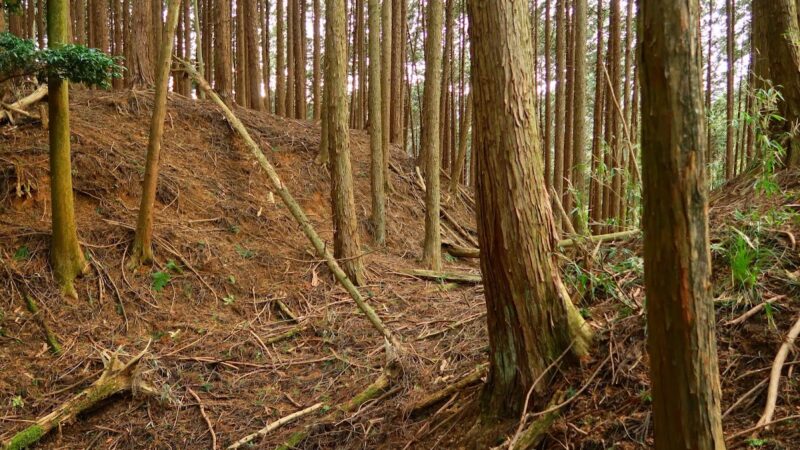
The most distinctive feature of Mikatani Castle is the thick earthworks and moats located on the north side. Because the north side has a relatively gentle slope, it was heavily defended as the direction from which enemy incursions were expected.
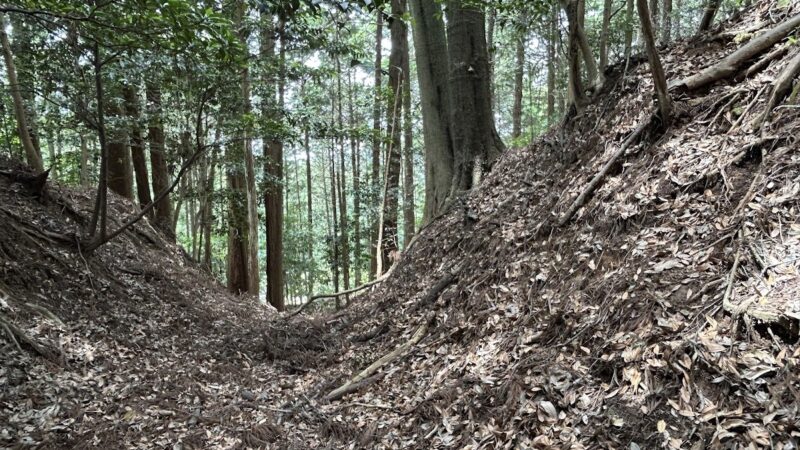
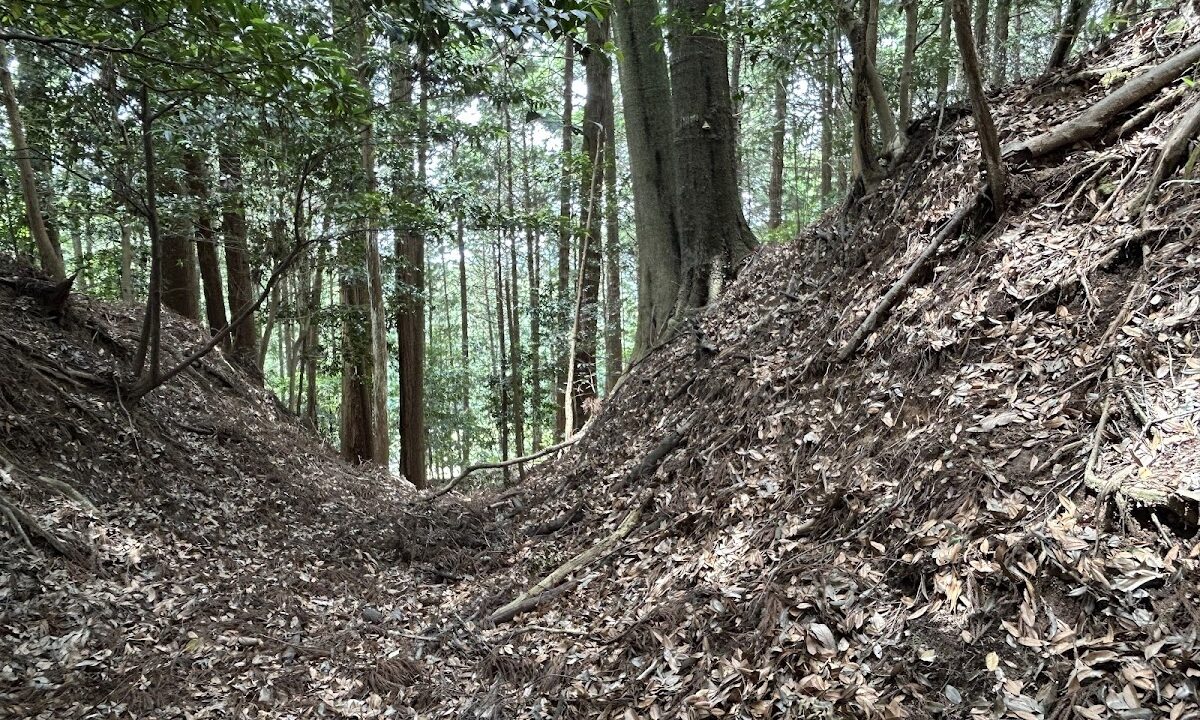
The earthen rampart is approximately 3 meters high and 5 meters wide, forming a strong defensive wall protecting the northern edge of the main enclosure. A moat is dug outside this rampart (to the north), creating a double line of defense. The moat is approximately 4 meters wide and 2 meters deep, and is a clearly visible structure even today.
The combination of the earthen rampart and moat is a typical defensive technique in medieval mountain castles, demonstrating that Mikatani Castle faithfully reflects the castle-building techniques of this era.
Defense Utilizing Natural Terrain
In contrast to the artificial defensive structures on the north side, the steep natural terrain from the west to the south functions as a defensive line. Because the slopes in these directions are steep, making enemy approach difficult, sufficient defensive capabilities could be achieved with minimal modifications.
This castle-building philosophy, which maximizes the use of natural terrain while constructing artificial defensive structures only where necessary, demonstrates the rational design of medieval mountain castles.
Placement of the Entrance (Koguchi)
The entrance to the main enclosure (koguchi) is presumed to have been located on the east side. The eastern side had a relatively gentle slope and served as a path to the castle. While the exact structure of the entrance is unknown, traces can still be seen today as a break in the earthworks.
Restoration and Highlights of the Watchtower
Nara Prefecture’s Only Reconstructed Structure
A watchtower has been presumably reconstructed on the earthworks north of the main enclosure of Mikatani Castle. This is the only medieval castle site in Nara Prefecture with a reconstructed structure, making it the castle’s greatest highlight.
The watchtower is a presumed reconstruction based on archaeological excavations, historical documents, and examples from other medieval castles, representing a watchtower that likely existed in a mountain castle during the Nanboku-cho period. It is a two-story wooden structure, approximately 6 meters tall.
Structure and Function of the Watchtower
The restored watchtower has a simple yet practical structure. The first floor is an open space composed of pillars and beams, while the second floor has a planked floor and walls. The roof is a hipped roof with a finish that mimics thatched roofing.
The main function of the watchtower was to monitor the surrounding area and detect approaching enemies early. Located at an altitude of 430m, it offered a wide view of the surrounding plains and roads, playing an important role as an information gathering base.
Stunning View
The view from the watchtower is magnificent; on a clear day, you can see the entire Nara Basin. To the west, you can see the city of Nara, and further in the distance, the Ikoma mountain range, while to the south, the mountains of the Yamato Plateau stretch out. This view offers a valuable opportunity to relive the scenery seen by the castle lords of the Middle Ages.
Remains of Mikatani Castle
Condition of the Main Enclosure
The main enclosure is preserved in relatively good condition. While the flat areas are somewhat overgrown with weeds, regular maintenance by local residents keeps it easily accessible. Although no building foundations or other structures have been found within the main enclosure, it is presumed that buildings such as residences and warehouses once existed there.
Condition of the Earthworks
The northern earthworks retain much of their original form from the time of construction. The earthworks have a trapezoidal cross-section, with a flat top approximately 2 meters wide. A watchtower has been restored on this flat surface, and it is possible to approach the tower by walking along the top of the earthworks.
The earthworks appear to have been constructed by excavating and piling up soil from the natural ground; no special construction methods such as rammed earth were used. This is a common method of earthwork construction in castles during the Nanboku-cho period.
Characteristics of the Horizontal Moat
The northern horizontal moat is an important remains that can still be clearly observed today. The moat extends east-west and is approximately 40 meters long. The moat’s cross-section is nearly V-shaped, a typical shape for medieval moats.
The eastern and western ends of the horizontal moat have disappeared, blending into the natural terrain, indicating that the excavated soil was used to build the earthworks. This combination of earthworks and moats is called a “moat-and-ditch moat” and is a basic defensive structure of medieval mountain castles.
Other Remains
Several small leveled areas have been identified around the main enclosure. These are thought to be auxiliary enclosures, known as koshikuruwa or obikuruwa, used for defensive reinforcement or as work spaces.
Furthermore, slight elevation changes and traces of cut slopes remain along the eastern approach to the castle, indicating that the approach was maintained.
Access to Mikatani Castle
Location
- Address: Mikatani, Yamatoe Village, Yamabe District, Nara Prefecture
- Elevation: Approximately 430m
- Relative Height: Approximately 20m
Access by Car
Access to Mikatani Castle is convenient by car. It is approximately 10 minutes from the Kannoguchi Interchange on National Route 25 (Meihan Expressway), or approximately 15 minutes from the Satsukibashi Interchange.
From the center of Yamatoe Village, take the prefectural road towards the Mikatani settlement. Signposts are installed within the settlement, indicating the route to the castle ruins. There is parking space near the castle ruins, but it is not large, so caution is advised if visiting with multiple vehicles.
Access by Public Transportation
Public transportation access is limited. The nearest station is Tsukigaseguchi Station on the JR Kansai Main Line, but it is approximately 5km from the station to the castle ruins, taking more than an hour on foot. Since bus services are infrequent, we recommend using a car for your visit.
Access Route and Time Required
From the parking area to the castle ruins, it’s about a 10-minute walk along a well-maintained access route. The path is relatively gentle, making it one of the easier mountain castles to climb. However, the ground can become slippery in rainy weather or winter, so appropriate footwear is recommended.
Points to Note and How to Enjoy Your Visit
Time Required for Visiting
For a visit to Mikatani Castle, you should allow about an hour, including the round trip on the access route. If you want to carefully observe the remains and enjoy the view from the watchtower, we recommend allocating about an hour and a half.
Photo Spots
Mikagani Castle has several excellent photo spots.
- Watchtower and Earthworks: When photographed from the north side, looking up, the height of the earthworks and the watchtower make for an impressive shot. 2. Horizontal Moat: The angle of looking up at the earthworks from the bottom of the moat conveys the impressive defensive structure of a medieval castle.
- View from the Main Enclosure: On clear days, you can photograph a beautiful panorama of the Nara Basin.
- Road to the Castle: The road to the castle, surrounded by trees, shows different expressions in each of the four seasons.
Best Seasons for Visiting
Mikagatani Castle can be visited throughout the year, but spring and autumn are especially recommended.
Spring (Late March to May): The fresh greenery is beautiful, and the weather is mild, making it ideal for visiting the castle. The surrounding mountains are vibrant with cherry blossoms.
Autumn (October to November): The autumn leaves are beautiful, and you can enjoy distant views in the clear air. The weather is pleasant, allowing for thorough observation of the ruins.
In summer, the vegetation grows thick, making it difficult to see the ruins. Also, in winter, caution is needed due to the cold and snow.
Points to Note When Visiting
- Although the castle ruins are well-maintained, please remember that it is a mountain castle and wear comfortable shoes and clothing.
- Don’t forget insect repellent in summer and warm clothing in winter.
- Bring your own drinking water. There are no vending machines around the castle ruins.
- To protect the remains, please be careful not to damage the earthworks or moats.
- Please take all your trash with you.
Nearby Attractions
Tourist Spots in Yamazoe Village
Yamazoe Village, where Mikatani Castle is located, has other attractions.
Kaminoyama: A mountain with an elevation of 619m, the summit is home to “Meemee Ranch,” where sheep graze. It’s ideal for hiking and nature observation.
Forest Park Kaminoyama: A nature park with a campsite and barbecue facilities, popular with families.
Yamato Plateau: A popular area for driving and touring, boasting beautiful plateau scenery.
Nearby Castles
Many medieval castles remain in Yamato Province, making it a great place for castle tours.
Ryuo-zan Castle: A large mountain castle located in Tenri City, Nara Prefecture, and the residence of the Toichi clan. Built on the summit of Mt. Ryuo (586m above sea level), it retains magnificent remains.
Koriyama Castle: A modern castle located in Yamato-Koriyama City, selected as one of the Continued Top 100 Japanese Castles. Built by Tsutsui Junkei, it underwent major renovations by Toyotomi Hidenaga. The castle tower base, stone walls, and moats remain in good condition, and it is also known as a famous cherry blossom viewing spot.
Takatori Castle: One of Japan’s three great mountain castles, located in Takatori Town, Takaichi District, and selected as one of Japan’s Top 100 Castles. This magnificent mountain castle, built on the summit of Mt. Takatori at an altitude of 583m, boasts impressive stone wall remains.
Uda Matsuyama Castle: A mountain castle located in Uda City, it is selected as one of the Continued Top 100 Japanese Castles. It was built in the 14th century by the Akiyama clan and later renovated by the Ito clan, vassals of Toyotomi Hidenaga.
Cultural Value of Mikatani Castle
Position in Nara Prefecture
Mikagani Castle is an important resource for the study of medieval castles in Nara Prefecture. While many medieval mountain castles exist in Yamato Province, most only remain as ruins. Castle sites like Mikatani Castle, where the construction elements have been restored and the appearance of a medieval castle can be visually understood, are extremely valuable.
Contribution to Medieval Castle Research
Mikagani Castle occupies an important position in castle research as a typical example of a single-enclosure castle from the Nanboku-cho period. Many researchers are paying attention to this castle as a concrete example of castle-building techniques from this period, with its defensive system using earthworks and moats, utilization of natural terrain, and the scale of the main enclosure.
The reconstruction of the watchtower is an estimated reconstruction based on documentary materials and archaeological findings, but it is valued as an attempt to concretely show the appearance of buildings in medieval castles.
As a Local Historical Heritage Site
Mikagatani Castle is an important historical heritage site of Yamazoe Village and is carefully preserved by the local people. Local volunteers continuously carry out maintenance activities, such as mowing grass, cleaning, and installing information boards.
Such community-led preservation activities are one of the ideal forms of cultural property protection, and Mikagatani Castle is a good example of coexistence between the community and cultural property.
Mikagatani Castle and the Medieval History of Yamato
Kofuku-ji Temple and the Yamato Samurai Clan
To understand the history of Mikagatani Castle, it is necessary to know the role of Kofuku-ji Temple in medieval Yamato Province. Kofuku-ji Temple, as the clan temple of the Fujiwara clan, wielded immense power from the Heian period onward, effectively ruling Yamato Province.
The Daijoin and Ichijoin sub-temples of Kofuku-ji each commanded numerous samurai groups and exercised power through estate management and military operations. The Mikatani clan was one such samurai group under Kofuku-ji’s command, serving as border guards for Daijoin.
The Nanboku-cho War and Yamato
During the Nanboku-cho period (1336-1392), Yamato Province became the stage for fierce conflict between the Southern and Northern Courts. While Kofuku-ji Temple was generally aligned with the Northern Court, some of its samurai groups sided with the Southern Court, making the situation complex.
The period in which Mikatani Castle was built coincides precisely with this turbulent period. It is believed that the castle was built amidst heightened military tensions and functioned as a base for regional defense.
Yamato Province and the Tsutsui Clan during the Sengoku Period
From the late Muromachi period to the Sengoku period, the Tsutsui clan rose to prominence in Yamato Province. Starting as members of the Kofuku-ji Temple monks, the Tsutsui clan eventually grew into a powerful Sengoku daimyo (feudal lord) of Yamato Province.
During the time of Tsutsui Junkei, with the support of Oda Nobunaga, the unification of Yamato Province progressed, and it is presumed that Mikatani Castle also came under the control of the Tsutsui clan. The description of “an outpost for the transfer to Iga Province” in the “Kofuku-ji Zatsuji-ki” (Miscellaneous Records of Kofuku-ji Temple) suggests that the Tsutsui clan used Mikatani Castle as a forward base when expanding their influence into Iga Province.
Future Challenges and Prospects for Mikatani Castle
Balancing Preservation and Utilization
Mikagani Castle is well-preserved thanks to the efforts of local residents, but continued preservation activities are necessary. In particular, earthen remains such as earthworks and moats are susceptible to erosion from wind and rain and the effects of vegetation, requiring regular observation and necessary repairs.
On the other hand, utilizing it as a tourist resource is also important. The restoration of the watchtower is an effective facility for stimulating public interest in medieval castles, but there is room for consideration in further enhancing explanatory panels and providing information using digital technology.
Deepening Academic Research
Many aspects of Mikatani Castle remain unclear. For example, the layout of buildings within the main enclosure, the exact construction date of the castle, and the time of its abandonment may be revealed through future archaeological excavations and documentary research.
In particular, historical materials concerning the Mikatani clan are limited, and further research is needed to understand the detailed activities of this family and the specific use of the castle.
Contribution to Regional Development
Mikagani Castle has the potential to contribute to regional development as a valuable tourist resource for Yamazoe Village. Attracting castle enthusiasts and history lovers is expected to revitalize the local economy and increase interest in the village’s history and culture.
Developing tourist routes that combine the castle with the surrounding natural environment and other tourist facilities, and holding castle-themed events are also potential future developments.
Summary
Mikagaya Castle is a valuable medieval castle ruin located in Yamatoe Village, Yamabe District, Nara Prefecture. Built during the Nanboku-cho period, it was a single-enclosure hill castle that served as the residence of the Mikagaya clan. The thick earthen ramparts and moats on the north side, and the defensive system utilizing the steep natural terrain from the west to the south, represent a typical structure of a medieval mountain castle.
As the only castle site in Nara Prefecture where the construction portion has been restored, the watchtower on the main enclosure’s earthen rampart is a must-see. This restored structure helps to concretely visualize the appearance of a medieval castle, making it valuable for both historical learning and tourism.
Thanks to continuous maintenance by local residents, the remains are well-preserved, allowing visitors to relive the scenery seen by the medieval castle lords. The surrounding area also boasts many other castles of Yamato Province and spots to enjoy the nature of Yamatoe Village, making it a region where you can enjoy both history and nature.
Mikatani Castle is an important historical site that tells the story of the medieval history of Yamato Province, and it is a cultural property that is expected to be properly preserved and utilized in the future. When you visit Nara, be sure to visit this little-known mountain castle and feel the spirit of the Middle Ages.