Kainagiyama Castle: A Thorough Explanation of the Sengoku Period Mountain Castle Ruins on the Yamato Plateau in Nara
What is Kainagiyama Castle?
Kainagiyama Castle is a Sengoku period mountain castle ruin located in Shiraishi-cho, Tsuge, Nara City, Nara Prefecture. Built on the summit of Mt. Kainagiyama (597m above sea level), the castle boasts an excellent location overlooking the Tsuge Basin (Tsukeno), and even today, the remains of the main keep, stone walls, wells, and vertical moats are well-preserved.
Also known as “Shiraishi Castle Mountain,” this mountain castle, surrounded by the natural beauty of the Yamato Plateau, is a valuable historical site that conveys the history of the Sengoku period, attracting attention from castle enthusiasts and history buffs. Because it remains in its natural, undeveloped state, it is one of the few castle ruins in Nara Prefecture where you can truly experience the feeling of being in a “castle.”
History of Kainagiyama Castle
Background of Construction and the Tada Clan
Kainagiyama Castle was built during the Tenbun era (1532-1555) by Tada Nobuzane, a descendant of the Seiwa Genji clan. The Tada clan was a prestigious family that, during the Kamakura period, originated from a branch of the Tada Genji clan that moved to Tada-sho in Yamato Province and established itself as the most powerful of the Yamauchi monks.
Tada Nobuzane built this castle to control the entire Tsuge region, repelling the Toyama clan, who had previously controlled the surrounding area, and establishing his dominion over the Tsuge region. Its location on the summit of Mount Kainagiyama was a strategic point overlooking the entire Tsuge Basin, making it an ideal base for governing the territory.
Oda Nobunaga’s Order to Demolish Castles and the Castle’s Abandonment
The history of Kainagiyama Castle reached a major turning point in 1580 (Tensho 8). This castle was also abandoned due to an order issued by Oda Nobunaga to demolish castles. This order was a policy implemented by Oda Nobunaga during his process of unifying Japan, ordering the destruction of castles that could serve as strongholds for opposing forces.
While detailed records of how the Tada clan came under Oda control, or whether they resisted, are lacking, it is believed that Kainagiyama Castle met its fate as part of Oda Nobunaga’s expanding influence in Yamato Province.
The Later Life of the Tada Clan
Regarding the Tada clan after the castle’s abandonment, a memorial tower for the Tada clan still remains at the site of the second bailey, attesting to the historical importance of the family in the region. As a prestigious family descended from the Seiwa Genji clan, they were deeply etched into the history of the Tsuge region.
Structure and Layout of Kainagiyama Castle
Main Bailey Site
Located on the summit of Mount Kainagiyama at an altitude of 597m, the main bailey site is the central part of Kainagiyama Castle. Currently, a monument marking the site of the castle stands there. From the main enclosure, you can enjoy a panoramic view of the Tsuge village (Tsuge Basin) and appreciate the seasonal scenery of the Yamato Plateau.
A third-order triangulation point is also installed, indicating that it functions as a mountaintop. The size and detailed structure of the main enclosure are characteristic of a mountain castle, utilizing the natural terrain.
Second Enclosure and Belt Enclosure
Below the main enclosure lies a series of belt enclosures, and the remains of the second enclosure are located there. The second enclosure contains the memorial tower of the Tada clan mentioned earlier, serving as a place to remember the castle lord’s family. Furthermore, a stone marker for the Hachidai Ryuo Shrine stands to the north of the second enclosure, offering a panoramic view of the Tsuge village from this location as well.
The belt enclosures are arranged to surround the main enclosure, serving to enhance its defensive capabilities. The structure of multiple interconnected enclosures demonstrates the defensive strength of a mountain castle.
Remains of Defensive Structures
Kainagiyama Castle boasts remarkably well-preserved remains of defensive structures characteristic of mountain castles from the Sengoku period.
Stone Walls
Unusually for a mountain castle, the remains of stone walls can be confirmed. These are valuable remains demonstrating the stonework techniques of the time, suggesting the castle’s status and high level of construction technology.
Ridge-Shaped Vertical Moats
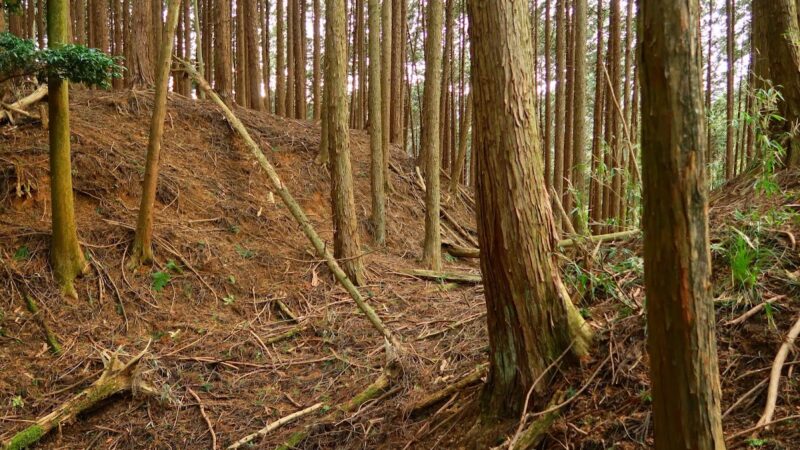
Ridge-shaped vertical moats dug into the slope are important defensive structures designed to prevent enemy intrusion. Multiple vertical moats are dug in parallel, preserving the unique defensive structure of mountain castles.
Well
The remains of a well can be found on the way to the mountaintop. Securing a water source during a siege was vital for a castle, and the presence of a well was extremely important for a mountain castle. The well remains can still be seen today, providing a tangible glimpse into the castle’s function at the time.
Highlights of Kainagiyama Castle
Views of the Tsuge Basin
The greatest highlight of Kainagiyama Castle is the view of the Tsuge Basin (Tsukeno Basin) from the remains of the main keep and the second keep. The view of the Yamato Plateau from the 597m-high mountaintop is breathtaking, allowing you to enjoy the beauty of each season: the fresh green of spring, the deep green of summer, the autumn foliage, and the snowy landscape of winter.
The villages and rural landscapes of Tsuge spread out below, allowing you to imagine what it was like when the castle lord ruled this area during the Sengoku period. On clear days, you can see the distant mountains, making it a popular spot for photography.
Well-Preserved Remains
Because the site has been preserved in its natural, undeveloped state, the remains such as stone walls, wells, and vertical moats remain in a form close to their original state. The stone walls, in particular, are in remarkably good condition for a mountain castle, making them a must-see for castle enthusiasts.
The clearly visible ridged trenches allow us to learn about the defensive system of a mountain castle from the Sengoku period. These remains offer a raw sense of history that cannot be experienced at well-maintained castle ruins.
Hachidai Ryuo Shrine and Place of Worship
The stone marker of the Hachidai Ryuo Shrine, located north of the second bailey, indicates that the castle ruins also functioned as a place of worship. While examples of mountain worship and castles being intertwined can be seen in various places, it appears that Kainagiyama Castle also coexisted as a military base and a place of worship.
Tada Clan Memorial Tower
The Tada clan memorial tower remaining at the second bailey is a valuable historical site that conveys the history of the castle lord’s family. It allows us to reflect on the footsteps of the Tada clan, descendants of a prestigious family descended from the Seiwa Genji, who ruled the Tsuge region.
Access Information
Location
630-2175 Nara Prefecture, Nara City, Tsuge Shiraishi-cho
Access by Car
Nearest Landmark
The trailhead is located approximately 300m south of the Shiraishi intersection. However, there are no signs or markers, so it is recommended to check a map or GPS beforehand.
Parking
You can use the parking lot for the Yamaryobo Kofun Cluster. From there, proceed along the village road and enter the hiking trail.
Access by Public Transportation
Public transportation access is limited, and visiting by car is recommended. Since it is a distance from the nearest station, consider using a taxi.
Hiking Time
The time required from the trailhead to the main castle ruins is approximately 45 minutes at an average pace. Since you will be climbing a mountain path, it is important to wear comfortable shoes and clothing.
Points to Note When Visiting
Maintenance Status
Kainagiyama Castle Ruins are an unmaintained mountain castle site, so please note the following:
- No Signposts or Trail Markers: There are no signposts or trail markers at the trailhead or within the castle ruins, so you need to check maps and route information in advance.
- Natural Hiking Trail: As it is not a maintained hiking trail, there are slippery areas and steep slopes.
- Difficulty Varies by Season: Particular caution is needed after rain or during snowy winters.
Clothing and Equipment
- Hiking Boots or Trekking Shoes: Shoes with non-slip soles are essential.
- Long Sleeves and Long Pants: Clothing that avoids skin exposure is recommended to protect your skin from bushes and branches.
- Hat and Gloves: Take sun protection and cold weather precautions depending on the season.
- Drinking Water: The climb to the summit takes approximately 45 minutes, so prepare water for hydration. – Maps & GPS: We recommend using your smartphone’s GPS function or a hiking app.
Best Season for Visiting
Spring to autumn is the best season to visit. Autumn, in particular, offers beautiful autumn foliage and excellent views. In winter, there is a possibility of snow, increasing the difficulty of the climb, so sufficient equipment and experience are necessary.
Nearby Tourist Attractions
Highlights of the Tsuge Area
The Tsuge area, where Kainagiyama Castle is located, is a naturally rich region of the Yamato Plateau. The following are some of the nearby tourist attractions:
Imperial Mausoleum Cluster
The Imperial Mausoleum Cluster itself, which is used as a parking lot, is a group of burial mounds of historical value.
Rural Landscape of Tsuge
The rural landscape spreading across the Tsuge Basin displays beauty in every season. You can enjoy a peaceful rural scene.
Nukui-dake
Nukui-dake, located near Kainagiyama, is also a popular hiking spot. You can also enjoy a traverse route that takes you through multiple mountains.
Other Castle Ruins in Nara City
Nara Prefecture has many other mountain castle ruins scattered throughout, allowing you to enjoy castle touring. Visiting them in conjunction with Kainagiyama Castle will give you a deeper understanding of the Sengoku period history of Yamato Province.
Evaluation and Visiting Time of Kainagiyama Castle
Evaluation from Castle Enthusiasts
On castle information websites such as Kojodan, it has an average rating of ★★★☆☆ (3.33). Because it is a natural, undeveloped mountain castle ruin, the difficulty of visiting is somewhat high, but it is highly rated for the excellent state of preservation of the remains and the magnificent views.
Recommended Visiting Time
The recommended visiting time, including hiking time, is approximately 45 minutes to 1 hour. However, if you plan to take photographs or observe the remains in detail, you will need more time. It is recommended to visit with a flexible schedule.
Number of Attackers
According to data from the Castle Attack Group, the number of attackers is only around 35, making it a hidden gem known only to a select few. Because it is not well-maintained, the number of visitors is limited, but this makes it a secluded spot where you can quietly experience history.
Historical Significance of Kainagiyama Castle
The Role of Mountain Castles in Yamato Province
Kainagiyama Castle is an important historical site that illustrates the reality of regional control in Yamato Province during the Sengoku period. In Yamato Province, where the control of central daimyo was difficult to extend, local lords established their own spheres of influence, and Kainagiyama Castle is a typical example.
The Tada clan’s control of the Tsuge region demonstrates how a prestigious family descended from the Seiwa Genji maintained power in the provinces, making it a valuable example for understanding Japanese medieval history.
Oda Nobunaga’s Rule of Yamato Province
The castle’s demolition in 1580, following the castle demolition order, is positioned as part of Oda Nobunaga’s rule over Yamato Province. In the process of consolidating Yamato Province under his direct control, Nobunaga ordered the destruction of castles belonging to local lords throughout the region, establishing a centralized system of rule. The abandonment of Kainagiyama Castle symbolizes this historical turning point.
Value in Mountain Castle Research
Kainagiyama Castle, preserved in its undeveloped, natural state, is a valuable sample for studying the structure of mountain castles during the Sengoku period. The remains, such as stone walls, ridged trenches, and wells, are well-preserved, allowing us to learn about the castle construction techniques and defensive systems of the time.
Photography Tips
Scenic Views
The views of the Tsuge Basin from the main keep and second bailey are must-photos when visiting Kainagiyama Castle. The view from near the stone marker of the Hachidai Ryuo Shrine is particularly spectacular, offering great opportunities for social media-worthy photos.
Photography Tips
- The oblique light in the early morning or evening is beautiful.
- The autumn foliage season offers rich colors.
- On sunny days, distant mountains can be captured in the photos.
Photos of Ruins
Ruins such as stone walls and vertical moats are popular subjects for castle enthusiasts. Enjoy capturing the texture of the stones and the depth of the moats by utilizing natural light.
Kainagiyama Castle Ruins Monument
The Kainagiyama Castle Ruins Monument, standing on the site of the main keep, is a classic photo spot for commemorating your visit. Including the village of Tsuge in the background creates a photo that effectively conveys the atmosphere of the castle ruins.
Summary
Kainagiyama Castle is a mountain castle ruin from the Sengoku period located in Tsuge, Nara City, Nara Prefecture. It was built by Tada Nobuzane during the Tenbun era and was abandoned in 1580 by Oda Nobunaga’s order to demolish castles. Located on a mountaintop at an altitude of 597m, this castle site offers panoramic views of the Tsuge Basin and retains well-preserved remains such as stone walls, wells, and ridged trenches.
As it is an undeveloped, natural mountain castle site, preparation and caution are necessary for a visit. However, this is precisely why it is a valuable spot where you can fully experience the atmosphere of a Sengoku period mountain castle. For castle enthusiasts, history buffs, and mountain climbing lovers, it is an attractive place where you can enjoy the nature and history of the Yamato Plateau simultaneously.
When visiting, please prepare comfortable shoes and clothing, a map or GPS, and drinking water, and enjoy the historical romance and spectacular views of Kainagiyama Castle while taking safety precautions.