Maruoka Castle (Konan City, Shiga Prefecture) Complete Guide | The Castle Ruins and Highlights of the Aoki Clan, One of the Fifty-Three Families of Koga
What is Maruoka Castle?
Maruoka Castle is a medieval mountain castle located in Kōjibukuro, Konan City, Shiga Prefecture. Known as the residence of the Aoki clan, one of the Fifty-Three Families of Koga, it is an important historical site that conveys the history of the Sengoku period in Ōmi Province.
It’s important to note that this is the Maruoka Castle in Konan City, Shiga Prefecture, unlike the Maruoka Castle in Fukui Prefecture, which is one of Japan’s 100 Famous Castles. It is sometimes called Kōjibukuro Castle locally and is a typical medieval hill castle built on a hill approximately 150 meters above sea level.
Even today, the remains of earthworks and dry moats are well-preserved, making them valuable resources for learning about the castle structure of the Sengoku period. Furthermore, it is believed that together with Higashi-Maruoka Castle, which is adjacent to the east, they formed an integrated defensive system.
History of Maruoka Castle
The Fifty-Three Families of Koga and the Aoki Clan
The Aoki clan, the lords of Maruoka Castle, were powerful local lords, counted among the Fifty-Three Families of Koga. The Fifty-Three Families of Koga are a collective term for local samurai groups that held power primarily in Koga County, Omi Province, and are known for their unique council-based self-governing organization.
The Aoki clan was based in Kanjibukuro and wielded influence in the surrounding area. The local lords of Koga were known for their superior military strategy and ninjutsu, and during the Sengoku period, they sometimes served various daimyo (feudal lords).
Relationship with the Rokkaku Clan
Initially, the Aoki clan was subordinate to the Rokkaku clan, the shugo daimyo (provincial governor) of Omi Province. The Rokkaku clan was a powerful daimyo controlling southern Omi, and they boasted their power from Kannonji Castle. Many of the Fifty-Three Families of Koga were under the Rokkaku clan’s control, and the Aoki clan was one of them.
Relationship with the Rokkaku Clan
The Aoki clan was initially subordinate to the Rokkaku clan, the shugo daimyo of Omi Province. Under the control of the Rokkaku clan, Maruoka Castle functioned as a regional base and the center of the Aoki clan’s territorial management. It is believed that Maruoka Castle played a crucial role as part of the Rokkaku clan’s defense network during this period.
Oda Nobunaga’s Invasion of Omi and Subjugation
In 1568 (Eiroku 11), when Oda Nobunaga began his march to Kyoto with Ashikaga Yoshiaki, the situation in Omi Province changed dramatically. Nobunaga captured Kannonji Castle, the Rokkaku clan’s stronghold, and expelled them from Omi.
In response to this change in circumstances, the Aoki clan chose to submit to Oda Nobunaga. Many of the 53 Koga clans also followed Nobunaga, and thereafter their territories were secured under the Oda regime. This decision allowed the Aoki clan to temporarily maintain their territory and status.
Territory Confiscation and Castle Abandonment by Hashiba Hideyoshi
Following the death of Oda Nobunaga in the Honnoji Incident of 1582 (Tensho 10), Hashiba Hideyoshi (later Toyotomi Hideyoshi) rose to prominence amidst the succession struggle. Hideyoshi brought Omi Province under his direct control and proceeded with the reorganization of the old local lords.
In 1585 (Tensho 13), Hashiba Hideyoshi confiscated the territory of the Aoki clan. This measure was part of Hideyoshi’s centralization policy, and many small local lords met a similar fate. It is believed that Maruoka Castle, along with the Aoki clan who lost their territory, was abandoned around this time.
After its abandonment, Maruoka Castle lost its military function and was subsequently used for farmland and forests. However, the castle ruins remained intact and continue to convey its original appearance to this day.
Castle Structure and Remains
Layout and Basic Structure
Maruoka Castle is a hill castle built on a hill approximately 150 meters above sea level, with a relative height difference of about 20 meters. The castle grounds extend approximately 100 meters east-west and 80 meters north-south, making it a medium-sized castle for a medieval mountain castle.
The castle’s basic structure is a linear layout with multiple enclosures arranged around a central main enclosure. The main enclosure is roughly square in shape and surrounded by earthen ramparts. It is believed that this main enclosure functioned as the lord’s residence and command post.
Characteristics of the Earthen Ramparts
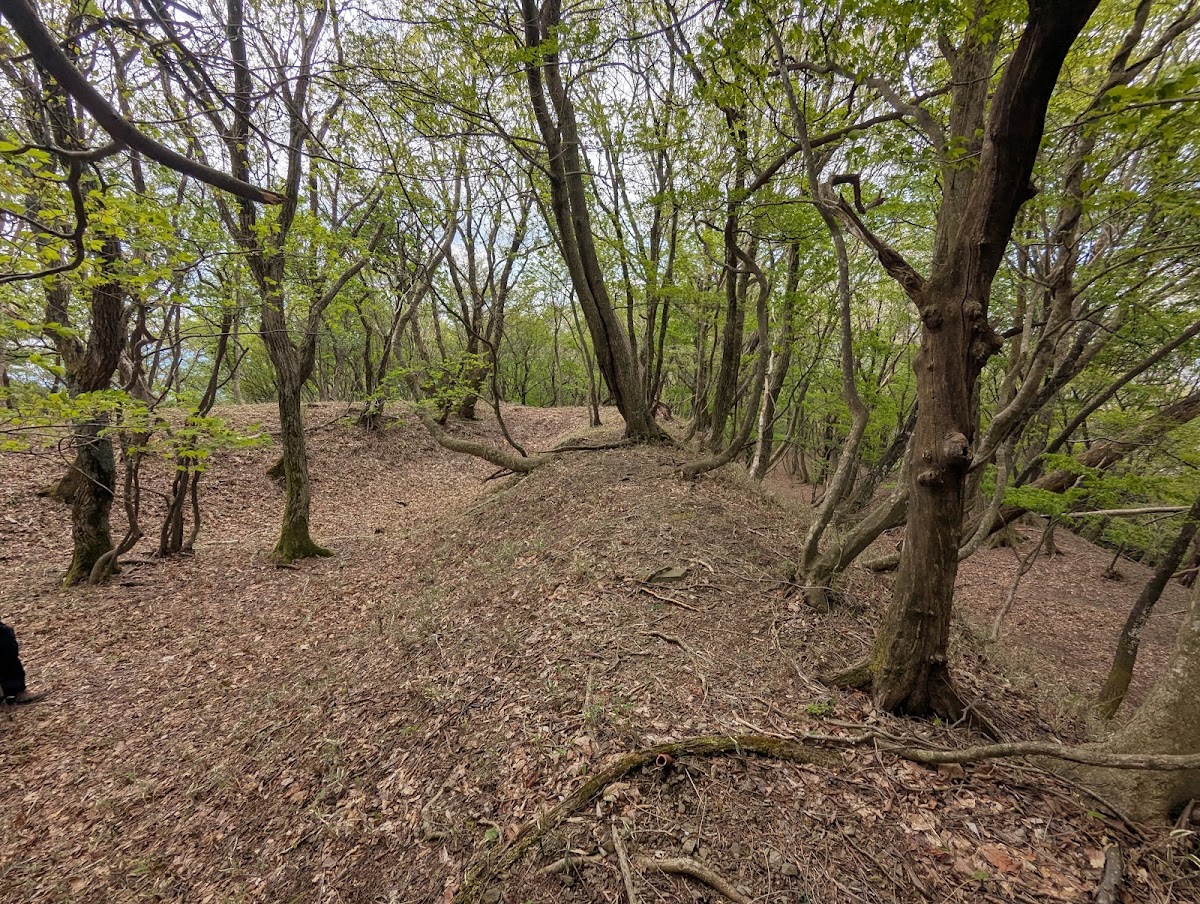
The most prominent remains of Maruoka Castle are the earthen ramparts. The ramparts surrounding the main enclosure still remain today, approximately 2-3 meters high, clearly demonstrating the defensive structure of the time.
The earthen ramparts were carefully constructed using the rammed earth method and have withstood hundreds of years of wind and rain to survive to this day. The earthworks on the north and west sides are particularly well-preserved, providing important clues for understanding the castle’s structure.
The tops of the earthworks are flat, suggesting that fences or walls were installed there. Furthermore, a dry moat was positioned outside the earthworks, forming a double line of defense.
Dry Moats and Horizontal Moats
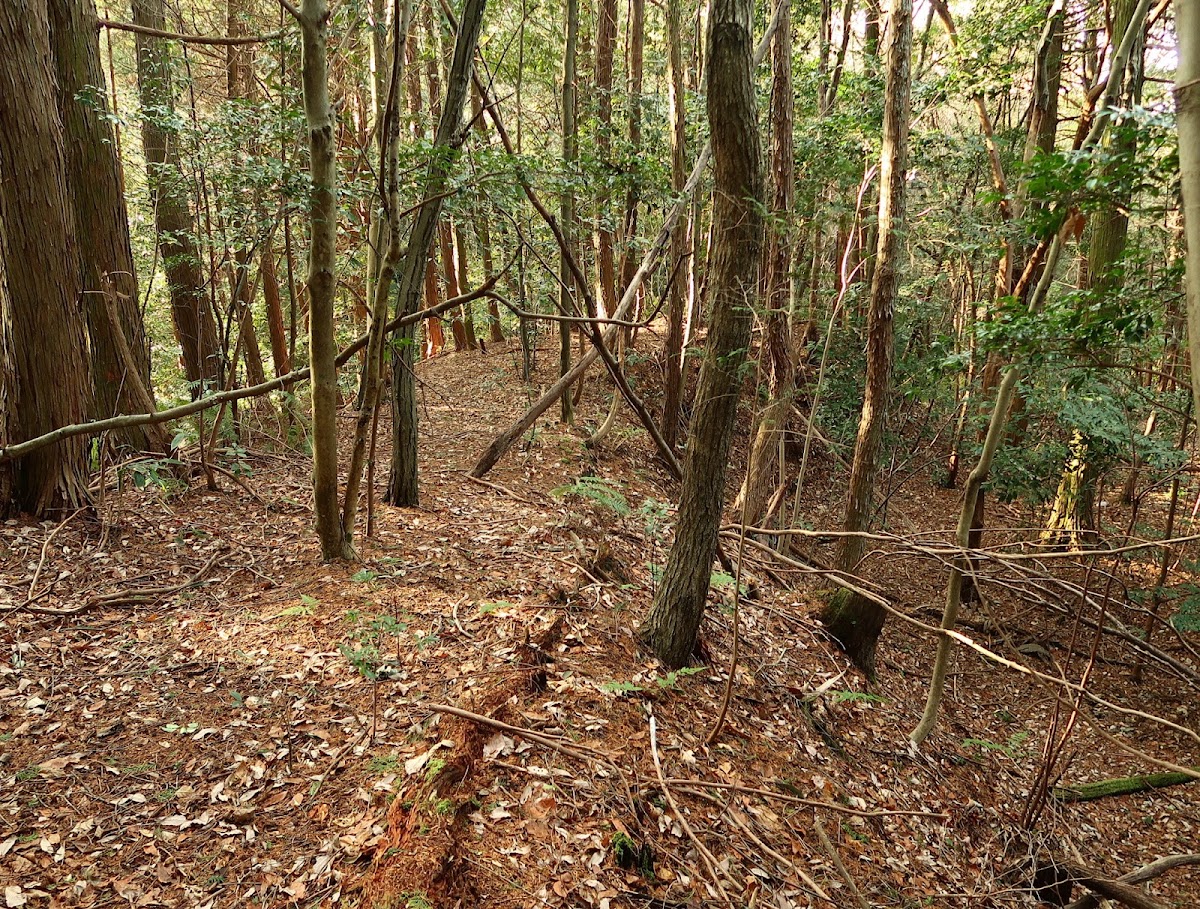
Multiple dry moats can be identified at Maruoka Castle. Of particular note are the triple horizontal moats remaining on the south side of the castle. These horizontal moats were dug along the contour lines and functioned as effective defensive structures to prevent enemy intrusion.
The horizontal moats are still about 2-3 meters deep today, and are thought to have been even deeper in the past. Earthworks were built between the horizontal moats, forming a multi-layered defensive structure.
Earthen bridges can be seen in some parts of the dry moats. These bridges were constructed as passages to cross the moats, strengthening defenses by limiting the entrances and exits to the castle.
Arrangement of Enclosures
Multiple enclosures are arranged around the main enclosure. These enclosures were arranged in a stepped pattern, each functioning as an independent defensive unit.
Each enclosure was demarcated by earthen ramparts and steep slopes, giving it a clear boundary. The enclosures varied in size; larger ones are presumed to have served as living spaces or warehouses, while smaller ones were likely used as watchtowers or armories.
Although a portion of the southern side has been reduced by a cemetery, the basic structure of the castle is still fully understandable.
Entrances and Passages
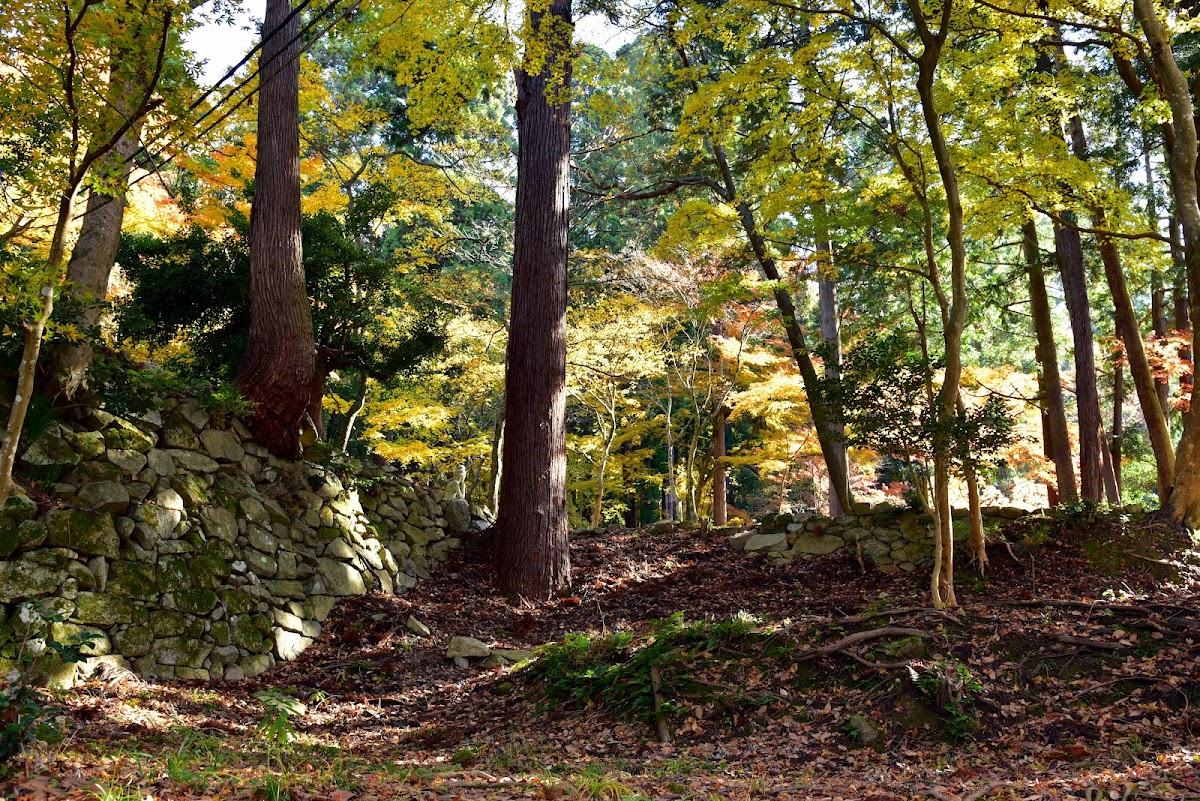
The entrances to the castle, known as “koguchi,” were crucial defensive points. Multiple koguchi have been identified at Maruoka Castle, each equipped with defensive structures such as earthen ramparts and stone walls.
A distinctive feature of these entrances is their curved, rather than straight, shape. This was a design intended to delay enemy advances and create a favorable situation for the defenders.
The passages within the castle were also strategically placed with defense in mind, featuring poor visibility and a structure that prevented large numbers of attackers from entering at once.
Relationship with Higashi-Maruoka Castle
Overview of Higashi-Maruoka Castle
Adjacent to the east side of Maruoka Castle lies an outpost called Higashi-Maruoka Castle. Like Maruoka Castle, Higashi-Maruoka Castle retains remnants such as earthworks and dry moats, indicating that the two castles formed an integrated defensive system.
Higashi-Maruoka Castle is slightly smaller than Maruoka Castle, but it functioned as an independent fortress. Its elevation and location are similar to Maruoka Castle, suggesting they were built around the same time.
Integrated Defensive System
Maruoka Castle and Higashi-Maruoka Castle are located only a few hundred meters apart, allowing them to be visible to each other. This arrangement indicates that the two castles were intended to cooperate in their defense.
If one castle was attacked, reinforcements could be sent from the other castle, or a flanking attack could be launched. Furthermore, sharing information between the two castles allowed for wide-area vigilance.
This type of defense system, consisting of multiple castles, was a common sight in Omi Province during the Sengoku period, demonstrating the Aoki clan’s skillful management of their territory.
Division of Roles
While Maruoka Castle served as the main castle and played a central role in politics and economics, Higashi-Maruoka Castle is thought to have played a stronger role as a military frontline base.
Higashi-Maruoka Castle functioned as the front line against threats from the east, monitoring enemy movements. Meanwhile, Maruoka Castle is presumed to have served as a base for rear support and command and control, overseeing the overall defense.
Access to the Site
Access by Public Transportation
The nearest station to Maruoka Castle by public transportation is Mikumo Station on the JR Kusatsu Line. The castle ruins are approximately a 30-40 minute walk from Mikumo Station.
It is also possible to use the Konan City Community Bus from Mikumo Station. Take a bus bound for Kōjibukuro and get off at the nearest bus stop. The castle ruins are approximately a 10-minute walk from there. However, community bus service is limited, so it is recommended to check the timetable in advance.
Access by Car
If traveling by car, it takes approximately 20-30 minutes from the Ritto or Ryūō Interchanges on the Meishin Expressway via National Route 1 and prefectural roads.
From the Kōnan Interchange on the Shin-Meishin Expressway, it takes approximately 15 minutes. When using a car navigation system, searching for “Kōjibukuro, Konan City, Shiga Prefecture” or “Kōjibukuro Cemetery” is recommended.
Parking Information
Access to the castle ruins is via the cemetery in the Kōjibukuro settlement. While there is parking available for visitors at the cemetery, please be considerate of local residents if parking for extended periods to visit the castle ruins.
Parking space is limited, so caution is advised if visiting in multiple vehicles. Please also use the parking facilities respectfully and avoid obstructing visitors to the cemetery. ### Important Notes for Visitors
Maruoka Castle Ruins are adjacent to a cemetery, so please maintain quiet and be considerate of those visiting the graves. The right side of the cemetery is the approach to Maruoka Castle, and the left side is the approach to Higashi-Maruoka Castle.
There are no well-maintained walking paths within the castle ruins, so we recommend wearing comfortable shoes and clothing. Particular caution is needed after rain, as the ground can become slippery.
Visiting Points and Recommended Route
Basic Visiting Route
Visiting Maruoka Castle generally begins from the cemetery’s parking lot. First, head towards the main enclosure of Maruoka Castle from the right side of the cemetery.
The first thing you’ll see is the triple moat remaining on the south side. This group of moats is the most important remains for understanding the defensive structure of Maruoka Castle, so observe it carefully. By checking the depth of the moats, the height of the earthworks, and the location of the earthen bridges, you can understand the defensive system of the time.
After crossing the moat and entering the main enclosure, you can see the surrounding earthworks. While it’s possible to walk on the top of the earthworks, please proceed cautiously to protect the remains. The interior of the main enclosure is relatively flat, suggesting that buildings once stood here.
After circling the main enclosure, explore the surrounding enclosures. Observing the layout, size, and condition of the cliffs of each enclosure will help you understand the overall structure of the castle.
Consecutive Visit to Higashi-Maruoka Castle
If you have ample time, we recommend visiting Higashi-Maruoka Castle as well. You can access Higashi-Maruoka Castle from the left side of the cemetery.
Earthworks and dry moats can also be seen at Higashi-Maruoka Castle, allowing you to compare similarities and differences with Maruoka Castle. Actually seeing the relative locations of the two castles will help you better understand the integrated defensive system.
If you plan to visit both castles, allow approximately 1 hour 30 minutes to 2 hours in total.
Photography Tips
When taking photographs at Maruoka Castle, we recommend documenting the earthworks and moats. The triple moat on the south side, in particular, can be better understood by taking multiple photos from different angles.
The earthworks of the main enclosure are also good photo opportunities. Recording the height, thickness, and structure of the earthworks will be helpful when comparing them to other castles later.
Photos showing the positional relationship with Higashi-Maruoka Castle are also valuable. Taking photos from a location that shows the arrangement and distance between the two castles will help in understanding the defensive system.
Seasonal Highlights
Maruoka Castle shows different faces depending on the season. Spring is beautiful with fresh greenery, and the outlines of the earthworks and moats are clearly visible, making it ideal for observing the castle’s structure.
Summer is a season when vegetation grows thick, making it difficult to see the remains, but it is a good time to imagine the natural environment of the time. However, insect repellent is essential.
Autumn is a beautiful season with colorful foliage, making it ideal for photography. Also, as the vegetation begins to wither, the details of the remains become easier to observe.
Winter is the season when the view opens up due to the falling leaves, making it the best time to grasp the overall structure of the castle. However, due to the dangerous footing during snowfall, it is best to avoid visiting during this time.
Nearby Historical Tourist Spots
Konan Sanzan
The Konan Sanzan (Three Mountains of Konan) are a representative tourist resource of Konan City. The three ancient temples of Joraku-ji, Choju-ji, and Zensui-ji are all Tendai sect temples and possess main halls designated as National Treasures.
In particular, Joraku-ji and Choju-ji form a pair known as “East Temple and West Temple,” preserving valuable architectural styles from the Heian to Kamakura periods. Visiting them in conjunction with a visit to Maruoka Castle allows you to experience the depth of Konan City’s history.
Around the Yasugawa River
The Yasugawa River, which flows through the central part of Konan City, fosters a rich natural environment. A promenade is maintained along the Yasugawa River, allowing visitors to enjoy walks and cycling.
The Yasugawa River basin has been a place of human habitation since ancient times, and many archaeological sites have been discovered there. Even during the time of Maruoka Castle, this river played an important role as a transportation route.
Koga Ninja-Related Facilities
The Aoki clan, who were lords of Maruoka Castle, were members of the Koga Fifty-Three Families and had deep ties to the Koga ninja. Museums and historical sites related to the Koga ninja are scattered throughout the surrounding area.
Visiting places like the Koga-ryu Ninja Residence and the Koga Ninja Village in Koga City will allow you to gain a deeper understanding of the historical background of the Aoki clan and the Koga Fifty-Three Families.
Historical Background of Konan City
Characteristics of the Koga Region
Konan City is part of the former Koga County and belongs to the historical and cultural sphere of the Koga region. The Koga region has a mountainous topography, and a highly independent community has been formed there since ancient times.
The local lords, represented by the Koga Fifty-Three Families, practiced autonomy through a council system and maintained a certain degree of independence from the central government. This regional characteristic is the background for the construction of numerous small and medium-sized castles like Maruoka Castle.
Positioning within Omi Province
Omi Province, meaning “Chikatsu Afumi” (近つ淡海), refers to the region centered around Lake Biwa, a lake close to the capital. While Konan City does not directly border Lake Biwa, it is located in the southern part of Omi Province and was a strategically important transportation hub.
The Tokaido and Nakasendo roads passed nearby, making it a strategically important point at the intersection of transportation routes connecting Kyoto and eastern Japan. Therefore, during the Sengoku period (Warring States period), it became a target of conflict among various powers, and Maruoka Castle was at the center of this struggle.
Modern Konan City
Modern Konan City aims to balance tourism promotion utilizing its historical resources with industrial development centered on industrial parks. With interchanges on the Meishin Expressway and Shin-Meishin Expressway, its role as a transportation hub connecting the Kinki and Chubu regions remains unchanged.
As a city with a population of approximately 50,000, it is promoting sustainable urban development while cherishing its natural environment and historical culture.
Preservation of Maruoka Castle and Future Challenges
Current State of Preservation
The remains of Maruoka Castle are preserved in relatively good condition. This is due to the lack of large-scale development after the castle’s abandonment and the preservation efforts of local residents.
Major remains such as earthworks and dry moats are clearly identifiable and are highly valued as historical materials for castle research. However, some parts have been reduced due to the expansion of the cemetery, and the castle does not remain in its complete form.
Preservation Activities and Local Initiatives
The local community is working on the preservation and utilization of historical heritage, including Maruoka Castle. Surveys are conducted by the Konan City Board of Education, and guided tours are held by local history enthusiasts.
The Mikumo school district is engaged in activities to introduce local castle sites and continues to disseminate information through websites and other means. These grassroots activities contribute to the preservation of the ruins and increased awareness.
Future Challenges and Prospects
Future challenges for Maruoka Castle include further investigation and preservation measures for the remains, and improving information provision for visitors. There are few detailed explanatory signs at the site, making it difficult for first-time visitors to understand.
Furthermore, the integrated preservation and utilization of Maruoka Castle and Higashi-Maruoka Castle is an important issue. Clearly demonstrating the relationship between the two castles would make it a valuable educational tool for a deeper understanding of the defensive systems of the Sengoku period.
In the future, it is expected that appropriate maintenance and the improvement of information facilities will enhance its value as a place for historical learning.
Summary
Maruoka Castle, located in Kanjibukuro, Konan City, Shiga Prefecture, is a valuable historical site that conveys the history of Omi Province during the Sengoku period, as the residence of the Aoki clan, one of the 53 families of Koga. Its history, from subservience to the Rokkaku clan to vassalship of Oda Nobunaga, and finally to the confiscation of its territory and abandonment by Hashiba Hideyoshi, symbolically illustrates the fate of local lords during the Sengoku period.
Even today, remains such as earthworks and dry moats remain in good condition, and the triple moat on the south side, in particular, is a valuable resource for understanding the defensive structure of medieval castles. Visiting Maruoka Castle in conjunction with the adjacent Higashi-Maruoka Castle allows you to grasp the overall picture of the integrated defensive system.
Accessible from the Kojibukuro Cemetery, Maruoka Castle is a historical site worth visiting for history buffs and castle enthusiasts. Visiting it along with other nearby tourist spots such as the Konan Sanzan (Three Mountains of Konan) will allow you to experience the rich history and culture of Konan City.
Unlike the Maruoka Castle in Fukui Prefecture, one of Japan’s Top 100 Castles, this is the lesser-known Maruoka Castle in Konan City, Shiga Prefecture. Within its tranquil ambiance lies the history of the Aoki clan and the 53 families of Koga who survived the Sengoku period.