Marune Castle (Toyota City, Aichi Prefecture) Complete Guide | History, Remains, Access, and Highlights Explained in Detail
What is Marune Castle? – A Medieval Castle that Functioned as a Strategic Base in Mikawa
Marune Castle is a medieval mountain castle located in Takahashi-cho, Toyota City, Aichi Prefecture. It was built on a plateau on the east bank of the Yahagi River, a strategic point known as “Unokubi” (Cormorant’s Neck), where the river narrows most after passing through Toyota city.
Its location, utilizing the tip of a plateau approximately 50 meters above sea level and 30 meters above ground, held strategic importance for monitoring and controlling the Yahagi River crossing point. Currently, it is maintained as Marune Castle Ruins Park, and remains such as dry moats and earthworks are well preserved.
Basic Information on Marune Castle
- Location: Takahashi-cho, Toyota City, Aichi Prefecture
- Other Names: None in particular
- Castle Structure: Hilltop Castle
- Construction Period: Unknown (Estimated to be late Muromachi period)
- Builder: Unknown
- Main Lords: Marune Mimasa-no-kami Munekatsu, Takahashi Yorishige (Legend)
- Remains: Dry moat, earthworks, baileys
- Designated Cultural Property: None
- Elevation: Approximately 50m
- Relative Height: Approximately 30m
History of Marune Castle – The Stage of Battles Between the Matsudaira and Oda Clans
Construction Period and Purpose
There are no reliable records regarding the construction period of Marune Castle, so the details are unknown. However, based on its location and layout, it is believed to have been built in the late Muromachi period.
Nearby lies Matsudaira-go, the birthplace of the Matsudaira clan. Based on the castle’s structural features, the prevailing theory is that it was built by the Matsudaira family in preparation for battle against the Oda clan. Its location, controlling the crossing point of the Yahagi River at “U-no-kubi,” was a strategically important transportation and military hub within Mikawa Province, suggesting it was a crucial base in the struggle for control of western Mikawa.
Marune Castle in the Sengoku Period
The “Tōshō Gunkan” (a historical chronicle) contains an entry for “Marune Castle” in 1561, indicating that it was definitely functioning as a castle at that time.
The name of Marune Mimasaka-no-kami Munekatsu is recorded as the castle lord. There is also a tradition that Takahashi Yorisada was the castle lord. The Takahashi family was known as a vassal family of the Matsudaira clan, making this important information suggesting a connection to the Matsudaira.
Conquest by Tokugawa Ieyasu
It is said that Tokugawa Ieyasu (then Matsudaira Motoyasu), who aimed to unify Mikawa Province, captured Marune Castle during the Eiroku era (1558-1570). It is believed that Ieyasu, in the process of successively pacifying the various powerful clans within Mikawa Province, also captured Marune Castle, a strategic stronghold in the Yahagi River basin.
Records indicate that the castle fell to Ieyasu during the time when Marune Munekatsu was the lord, and it is presumed that this battle brought Marune Castle under the control of the Matsudaira (Tokugawa) clan.
History After Abandonment
There are no clear records of when Marune Castle was abandoned, but it is believed to have lost its function as a castle sometime between the late Sengoku period and the early Edo period. This is because the Edo period brought peace, and the military value of the mountain castle declined.
In modern times, thanks to local preservation efforts, the site has been developed into Marune Castle Ruins Park, a historical heritage site that preserves the valuable remains of a medieval castle for future generations. ## Marune Castle’s Layout and Structure – Features of the Semicircular Enclosure and Crescent Moat
Overall Layout and Structure
Marune Castle’s layout cleverly utilizes the tip of a plateau on the east bank of the Yahagi River. The south and west sides of the plateau face steep cliffs along the Yahagi River, forming a natural stronghold.
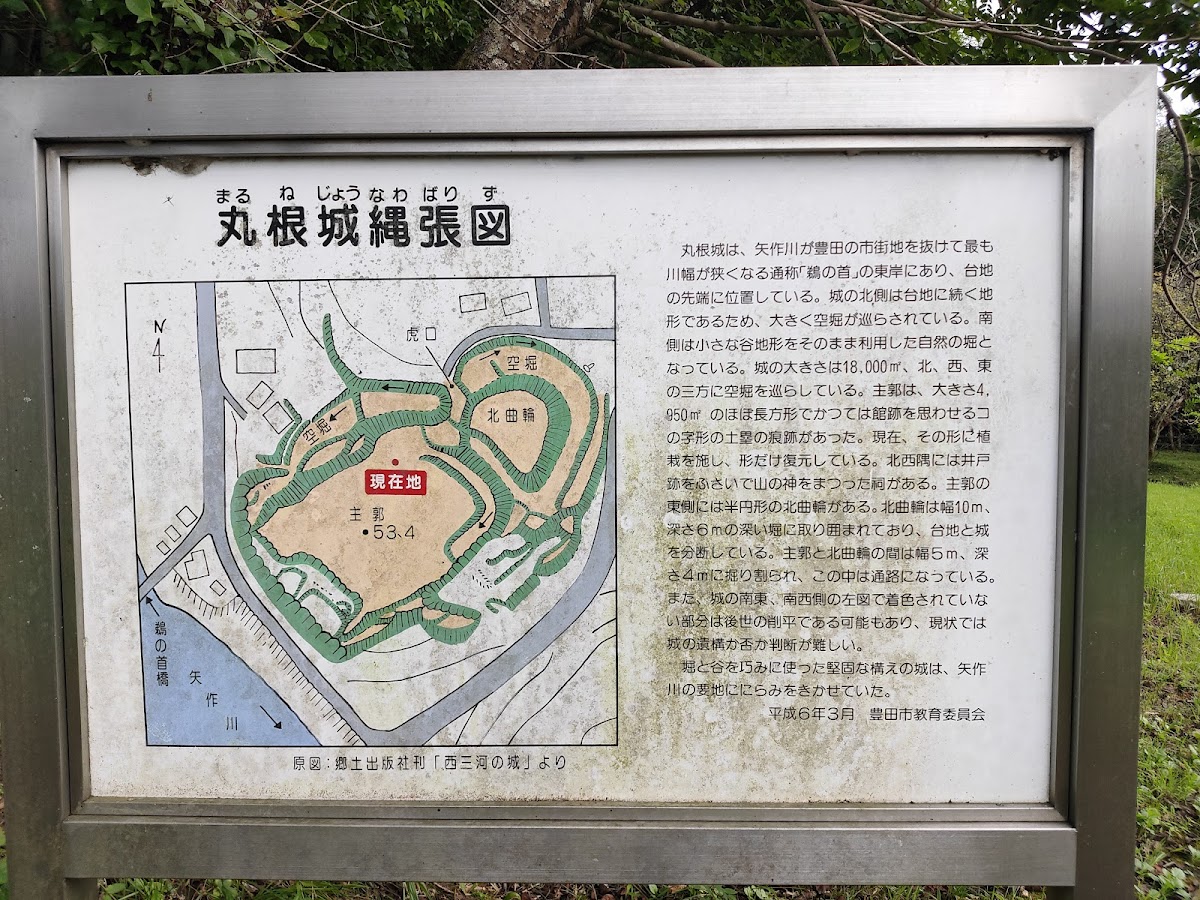
The main part of the castle is located at the tip of the plateau, with a dry moat and earthen ramparts as defensive structures on the north side (the direction the plateau continues). This arrangement is a typical mountain castle structure designed to prepare for attacks from the north, where the plateau continues.
Northern Enclosure and Distinctive Dry Moat
The greatest highlight of Marune Castle is the semicircular enclosure located on the north side and the dry moat built in front of it.
The northern enclosure has a semicircular shape, and a crescent-shaped dry moat is built in front of it. This dry moat is approximately 3-4 meters deep and 5-6 meters wide, and is still clearly visible today. The curved shape of the dry moat is reminiscent of a umadashi (a defensive outwork), a feature that has attracted attention among castle researchers. A umadashi is a defensive structure built in front of a castle gate, serving as a base for friendly attacks while preventing enemy intrusion.
Earthworks Arrangement
Earthworks were constructed inside the dry moat (towards the center of the castle), and approximately 2-meter-high earthworks remain in good condition today. Standing on the earthworks, one can appreciate the excellent visibility provided when intercepting enemies attacking across the dry moat.
The earthworks are positioned to surround the northern enclosure, and it is believed that they enhanced defensive capabilities while also serving to partition the space within the enclosure.
Enclosure Arrangement and Composition
The enclosure configuration of Marune Castle is relatively simple, centered around the main enclosure (equivalent to the main keep) and the northern enclosure. The main enclosure is located at the highest point of the plateau, with the northern enclosure extending to its north.
The main enclosure measures approximately 40 meters east-west and 30 meters north-south, a standard size for a small medieval mountain castle. It is presumed that the lord’s residence and other important facilities were located here.
Relationship with the Yahagi River
The castle’s west and south sides face the Yahagi River, and the difference in elevation to the river serves as a natural defensive line. In particular, its position overlooking a point where the river narrows, known as “U-no-kubi,” indicates that monitoring and controlling the river crossing was a crucial function of the castle.
The Yahagi River was a major river in Mikawa Province and a vital point for water transport and transportation. Marune Castle’s location, utilizing the river’s flow, allowed for effective defense even with a small force.
Highlights of Marune Castle – Remains and Attractions You Can See on Site
Highlight 1: The Curved Dry Moat
A must-see when visiting Marune Castle is the dry moat in front of the northern enclosure. The unique, arc-shaped form is a distinctive structure rarely seen in other castles and is highly regarded among castle enthusiasts.
The dry moat still clearly retains its depth and width, allowing visitors to experience the defensive structure of the time. Looking up from the bottom of the moat, you can appreciate the high defensive strength created by the height of the earthworks and the depth of the dry moat.
Highlight 2: Semicircular North Enclosure
The semicircular shape of the North Enclosure is another major feature of Marune Castle. This enclosure may have functioned as a barbican, and is thought to have served not only as a defensive point but also as a base for sorties.
The interior of the North Enclosure is relatively flat and is currently a grassy area. Walking around the enclosure allows you to appreciate its shape and the ingenuity of its layout.
Highlight 3: Well-Preserved Earthworks
The earthworks of Marune Castle are still well-preserved, even several hundred years after its construction. The height and shape of the earthworks are clearly preserved, making them valuable remains for learning about the defensive structures of medieval castles.
There are also places where you can walk on top of the earthworks, allowing you to experience the perspective of the defending soldiers of the time.
Highlight 4: View of the Yahagi River
From the castle ruins, you can enjoy views of the Yahagi River and the scenery on the opposite bank. The view from the point overlooking the river narrows, known as “U-no-kubi,” is particularly important for understanding the strategic importance of this castle.
Although the landscape has changed due to river improvements, you can still appreciate the castle’s strategic location in relation to the Yahagi River.
Highlight 5: Well-maintained Walking Paths
As the site has been developed as Marune Castle Ruins Park, walking paths have been established, allowing for safe viewing of the remains. Information boards are also installed, creating an environment where even first-time visitors can understand the history and structure of the castle while exploring.
The balance between park development and the preservation of the remains is well-maintained, making it a place where you can enjoy both historical learning and nature walks. ## Access Information to Marune Castle
Access by Train and Bus
Using the Meitetsu Mikawa Line:
- Get off at “Toyota-shi Station” on the Meitetsu Mikawa Line
- Approximately 25 minutes on foot from the station (approx. 2 km)
- Or approximately 5 minutes by taxi
Using the Toyota Oiden Bus:
- Take a bus bound for “Takahashi/Takemura” from Toyota-shi Station
- Get off at the “Takahashi” bus stop and walk for approximately 5 minutes
While access by public transportation is possible, the number of buses is limited, so it is recommended to check the timetable in advance.
Access by Car
From Tomei Expressway:
- Approximately 15 minutes (approx. 8km) from the Tomei Expressway “Toyota IC”
- Via National Route 153 to Prefectural Route 342
From Isewangan Expressway:
- Approximately 20 minutes (approx. 10km) from the Isewangan Expressway “Toyota Minami IC”
Car Navigation Settings:
- Address: Takahashi-cho, Toyota City, Aichi Prefecture
- Target Facility: Marune Castle Ruins Park
Parking Information
Marune Castle Ruins Park has a dedicated parking lot.
- Number of Parking Spaces: Approximately 5 (Free)
- Operating Hours: No specific restrictions
- Fee: Free
The parking lot is small and may be full on holidays or during castle-touring events. In that case, please consider using nearby street parking spaces (in a location that does not cause inconvenience) or using public transportation.
Map and Location
Marune Castle is located northeast of the center of Toyota City, along the Yahagi River. The surrounding area is dotted with historical sites associated with the Matsudaira clan, such as Matsudaira Village and Matsudaira Castle, making it an easily accessible location for castle-touring routes.
Visitor Guide – Points to Note and Recommended Time to Visit
Admission Fee and Opening Hours
- Admission Fee: Free
- Opening Hours: Always open (maintained as a park)
- Closed Days: None
Marune Castle Ruins Park is always open and can be visited freely at any time. However, nighttime visits are recommended due to poor visibility and potential danger.
Estimated Visit Time
- Standard Visit Time: Approximately 30-40 minutes
- For a More In-Depth Visit: Approximately 60 minutes
- Including Photography: Approximately 60-90 minutes
The castle ruins are relatively compact, so the main remains can be seen in about 30 minutes. If you plan to take photographs or conduct detailed observations, it’s advisable to allow about an hour.
Recommended Time to Visit
Spring (March-May):
- Beautiful fresh greenery, ideal season for strolling
- Mild temperatures, comfortable for extended visits
Autumn (October-November):
- Some time to see autumn foliage, beautiful scenery
- Fewer insects, ideal for exploring the castle ruins
Summer (June-August):
- Dense greenery, making the ruins easier to see
- However, heat and insect repellent are necessary
Winter (December-February):
- Fallen leaves make the shape of the ruins easier to see
- Cold weather precautions are necessary, but it’s a suitable season for visiting
Clothing and Items to Bring
Recommended Clothing:
- Comfortable walking shoes (sneakers or trekking shoes)
- Comfortable clothing
- Hat and sunscreen in summer
- Warm clothing in winter
Useful Items to Bring:
- Camera (for documenting the ruins)
- Drinks (especially in summer)
- Insect repellent spray (spring to autumn)
- Maps and guidebooks
Points to note when visiting
- Watch your step: There are unstable footing areas around the dry moats and earthworks.
- No trespassing on private property: Please be mindful of visiting within the areas designated as a park.
- Protection of historical remains: Please be careful not to damage the earthworks or dry moats.
- Take your trash home: There are no trash cans within the castle grounds, so please be sure to take your trash with you.
- Check the weather: The ground can become slippery in rainy weather, so please refrain from visiting or take extra caution.
Nearby castles and historical spots
Matsudaira Castle (approx. 6km)
This castle is located in the birthplace of the Matsudaira clan and is an essential historical site for learning about the history of the Matsudaira clan. It is about a 15-minute drive from Marune Castle, and visiting both is recommended.
Matsudaira Village (approx. 7km)
This is the ancestral home of the Matsudaira clan, and is home to numerous historical sites associated with the Matsudaira, such as Matsudaira Toshogu Shrine and Takatsuki-in Temple. The historical landscape is well-preserved, offering a glimpse into the medieval atmosphere.
Koromo Castle (approx. 5km)
A modern castle located in the center of Toyota City, with a reconstructed corner turret. While from a different era than Marune Castle, it is an important castle for understanding the history of castles in Mikawa Province.
Ogyu Castle (approx. 12km)
The residence of the Ogyu Matsudaira clan, a branch of the Matsudaira clan, this castle retains the remains of a full-fledged mountain castle. It is especially recommended for castle enthusiasts.
Ushino Castle (approx. 8km)
A medieval castle located within Toyota City, it may have functioned at the same time as Marune Castle. The remains are well-preserved.
Castle Tour Model Course
Half-Day Course (Morning):
- Marune Castle (40 min)
- Koromo Castle (30 min)
- Lunch in central Toyota City
Full-Day Course:
- Matsudaira Village (60 min)
- Matsudaira Castle (40 min)
- Lunch
- Marune Castle (40 min)
- Ogyu Castle (60 min)
This course allows you to efficiently visit castles associated with the Mikawa Matsudaira clan.
Differences between Marune Castle and Marune Fort of the Battle of Okehazama
Two Easily Confused “Marune Castles”
When many history buffs hear the name “Marune Castle,” they think of “Marune Fort” (Midori Ward, Nagoya City), built by Oda Nobunaga to besiege Otaka Castle, which was held by the Imagawa clan, during the Battle of Okehazama. However, the Marune Castle in Toyota City is a completely different castle.
There are three castles in Aichi Prefecture with the name “Marune”:
- Marune Castle in Toyota City (introduced in this article)
- Marune Fort in Midori Ward, Nagoya City (related to the Battle of Okehazama)
- Marune Castle in Obu City (less well-known)
Differences from Marune Fort (Midori Ward, Nagoya City)
Construction Period:
- Marune Castle in Toyota City: Late Muromachi period (estimated)
- Marune Fort in Nagoya City: Built in 1560 by Oda Nobunaga
Purpose of Construction:
- Marune Castle in Toyota City: A permanent fortress controlling a crossing point of the Yahagi River
- Marune Fort in Nagoya City: A temporary fort for the siege of Otaka Castle
Historical Role:
- Marune Castle in Toyota City: A base for regional control related to the Matsudaira clan
- Marune Fort in Nagoya City: Fallen to Imagawa Yoshimoto’s forces during the Battle of Okehazama
Current Status:
- Marune Castle, Toyota City: Remains are well-preserved and the site has been developed into a park.
- Marune Fort, Nagoya City: Residential development has progressed, and only a few remains remain.
Origin of the Name
The place name “Marune” exists in multiple locations within Aichi Prefecture. Because castles and forts were built in each of these areas, multiple castles share the same name. There are various theories regarding the origin of the name, but it is generally believed to derive from topographical features.
Research and Evaluation of Marune Castle
Position in Castle Research
Due to the lack of reliable historical records regarding the construction date and lord of Marune Castle, its historical evaluation is limited. However, its unique layout and the good state of preservation of its remains have attracted attention in the field of castle research.
In particular, the structure of the arc-shaped dry moat and the semi-circular northern enclosure may have served a function similar to a barbican, and it is being studied as an example of the development of defensive techniques in medieval castles in the Mikawa region.
Evaluation on Kojodan
The castle information website “Kojodan” has received evaluations from over 200 castle owners (visitors). Many visitors have given the following evaluations:
- The remains are well-preserved.
- The shape of the dry moat is distinctive and impressive.
- Access is relatively easy.
- It is well-maintained as a park and easy to visit.
On the other hand, some argue that it lacks historical narrative due to the limited information available about the castle’s construction date and lords.
Local Preservation Activities
Toyota City has designated Marune Castle Ruins as a valuable historical heritage site and is working to preserve and maintain it as a park. Local history enthusiasts regularly conduct guided tours and explanatory activities, utilizing the site for local history education.
Further excavations and research may clarify the historical significance of Marune Castle.
The Relationship Between Marune Castle and the Matsudaira Clan
Proximity to the Origin of the Matsudaira Clan
Located approximately 7 km northeast of Marune Castle is Matsudaira-go, the birthplace of the Matsudaira clan. This geographical proximity suggests that Marune Castle may have had some connection to the Matsudaira clan.
The Matsudaira clan was a family that settled in Matsudaira-go, Kamo-gun, Mikawa Province during the mid-Muromachi period, and expanded its power throughout western Mikawa during the Sengoku period. The Yahagi River basin, where Marune Castle is located, was an important area for the Matsudaira clan’s expansion of power.
Connection to the Matsudaira Clan Based on the Castle Layout
The layout of Marune Castle has been noted for its similarities to other castles built by the Matsudaira clan. In particular, the combination of semi-circular baileys and arc-shaped dry moats is considered to share common defensive techniques with castles associated with the Matsudaira clan.
Throughout the Sengoku period, the Matsudaira clan, surrounded by powerful forces such as the Oda and Imagawa clans, built numerous castles with efficient defensive structures to survive. Marune Castle is highly likely to have been one of them.
Tokugawa Ieyasu’s Unification of Mikawa and Marune Castle
Tokugawa Ieyasu, who changed his surname from Matsudaira to Tokugawa, proceeded with the unification of Mikawa Province during the Eiroku era. In the process, he captured various castles along the Yahagi River basin, and Marune Castle was one of them.
Ieyasu’s capture of Marune Castle was a crucial step in the unification of Mikawa, and strategically, securing a crossing point on the Yahagi River strengthened his control over western Mikawa.
The Charm of Marune Castle – Why You Should Visit
Well-Preserved Medieval Castle Remains
The greatest charm of Marune Castle is the excellent state of preservation of its medieval castle remains. While many medieval castles have been lost due to development, Marune Castle remains a valuable historical site, with its dry moats, earthworks, and bailey layouts clearly preserved, making it easy to imagine the castle’s appearance at the time.
Learning Value of the Distinctive Layout
The distinctive layout, featuring a curved dry moat and a semicircular northern bailey, is a valuable example for learning about castle construction techniques and tactics. For castle enthusiasts and history buffs, observing the remains firsthand allows them to experience medieval defensive techniques.
Ease of Access
As it is maintained as a park, it provides a safe environment for even beginners to visit. Parking is available, making it easily accessible by car. Unlike full-fledged mountain castles, it doesn’t require climbing equipment, making it an attractive and easily accessible destination.
Combining with Nearby Historical Sites
There are many historical spots in the surrounding area, such as Matsudaira Village, Matsudaira Castle, and Koromo Castle, allowing for a full-day route exploring the history of Mikawa. While Marune Castle is enjoyable on its own, combining a visit with other nearby historical sites will allow for a deeper understanding of Mikawa’s Sengoku period history.
Historical Walk in a Quiet Environment
Marune Castle is not a well-known tourist destination, offering a peaceful environment for historical exploration. It’s an ideal spot for those who want to avoid crowds and observe the ruins at their own pace.
Castle Stamp and Related Goods Information
Availability of Castle Stamps
As of 2024, Marune Castle does not officially issue castle stamps. However, other castles in Toyota City (such as Koromo Castle) do issue them, so there is a possibility that Marune Castle will issue them in the future.
For the latest information on castle stamp availability, please contact the Toyota City Tourism Association or the Toyota City Local History Museum.
Related Books and Guidebooks
While there are few specialized books on Marune Castle, you can find information in the following books:
“Castles of Aichi Prefecture” (Kyodo Publishing)
- A comprehensive guide to castles in Aichi Prefecture, including information on Marune Castle.
“Illustrated Guide to Japanese Castles: Aichi Castles”
- Explains castles in Aichi Prefecture with photographs and diagrams.
“Walking the Famous Castles of Tokai: Aichi Edition” (Yoshikawa Kobunkan)
- Introduces castles in Aichi Prefecture from an academic perspective, and also mentions Marune Castle.
Toyota City Local History Museum
The Toyota City Local History Museum has materials and exhibits related to castles in the city, and you can also find information on Marune Castle there. Visiting before your visit will allow you to understand Marune Castle more deeply before going to the actual site.
Toyota City Local History Museum:
- Address: 1-21-2 Jincho-cho, Toyota City, Aichi Prefecture
- Opening Hours: 9:00 AM – 5:00 PM
- Closed: Mondays (or the following day if Monday is a public holiday), New Year holidays
- Admission Fee: Free
Summary – A Recommendation to Visit Marune Castle
Marune Castle is a fascinating medieval castle with well-preserved remains and a distinctive layout, although many aspects of its construction date and lord remain unknown. Its strategic location at “U-no-kubi” on the Yahagi River, and its unique structure of a curved dry moat and semi-circular northern enclosure, make it worth seeing even for those who aren’t castle enthusiasts.
As it’s maintained as a park, it’s safe for beginners to visit, and the fact that it’s free is a major attraction. When visiting Toyota City, be sure to visit Marune Castle along with other nearby historical sites such as Matsudaira-go and Matsudaira Castle.
In this tranquil setting, slowly observing the remains of a medieval castle and reflecting on Mikawa during the Sengoku period will be an invaluable experience for history buffs.
Marune Castle, though not flashy, is a precious historical site that clearly conveys the traces of history. It is a castle site that I wholeheartedly recommend to anyone interested in the Sengoku history of Mikawa, those interested in castle architecture, and those who simply want to enjoy a peaceful historical stroll.