Kuroki Nishijo Castle (Uda City, Nara Prefecture) Complete Guide | History, Remains, and Access Information
Kuroki Nishijo Castle, located in Uda City, Nara Prefecture, is a mountain castle that conveys the tension of the Sengoku period (Warring States period). Built on a mountaintop approximately 450 meters above sea level, this castle is known as a fortified camp built by Matsunaga Hisahide for the attack on Akiyama Castle, and valuable remains, including more than 20 rows of vertical trenches, remain in excellent condition. This article comprehensively covers essential information for castle enthusiasts, from the historical background of Kuroki Nishijo Castle to its highlights, a visitor’s guide, and information on surrounding castle ruins.
History and Construction Background of Kuroki Nishijo Castle
Uda Region in the Sengoku Period
Uda City is a historically significant region mentioned in the “Kojiki” and “Nihon Shoki” (ancient Japanese chronicles), and during the Sengoku period, it held an important position as a strategic point in Yamato Province. The Akiyama clan, who ruled Uda County, were local lords that had been based at Akiyama Castle (also known as Ryuo-zan Castle) since the Muromachi period. However, in the mid-16th century, their conflict with Matsunaga Hisahide, who was expanding his power in the Kinai region, intensified.
Theory of Construction by Matsunaga Hisahide
There are several theories regarding the construction of Kuroki-Nishi Castle, but the most widely accepted is that it was a fortified camp built by Matsunaga Hisahide. During the Eiroku era (1558-1570), Hisahide aimed to unify Yamato Province and planned to capture Akiyama Castle, the Akiyama clan’s base. It is believed that, in order to surround and monitor Akiyama Castle, he positioned several subsidiary castles and fortified camps around it, including Kuroki-Nishi Castle, Kuroki-Kita Castle, Kuroki-Higashi Castle, and even Hongō Castle and Hongō-Higashi Castle.
Kuroki-Nishi Castle is presumed to have functioned as a central base among these castles and played a crucial role in Hisahide’s military operations. Judging from the castle’s structure and layout, it exhibits characteristics of a fortified camp built efficiently in a short period, making it a valuable example for understanding Sengoku period castle construction techniques.
Other Construction Theories
On the other hand, there is a legend that it was the residence of a local powerful family named Kuroki Togoro. There is also a theory that it was built by the Akiyama clan as a temporary base when they were driven out of their main castle, Akiyama Castle. However, considering the castle’s size, layout, and its relationship to the surrounding group of castles, the theory that it was a fortified camp built by Matsunaga Hisahide is considered the most convincing.
Kuroki Nishi Castle After the Capture of Akiyama Castle
There are no clear records of how Kuroki Nishi Castle was used after Matsunaga Hisahide’s capture of Akiyama Castle. After Hisahide’s power declined, it is believed to have been abandoned and disappeared from the historical stage. However, its remains are well-preserved and continue to provide important materials for modern castle research.
Structure and Layout of Kuroki-Nishi Castle
Overall Layout
Kuroki-Nishi Castle is a mountain castle with a main enclosure located on a mountaintop at an altitude of approximately 450 meters, and multiple enclosures arranged along the ridge. Located in the mountainous area of Uda City, Nara Prefecture, its defensive layout skillfully utilizes the surrounding terrain. Defensive structures are provided on the ridges extending east, west, north, and south from the main enclosure, with a particularly prominent structure designed to anticipate attacks from the direction of Akiyama Castle.
Main Enclosure and Enclosure Groups
The main enclosure measures approximately 30 meters east-west and 20 meters north-south, and is surrounded by earthen ramparts. These ramparts are about 1-2 meters high and are relatively well-preserved. The second and third enclosures are arranged around the main enclosure, with a stepped structure descending downwards. Each enclosure is clearly demarcated by steep slopes, enhancing its defensive capabilities.
Characteristics of the Ridge-Shaped Vertical Moats
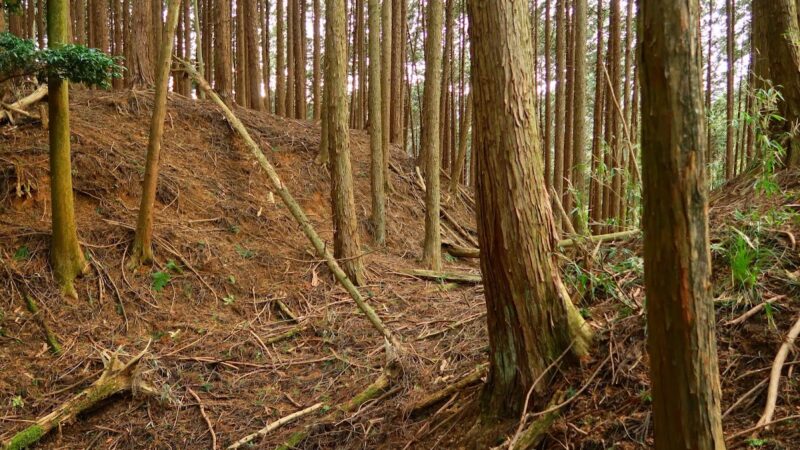
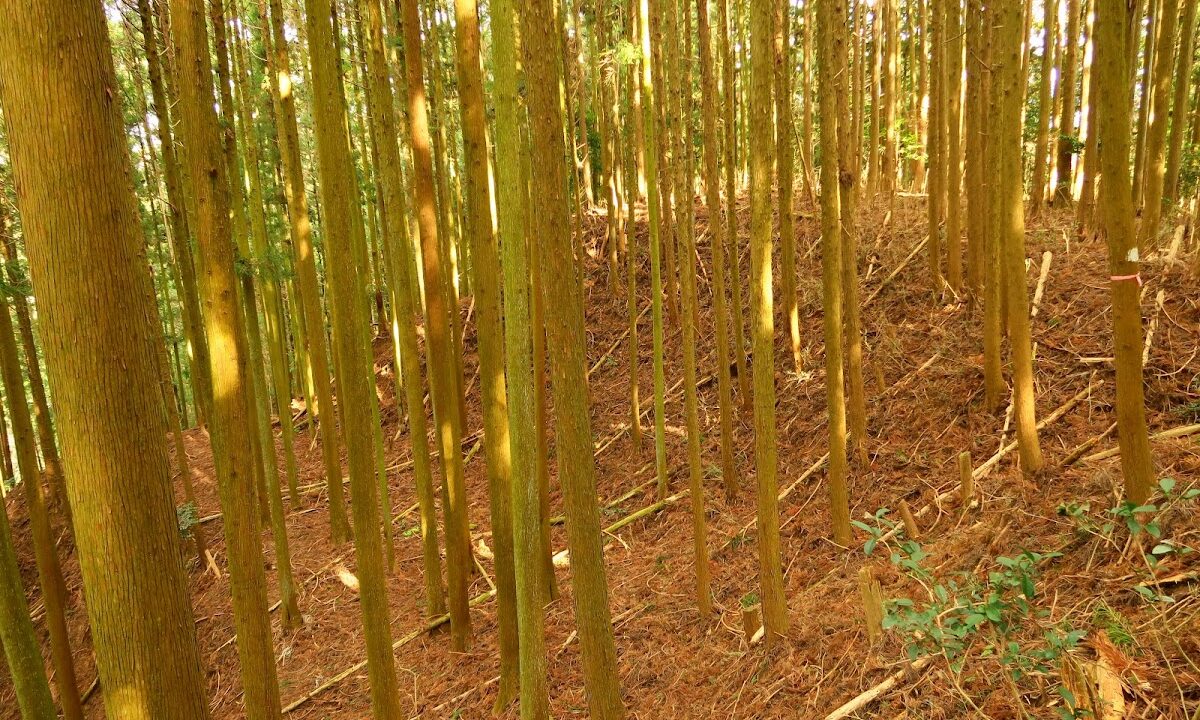
The greatest highlight of Kuroki-Nishi Castle is the group of ridge-shaped vertical moats, of which more than 20 can be identified. These are multiple vertical moats dug parallel to the slope, effectively hindering enemy lateral movement and dispersing attacks. The ridge-shaped vertical moats of Kuroki-Nishi Castle are mainly located on the northern slope of the main enclosure, with a dense arrangement of vertical moats measuring 1-2 meters wide and 20-30 meters long.
Such a large number of ridge-shaped vertical moats remain in castle ruins, which is rare even within Nara Prefecture, making them extremely important remains for understanding castle construction techniques of the Sengoku period. Ridge-shaped vertical moats were a defensive technique that developed in the latter half of the 16th century, and this can be seen as evidence that Matsunaga Hisahide introduced the latest technology of the time.
Large Moat and Vertical Moats
The large moat separating the main enclosure from the outside is also an important remains of Kuroki-Nishi Castle. This moat, approximately 10 meters wide and 5 meters deep, completely cuts off the ridgeline, forming a strong defensive line to prevent enemy intrusion. Furthermore, vertical moats branching off from this large moat descend the slope, providing a structure to defend against attacks from the flanks.
Vertical moats are also positioned on the east and west sides of the main enclosure, extending down the slope almost to the foot of the mountain. These vertical moats are approximately 2-3 meters deep and can still be clearly seen today.
Earthworks
Earthworks are positioned around the main enclosure and each of the baileys. The earthwork on the north side of the main enclosure, in particular, is relatively high at approximately 2 meters, and is thought to have served to defend against arrows and gunfire from the direction of Akiyama Castle. Traces of stonework can also be seen in parts of the earthworks, suggesting an intention for even stronger defense.
Highlights of Kuroki Nishi Castle (Castle Notes)
Observation of the Ridge-Shaped Vertical Moats
When visiting Kuroki Nishi Castle, the first thing to pay attention to is the ridge-shaped vertical moats. Descending the slope on the north side of the main enclosure, you can observe up close the arrangement of more than 20 parallel vertical moats. The winter season, when the leaves have fallen, is recommended as these remains are more clearly visible. By actually examining the spacing, depth, and length of the ridge-shaped vertical moats, you can truly appreciate the high level of castle-building technology during the Sengoku period.
The Impressive Large Moat
The large moat in front of the main enclosure is another highlight of Kuroki Nishi Castle. The deeply and sharply excavated moat still speaks to its high defensive function even after several hundred years. Looking up from the bottom of the moat, you will be overwhelmed by the height and steepness of the cliffs on both sides. This large moat is a point where you can truly feel that it was the last line of defense against enemy incursions. ### Earthworks of the Main Enclosure
Upon reaching the main enclosure, examine the surrounding earthworks. The northern earthworks, in particular, are remarkably well-preserved, maintaining almost their original height. Standing atop the earthworks, you can overlook the direction of Akiyama Castle, demonstrating how well-suited Kuroki Nishi Castle was for monitoring and attacking Akiyama Castle.
Excellent View and Location
From the main enclosure, you can enjoy a panoramic view of the mountainous area of Uda City. If the weather is clear, you may even be able to identify the location of Akiyama Castle and other nearby castle ruins such as Kuroki Kita Castle and Kuroki Higashi Castle. This view is one of the reasons Kuroki Nishi Castle was chosen as a fortified camp, offering a valuable opportunity to experience the military perspective of the Sengoku period.
Preservation of the Remains
Kuroki Nishi Castle remains untouched by development and stands quietly amidst nature. Therefore, the remains are exceptionally well-preserved, retaining much of their original appearance. All the remains, including earthworks, moats, vertical moats, and rows of vertical moats, are clearly visible, making it a highly desirable spot for castle enthusiasts.
Visitor Guide (Access and Precautions)
Location and Basic Information
Location: Ouda area, Uda City, Nara Prefecture (formerly Ouda Town)
Castle Type: Mountain castle (fortified camp)
Construction Period: Estimated to be during the Eiroku era (1558-1570)
Builder: Matsunaga Hisahide (estimated)
Elevation: Approximately 450 meters
Remains: Earthworks, moats, vertical moats, rows of vertical moats, baileys
Access by Public Transportation
When using public transportation, the nearest station is Kintetsu Osaka Line’s “Haibara Station”. There is no direct public transportation from Haibara Station to Kuroki Nishijo Castle, so we recommend taking a taxi or renting a car. The distance from Haibara Station to the castle ruins is approximately 10 kilometers, a 20-30 minute drive.
Uda City is located in the eastern part of Nara Prefecture, and while public transportation access is somewhat inconvenient, this allows you to enjoy exploring the castle ruins amidst abundant nature and a peaceful environment.
Access by Car
Access by car is the most convenient. From the Meihan Expressway “Hari IC,” head south on National Route 369, passing through Uda city center towards Ouda. You will arrive near the castle ruins in about 30 minutes from Hari IC.
However, you cannot drive directly to the base of the castle ruins. You will need to find a roadside parking space (such as along a farm road) in the village at the foot of the hill and park there, then walk to the castle. When parking, please be careful not to inconvenience local residents and choose a location that does not interfere with farm work.
Ascent Route and Estimated Time
The ascent route to Kuroki Nishi Castle lacks clear signposts, requiring you to follow faint trails. The walk from the base to the main enclosure takes approximately 20-30 minutes. The route is mostly steep and particularly slippery after rain, so appropriate hiking boots and clothing are essential.
During the ascent, you will cross vertical moats and rows of vertical moats; please be careful not to damage these remains. Also, due to dense undergrowth and poor visibility in summer, visits from winter to early spring are recommended.
Precautions for Visiting
- Equipment: Be sure to bring hiking boots, long-sleeved shirt and pants, gloves, a hat, and drinking water.
- Season: Winter to early spring (November to March) is ideal for observing the remains. Summer is characterized by dense undergrowth and the risk of venomous snakes such as pit vipers.
- Avoid Solo Travel: Visit in groups whenever possible to prepare for any accidents.
- Mobile Phone: Cell phone reception may be unavailable in mountainous areas, so inform family members or others of your destination beforehand.
- Protection of Historical Remains: Act carefully to avoid damaging earthworks or moats.
- Private Property: The area surrounding the castle ruins may include private property. Follow any signs indicating “No Entry.”
Nearby Tourist Information
Besides Kuroki Nishijo Castle, Uda City has many other tourist attractions. When visiting, we recommend also visiting the following places:
- Uda Matsuyama District: An old townscape designated as an Important Preservation District for Groups of Traditional Buildings
- Muro-ji Temple: An ancient temple known as the “Women’s Koya”
- Ono-ji Temple: A temple famous for its rock-carved Buddha statues
- Kagirohi Hill: A Manyo-era site known for the poems of Kakinomoto no Hitomaro
The Haibara area is convenient as a base for sightseeing in Uda City. The city hall is located in Haibara Shimoitari, and tourist information, restaurants, and accommodations are concentrated around Haibara.
Nearby Castles and Related Fortresses
Akiyama Castle (Ryuo-zan Castle)
Located approximately 2 kilometers northeast of Kuroki Nishi Castle, this was the main castle of the Akiyama clan. Built on Ryuo-zan Mountain at an altitude of approximately 490 meters, it was a large mountain castle targeted by Kuroki Nishi Castle. The main enclosure, second enclosure, and third enclosure are connected, and remnants such as moats and earthworks remain in good condition. When visiting Kuroki Nishijo Castle, we highly recommend also visiting Akiyama Castle. Visiting both castles allows you to experience the perspectives of both the attacking and defending sides, leading to a deeper understanding of the battles of the Sengoku period.
Kuroki Kitajo Castle
This is a subsidiary castle located north of Kuroki Nishijo Castle. Like Kuroki Nishijo Castle, it is believed to be a fortified camp built by Matsunaga Hisahide for the purpose of attacking Akiyama Castle. Although slightly smaller in scale than Kuroki Nishijo Castle, remnants such as earthworks and moats can be seen. It is approximately 500 meters from Kuroki Nishijo Castle, and it is possible to travel along the ridge.
Kuroki Higashijo Castle
This is a subsidiary castle located east of Kuroki Nishijo Castle. This is also presumed to be a fortified camp built by Matsunaga Hisahide, and it played a part in the network of castles surrounding Akiyama Castle. Although small in scale, remnants such as vertical moats and baileys remain.
Hongō Castle / Hongō Higashijo Castle
This is a group of castles located south of Kuroki Nishijo Castle. These are also thought to be part of the network of fortified encampments used to attack Akiyama Castle. Hongō Castle is relatively large in scale and has a structure with multiple baileys and moats.
Castles of the Uda Region
In addition to the above, there are many other castle ruins in Uda City. Mountain castles built from the medieval period to the Sengoku period, such as Sawa Castle, Takai Castle, and Hirai Castle, are scattered throughout the area, making it an attractive exploration area for castle enthusiasts. Visiting these castle ruins will allow for a deeper understanding of the medieval history of the Uda region.
Research and Evaluation of Kuroki Nishi Castle
Position in Castle Research
Kuroki Nishi Castle is considered important material for understanding Matsunaga Hisahide’s castle-building techniques. In particular, the more than 20 ridged vertical moats are valuable remains that demonstrate the development of defensive technology in the late 16th century and are highly valued by castle researchers. Hisahide is known for building innovative castles such as Tamon-yama Castle and Shigi-san Castle, but these remains confirm that he also introduced the latest technology in encampment encampments like Kuroki Nishi Castle.
Evaluation by Castle Enthusiasts Nationwide
On castle enthusiast community sites such as “Kojodan,” Kuroki Nishijo Castle has received high praise for its “excellent state of preservation of remains” and “magnificent rows of vertical moats.” While the difficulty of visiting is somewhat high, its appeal lies in the opportunity to enjoy Sengoku period remains in an untouched natural setting.
Among castle fans, it is recommended to visit the castle group in the Uda region, including Kuroki Nishijo Castle, as a single “Kuroki Castle Group,” and a “castle-hopping route” visiting multiple castle sites over a single day has been proposed.
Challenges of Preservation and Utilization
Currently, Kuroki Nishijo Castle has no special protective measures in place and is left in a natural state. While the remains are well-preserved, there is a possibility of damage from fallen trees or landslides in the future. There are also concerns about the risk of the remains being trampled due to an increase in visitors.
It is desirable that Uda City and Nara Prefecture designate the site as a cultural property and formulate an appropriate preservation and management plan. At the same time, creating an environment where visitors can safely enjoy the castle ruins, such as installing information boards and improving the access routes, is also a crucial issue.
Kuroki Nishi Castle and Matsunaga Hisahide
The Figure of Matsunaga Hisahide
Matsunaga Hisahide (1508?-1577) is known as one of the most notorious warlords of the Sengoku period. He rose to prominence serving Miyoshi Nagayoshi and brought Yamato Province under his control. While he built innovative castles such as Tamon-yama Castle and Shigi-san Castle, and was deeply knowledgeable in tea ceremony and culture, he is also known for numerous atrocities, including assassinating his lord and the burning of the Todai-ji Great Buddha Hall.
In the end, he rebelled against Oda Nobunaga and committed suicide at Shigi-san Castle. The anecdote of him smashing the famous “Hiragumo tea kettle” before his death is well-known.
Hisahide’s Rule of Yamato Province and Castle Policy
Hisahide, in his rule of Yamato Province, emphasized strategic castle placement. Centered around his main castle, Tamon-yama Castle, he established a network of branch castles throughout the region, creating a fortress network to suppress rebellious forces. It is believed that during the siege of Akiyama Castle, he employed a tactic of surrounding the castle by deploying multiple encampments, including Kuroki-Nishi Castle.
Hisahide’s castle policy is said to have influenced the castle placement of later figures such as Oda Nobunaga and Toyotomi Hideyoshi, making it an important subject of study for understanding military strategy during the Sengoku period.
Hisahide’s Castle Construction Techniques as Seen at Kuroki-Nishi Castle
The ridged vertical moats at Kuroki-Nishi Castle demonstrate Hisahide’s active adoption of the latest castle construction techniques of the time. Ridged vertical moats were a defensive technique that developed mainly in western Japan in the late 16th century, and the remains of Kuroki-Nishi Castle are valuable as an early example.
Furthermore, the skillful use of the terrain in the castle’s layout and the efficient arrangement of the baileys reflect Hisahide’s practical approach to castle construction. The fact that he constructed such a sophisticated defensive structure, despite it being a temporary military facility, speaks volumes about Hisahide’s deep understanding of castle architecture and his unwavering determination to conquer Akiyama Castle.
Summary
Kuroki Nishi Castle is a Sengoku period mountain castle quietly nestled in the mountainous region of Uda City, Nara Prefecture. Built by Matsunaga Hisahide for the purpose of conquering Akiyama Castle, it boasts valuable remains, including over 20 rows of vertical trenches, in excellent condition. While somewhat difficult to access, it’s a must-see spot for castle enthusiasts, offering a chance to experience Sengoku period castle construction techniques amidst untouched nature.
When visiting Uda City, exploring not only Kuroki Nishi Castle but also the surrounding castles such as Akiyama Castle, Kuroki Kita Castle, and Kuroki Higashi Castle will provide a deeper understanding of Sengoku period battles. Furthermore, you can experience the rich historical and cultural heritage of Uda Matsuyama’s old townscape and Murō-ji Temple.
Why not embark on a journey to explore Kuroki Nishi Castle in Uda City, Nara Prefecture—a mountain castle that evokes the atmosphere of the Sengoku period? A powerful presence of the ridged trenches and a valuable experience of feeling the spirit of the ruthless warlord Matsunaga Hisahide await you.