Kuroki Kita Castle (Uda City, Nara Prefecture) Complete Guide | History, Remains, and Access Information
What is Kuroki Kita Castle?
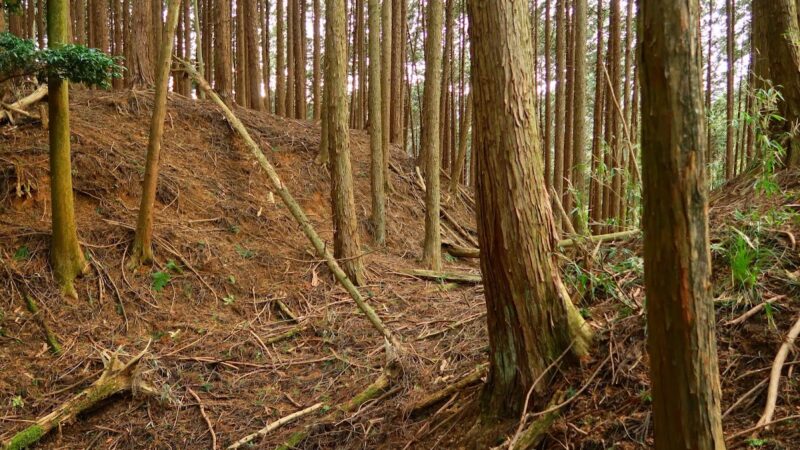
Kuroki Kita Castle is a medieval mountain castle located in Kuroki, Ouda, Uda City, Nara Prefecture. Built on a hill approximately 420 meters above sea level, this castle played an important role as a surrounding fortress of Uda Matsuyama Castle. Even today, the remains of earthworks, baileys, and moats are well-preserved, making it a valuable historical site that conveys the appearance of a mountain castle from the Sengoku period.
As its name suggests, Kuroki Kita Castle is located on the north side of the Kuroki area and functioned as one of several castle complexes, including Kuroki Nishi Castle and Kuroki Higashi Castle. Its location, with an elevation difference of approximately 40 meters, provided excellent conditions for both defense and surveillance, making it an indispensable site for understanding the military strategy of the Uda region during the Sengoku period.
Location and Basic Information
Location: Kuroki, Ouda, Uda City, Nara Prefecture
Former Province: Yamato Province
Classification/Structure: Hill Castle (Mountain Castle)
Elevation: Approximately 420 meters
Relative Height: Approximately 40 meters
Major Remains: Earthworks, baileys, moats, trenches, vertical moats
Construction Period: Sengoku period (details unknown)
Year of Abandonment: Unknown (estimated to be late Sengoku period)
Kuroki North Castle is located northeast of the Uda Matsuyama Castle ruins and can be accessed from near Matabei Cherry Tree. It is also possible to reach Kuroki West Castle by following the ridge, suggesting that these castles formed an integrated defensive system.
History and Background
Background of Construction
The construction period and builder of Kuroki North Castle are unknown due to a lack of clear historical records. However, given its relationship with the surrounding castle complex, it is believed to have been built amidst the complex political situation of the Uda region during the Sengoku period (Warring States period).
The Uda region is located in the eastern part of Yamato Province and was a crucial transportation hub to Ise and Iga. Controlling this area was extremely important for maintaining influence from the Nara Basin to the eastern provinces. Therefore, a network of castles centered around Uda Matsuyama Castle was formed, and it is presumed that Kuroki Kita Castle played a part in it.
The Akiyama Clan and Uda’s Rule
The Uda region was ruled by the Akiyama clan throughout the medieval period. The Akiyama clan used Akiyama Castle (the predecessor of Uda Matsuyama Castle) as their base and controlled the territory by placing several branch castles around it. It is highly probable that Kuroki Kita Castle was also built within the Akiyama clan’s system of rule.
Akiyama Castle, the Akiyama clan’s residence, is believed to have been located on the site of the Uda Matsuyama Castle ruins, and Kuroki Kita Castle is thought to have been an important base forming part of its defensive line. Judging from the castle’s layout, it is assumed to have played a role in monitoring and defending against invasions from the north. ### Matsunaga Hisahide’s Invasion of Uda
During the late Sengoku period, Matsunaga Hisahide expanded his power in Yamato Province. It is believed that Hisahide aimed to capture Akiyama Castle, and in the process, built several fortified camps, including Kuroki Nishi Castle.
Regarding Kuroki Kita Castle, there are several theories, including that it was a fortified camp built by Matsunaga Hisahide for the purpose of capturing Akiyama Castle, or that it was built by the Akiyama clan as a base when they were driven out of their main castle. In any case, it is undeniable that Matsunaga Hisahide’s invasion of the Uda region had a significant impact on the formation of the castle complex in the Kuroki area.
Changes under the Toyotomi Regime
Entering the Tensho era (1573-1592), Oda Nobunaga and later Toyotomi Hideyoshi progressed in unifying Japan. Yamato Province became a direct territory of the Toyotomi regime, and the Uda region underwent significant changes.
When Toyotomi Hidenaga ruled Yamato, Kii, and Izumi provinces, Uda Matsuyama Castle underwent extensive renovations as a modern castle. During this period, it is believed that the surrounding medieval mountain castles, including Kuroki Kita Castle, ceased to serve their military purpose and were abandoned.
Castle Structure and Remains
Characteristics of the Layout
Kuroki Kita Castle is a mountain castle that skillfully utilizes the hilly terrain. Multiple enclosures are arranged around the main enclosure, and defenses are strengthened by earthworks and moats. The castle maximizes its location with a relative elevation difference of approximately 40 meters, demonstrating ingenuity in making enemy intrusion difficult.
The castle’s layout unfolds along the ridgeline, characterized by a structure that integrates natural terrain with artificial defensive facilities. This arrangement is typical of medieval mountain castles and is a valuable example for understanding castle construction techniques of the Sengoku period.
Earthworks and Enclosures
The earthworks that remain today are the main defensive structures of Kuroki Kita Castle. The earthen ramparts surrounding the enclosure served to prevent enemy intrusion and protect the soldiers within. The height and placement of the ramparts suggest that this castle was built with actual combat in mind.
Multiple enclosures (kuruma) have been identified, each presumably having a different function. The main enclosure is located in the center of the castle and is thought to have housed the lord and major forces. The secondary and outer enclosures likely defended the main enclosure and were used for troop garrisons and storage of supplies.
Moats and Trenches
Defensive structures such as moats and trenches have also been identified at Kuroki Kita Castle. Trenches, which artificially cut across ridges to hinder enemy advances, were an extremely important defensive measure for mountain castles.
The scale and placement of the trenches indicate that this castle was not merely a lookout post, but a full-fledged military facility prepared for actual combat. The presence of vertical trenches has also been confirmed, suggesting a strategy to attack enemies climbing the slopes from the flanks.
Structure of the Koguchi (gateway entrance)
The koguchi, the entrance to a castle, is a crucial defensive point. The koguchi of Kuroki Kita Castle is designed to be winding rather than straight, making enemy intrusion difficult. Such ingenuity is a common feature found in castles of the Sengoku period (Warring States period).
Earthworks were positioned around the koguchi, allowing for attacks on invading enemies from the flanks. This defensive philosophy demonstrates the high level of castle-building technology in medieval mountain castles.
Relationship with Surrounding Castles
Cooperation with Kuroki Nishi Castle
Walking along the ridge from Kuroki Kita Castle leads to Kuroki Nishi Castle. These two castles are geographically close and are thought to have cooperated to form a defensive line.
There are several legends surrounding Kuroki Nishi Castle, including the theory that it was the residence of Kuroki Togoro, the theory that it was a base for the Akiyama clan when they were driven out of Akiyama Castle, and the theory that it was a fortified camp built by Matsunaga Hisahide for his attack on Akiyama Castle. It is speculated that Matsunaga Hisahide likely positioned Kuroki West Castle as a base to control multiple castles, including Kuroki North Castle and Kuroki East Castle.
Positional Relationship with Kuroki East Castle
Kuroki East Castle is also one of the castle complexes in the Kuroki area. It is believed that the three castles—Kuroki North Castle, Kuroki West Castle, and Kuroki East Castle—each played a role in monitoring and defending different directions, forming a comprehensive defensive system.
While it is uncertain whether these castles functioned simultaneously, it is possible they were used interchangeably depending on the situation amidst the complex military landscape of the Sengoku period.
Relationship with Uda Matsuyama Castle
Kuroki North Castle is positioned as a surrounding castle of Uda Matsuyama Castle. Uda Matsuyama Castle, formerly Akiyama Castle, is an important castle that was developed as a modern castle under the Toyotomi regime.
It is thought that Kuroki North Castle and other surrounding mountain castles functioned as an outer defensive line for Uda Matsuyama Castle, preparing for invasions from the north and east. Even after Uda Matsuyama Castle was developed as a modern castle, these mountain castles likely played a complementary role for a certain period.
Connection to Hongō Castle and Hongō Higashi Castle
Similar to the castle complex in the Kuroki area, Hongō Castle and Hongō Higashi Castle also functioned as subsidiary castles around Uda Matsuyama Castle. These castles were part of a network defending the entire Uda region, and it is presumed that they worked in coordination with each other to protect their territory.
During the Sengoku period, the Uda region constructed an efficient defensive system by combining multiple small mountain castles. Kuroki Kita Castle played an important role in this system.
Access and Visiting Information
Access Methods
Using Public Transportation:
- Take the Nara Kotsu bus bound for “Ouda” from Kintetsu Osaka Line “Haibara Station”
- After getting off at the “Ouda” bus stop, walk to the Kuroki area
- Access to the castle path is possible from near Matabei Cherry Tree
Using a Car:
- Approximately 30 minutes from Meihan National Highway “Hari IC” via National Route 369
- Parking is available near Matabei Cherry Tree (can be crowded during cherry blossom season)
- Approximately 10 minutes by car from the center of Uda City to the Kuroki area
Precautions for Visiting the Castle
Kuroki Kita Castle is not a well-maintained tourist site, but a historical site with the remains of a mountain castle. Please note the following points when visiting the castle.
- Attire: Comfortable clothing and hiking boots are recommended.
- Season: Spring to autumn is the best time to visit the castle, but insect repellent is necessary during the summer.
- Equipment: Please carry water, a map, and a compass (or GPS device).
- Safety: Avoid visiting alone; it is recommended to go in a group.
- Manners: Please be careful not to damage the ruins, and be sure to take all your trash with you.
Points to Note When visiting Kuroki Kita Castle, please pay attention to the following points.
- Earthwork Arrangement: Observe the shape and height of the earthworks surrounding the enclosures to confirm the defensive measures.
- Moat: Confirm the scale of the moat cutting across the ridge to appreciate the effort required for its construction.
- Enclosure Arrangement: Understand the castle’s structure from the relative positions of the main enclosure and secondary enclosures.
- View: Enjoy the view from the castle and understand its position relative to the surrounding area.
- Road to Kuroki Nishijo: Confirm the route to Kuroki Nishijo by following the ridge.
Recommended Spots in the Area
Matabei Cherry Tree
The Matabei Cherry Tree, located near the entrance to Kuroki Kitajo Castle, is a magnificent weeping cherry tree over 300 years old. Named after the legend of Goto Matabei, who played an active role in the Summer Siege of Osaka, this cherry tree is a popular tourist spot in Uda City, attracting many visitors in spring.
When visiting Kuroki Kitajo Castle, we highly recommend also visiting the Matabei Cherry Tree. The castle ruins are especially beautiful during cherry blossom season (late March to early April), allowing visitors to enjoy both a stroll through the castle grounds and cherry blossom viewing.
Uda Matsuyama Castle Ruins
If you visit Kuroki Kita Castle, be sure to also visit the Uda Matsuyama Castle Ruins. Uda Matsuyama Castle is an important castle, selected as one of the Continued Top 100 Japanese Castles, with well-preserved remains such as stone walls and baileys.
Understanding its relationship with Kuroki Kita Castle will give you a deeper understanding of the castle network in the Uda region from the Sengoku period to the early modern period.
Takatori Castle
Takatori Castle, a famous castle representing Nara Prefecture, is also located relatively close to Uda City. One of Japan’s three greatest mountain castles, Takatori Castle is a magnificent mountain castle with impressive stone walls, a must-see spot for castle enthusiasts.
Comparing medieval mountain castles like Kuroki Kita Castle with early modern mountain castles like Takatori Castle allows you to experience the development process of castle architecture.
Historic Townscape of Uda City
The townscape of Uda Matsuyama has been designated as an Important Preservation District for Groups of Traditional Buildings, and it retains a strong sense of the Edo period. Strolling through the streets lined with old merchant houses and townhouses gives you the feeling of stepping back in time.
By enjoying a stroll through the historical townscape in conjunction with a visit to the castle ruins, you can gain a more comprehensive understanding of the history of the Uda region.
The Charm and Value of Kuroki Kita Castle
Historical Value
Kuroki Kita Castle is a valuable historical site for understanding the military strategies of the Uda region during the Sengoku period. Unlike early modern castles with large stone walls, it retains the typical form of a medieval mountain castle, mainly consisting of earthworks and moats, and occupies an important position in the study of castle history.
In particular, its relationship with surrounding castles such as Kuroki Nishi Castle and Kuroki Higashi Castle is a good example of the complex defensive system of the Sengoku period, and it should be evaluated not as a single castle, but as part of a group of castles.
Preservation of the Ruins
Fortunately, the ruins of Kuroki Kita Castle are preserved in relatively good condition. Major structures such as earthworks, baileys, and moats remain clearly visible, allowing us to imagine the castle’s appearance at the time.
Its location in the mountains, untouched by development, has contributed to its preservation. With continued appropriate preservation and management, it will be possible to pass on this valuable historical heritage to future generations.
Significance in Castle Research
Small to medium-sized mountain castles like Kuroki Kita Castle tend to be less studied compared to large castles. However, these small regional castles are crucial sources of information for understanding the realities of the Sengoku period (Warring States period).
Historical events such as Matsunaga Hisahide’s invasion of Uda, the Akiyama clan’s rule, and the reorganization under the Toyotomi regime can be deciphered from the ruins of Kuroki Kita Castle. Further historical facts are expected to be revealed through future excavations and research.
As a Regional Cultural Heritage Site
Kuroki Kita Castle is a valuable cultural heritage site of Uda City. As a historical site that tells the story of the region’s history, it has potential for use in education and tourism.
It is important to widely communicate the value of Kuroki Kita Castle through preservation activities by local residents and castle enthusiasts, as well as through the implementation of guided tours and site visits. Passing on historical heritage to future generations is also our responsibility.
Summary
Kuroki Kita Castle is a Sengoku period mountain castle located in Kuroki, Ouda, Uda City, Nara Prefecture. Built on a hill approximately 420 meters above sea level, the castle retains well-preserved remains such as earthworks, baileys, and moats, preserving a typical form of a medieval mountain castle.
As part of the surrounding castles of Uda Matsuyama Castle, Kuroki Kita Castle, along with Kuroki Nishi Castle and Kuroki Higashi Castle, formed a defensive network and is indispensable for understanding the military strategy of the Uda region during the Sengoku period. It played an important role in historical changes such as the rule of the Akiyama clan, the invasion of Matsunaga Hisahide, and the reorganization under the Toyotomi regime.
While Kuroki Kita Castle is not currently a developed tourist attraction, it is a historical site worth visiting for castle enthusiasts and history buffs. Visiting it along with other nearby sights such as Matabei Cherry Tree, Uda Matsuyama Castle ruins, and the historic townscape will allow you to deeply appreciate the rich history and culture of the Uda region.
Kuroki Kita Castle exudes the spirit of the Sengoku period. Why not visit this historically romantic mountain castle at least once?