Kuroishi Jinya (Aomori Prefecture): A Thorough Explanation of the History of a Branch Domain of the Hirosaki Domain and Current Highlights
The Kuroishi Jinya, located in the heart of Kuroishi City, Aomori Prefecture, is a historical building that once functioned as the residence of the Kuroishi Tsugaru family, who were granted territory from the Hirosaki Domain during the Edo period. While now developed as Miyuki Park, remnants such as moat remains and stone monuments convey the atmosphere of the past. This article provides a comprehensive explanation of the Kuroishi Jinya, including its detailed history, architectural features, current historical sites, and surrounding tourist attractions.
What is Kuroishi Jinya?: Basic Information and Historical Positioning
Overview of the Jinya and its Alternate Name, “Crow Castle”
The Kuroishi Jinya was the residence of the Kuroishi Tsugaru family, a hatamoto (direct retainer of the shogun) who alternated between the two domains, built in Tsugaru County, Mutsu Province (present-day Uchimachi, Kuroishi City, Aomori Prefecture). While officially called a “Jinya” (fortified residence), its scale and structure led to it also being referred to as “Kuroishi Castle.” Of particular note is its nickname, “Ujō” (Crow Castle), which originates from the fact that its walls were painted black. This black appearance is thought to have been a design feature to cope with the harsh climate conditions of the snowy Tsugaru region.
The jinya (fortified residence) was built in 1656 (Meireki 2) as the base of the Kuroishi Tsugaru family, who held a fiefdom of 5,000 koku. Unlike a “castle,” which was the residence of a daimyo (feudal lord), a “jinya” was a facility where a hatamoto (direct retainer of the shogun) with a fiefdom of less than 10,000 koku resided. The Kuroishi jinya was a relatively large facility for a jinya.
Establishment of the Kuroishi Tsugaru Family: Distribution of Territory from the Hirosaki Domain
The history of the Kuroishi Tsugaru family begins with Tsugaru Nobufusa, the third son of Tsugaru Nobuhira, the second lord of the Hirosaki Domain. In 1631 (Kanei 8), Nobufusa was granted 5,000 koku by his older brother, the third lord Tsugaru Nobuyoshi, and became an independent hatamoto (direct retainer of the shogun) as a kōtai yoriai. A Kōtai-yoriai was a special status of a hatamoto (direct retainer of the shogun) with a stipend of less than 10,000 koku, who received treatment equivalent to that of a daimyo (feudal lord) and was obligated to participate in the sankin-kōtai (alternate attendance) system.
Nobuhide initially resided in an area called Sakaimatsu, but in 1656 (Meireki 2), he built a new jinya (fortified residence) near the present-day Kuroishi Civic Cultural Center. This site is also the location of the former Kuroishi Elementary School and became the center of Kuroishi’s town development. Nobuhide developed the castle town in parallel with the construction of the jinya, laying the foundation for the current Kuroishi city center.
Promotion to Kuroishi Domain and Development of the Jinya
Domain Reforms in the Late Edo Period: From Kōtai-yoriai to Daimyo
The Kuroishi Tsugaru family continued to exist as Kōtai-yoriai hatamoto for a long time, but in 1868 (Keio 4), during the late Edo period, they experienced a dramatic turning point. During the chaotic period of the Boshin War, the 10th head of the family, Tsugaru Tsugukoto, whose contributions to the new government were recognized, was granted an increase in his stipend to 10,000 koku and officially elevated to the rank of daimyo. This established the Kuroishi Tsugaru family as an independent domain, the “Kuroishi Domain.”
However, this period as the Kuroishi Domain was extremely short, ending after only three years with the abolition of the feudal domains in 1871. Nevertheless, the fact that they survived as a rotating samurai family for over 200 years before being elevated to daimyo status speaks to the unique history of the Kuroishi Tsugaru family.
Structure and Size of the Jinya (Fortified Residence)
The Kuroishi Jinya was a relatively large facility for a fortified residence. According to historical records, the residence occupied a rectangular plot of land surrounded by a moat, and contained buildings such as the main hall, longhouses, and storehouses. Samurai residences lined the perimeter of the grounds, and a merchant district stretched to the north.
The grounds of the jinya (fortified residence) roughly correspond to the current Miyuki Park and Kuroishi Civic Cultural Center, and its area is estimated to be about 2 hectares. The moat is said to have been about 10 meters wide and 3 meters deep, serving as a defensive structure. However, stone walls were only partially used; the majority of the structure appears to have been constructed of earthen ramparts.
The jinya’s training grounds were located in the center of the current Miyuki Park, where martial arts training took place. Furthermore, the residences of the retainers were located to the south of the jinya, and a merchant district where merchants and artisans lived developed to the north. This merchant district developed into the area around the current “Nakamachi Komise Street.”
Architectural Features of the Kuroishi Jinya and the “Komise” Culture
Wisdom of Snow Country: What is a Komise?
“Komise” is indispensable when discussing Kuroishi. A komise is a canopy-like arcade built in front of townhouses facing the street, a unique architectural style of snow country. In the Tsugaru region, which experiences heavy snowfall, buildings were designed with deep eaves to create pedestrian spaces and ensure safe passage during winter.
The komise (covered walkways) of Kuroishi are said to have been encouraged by the first lord, Tsugaru Nobuhide, when he planned the town layout. The Takahashi family residence, built in 1763, is one of the oldest existing komise buildings, and at that time, many merchant houses with komise already lined the area.
The komise were not merely snow shelters; they were practical spaces that functioned throughout the year, providing shade in summer and shelter from rain. They also served as display spaces for goods for merchants, playing an important role as a place of economic activity.
Town Layout and Characteristics of the Castle Town (Jinya Town)
The townscape of Kuroishi was formed by the planned town layout of Tsugaru Nobuhide. A clear division was established with the Jinya (fortified residence) at the center, with samurai residences to the south and merchant districts to the north, each area assigned a different function. The merchant district developed along the street extending east and west from Nakamachi. This street is the present-day “Nakamachi Komise Street,” where merchant buildings dating back to the Edo period still remain. Along both sides of the street, merchant houses such as miso and soy sauce breweries, kimono shops, and sake breweries lined the street, supporting the economy of Kuroishi.
The samurai residence district was located south of the jinya (feudal lord’s office), and the size of the residence plots was determined according to the rakudaka (rice yield). While most of the area has now been converted into residential land, some traces of the original land divisions and waterways remain.
Current Kuroishi Jinya Site: Highlights of Miyuki Park
Development and Current Status of Miyuki Park
After the abolition of the feudal system in 1871 (Meiji 4), the buildings of the Kuroishi Jinya were gradually demolished, and the site came to be used for schools and public facilities. Currently, the former jinya site has been developed into “Miyuki Park,” a place of relaxation for citizens.
The name Miyuki Park originates from a visit by a member of the imperial family during the Taisho era. Numerous cherry trees are planted within the park, making it a popular spot for cherry blossom viewing in spring. The Kuroishi Citizens’ Cultural Center is also located in one corner of the park, serving as a hub for cultural activities.
The park covers approximately 1.5 hectares, with the former horse training grounds from the Jinya (feudal lord’s residence) era occupying its central area. Playgrounds and rest facilities are installed within the park, making it popular with a wide range of ages, from children to the elderly.
Remains of the Moat and Red Bridge: Relics of the Past
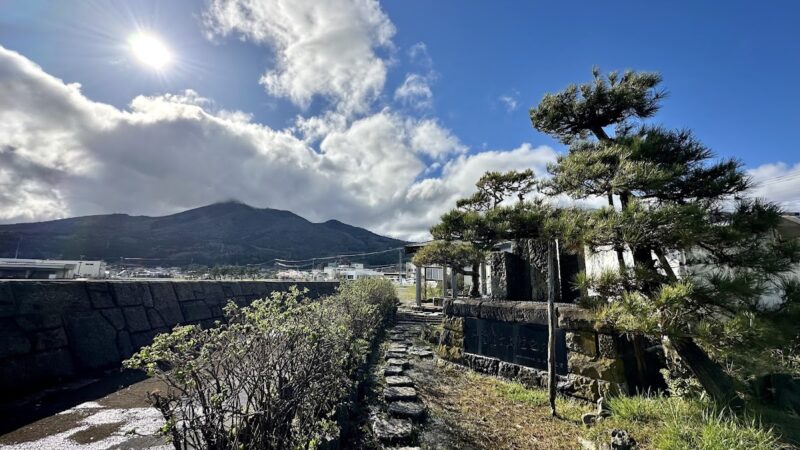
The most striking feature of Miyuki Park is the remaining portion of the moat that surrounded the Jinya. The moat is partially preserved on the west and south sides of the park, and is approximately 2-3 meters deep. The moat still contains water, conveying a glimpse of its former glory.
The red bridge spanning the moat is a symbolic feature of the park. This bridge is a reconstruction modeled after the bridge from the time of the jinya (fortified residence), and it plays a role in enhancing the park’s landscape. From the bridge, you can enjoy a panoramic view of the moat, making it a popular spot for photography.
The moat’s depth varies depending on the location, but at its deepest point, it reaches approximately 3 meters. Traces of earthworks remain inside the moat, indicating its function as a defensive structure. However, it can be confirmed that no stone walls were used, and that the earthworks were primarily constructed from piled-up earth.
Castle Site Monument and Information Board: Historical Monuments
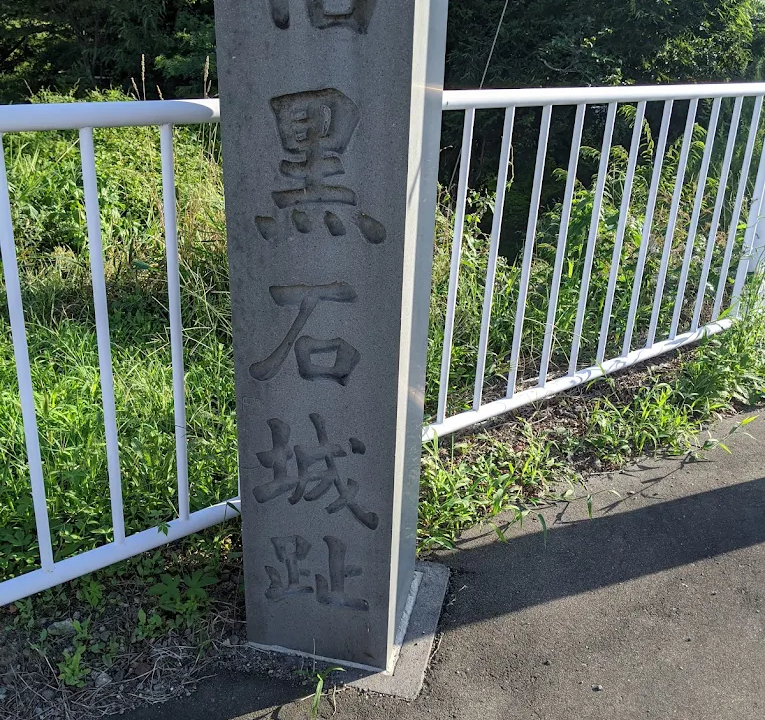
At the edge of Miyuki Park stands a large castle site monument. This monument is inscribed with “Kuroishi Castle Site,” indicating that this was once the site of the Kuroishi Tsugaru family’s jinya. The monument was erected in the Showa era by local volunteers and is an important historical monument that conveys the history of Kuroishi to future generations.
Near the castle site monument, there is also an information board explaining the history of the Kuroishi jinya. The information board displays a map of the Jinya (fortified residence) layout and historical background, helping visitors understand the history of Kuroishi. It also includes old photographs and illustrations from the Jinya era, allowing visitors to visually experience what it was like in those days.
Parking and Access Information
Miyuki Park has a parking lot almost the same size as the park itself. Parking is free and can accommodate approximately 50 regular-sized cars. The park is easily accessible from the parking lot in about a 1-minute walk, making it very convenient.
The park has no specific opening hours and is open year-round. However, lighting is limited at night, so daytime visits are recommended. During the spring cherry blossom season, nighttime illuminations are sometimes held.
Nearby Attractions: Komise Street and Historic Buildings
Nakamachi Komise Street: Important Preservation District for Groups of Traditional Buildings
Nakamachi Komise Street is located about a 10-minute walk north from the Kuroishi Jinya ruins. This street features a continuous row of merchant buildings dating back to the Edo period, and in 2005, it was designated a National Important Preservation District for Groups of Traditional Buildings.
The street is approximately 400 meters long, and the continuous rows of traditional shop walls (komise) on both sides create a unique landscape. In particular, the Takahashi, Koyamauchi, and Narumi residences have well-preserved architectural styles from the Edo to Meiji periods, and interior tours are available (some require a fee).
Along the Komise Street, cafes and souvenir shops housed in traditional buildings also operate, allowing visitors to enjoy a stroll while soaking up the historical atmosphere. Especially in winter, you can experience walking under the komise, avoiding the snow, and get a real feel for the lifestyle and culture of a snowy region.
Former Fire Station: A Pseudo-Western Style Building from the Taisho Era
In a corner of Komise Street, the former fire station built during the Taisho era still stands. This two-story wooden building in a pseudo-Western style was used as a base for firefighting activities at the time.
The building’s exterior is a typical example of “pseudo-Western architecture,” combining Japanese style with Western decorations, showing the influence of Western architecture in the window frames and eaves ornaments. Although it no longer functions as a fire-fighting facility, the building has been preserved and is cherished as a symbol of Kuroishi’s modernization.
Kuroishi Shrine: A shrine dedicated to the founder of the domain
In Kuroishi city is the Kuroishi Shrine, dedicated to Tsugaru Nobuhide, the first head of the Kuroishi Tsugaru family. This shrine was founded to commemorate Nobuhide’s achievements and is revered as a guardian deity of the region.
Within the shrine grounds, there are stone monuments and lanterns related to the Tsugaru family, allowing visitors to feel the history of Kuroishi. An annual festival is held in September, attracting local residents.
Fujimikan: A restaurant building established in the Meiji era
Founded in 1895 (Meiji 28), Fujimikan is known as Kuroishi’s first restaurant. The three-story wooden building retains many characteristics of high-class Meiji-era restaurant architecture, making it worthwhile to admire even just from its exterior.
The building is still in operation today (reservations required), and its interior retains luxurious tatami rooms and furnishings. As a building symbolizing Kuroishi’s economic prosperity, it is a historical heritage site of the region.
How to Access Kuroishi Jinya
By Train
The Konan Railway Konan Line is the most convenient way to get to Kuroishi City. The journey from Hirosaki Station to Kuroishi Station takes approximately 30 minutes, and the fare is 540 yen one way. The Konan Line runs about 1-2 times per hour, allowing you to enjoy a leisurely journey typical of a local line.
From Kuroishi Station to Miyuki Park is about a 15-minute walk. Exit the station and head north; after passing through the city center, you will arrive at the park. You will pass through a shopping street along the way, allowing you to experience the local atmosphere.
Alternatively, you can take a Konan Bus from Hirosaki Station on the JR Ou Main Line. Take a bus bound for Kuroishi from Hirosaki Station and get off at “Kuroishi Station” or “Kuroishi City Hall.” The journey takes approximately 40 minutes and costs 670 yen one way.
If traveling by car
If traveling by car, the nearest exit is the Kuroishi Interchange on the Tohoku Expressway. From the interchange to Miyuki Park is approximately 10 minutes, about 5 kilometers. After exiting the interchange, proceed along National Route 102 towards Hirosaki and follow the signs in the city center to reach the park.
From central Hirosaki, it takes approximately 20 minutes, about 15 kilometers, via National Route 102. A sightseeing route visiting Hirosaki Castle and the Kuroishi Jinya Ruins is an ideal course for understanding the history of the Tsugaru region.
From Aomori City, it takes approximately 1 hour, about 50 kilometers, via National Route 7 and National Route 102. You will pass through the Namioka area along the way, where you can take a break at a roadside station.
Kuroishi Jinya and Hirosaki Castle: Castle Culture of the Tsugaru Region
Relationship between the Hirosaki Domain and its Branch Domains
Understanding the relationship between the Kuroishi Jinya and its branch domain is crucial to understanding its connection to the main Hirosaki Domain. The Hirosaki Domain was a large domain with a 100,000 koku (unit of rice production) yield that governed the Tsugaru region, established by Tsugaru Tamenobu. Hirosaki Castle is one of the representative early modern castles in the Tohoku region, with many structures, including the keep, still existing.
The Kuroishi Tsugaru family was a branch family beginning with Nobuhide, the third son of Tsugaru Nobuhira, the second lord of the Hirosaki Domain. They were granted 5,000 koku and became alternating yoriai hatamoto (direct retainers of the shogun). While formally an independent family, the relationship between the main domain and its branch domain meant they were under the strong influence of the main domain.
The heads of the Kuroishi Tsugaru family traditionally attended important ceremonies of the Hirosaki Domain and participated in domain administration. Furthermore, the ties between the two families were strengthened through marriage, maintaining the unity of the Tsugaru clan.
The Difference Between a Jinya and a Castle
Comparing the Kuroishi Jinya and Hirosaki Castle clearly illustrates the difference between a “jinya” and a “castle.” Hirosaki Castle is a full-fledged early modern castle with stone walls, a keep, turrets, and gates, emphasizing its function as a military facility. On the other hand, the Kuroishi Jinya was a defensive facility primarily consisting of moats and earthworks, and its scale and function did not match that of a castle.
This difference reflects the difference in the two families’ land holdings and social status. The Hirosaki domain was a daimyo with a 100,000 koku (unit of rice production) domain and was permitted by the shogunate to build a castle. In contrast, the Kuroishi Tsugaru family was a hatamoto (direct retainer of the shogun) with a 5,000 koku domain and was not permitted to build a castle. Therefore, their residence was called a “jinya,” and its defensive facilities were limited.
However, the fact that the Kuroishi Jinya was also called “Kuroishi Castle” indicates the importance of the Kuroishi Tsugaru family to the region. In effect, it was recognized by the local people as a facility equivalent to a castle.
Kuroishi’s History and Culture: From a Jinya Town to the Present
Kuroishi in the Edo Period: A Key Transportation Hub
Kuroishi is located in the inland part of the Tsugaru region and was a key point on the highway connecting Hirosaki and the Nanbu region. In particular, the highway from Hirosaki to Hachinohe (the current National Route 102) passed through it, and it functioned as a post town.
As a Jinya town, Kuroishi formed a society where samurai and townspeople coexisted. The samurai residences were where the practical affairs of the domain were conducted, while commerce and industry flourished in the townspeople’s quarters. In particular, miso and soy sauce brewing, sake brewing, and textiles thrived, making it one of the economic centers of the Tsugaru region.
Changes After the Meiji Restoration
With the abolition of the feudal domains and establishment of prefectures in 1871 (Meiji 4), the Kuroishi domain ceased to exist and was incorporated into Aomori Prefecture via Kuroishi Prefecture. The Jinya buildings were gradually demolished, and schools and public facilities were built on the sites.
From the Meiji to the Taisho era, Kuroishi experienced a wave of modernization. The opening of the railway (Konan Railway Konan Line, 1927) improved transportation and further developed commerce and industry. Western-style and pseudo-Western-style buildings constructed during this period still remain in the city today.
Modern Kuroishi: Town Development Utilizing History
Modern Kuroishi is a regional city with a population of approximately 30,000. Agriculture (especially apple cultivation) and tourism are its main industries. The city is promoting town development that preserves and utilizes its historical townscape, with the preservation and development project of Nakamachi Komise Street being a prime example.
Kuroishi has become nationally known as the “town of Komise,” attracting many tourists throughout the year. In particular, during the “Kuroishi Yosare” (traditional Bon dance) held every August, many people gather, and the entire town is filled with energy.
Best Season to Visit and How to Enjoy It
Spring: A Famous Cherry Blossom Spot
Miyuki Park is known as a famous cherry blossom spot in spring. Approximately 100 Somei Yoshino cherry trees are planted in the park, and they are in full bloom from late April to early May. During the cherry blossom season, you can see locals enjoying cherry blossom viewing.
During cherry blossom season, you can also enjoy rows of cherry trees around the park. After visiting the Jinya Ruins, a stroll to Komise Street allows you to enjoy the interplay of the historical townscape and cherry blossoms.
Summer: The Excitement of the Yosare Festival
The “Kuroishi Yosare” festival, held in mid-August, is Kuroishi’s largest festival. It’s a traditional Bon Odori dance from the Tsugaru region, and the dance circles spread throughout the city streets. During the festival, Komise Street also becomes a venue, allowing you to experience traditional culture amidst the historical townscape.
During the Yosare Festival, accommodations in the city become crowded, so early reservations are necessary. Alternatively, you can stay in Hirosaki City and visit on a day trip.
Autumn: Season of Autumn Leaves and Harvest
From late October to early November, the Kuroishi area enters its autumn foliage season. The trees in Miyuki Park also change color, allowing you to enjoy the tranquil atmosphere of autumn. This is also the apple harvest season in the Tsugaru region, and you can purchase fresh apples at direct sales outlets in the city.
Winter: Snow Country Atmosphere and Komise Experience
Winter in Kuroishi offers a unique snow country atmosphere. In particular, walking under the snow-covered komise (traditional storehouses) along Komise Street allows you to experience the lifestyle and culture of a snow country. Snowfall is heavy from December to March, sometimes exceeding 1 meter at its peak.
For winter visits, warm clothing and non-slip shoes are essential. Also, transportation may be delayed during snowfall, so plan your trip with plenty of time to spare.
Summary: Historical Value and Modern Significance of Kuroishi Jinya
Kuroishi Jinya (Kuroishi Castle) was the base of the Kuroishi Tsugaru family, a branch of the Hirosaki Domain with a history spanning over 200 years. Its unique history of rising from a daimyo (feudal lord) to a hatamoto (direct retainer of the shogun) during the late Edo period makes it an important historical site for understanding the history of the Tsugaru region.
Although the Jinya buildings themselves are gone, the site, now developed as Miyuki Park, retains traces of the moat and a castle monument, conveying the atmosphere of the past. Furthermore, Nakamachi Komise Street, located north of the Jinya, is a valuable historical streetscape that preserves the town layout from the Jinya era.
Visiting the Kuroishi Jinya site offers not only the opportunity to see a historical site, but also an opportunity to learn about the history and culture of the Tsugaru region, the lifestyle of a snow country, and the preservation efforts of traditional townscapes. Visiting it in conjunction with Hirosaki Castle will provide a deeper understanding of the castle culture of the Tsugaru region.
When you visit Aomori Prefecture, be sure to visit the Kuroishi Jinya Ruins and the surrounding historic townscape. Just 30 minutes from Hirosaki, you’re sure to discover the charm of Kuroishi, a city with its own unique history and culture.