Complete Guide to Kofu Castle: A Thorough Explanation of Maizuru Castle’s History, Highlights, and Access Information
Located in the heart of Kofu City, Yamanashi Prefecture, Kofu Castle is a flatland castle built by order of Toyotomi Hideyoshi. Also known as “Maizuru Castle,” it was given this name because its white walls resemble a crane spreading its wings. Currently, it is maintained as Maizuru Castle Park and Kofu City Historical Park, and is designated as a national historic site. This article comprehensively explains everything you need to know before visiting Kofu Castle, from its history and highlights to practical access information.
What is Kofu Castle?: Basic Information and Overview
Kofu Castle is a flatland castle built on a hill called Ichijo-Koyama in the northern part of the Kofu Basin. It once boasted a vast castle complex of over 20 hectares, consisting of multiple baileys including the main keep, the keep bailey, the Inari bailey, the sukiya bailey, and the blacksmith bailey.
Origin of the Alternate Name for Maizuru Castle
The reason Kofu Castle is called “Maizuru Castle” lies in its elegant appearance. The overlapping white walls resembled a crane spreading its wings, hence the elegant name. This beautiful appearance was cherished as a symbol of Kofu from the late Sengoku period to the Edo period.
Current Kofu Castle Ruins
Currently, part of the castle ruins is open as Maizuru Castle Park, and the Kaji-kuruwa (blacksmith’s enclosure) on the south side is open as Kofu City Historical Park. Located in a prime location about a 3-minute walk from JR Kofu Station, it is a popular spot for tourists and locals alike, offering a spectacular panoramic view of the Kofu Basin from the castle tower base.
History of Kofu Castle: From Construction to the Present
Kai Province After the Fall of the Takeda Clan
In 1582 (Tensho 10), when the Takeda clan was destroyed by Oda Nobunaga’s conquest of the Takeda, Kai Province came under the control of the Oda family. After the Honnō-ji Incident, the region came under the control of Tokugawa Ieyasu. However, following the Siege of Odawara in 1590, Toyotomi Hideyoshi’s redistribution of territories brought Kai Province under the direct control of the Toyotomi regime.
History and Purpose of Castle Construction
After the fall of the Takeda clan, construction of Kōfu Castle began under the orders of Toyotomi Hideyoshi. The purpose of its construction was to secure a crucial strategic base to counter Tokugawa Ieyasu, who was stationed in the Kantō region. Initially, Toyotomi Hidekatsu, Hideyoshi’s nephew, became the castle lord. Later, Asano Nagamasa and his son Yukinaga served as lords, and full-scale construction progressed.
Construction progressed in stages from the Tenshō era to the Keichō era, resulting in the completion of a magnificent flatland castle utilizing the Ichijō-Koyama hill. This castle, with its keep foundation comparable in size to those of Edo Castle, Nagoya Castle, and Osaka Castle, was a large-scale fortress that represented the prestige of the Toyotomi regime.
Kofu Castle in the Edo Period
After the Battle of Sekigahara and the establishment of the Tokugawa regime, Kofu Castle maintained its importance as a defense against the west. Hiraiwa Chikayoshi, a senior retainer of Tokugawa Ieyasu, became the castle lord, and thereafter, daimyo close to the Tokugawa family, such as shogunate retainers and hereditary daimyo, served as castle lords.
Of particular note is the fact that Yanagisawa Yoshiyasu, who wielded great power as a close advisor to the 5th Shogun Tokugawa Tsunayoshi during the Genroku era, became the castle lord. Yanagisawa Yoshiyasu focused on developing Kofu Castle and its surrounding town, improving the castle’s fortifications. However, in 1724, when Yanagisawa Yoshiyasu’s son, Yanagisawa Yoshisato, was transferred to Yamato-Koriyama, Kofu Castle became a “Kofu Kinban-governed” territory without a lord, and was managed as a direct shogunate territory.
Changes in the Modern Era
In 1727, a major fire broke out within the castle, destroying many buildings. Although partial reconstructions were carried out afterward, complete restoration was never achieved throughout the Edo period.
In the Meiji era, due to the decree abolishing castles, Kofu Castle was gradually dismantled, and the land within the castle grounds was sold off to private individuals or used as the site for public facilities such as schools. While the stone walls and some baileys remained, most of the buildings were lost.
In 1968, the Kofu Castle ruins were designated a national historic site, and since then, restoration and development projects have been underway by Yamanashi Prefecture and Kofu City. Efforts to restore the castle to its former glory continue, including the restoration of the Inari Turret in 2004 and the Yamate Gate in 2013.
Kofu Castle Highlights: Must-See Spots Details
Tenshudai: A Scenic Spot Offering Panoramic Views of the Kofu Basin
The greatest highlight of Kofu Castle is the Tenshudai, located at the highest point of the castle. This castle keep base is massive, ranking second only in size to Edo Castle, Nagoya Castle, and Aizu-Wakamatsu Castle, and is believed to have once housed a five-story keep.
From the keep base, you can enjoy a 360-degree panoramic view of the Kofu Basin. On clear days, you can see Mount Fuji, the Southern Alps, and the Yatsugatake Mountains, making it one of the best viewpoints in the prefecture. The view at sunset is particularly spectacular, with the sight of Kofu city lights beginning to illuminate the city being truly magical.
The stone walls of the keep base are built using the old “nozurazumi” method, characterized by their powerful appearance created by stacking natural stones as they are. These stone walls are a valuable historical relic that conveys the techniques used at the time of the castle’s construction.
Stone Walls: A Relic Showcasing the Pinnacle of Castle Construction Techniques
The stone walls of Kofu Castle are one of the most important historical relics remaining throughout the castle grounds. Many nozurazumi stone walls remain in the main keep, Inari Kuruwa, and Sukiyakuruwa, conveying the appearance of the castle at the time of its construction.
The stones used in the stone walls were granite and andesite transported from the Kofu area, and some of the stones still bear the marks of stone splitting, known as arrow holes. These arrow holes are holes made by driving wedges into the stone to split it, and are valuable traces for understanding the stonemasonry techniques of the time.
Furthermore, stones with line engravings have been discovered within the stone walls. These are thought to be graffiti or markings left by those involved in the castle’s construction, and are fascinating remains that allow us to feel the presence of the people of that time.
Inari Yagura (Inari Tower): A Heisei Era Restoration
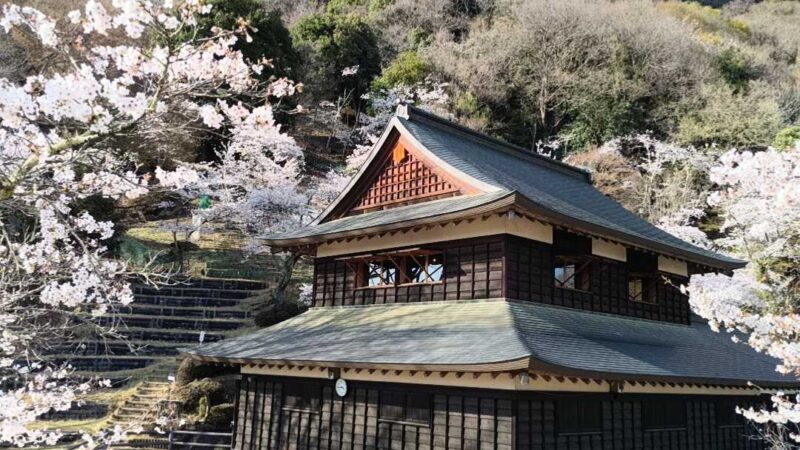
The Inari Yagura is a two-story tower restored in 2004. It was reproduced as faithfully as possible based on archaeological excavations and Edo period drawings.
The interior of the tower is open to visitors and features exhibits on the history of Kofu Castle and its construction techniques. From the tower, one can overlook Maizuru Castle Park, which is helpful for understanding the castle’s structure. The beautiful contrast between the white walls and black tiles evokes the elegant appearance of Maizuru Castle in its heyday.
Kurogane-mon (Iron Gate): Main Gate to the Honmaru (Main Keep)
Kurogane-mon is an important gate that functioned as the main gate to the Honmaru. Restored in 2013, it has the structure of a masugata-mon (square-shaped gate) consisting of a Koraimon (Korean-style gate) and a yagura-mon (turret gate).
The gate’s name comes from the fact that iron plates were attached to the doors. In its restoration, the original appearance was recreated by referencing foundation stones unearthed during archaeological excavations, Edo-period drawings, and old photographs. The path leading to the Honmaru through Kurogane-mon is a valuable route that allows visitors to experience the former approach to the castle.
Yamanote-gomon (Mountain Gate): A Highlight of Kofu City Historical Park
Located on the south side of Kofu Castle, in the Kaji-kuruwa (Blacksmith’s Enclosure), Yamanote-gomon is one of the castle’s main gates, restored in 2013. This gate was an important entrance facing the Koshu Kaido road, a crucial transportation hub connecting Edo (Tokyo) and Kofu.
The Yamate-gomon gate is a central facility within the Kofu City Historical Park, and the interior houses a museum. Exhibits showcase the history of Kofu Castle, the appearance of the castle town, and the results of archaeological excavations, making it an essential facility for understanding Kofu Castle.
Remnants of stone walls and moats remain around the gate, allowing visitors to experience the atmosphere of the castle in its heyday. Furthermore, the route of the Koshu Kaido road has been recreated in front of the gate, allowing visitors to experience the feeling of being a traveler in the Edo period.
Uchishoin-mon and Inari-kuruwa-mon: Restored gates of each enclosure
Kofu Castle had multiple gates arranged sequentially from the main keep. The Uchishoin-mon and Inari-kuruwa-mon have also been restored, making them highlights when touring the castle grounds.
These gates are important remains for understanding the defensive structure of the castle. The castle grounds are strategically placed along the pathways connecting the baileys, showcasing numerous features designed to prevent enemy intrusion.
Sukiyakuruwa and Kaji-kuruwa: Understanding the Castle’s Structure
Kofu Castle is a complex castle complex composed of multiple baileys. The Sukiyakuruwa was a cultural space containing tea rooms and other cultural facilities, while the Kaji-kuruwa is believed to have been the workshop of blacksmiths.
Currently, the Kaji-kuruwa has been developed as Kofu City Historical Park, where visitors can see the remains of the Yamate-gomon Gate, stone walls, and moats. Located on the south side, it is easily accessible from Kofu Station.
Kofu Castle Timeline: Major Events
- Tensho 10 (1582): The Takeda clan falls.
- Tensho 18 (1590): Construction of the castle begins by order of Toyotomi Hideyoshi.
- Keicho 5 (1600): After the Battle of Sekigahara, it comes under the control of the Tokugawa family.
- Genroku 3 (1690): Yanagisawa Yoshiyasu becomes the lord of the castle.
- Kyoho 9 (1724): Yanagisawa Yoshisato is transferred to Yamato-Koriyama and becomes the Kofu garrison commander.
- Kyoho 12 (1727): A major fire breaks out within the castle, destroying many buildings.
- After the Meiji Restoration: Demolition progresses due to the castle demolition order.
- Showa 43 (1968): Designated a national historic site.
- **2004 (Heisei 16): Completion of Inari Turret Restoration
- **2013 (Heisei 25): Completion of Iron Gate and Yamate Gate Restoration
Kofu Castle (Maizuru Castle Park) Map and Park Layout
Kofu Castle ruins are broadly divided into two areas: Maizuru Castle Park (north side) and Kofu City Historical Park (south side).
Maizuru Castle Park Area
- Tenshudai (highest point)
- Honmaru Ruins
- Inari Turret
- Iron Gate
- Inari Kuruwa
- Sukiyakuruwa
- Uchishoin Gate
- Stone Wall Group
Kofu City Historical Park Area
- Yamate Gate
- Kaji Kuruwa
- Remains of Stone Walls and Moats
- Historical Materials Exhibition Room
Both areas are accessible on foot, and it takes approximately 1.5 to 2 hours to see the entire site. The path to the castle keep has many stairs, so we recommend wearing comfortable shoes.
Hot Springs: Kofu Castle and Hot Spring Culture
Hot spring culture has been deeply rooted in the castle town of Kofu since the Edo period. Yumura Onsen, in particular, was used by the castle lord and his retainers as a retreat for Kofu, and is a historic hot spring resort that has continued since the time of Takeda Shingen.
Even today, there are several hot spring facilities in Kofu City, allowing you to relax and soothe your fatigue after visiting Kofu Castle. Combining a castle ruins stroll with a hot spring bath is a unique way to enjoy Kofu.
Useful Information for Your Visit
Opening Hours
Maizuru Castle Park
- The park itself is open 24 hours a day
- Inari Turret: 9:00 AM – 4:30 PM (Last entry 4:00 PM)
Kofu City Historical Park (Yamate-gomon Gate)
- 9:00 AM – 5:00 PM (Last entry 4:30 PM)
Closed Days
Inari Turret & Yamate-gomon Gate (Common)
- Every Monday (If Monday is a public holiday, the following weekday)
- Year-end and New Year holidays (December 29th – January 3rd)
- Other temporary closures may occur.
*The park itself is open year-round for strolling.
Admission Fee
Free Admission to both Maizuru Castle Park and Kofu City Historical Park
Strolling through the park and visiting the Inari Turret and Yamate-gomon Gate are both free of charge. The ease of visiting is one of Kofu Castle’s charms.
Access Information
Access by Train
- Approximately 3 minutes on foot from the South Exit of Kofu Station on the JR Chuo Main Line (Maizuru Castle Park)
- Approximately 5 minutes on foot from the South Exit of Kofu Station on the JR Chuo Main Line (Kofu City Historical Park/Yamate-gomon Gate)
Access by Car
- Approximately 20 minutes from the Kofu-Showa Interchange on the Chuo Expressway
- Approximately 25 minutes from the Ichinomiya-Misaka Interchange on the Chuo Expressway
Parking
- Several Kofu City-operated parking lots (paid) are available in the surrounding area.
- There is no free parking lot specifically for Maizuru Castle Park, but using nearby coin-operated parking lots is convenient.
Volunteer Tourist Guides
In Yamanashi Prefecture, following the restoration of the Inari Turret in 2004, volunteer tourist guides for Kofu Castle were recruited and continue to be active. If you wish to have a guided tour, it is recommended to inquire in advance. Explanations from a guide with specialized knowledge will allow you to gain a deeper understanding of the history and highlights of Kofu Castle.
Nearby Tourist Attractions
Takeda Shrine (Tsutsujigasaki Mansion Site)
This shrine stands on the site of Tsutsujigasaki Mansion, the former residence of the Takeda clan. It enshrines Takeda Shingen and was the center of Kai Province before Kofu Castle was established. Located about 10 minutes by bus from Kofu Station, it’s a popular spot often visited in conjunction with Kofu Castle.
Kofu City Fujimura Memorial Hall
This is a Western-style building from the Meiji era, relocated to Maizuru Castle Park. It’s a valuable cultural asset as the first full-fledged Western-style building in Yamanashi Prefecture, and interior tours are available.
Koshu Yume Koji
Located at the north exit of Kofu Station, this commercial facility recreates the Kofu castle town of the Meiji, Taisho, and Showa periods. Restaurants, cafes, and souvenir shops line the street, offering opportunities for strolling and dining.
Tips for Maximizing Your Kofu Castle Experience
Recommended Time to Visit
Kofu Castle boasts beauty in every season, but the following times are particularly recommended.
- Spring (late March to early April): Known as a famous cherry blossom viewing spot, approximately 160 Somei Yoshino cherry trees bloom here. The trees are also illuminated at night, allowing visitors to enjoy a magical view of the cherry blossoms after dark.
- Autumn (November): The autumn foliage is beautiful, and the contrast between the stone walls and the leaves is magnificent.
- Winter (December to February): The air is clear, allowing for a clear view of Mt. Fuji, and the view from the castle tower base is superb.
Clothing and Items to Bring When Visiting
- Comfortable walking shoes are essential as you will be climbing stairs to reach the castle tower base.
- In summer, the sun is strong, so bring a hat and sunscreen.
- In winter, it is windy and cold, so take proper precautions against the cold.
- A camera is a must. Recommended for taking photos of the views from the castle tower base and the stone walls.
Efficient Sightseeing Route
- From Kofu Station South Exit to Maizuru Castle Park
- Visit the Inari Turret
- Pass through the Iron Gate to the Main Enclosure
- Climb to the castle tower base and enjoy the view
- Stroll through the Sukiyakuruwa and Inari Kuruwa areas
- Move to Kofu City Historical Park
- Visit the Yamate-gomon Gate and the Museum
This route allows for a visit of approximately 1.5 to 2 hours.
Summary: The Charm and Value of Kofu Castle
Kofu Castle was built by order of Toyotomi Hideyoshi after the fall of the Takeda clan and was an important castle that functioned as the center of Kai Province throughout the Edo period. Currently, it is maintained as Maizuru Castle Park and Kofu City Historical Park, offering many attractions such as the spectacular views from the castle tower base, beautiful stone walls, and the restored Inari Turret and Yamate-gomon Gate.
Located just a 3-minute walk from JR Kofu Station, Kofu Castle boasts an excellent location and is easily accessible with free admission. The view from the castle tower, overlooking the Kofu Basin, is one of the prefecture’s most spectacular sights, captivating visitors for years to come.
Kofu Castle is a valuable cultural asset that conveys the history from the Sengoku period to the Edo period, and a source of pride for the people of Yamanashi Prefecture. Restoration and development work is still ongoing, and it is expected to regain its former glory in the future. It’s a recommended tourist spot not only for history buffs, but also for those who want to enjoy breathtaking scenery and leisurely strolls.
When you visit Kofu, be sure to stop by Kofu Castle and experience its history and charm.