Complete Guide to Kiriyama Castle (Kanazawa City, Ishikawa Prefecture) | Detailed Explanation of History, Highlights, and Access
Located in Kiriyama-cho, Kanazawa City, Ishikawa Prefecture, Kiriyama Castle is a mountain castle built at the end of the Sengoku period as a key point for border defense between Kaga Province and Etchu Province. Fuwa Naomitsu, a senior retainer of Maeda Toshiie, served as the castle lord and played a crucial role as the front line in the conflict with Sasa Narimasa. This article thoroughly explains this little-known Sengoku mountain castle, from its historical background to detailed remains and an actual visitor’s guide.
Overview and Basic Information of Kiriyama Castle
Kiriyama Castle is a mountain castle built on a mountaintop 142 meters above sea level, with a relative height difference of approximately 70 meters. Currently located in Kiriyama-cho, Kanazawa City, Ishikawa Prefecture, it occupies a strategically important location near the border between Kaga Province and Etchu Province.
Classified as a typical Sengoku period mountain castle, its defensive facilities such as earthworks, baileys, and moats remain in good condition. The castle is estimated to have been built during the Tensho era (1573-1592), and is thought to have been particularly developed after the Battle of Shizugatake in 1583 (Tensho 11), amidst the intensifying conflict between the Maeda and Sasa clans.
The castle is of medium size for a medieval mountain castle, with a layout of multiple baileys arranged around a central bailey. It played a key role in the defense line of the Kaga Maeda clan, directly confronting Matsune Castle, which belonged to the Sasa clan on the opposite bank in Etchu Province.
History of Kiriyama Castle | The Conflict Between the Maeda and Sasa Clans
Background of Construction and the Sengoku Period
The background to the construction of Kiriyama Castle lies in the expansion of Oda Nobunaga’s power in the Hokuriku region and the subsequent succession struggle. In 1581 (Tensho 9), Oda Nobunaga granted Maeda Toshiie the entire province of Noto, and also brought part of Kaga Province under his control. Meanwhile, Etchu Province was governed by Sasa Narimasa, and the two territories bordered each other.
After the Honnoji Incident in 1582 (Tensho 10), when the Oda regime collapsed, a reorganization of powers began in the Hokuriku region. The conflict between Toyotomi Hideyoshi and Shibata Katsuie became apparent, and after Hideyoshi’s victory at the Battle of Shizugatake in 1583, Maeda Toshiie sided with Hideyoshi, while Sasa Narimasa took an anti-Hideyoshi stance.
Against the backdrop of this political conflict, military tensions rose in the border region between Kaga and Etchu. It is believed that Kiriyama Castle was built or significantly renovated during this period to strengthen the Maeda clan’s defensive line.
Fuwa Naomitsu and Kiriyama Castle
The lord of Kiriyama Castle was Fuwa Hikosaburo Naomitsu. Naomitsu was born the son of Fuwa Mitsuharu and was a samurai who served Maeda Toshiie. Fuwa was from Mino Province and was a highly valued hereditary retainer within the Maeda family.
Naomitsu, as the lord of Kiriyama Castle, bore the heavy responsibility of being the frontline commander preparing for invasions from the Etchu region. As is evident from the castle’s location, it was expected to monitor the Sasa clan’s fortresses, including Matsune Castle on the opposite bank, and to play a crucial role in defense in times of emergency.
The Battle of Suemori Castle and Kiriyama Castle
In September 1584 (Tensho 12), Sasa Narimasa launched a large-scale invasion of Maeda territory. This was the “Battle of Suemori Castle.” Narimasa besieged Suemori Castle in Noto Province with approximately 10,000 troops, and Maeda forces, including Okumura Nagafuku, defended the castle.
Fuwa Naomitsu fought as the vanguard of the Maeda army in this battle. He played a part in the relief force led by Maeda Toshiie himself, engaging in fierce battles against the Sasa army. Thanks to Naomitsu’s efforts, the Maeda army succeeded in lifting the siege of Suemori Castle, forcing the Sassa army to retreat.
After this battle, the strategic importance of Kiriyama Castle increased even further. Sassa Narimasa still controlled Etchu Province, and the Maeda side needed to strengthen their border defenses in preparation for another invasion.
The Battle of Toyama and the Castle’s Abandonment
In August 1585 (Tensho 13), Toyotomi Hideyoshi personally led a massive army of 100,000 men into the Hokuriku region to subdue Sassa Narimasa. This was the “Battle of Toyama (Sarasa Crossing).” Faced with Hideyoshi’s overwhelming military strength, Narimasa surrendered without resistance, and Etchu Province came under the control of Maeda Toshiie.
This resolved the military tensions along the border between Kaga and Etchu Provinces. Kiriyama Castle lost its original role as a defense against Etchu and is believed to have been abandoned around this time. Although it lasted only a short period of a few years, Kiriyama Castle functioned as an important military base supporting the Maeda clan’s control of the Hokuriku region.
Structure and Layout of Kiriyama Castle
Main Enclosure and Bailey Arrangement
Kiriyama Castle’s layout features a main enclosure (honmaru) at the mountaintop, surrounded by multiple baileys, creating a concentric enclosure structure. The main enclosure measures approximately 30 meters east-west and 25 meters north-south, a standard size for a mountain castle.
Earthworks surround the main enclosure, and the earthworks on the north and west sides, in particular, are well-preserved, exceeding 2 meters in height. The earthworks were constructed using embankment techniques rather than rammed earth, characteristic of hastily built castles during the Sengoku period.
The second and third baileys are arranged in a stepped fashion to the east and south of the main enclosure. These baileys are located at a lower level than the main enclosure, creating a multi-layered defensive structure. Each enclosure is smaller than the main enclosure and is presumed to have been used for troop garrisoning and supply storage.
Characteristics of Defensive Structures
The most distinctive feature of Kiriyama Castle’s defensive structures is the arrangement of moats. Multiple moats were constructed along the ridges on both the north and south sides of the castle, serving to prevent enemy incursions.
The moat on the north side is particularly large, reaching over 4 meters in depth and up to 10 meters in width. Since this direction faces Etchu Province, i.e., the territory of the opposing Sasa clan, it is clear that this was the most important defensive line.
Earthworks were constructed not only around the main enclosure but also partially around each enclosure. The height of the earthworks varies depending on the location, but is generally in the range of 1.5 to 2.5 meters. It is thought that fences or walls were built on top of the earthworks, but the wooden parts have been lost, and only the bases of the earthworks remain today.
The Castle Entrance and Ascent Route
The castle entrance (koguchi) is located on the southeast side of the main enclosure. This entrance is not a simple opening, but rather a staggered entrance with a curved earthen rampart, demonstrating a design intended to prevent direct enemy advances.
The main ascent route is thought to be the one from the south side of the mountain leading to the main enclosure. Traces of the mountain path remain today, showing a structure that gradually increases in altitude while passing through enclosures. Small flat areas are scattered along this route, suggesting the possibility of gates, guardhouses, and other facilities.
There are also traces of a small path on the north side of the castle, which is thought to be a rear entrance (karate), but this is likely an emergency escape route utilizing the steep terrain.
Highlights and Remains of Kiriyama Castle
Well-Preserved Earthen Ramparts
The greatest highlight of Kiriyama Castle is its well-preserved group of earthen ramparts. The earthen rampart on the north side of the main enclosure, in particular, retains its original shape remarkably well, clearly visible at a height of over 2 meters.
Observing the cross-section of the rampart reveals a structure composed of multiple layers of earth. This is characteristic of castles built rapidly during the Sengoku period, indicating that construction was carried out quickly using earthworks rather than meticulous methods like rammed earth.
Walking along the top of the rampart allows one to experience the castle’s defensive structure firsthand. From the rampart, one can overlook the surrounding terrain, and the view towards Etchu Province to the north is particularly unobstructed, highlighting the importance of its surveillance function.
Clear Moat
The moat located on the northern ridge of the castle is one of the most impressive remains of Kiriyama Castle. This large moat, over 4 meters deep, can still be clearly seen today.
Standing at the bottom of the moat, one is overwhelmed by the height of the cliffs on both sides. One is astonished by the technical skill and labor mobilization capabilities of the Sengoku period, who were able to carry out such civil engineering work using only human power. The moats were not simply excavated; the excavated soil was piled up on both sides, creating a more effective defensive barrier.
The moats on the south side are not as large as those on the north side, but multiple moats are constructed in succession, demonstrating a multi-layered defensive strategy. Attempting to cross these moats allows one to experience their high level of defensive effectiveness.
Arrangement of the Enclosures
The arrangement of the enclosures, from the main enclosure to the second and third enclosures, exhibits a typical structure for a Sengoku period mountain castle. There are elevation differences between each enclosure, allowing for views from the upper enclosures to the lower ones.
The second enclosure is located east of the main enclosure and is approximately half the size of the main enclosure. This enclosure offers a view towards Kanazawa city and may have functioned as a communication and information transmission hub.
The third enclosure is located further east, at a lower elevation, and was constructed utilizing the relatively flat terrain. This enclosure is presumed to have been used for troop garrisoning and supply storage, and traces such as post holes have been partially confirmed.
Views and Location
The views from Kiriyama Castle are essential to understanding its strategic importance. From the main enclosure, one can see the Sai River to the north and the Etchu region on the opposite bank. On a clear day, the area where Matsune Castle once stood is also visible, giving a clear sense of the mutual surveillance relationship between the two castles.
To the east lies the city of Kanazawa, and to the west, a mountain range stretches out. This location clearly demonstrates Kiriyama Castle’s function in detecting invasions from Etchu early and transmitting information to Kanazawa.
The south side of the castle has a relatively gentle slope, which suggests from the topography that this was the main approach to the castle. On the other hand, the north side has a steep slope, revealing a defensive plan that made maximum use of the natural terrain.
Access and Visiting Guide to Kiriyama Castle
Location and Transportation
Kiriyama Castle is located in Kiriyama-cho, Kanazawa City, Ishikawa Prefecture. The most convenient way to access the castle ruins is by private car. From central Kanazawa, head north on National Route 159; you will arrive in the vicinity of Kiriyama-cho in about 30 minutes.
If using public transportation, you can take the Hokutetsu bus from JR Kanazawa Station, but you will need to walk from the nearest bus stop to the castle ruins. Since the number of buses is limited, it is recommended to check the timetable in advance.
Ascent Route and Time Required
To reach the castle ruins, you must hike up from the foot of the mountain. The entrance to the trail is near the Kiriyama-cho settlement, and there are few signs, so it is important to confirm your location beforehand using a map or GPS device.
The trail is a mountain path, climbing approximately 70 meters in elevation. The path is relatively well-maintained, but it can become slippery after rain, so caution is advised. The time required from the entrance to the main enclosure is approximately 20 to 30 minutes at a normal pace.
It is recommended to allow 30 minutes to 1 hour to explore the area around the main enclosure. To carefully observe the remains such as earthworks and moats, and enjoy the surrounding views, we recommend allocating a total of 1.5 to 2 hours for your visit.
Notes for Visitors
Kiriyama Castle is not a well-maintained tourist facility; the remains are preserved within a forest. Please note the following points when visiting:
Clothing and Equipment: Appropriate clothing and footwear for hiking are necessary. In particular, wear non-slip hiking boots or trekking shoes. Bring insect repellent in summer and warm clothing in winter.
Safety Measures: Avoid visiting alone; group travel is recommended. Since cell phone reception can be poor in mountainous areas, it is important to inform family or friends of your planned visit in advance.
Season and Weather: The best season to visit is from spring to autumn. During winter, snow and ice may make climbing the castle difficult. Also, visits should be avoided during or immediately after rain, as the ground can be slippery.
Manners: The castle ruins are a valuable historical site. Please be careful not to damage the earthworks or moats, or collect plants. Always take your trash with you and help preserve the natural environment.
Related Historical Sites in the Surrounding Area
When visiting Kiriyama Castle, visiting the related historical sites in the surrounding area will provide a deeper understanding.
Katata Castle: A Sengoku period mountain castle located in northern Kanazawa City, which, like Kiriyama Castle, formed part of the Maeda clan’s defensive line. It is approximately a 15-minute drive from Kiriyama Castle.
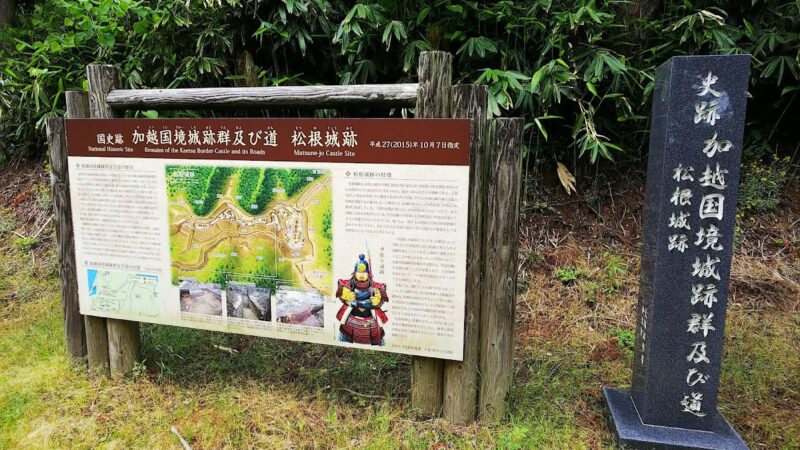
Matsune Castle (Toyama Prefecture): A castle that once faced Kiriyama Castle as a Sasa clan stronghold. Currently located on the Toyama Prefecture side, actually seeing its relative position to Kiriyama Castle helps to understand the military tensions of the time.
Kanazawa Castle: Kanazawa Castle, the residence of Maeda Toshiie, was the base of Kiriyama Castle. Currently, it is maintained as Kanazawa Castle Park, where visitors can see a variety of stone walls, earning it the nickname “museum of stone walls.” Along with a visit to Kiriyama Castle, it is a must-see historical site for understanding the Maeda clan’s castle system.
Historical Significance and Evaluation of Kiriyama Castle
Maeda Clan’s Border Defense Strategy
Kiriyama Castle played a crucial role in the border defense system constructed by Maeda Toshiie. In addition to Kiriyama Castle, several other fortresses were positioned along the border between Kaga Province and Etchu Province, coordinating with each other to form a defensive line.
This defense concept not only prevented enemy invasions but also functioned as a network for early warning and information transmission. The distance from Kiriyama Castle to Kanazawa Castle is approximately 15 kilometers in a straight line, within the range where information could be transmitted by smoke signals and fast horses.
The Maeda clan’s border defense strategy held significant importance in maintaining their independence as a daimyo under the Toyotomi regime. By demonstrating defensive capabilities against external enemies, they aimed to maintain the stability of their territory and their political position.
A Typical Example of a Sengoku Period Mountain Castle
Kiriyama Castle is a valuable example for studying the structure and construction techniques of Sengoku period mountain castles. It possesses typical elements of a Sengoku period mountain castle, such as earthworks, moats, and bailey layouts, and is also well-preserved.
Particularly noteworthy is its character as a hastily constructed castle built in a short period. It is not a permanent residence, but rather a castle built for a specific military purpose, and abandoned once that purpose was achieved—a pattern characteristic of Sengoku period castles.
Furthermore, it is distinctive for being constructed using only civil engineering techniques, without the use of stone walls. This indicates that it was built during the Tensho era, when full-fledged stone wall construction techniques had not yet spread throughout the Hokuriku region.
Its Place in Local History
Kiriyama Castle is one of the important historical sites for understanding the history of Kanazawa City. Kanazawa is famous for Kanazawa Castle, which developed as a castle town under the Maeda clan. However, it’s important not to forget that its prosperity was underpinned by the security provided by border fortresses like Kiriyama Castle.
For local residents, Kiriyama Castle symbolizes the history of their hometown. In the Kiriyama-cho area, preservation activities and historical research of the castle ruins are being carried out by local volunteers, making it a core element of the region’s identity.
In recent years, there have been movements to utilize Kiriyama Castle as a local historical resource. By welcoming visitors from history enthusiasts and castle fans, it has the potential to contribute to the revitalization of the region.
Current Status and Challenges of Kiriyama Castle Research
Excavation Surveys and Research Results
No full-scale archaeological excavations have been conducted on Kiriyama Castle to date. All currently identifiable remains are civil engineering structures remaining on the ground surface. Therefore, detailed information about the castle’s structure, the period of its use, and the circumstances of its abandonment are limited to estimations based on historical documents and surface observations.
Regarding the castle’s layout, surveys and drawings have been conducted by castle researchers, clarifying the basic structure. However, details such as the specific use of each enclosure and the arrangement of buildings remain subjects for future research.
Even in historical documents, descriptions of Kiriyama Castle are limited. While the activities of Fuwa Naomitsu can be confirmed in documents related to the Battle of Suemori Castle, detailed records of Kiriyama Castle itself are scarce.
Preservation and Utilization Efforts
Currently, Kiriyama Castle has not received official designation as a historical site. Therefore, there is no organized preservation management, and it is maintained in its natural state.
On the other hand, local history enthusiasts and castle researchers are carrying out voluntary preservation activities. Volunteer-based activities such as regular grass cutting and maintenance of the approach to the castle contribute to the maintenance of the castle ruins.
Future challenges include formal evaluation and designation as a historical site, and the establishment of a planned preservation management system. Furthermore, balancing visitor safety with the utilization of the site as a historical resource is also an important consideration.
Future Research Directions
Research on Kiriyama Castle still has many unanswered questions. The following are some promising directions for future research:
Archaeological Investigation: The discovery and analysis of artifacts through excavation are essential for clarifying the period of use and the living conditions of the castle’s inhabitants. In particular, the confirmation of building remains in the main enclosure and baileys will provide important information for understanding the castle’s function.
Excavation of Historical Documents: New information about Kiriyama Castle may be contained within historical documents related to the Maeda and Fuwa families. Extensive research of historical materials, including local documents and temple/shrine records, is required.
Comparative Research with Surrounding Castles: Instead of studying Kiriyama Castle in isolation, comparative research with surrounding castles such as Katada Castle and Matsune Castle will deepen our understanding of the Maeda clan’s overall defense system.
Positioning within Local History: Research that considers Kiriyama Castle not merely as a military facility, but within its context with the local community, is also important. An approach from a regional history perspective is expected, focusing on the impact of the castle’s construction and maintenance on local residents, and land use after its abandonment.
Summary: The Charm of Kiriyama Castle and the Significance of Visiting It
Kiriyama Castle was built for a short period of just a few years at the end of the Sengoku period, with the clear purpose of defending the border between Kaga and Etchu provinces, and then its role came to an end. While it lacks a magnificent keep or stone walls, its basic defensive structures—earthworks and moats—remain well-preserved, making it a valuable historical site where one can experience the essence of a Sengoku period mountain castle.
The fact that Fuwa Naomitsu, a senior retainer of Maeda Toshiie, served as the castle lord and played a leading role in the Battle of Suemori Castle indicates that this castle was not merely a surveillance post, but a military facility designed for actual combat. In a crucial phase of Sengoku history in the Hokuriku region, during the conflict with Sasa Narimasa, Kiriyama Castle played a frontline role.
Currently, Kiriyama Castle rests in a quiet mountain forest. With few visitors and minimal maintenance, this site allows you to truly experience the atmosphere of the Sengoku period. Standing atop the earthen ramparts and gazing north towards Etchu Province, you can almost feel the tension of the soldiers who monitored the movements of the Sasa clan here 440 years ago.
Many tourists visiting Kanazawa visit famous historical sites such as Kanazawa Castle and Kenrokuen Garden, but venturing to lesser-known mountain castles like Kiriyama Castle provides a more comprehensive understanding of the Maeda clan’s rule over their territory. The prosperity of Kaga Province, with its million koku of rice production, was built upon the security provided by these border fortresses.
A visit to Kiriyama Castle holds more significance than simply sightseeing a historical site. It is an experience that allows you to reflect on the role played by small, provincial castles that do not appear on the main stage of history, and to use your imagination to envision the lives of the people who lived during the Sengoku period. Through the remains of earthen ramparts and moats, it is a precious opportunity to feel history firsthand.
When you visit Kanazawa City in Ishikawa Prefecture, be sure to also visit Kiriyama Castle. In stark contrast to the splendor of Kanazawa Castle, a simple yet powerful Sengoku period mountain castle awaits you.