Complete Guide to Kifune Castle Ruins (Takaoka City, Toyama Prefecture): From the Ishiguro Clan’s Residence to the Tensho Earthquake
Kifune Castle, located in Kifune, Fukuoka-machi, Takaoka City, Toyama Prefecture, is an important medieval castle known as “Takaoka Castle” before the construction of Takaoka Castle. Built in 1184 by Ishiguro Mitsuhiro, a powerful local lord of Etchu Province, this flatland castle boasts a history of approximately 400 years and is currently protected as a Toyama Prefecture designated historical site. This article provides a comprehensive explanation of Kifune Castle, including its historical background, structure, the tragedy caused by the Tensho Earthquake, and its current state.
Historical Background of Kifune Castle
Construction by Ishiguro Mitsuhiro
Kifune Castle (木舟城) was built in 1184 by Ishiguro Taro Mitsuhiro. It is sometimes written as Kifune Castle or Kifune Castle, but both refer to the same castle.
Ishiguro Mitsuhiro was a powerful local lord in Etchu Province who distinguished himself in the Battle of Kurikara Pass in 1183, fighting alongside Kiso Yoshinaka (Minamoto no Yoshinaka) against the forces of Taira no Koremori. Having expanded his power through this military achievement, the Ishiguro clan is said to have built Kibune Castle as a new base in a strategic location in the northern part of the Tonami Plain.
The Ishiguro clan originally resided at Fukumitsu Castle, but as the family prospered, several branch families were established, and one of these branches built its own independent power base at Kibune Castle. Kibune Castle’s location on a slightly elevated area on the right bank of the Oyabe River was strategically important, making it a symbolic fortress representing the Ishiguro clan’s power base in Etchu Province.
The Ishiguro Clan’s Rule in the Medieval Period
After its construction, Kibune Castle continued to function as the Ishiguro clan’s residence. Throughout the medieval period, the Ishiguro clan played a central role in the politics, economy, and military affairs of the region as a powerful local lord in Etchu Province.
The castle town also developed, and it is believed that a town measuring approximately 1.2 kilometers east-west and 1 kilometer north-south was formed. This was a considerably large castle town for its time, indicating that Kibune Castle functioned not merely as a military base, but as a central city in the region.
Changes in the Sengoku Period
With the arrival of the Sengoku period (Warring States period), Kibune Castle was also tossed about by the tides of the times. Etchu Province became a battleground for various forces, including the Uesugi clan, the Ikkō-ikki rebels, and the Oda clan, and Kibune Castle was caught in the middle of this turmoil.
During the Tenshō era, Sasa Narimasa, a vassal of Oda Nobunaga, came to control Etchu Province, and Kibune Castle temporarily functioned as a castle under Sasa Narimasa’s control. During this period, Kibune Castle was positioned as one of the important bases for controlling Etchu Province.
Maeda Hidetsugu’s Entry into Kibune Castle and the Tensho Earthquake
In 1585, after Toyotomi Hideyoshi’s conquest of Etchu Province, Maeda Hidetsugu, the youngest brother of Maeda Toshiie, entered Kibune Castle. Hidetsugu was expected to play a crucial role in supporting his brother Toshiie’s rule over Etchu.
However, fate was cruel. Just a few months after his entry, in November of 1585 (January 1586 in the Western calendar), the Tensho Earthquake, a major disaster that would go down in history, struck. This massive earthquake, estimated to have a magnitude of 7.8 to 8.0, caused immense damage from the Tokai region to the Hokuriku region.
Kibune Castle collapsed overnight, and its lord, Maeda Hidetsugu, and his wife lost their lives in the castle’s collapse. The tragic end of Hidetsugu and his wife is etched in history as a symbol of the devastation caused by the Tensho Earthquake. The castle town also suffered catastrophic damage, and many residents perished.
The Abandonment of the Castle and Its Aftermath
Following the devastating damage caused by the Tensho Great Earthquake, Kibune Castle was effectively abandoned. The Maeda clan moved their base of operations for Etchu Province to another castle, and Kibune Castle was never rebuilt.
Later, in 1605, when Takaoka Castle was built by Maeda Toshinaga, Takaoka became the new center of the region, and Kibune Castle’s historical role came to a complete end. Its importance is evident from the fact that until Takaoka Castle was built, “Takaoka Castle” referred specifically to Kibune Castle.
The Structure and Scale of Kibune Castle
Characteristics as a Flatland Castle
Kibune Castle is a flatland castle located on the right bank of the Oyabe River in the northern part of the Tonami Plain. It employs a rare flatland castle style for a castle built from the late Heian period to the early Kamakura period, and is considered an important historical site that demonstrates the characteristics of castle architecture at that time.
The castle was built on a slightly elevated area and surrounded by deep rice paddies (wetlands). This defensive system, skillfully utilizing the natural terrain, demonstrates a unique defensive philosophy in an era dominated by mountain castles. The deep rice paddies made enemy approach difficult and effectively defended against cavalry attacks.
Three-Enclosure Structure and Moat Arrangement
Kibune Castle had a three-enclosure structure, with the main enclosure (honmaru) at its center, and enclosures located to the north and south. This arrangement enhanced the castle’s defensibility while also allowing for the dispersed placement of living spaces and administrative functions.
The castle was surrounded by three moats, clearly demonstrating a multi-layered defensive strategy. The three-tiered defensive line—the inner moat protecting the innermost enclosure, the middle moat protecting the middle enclosure, and the outer moat protecting the outermost enclosure—represented advanced castle-building techniques for the time.
The water in the moats was drawn from the surrounding wetlands and the Oyabe River, and it is believed that they always functioned as water-filled moats. These water-filled moats may have served not only a defensive function but also provided water for daily life and agriculture within the castle.
Scale of the Castle Town
As mentioned above, the castle town of Kibune Castle measured approximately 1.2 kilometers east-west and 1 kilometer north-south. This size was considerable for a regional castle town in the medieval period, suggesting that commercial activity and handicrafts flourished.
The castle town contained not only samurai residences but also residential areas for merchants and artisans, as well as temples and shrines, functioning as a complete city. It is believed that before the Tensho earthquake, the Kibune castle town was one of the important economic and cultural centers in Etchu Province.
Current State of Kibune Castle Ruins
Current Status of the Remains
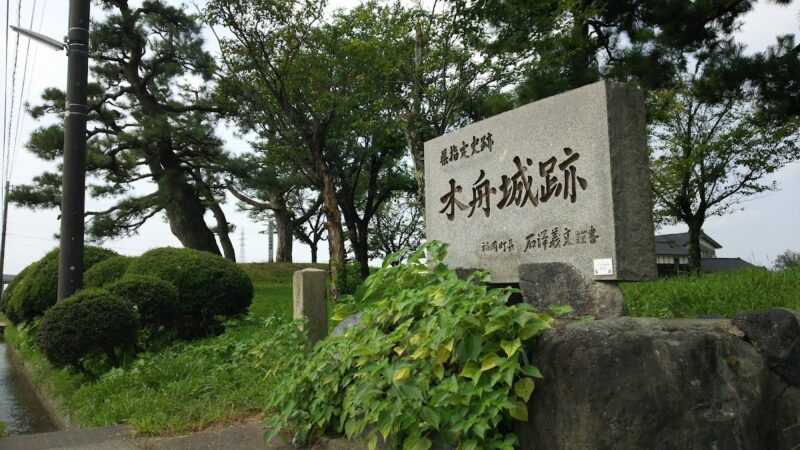
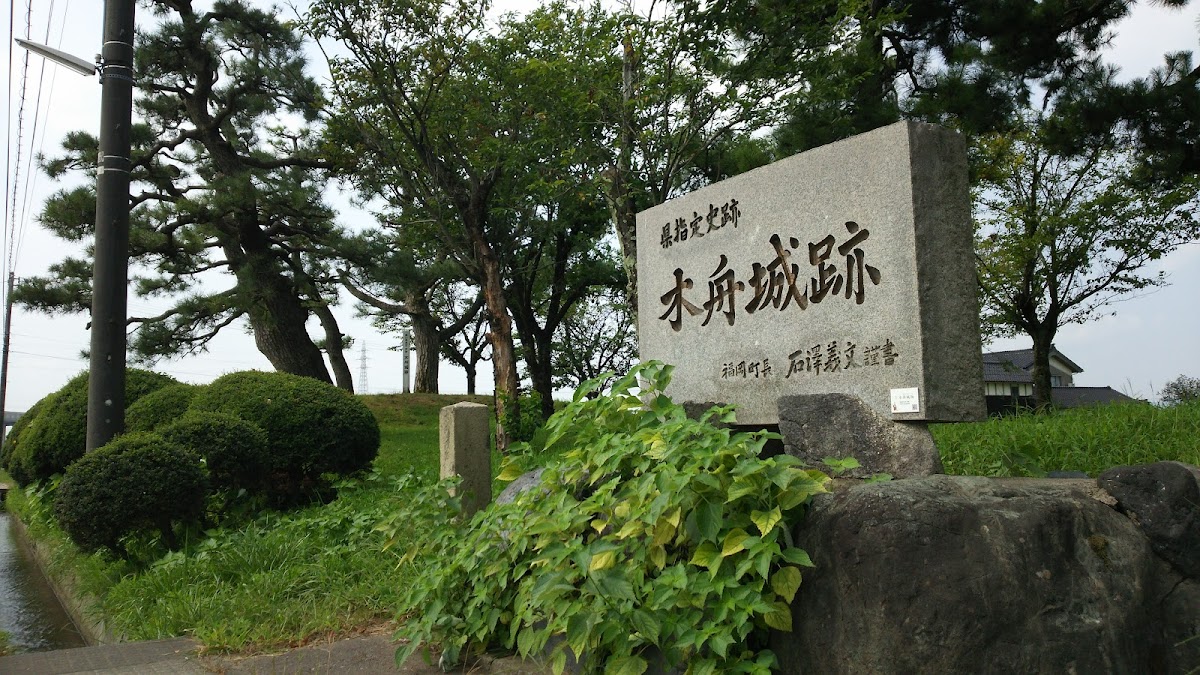
The current Kibune Castle ruins are located in the rice paddy area of Kibune, Fukuoka-machi, Takaoka City, Toyama Prefecture. The magnificent appearance of the former castle has been lost, and only a slightly elevated area, thought to be part of the castle grounds, remains in the rice paddies.
However, careful observation reveals traces of the former castle. Subtle undulations of the terrain indicate the layout of the castle grounds, and areas where the surrounding rice paddies are lower are likely the remains of moats. A portion of the castle ruins has been developed into a small park with information boards. While the remains themselves are small, some parts remain clearly visible, making it a valuable historical site from the perspective of castle archaeology.
Protection as a Toyama Prefecture Designated Historic Site
Kibune Castle Ruins are officially designated as a Toyama Prefecture Historic Site and are protected under the Cultural Properties Protection Law. This designation restricts the destruction of remains and unauthorized excavation, ensuring that its historical value is passed on to future generations.
The local Takaoka City and Fukuoka Town are working to preserve and utilize the Kibune Castle Ruins, carrying out regular grass cutting and updating of information boards. It is also used as a site for local history education, and is a subject of local history studies for elementary and junior high school students.
Access and Visiting Information
Kibune Castle Ruins are approximately a 15-minute walk from JR Fukuoka Station. If traveling by car, it is approximately 20 minutes from the Takaoka Interchange on the Hokuriku Expressway.
The area surrounding the castle ruins is a quiet, rural landscape. From spring to autumn, the rice paddies are a beautiful green, allowing visitors to enjoy a peaceful historical stroll. Visiting is free, and there is no entrance fee.
Information boards are installed on-site, where you can learn about the history and structure of Kibune Castle. However, since much of the castle site is private land and farmland, visitors should be considerate and avoid disturbing the lives and agricultural work of local residents.
Historical Significance of Kibune Castle
Strategic Importance in Etchu Province
Kibune Castle played a crucial role in the politics and military affairs of Etchu Province. Its location in the northern part of the Tonami Plain was a vital transportation hub connecting Kaga Province and Etchu Province, and also a strategically important location controlling the water transport of the Oyabe River.
The fact that the Ishiguro clan built a castle in this location indicates not only their military achievements in the Battle of Kurikara Pass, but also their deep understanding of the geopolitical importance of this region.
Advanced Design as a Flatland Castle
Despite being built at the end of the 12th century, the adoption of a flatland castle design demonstrates the advanced nature of Kibune Castle. At the time, most castles were mountain castles, and flatland castles were a minority.
The ability of Kibune Castle to adopt a flatland castle design is thought to be due to its ability to utilize the surrounding wetlands for defense, and the high economic power and technical skill of the Ishiguro clan. This flatland castle design can be said to have foreshadowed the castle designs that became mainstream from the Sengoku period to the early modern period.
A Historical Witness to the Tensho Earthquake
Kibune Castle is remembered in history as a symbol of the damage caused by the Tensho Earthquake. The tragedy of Maeda Hidetsugu and his wife is an important historical episode that conveys the horrific nature of this great earthquake.
The Tensho Earthquake was one of the largest earthquakes in Japanese history, and the collapse of Kibune Castle is an important example for understanding the scale and impact of this natural disaster. From the perspective of disaster history research, the Kibune Castle ruins are a valuable historical site.
Nearby Historical Sites
Historical Heritage of Fukuoka Town
Fukuoka Town in Takaoka City, where the Kibune Castle ruins are located, is home to many other historical sites. Fukuoka Town flourished as a transportation hub from ancient times, and historical buildings and sites from the medieval to early modern periods are scattered throughout the area.
Nearby, there are temples and shrines associated with the Ishiguro clan, as well as traces of medieval roads. Visiting these sites in conjunction with the Kibune Castle ruins allows for a deeper understanding of the region’s history.
Connection to Takaoka Castle
An essential aspect of understanding the history of Kibune Castle is its relationship with Takaoka Castle, which was built later. Takaoka Castle was built in 1605 by Maeda Toshinaga and became the central castle of Etchu Province, replacing Kibune Castle.
The Takaoka Castle ruins are now maintained as Takaoka Old Castle Park and are approximately 15 minutes by car from the Kibune Castle ruins. Visiting both castle ruins allows you to experience the evolution of castles in Etchu Province and the history of the Maeda clan’s rule.
Current Status and Challenges of Kibune Castle Research
Archaeological Investigation
Partial excavations have been conducted at the Kibune Castle site, uncovering fragments of medieval pottery and building foundations. These artifacts provide important information for understanding the castle’s age and characteristics.
However, large-scale excavations are difficult because most of the castle site is still used as farmland. It is hoped that the use of non-destructive testing techniques (such as ground-penetrating radar) will reveal the complete picture of the underground remains.
Research on Historical Documents
While historical documents concerning Kibune Castle are limited, fragmentary descriptions remain in the *Taiheiki* and local ancient documents. Research continues to shed more detail on the castle’s history and the activities of the Ishiguro clan by carefully interpreting these documents.
Records concerning the Tensho Great Earthquake are particularly important from the perspective of disaster history research, and multifaceted research is underway. Records concerning the death of Maeda Hidetsugu are valuable primary sources for understanding the extent of the damage at the time.
Records concerning the Tensho Great Earthquake are particularly important from the perspective of disaster history research, and multifaceted research is being conducted. ### Challenges in Preservation and Utilization
There are several challenges in preserving and utilizing the Kibune Castle ruins. The biggest challenge is that the majority of the remains are on private land. Balancing agricultural use with historical site protection is not easy, and the understanding and cooperation of landowners are essential.
Furthermore, raising awareness of the castle ruins is another challenge. It is less well-known than Takaoka Castle, and the number of visitors is limited. To promote its use as a tourist resource, improvements to information facilities and strengthening of information dissemination are necessary.
Summary
Kibune Castle is a medieval flatland castle located in Kibune, Fukuoka-machi, Takaoka City, Toyama Prefecture, built in 1184 by Ishiguro Mitsuhiro. It has a history of approximately 400 years as the residence of the Ishiguro clan, a powerful family in Etchu Province who played an active role in the Battle of Kurikara Pass, and was the center of the region, encompassing a castle town measuring 1.2 kilometers east-west and 1 kilometer north-south.
During the Sengoku period, Kibune Castle served under the control of Sasa Narimasa. In 1585, Maeda Hidetsugu, the youngest brother of Maeda Toshiie, entered the castle. However, the castle collapsed in the Tensho Great Earthquake of November of the same year, and Hidetsugu and his wife lost their lives. This tragedy led to the abandonment of Kibune Castle, and Takaoka Castle later became the new center of the region.
Currently, the Kibune Castle ruins are protected as a Toyama Prefecture designated historical site, and a slightly elevated area, believed to be part of the castle’s enclosure, remains amidst the rice paddies. Although small in scale, the remains are clearly identifiable, making it a valuable historical site from the perspective of medieval castle research and disaster history research.
The fact that “Takaoka Castle” referred to Kibune Castle before Takaoka Castle was built clearly demonstrates its historical importance. Kibune Castle disappeared from the historical stage due to the natural disaster of the Tensho Great Earthquake, but its remains still quietly tell the story of its former glory and tragedy.
Visiting the ruins of Kibune Castle offers a valuable opportunity to learn about the medieval history of Etchu Province, the Maeda clan’s rule over Etchu, and the historical disaster of the Tensho Great Earthquake. The castle ruins, quietly remaining amidst the rural landscape, are a place that makes you feel both the weight of history and the awe-inspiring power of nature.