Kamo Castle Ruins (Kamo, Fukuoka-machi, Takaoka City) | A Thorough Explanation of the History and Remains of a Medieval Mountain Castle in Toyama Prefecture
Located in Kamo, Fukuoka-machi, Takaoka City, Toyama Prefecture, Kamo Castle Ruins is an important mountain castle site that tells the history of the Etchu region from the Nanboku-cho period to the Sengoku period. Currently protected as a Takaoka City designated historical site, the remains such as dry moats and baileys, which retain the appearance of the time, can still be seen. This article will provide a detailed explanation of Kamo Castle’s historical background, records found in historical documents, the characteristics of its castle structure, and how to access the site.
What is Kamo Castle? | A Medieval Mountain Castle in Kamo, Fukuoka-machi, Takaoka City, Toyama Prefecture
Kamo Castle is a medieval mountain castle built in the mountainous area of Kamo, Fukuoka-machi, Takaoka City, Toyama Prefecture. Its exact location is Kamo, Fukuoka-machi, Takaoka City, Toyama Prefecture, in an area known as Shirogahira. Built on a hilly area at an altitude of approximately 200 meters, this castle functioned as a strategic military stronghold in Etchu Province from the Nanboku-cho period to the Sengoku period.
The most distinctive feature of Kamo Castle is that its name is recorded in multiple historical documents. It appears as “Kamo Castle” or “Kamoyama no Futatsujo” in primary historical sources of the time, such as the “Ninomiya En’a Gunchujo” and Reizei Tamehiro’s “Etchu Shimomuki Nikki,” suggesting its important role in the region.
Currently, the Kamo Castle ruins are protected as a designated historical site by Takaoka City, and some of the castle remains are well-preserved. It attracts attention among local history enthusiasts and castle researchers as a typical example of a medieval mountain castle in Etchu Province.
History of Kamo Castle | From the Nanboku-cho Period to the Sengoku Period
Kamo Castle in the Nanboku-cho Period (14th Century)
The oldest reliable record of Kamo Castle dates back to Joji 2 (1363). According to the “Ninomiya En’a Military Service Report,” on March 13th of that year, the Ninomiya clan, participating in the punishment of Momoi Naotsune, were ordered to serve as the Kamo Castle Corps.
Momoi Naotsune was a military commander during the Nanboku-cho period, who served Ashikaga Takauji and later expanded his power in the Etchu and Echigo regions. During the Jōji era, he clashed with the shogunate, and fierce battles raged within Etchu Province. The fact that the Ninomiya clan was mobilized as the Kamo Castle Corps indicates that Kamo Castle was already functioning as a military base at that time.
Furthermore, records show that on May 12th of the same year, they burned down Atamagata Castle (Atamagawa Castle) along with the Kamo Castle Corps. Atamagata Castle is believed to have been located in the present-day Fukuoka-machi area of Takaoka City. The participation of the Kamo Castle Corps in this operation suggests that Kamo Castle functioned not merely as a defensive base, but also as a base for active military operations.
Kamo Castle in the Mid-Muromachi Period (15th Century)
Records indicate that during the Chōroku era (1457-1460), Akamatsu Masanori, the governor of half of Kaga Province, resided in a place called Jōgahira, above Goishō Takahata Village (Kamo).
Akamatsu Masanori was a powerful daimyo of the Muromachi Shogunate and, as the governor of half of Kaga Province, wielded influence in the Etchū region as well. The fact that the Akamatsu clan established their residence around Kamo Castle indicates the politically and militarily important location of this area. Goishō is the area stretching from present-day Fukuoka-machi in Takaoka City to Imizu City, a strategically important location overlooking the fertile plains of the Oyabe River basin.
Kamo Castle in the Sengoku Period (Late 15th Century)
In 1491 (Entoku 3), the “Etchu Shimomuki Nikki” (Diary of My Journey to Etchu Province), a record of a visit to Etchu Province by the court noble Reizei Tamehiro, contains the description of “Two Castles on Mount Kamo.”
This expression “two castles” suggests the possibility that Kamo Castle consisted of two castle buildings, or two main baileys. Indeed, on-site investigations have confirmed multiple leveled areas and dry moats, suggesting a structure where the castle was divided into multiple sections.
Reizei Tamehiro was a court noble from Kyoto who visited Etchu Province to record its cultural state. His record of Kamo Castle, viewed from the perspective of a cultural figure rather than a military one, is a valuable historical source for understanding how castles were perceived at the time.
Structure and Remains of Kamo Castle
Layout and Arrangement of Baileys
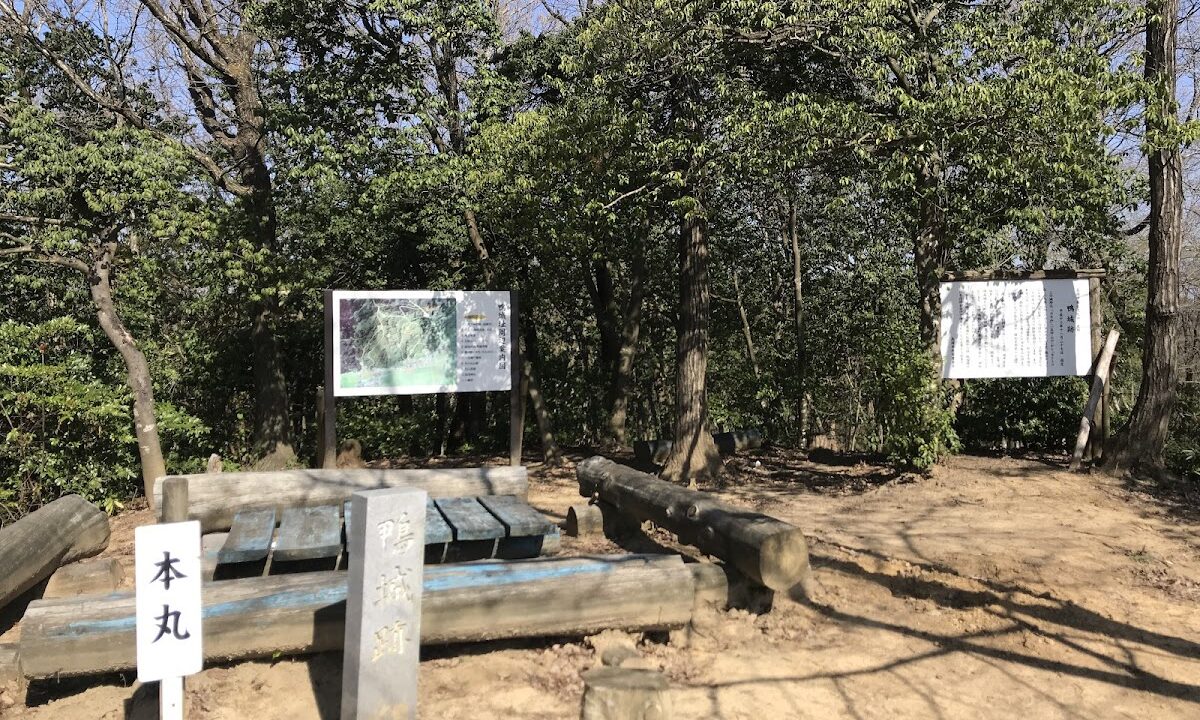
Kamo Castle possesses the typical structure of a medieval mountain castle, characterized by a layout that skillfully utilizes the natural terrain. The main enclosures were located on the mountaintop and along the ridge, and each can still be seen today as a flattened surface created by leveling.
As can be inferred from the record “Two Castles of Kamo Mountain,” the castle is thought to have been divided into two main parts. One was the main castle area centered around the main enclosure, and the other was a secondary enclosure or outpost-like section. This type of multi-enclosure structure is a common feature of mountain castles from the Sengoku period, and was intended to improve defensive capabilities and disperse the command structure.
Dry Moats and Defensive Structures
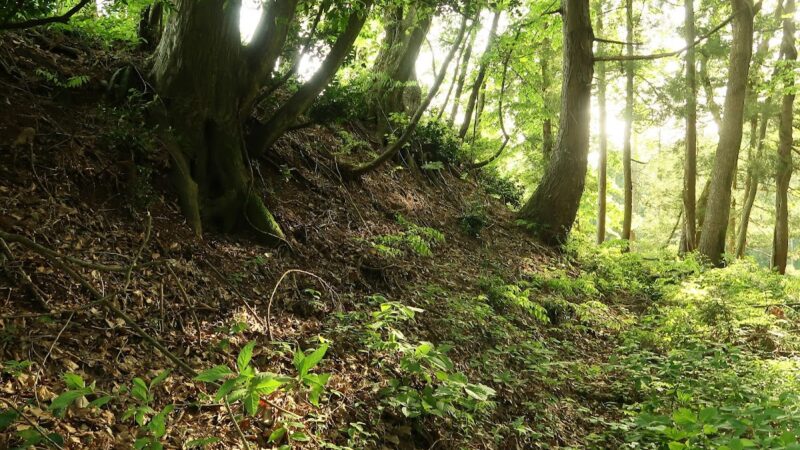
The most prominent remaining structure at the Kamo Castle site is the dry moats. Dug between enclosures or along the ridge, these dry moats were important defensive structures to prevent enemy intrusion.
The dry moats that can be seen on site are several meters deep and several meters wide, demonstrating the high level of castle-building technology of the time. In particular, the dry moats around the main enclosure show signs of later renovations that strengthened their defensive capabilities.
The layout of the dry moats reveals the location of the castle’s main entry points and the direction from which attacks were anticipated. In the case of Kamo Castle, the layout was designed to guard against approaches from the Oyabe River basin, suggesting it played a role in monitoring major roads within Etchu Province.
Mototoriyama and Fort Ruins
In the area surrounding Kamo Castle, a location called Mototoriyama and several fort ruins have been identified. These are thought to have functioned as subsidiary castles or watchtowers of Kamo Castle, forming part of a castle network.
Mototoriyama is located a short distance from the main Kamo Castle, situated at a point that allowed for monitoring a wider area. In medieval mountain castles, it was common to construct a wide-area defensive network by placing multiple forts not only in addition to the main castle but also in the surrounding area.
Historical Background of Kamo Castle and Etchu Province
Etchu Province during the Nanboku-cho Period
During the Nanboku-cho period (14th century), Etchu Province was one of the front lines where the forces of the Southern and Northern Courts fiercely clashed. The record that the Kamo Castle forces participated in Momoi Naotsune’s punitive expedition indicates that this region was not merely a frontier, but an important area directly influenced by the political and military movements of the central government.
Etchu Province was a crucial transportation hub connecting Kyoto, the Hokuriku region, and the eastern provinces, with the Oyabe River basin being a particularly important route. It is believed that Kamo Castle functioned as a base for monitoring and controlling this transportation route.
Regional Control in the Muromachi and Sengoku Periods
During the Muromachi period, a complex system of governance was formed in Etchu Province, involving shugo (provincial governors) and local lords. While powerful central shugo like Akamatsu Masanori exerted influence in Etchu, local lords also built their own power bases.
While the specific clans that formed the base of power at Kamo Castle are not entirely clear, historical records confirm the involvement of the Ninomiya clan and local lords. During the Sengoku period (Warring States period), Etchu Province became a battleground for various forces, including the Uesugi clan, the Ikkō-ikki rebels, the Oda clan, and Sasa Narimasa, and it is presumed that Kamo Castle was also affected by these conflicts.
Current Status and Preservation of Kamo Castle Ruins
Protection as a Takaoka City Designated Historic Site
Kamo Castle Ruins are officially designated as a Takaoka City Designated Historic Site and are protected as a valuable historical heritage of the region. The city conducts regular surveys and preservation activities, and measures are taken to prevent the destruction of the remains.
The historic site designation protects the ruins from uncontrolled development, and academic research is continuously conducted. Local history research groups and castle researchers are also actively conducting surveys, accumulating new discoveries and knowledge.
Visiting the Ruins and Points to Note
When visiting Kamo Castle Ruins, precautions specific to mountain castles are necessary. The ruins are located in a forest, and there are no clearly defined walking paths. Please note the following points when visiting:
- Appropriate clothing and equipment: Clothing suitable for mountain hiking, such as hiking boots, long sleeves, and long pants, is necessary.
- Seasonal selection: The ruins are easier to observe from winter to early spring than in summer when the vegetation is lush.
- Safety precautions: Avoid traveling alone, and if possible, it is advisable to be accompanied by a local guide.
- Protection of ruins: Act carefully to avoid damaging the dry moats and baileys.
Access information and nearby attractions
How to access Kamo Castle Ruins
Location: Kamo, Fukuoka-machi, Takaoka City, Toyama Prefecture
Access by car:
- Approximately 20 minutes from Takaoka IC on the Hokuriku Expressway
- Approximately 10 minutes from Fukuoka IC on the Noetsu Expressway
- Approximately 30 minutes from the center of Takaoka City via National Route 8
Public transportation:
- Get off at Fukuoka Station on the JR Johana Line, then take a taxi or walk (approximately 3 km)
- While it’s possible to use the Kaetsuno Bus, you’ll need to walk from the bus stop.
There is no parking available, so please be considerate of locals when using parking spaces at nearby public facilities or shrines.
Nearby Historical Spots
When visiting Kamo Castle Ruins, we recommend also visiting other historical spots around Fukuoka-machi, Takaoka City:
Fukuoka Castle Ruins: A flatland castle that existed from the Sengoku period to the early Edo period, allowing for a comparison of castle architecture from a different era than Kamo Castle.
Takaoka Old Castle Park: The site of Takaoka Castle, built by Maeda Toshinaga, the second head of the Kaga Maeda family, and one of Japan’s 100 Famous Castles. It’s located in the city center and easily accessible.
Fukuoka-machi Historical and Folk Museum: A facility where you can learn about the local history and culture; it may also have exhibits related to Kamo Castle.
Historical Significance and Future Challenges of Kamo Castle
Position in the Medieval History of Etchu Province
Kamo Castle holds significant importance as a typical example of a medieval mountain castle in Etchu Province, in the following respects:
- Correspondence with Historical Documents: One of the few mountain castles in Etchu Province with records in multiple primary historical sources.
- Long-Term Use: Evidence of use for over 150 years, from the Nanboku-cho period to the Sengoku period.
- Center for Regional Control: Role as a center controlling the Oyabe River basin, a crucial transportation and economic hub.
- Changes in Castle Structure: Traces of renovations and expansions over time can be read from the remains.
Future Preservation and Utilization
Future challenges for the Kamo Castle site include the following:
Continued Academic Research: More detailed surveys and archaeological excavations are expected to reveal the full structure of the castle. In particular, clarifying the specific structure of the “Futatsu Castle” and its changes over time is crucial.
Preservation Environment Development: Because the ruins within the forest are susceptible to natural erosion and vegetation changes, appropriate preservation measures are necessary. At the same time, a balanced preservation plan is required to prevent excessive development from compromising the authenticity of the ruins.
Promotion of Public Access: To raise awareness of the site’s historical value, the installation of information boards, development of viewing paths, and the implementation of guided tours should be considered. However, ensuring safety and protecting the ruins must be a prerequisite.
Community Collaboration: It is crucial to create a system for protecting and passing on the site as a regional historical heritage, in cooperation with local residents and local history research groups. Utilization in school education and collaboration with local events would also be effective.
Summary | The Charm and Significance of Visiting Kamo Castle Ruins
Kamo Castle Ruins, located in Kamo, Fukuoka-machi, Takaoka City, Toyama Prefecture, is a valuable historical site that conveys the history of Etchu Province from the Nanboku-cho period to the Sengoku period. The Kamo Castle ruins, a mountain castle with a solid history backed by historical documents such as the “Ninomiya En’a Military Service Report” (recording participation in the campaign against Momoi Naotsune in 1363) and the description of “the two castles of Kamo Mountain” in Reizei Tamehiro’s “Etchu Shimomuki Nikki” (Diary of a Journey Down to Etchu), have attracted attention from researchers.
The remaining structures, such as dry moats and baileys, are valuable evidence that convey the castle-building techniques and strategic thinking of the time. The leveled surfaces and traces of repeated renovations for defense indicate that this castle was not merely a temporary fort, but a full-fledged mountain castle that was maintained and used for a long period.
Protected as a Takaoka City designated historical site, the Kamo Castle ruins are a worthwhile place to visit for those interested in the medieval history of Etchu, castle enthusiasts, and history buffs. You can fully appreciate the charm of a medieval mountain castle, distinct from Takaoka Castle built by Maeda Toshinaga.
A visit to the Kamo Castle ruins allows you to experience the living history of the region in a way that you can’t learn from textbooks, and to truly understand the important role that Etchu Province played in the political and military history of medieval Japan. When exploring the history of Toyama Prefecture, why not add the Kamo Castle ruins to your list of destinations?