Complete Guide to Katsuyama Castle (Kofu City) | A Medieval Castle in Yamanashi Prefecture, the Stage of the Takeda Clan’s Internal Conflict
What is Katsuyama Castle?
Katsuyama Castle is a medieval mountain castle located in Katsuyama, Kamisone-cho, Kofu City, Yamanashi Prefecture. Built on a hill now occupied by orchards, it occupies a strategic location along the Nakado Highway, connecting Kai and Suruga provinces. In the early Sengoku period, it functioned as an important base during the internal conflicts surrounding the succession of the Takeda clan, and is an indispensable historical site when discussing the history of Kai Province.
Built on an isolated hill approximately 30 meters high, this castle is known as the base of Aburakawa Nobue, son of Takeda Nobumasa. Its name is also recorded in the “Kai no Kuni Shi,” compiled in the late Edo period, making it a valuable cultural heritage site that conveys the region’s historical landscape to the present day.
Historical Background of Katsuyama Castle
The Takeda Clan’s Succession Dispute and Aburakawa Nobue
Katsuyama Castle first appears on the historical stage during the Takeda clan’s succession dispute from the late 15th to the early 16th century. Takeda Nobumasa, the governor of Kai Province, had several sons, and a fierce conflict arose between his eldest son, Takeda Nobunawa, and his second son, Aburakawa Nobue (who adopted the name Aburakawa), over the succession.
Aburakawa Nobue was based in Aburakawa, Yamanashi County, but it is believed he used Katsuyama Castle as an important base. During this period, his father, Nobumasa, was retired, but he became entangled in the conflict between Nobunawa and Nobue, leading to heightened political tensions within the Takeda family.
A Strategic Point on the Nakado Highway
The location of Katsuyama Castle held extremely important military and economic significance. The castle faced the Nakado Highway, which connected Kai and Suruga provinces, giving it a strategic location for monitoring and controlling the movement of supplies and troops. This highway was one of the main routes passing through the southern part of the Kofu Basin and was an indispensable transportation route for the Takeda clan’s control of their territory during the Sengoku period.
It is presumed that Aburakawa Nobue established Katsuyama Castle as his base to gain an advantage in the political and military conflict with his brother, Nobunawa, by controlling this strategic transportation point. The castle’s location on a hill overlooking the Kofu Basin was ideal for monitoring developments in the surrounding area.
Outcome of the Takeda Clan’s Internal Conflict
The conflict between Takeda Nobunawa and Aburakawa Nobue ultimately ended in Nobunawa’s victory. Nobunawa’s son, Takeda Nobutora, inherited the family headship and proceeded to unify Kai province. Nobutora resolved the internal conflict that had plagued his father’s generation and solidified the foundation of the Kai Takeda clan.
While historical records are scarce and many aspects of Katsuyama Castle’s fate after Aburakawa Nobue’s defeat remain unclear, it’s possible it continued to function to some extent within the Takeda clan’s territorial control system. The castle’s subsequent transformations are gradually being revealed through archaeological excavations and documentary research.
Katsuyama Castle’s Layout and Structure
Castle Area and Topographical Utilization
Katsuyama Castle encompassed the entire isolated hill, and it’s believed that a dry moat surrounded its base. Its size, approximately 30 meters in elevation, is medium for a medieval mountain castle, but its location near the plains of the Kofu Basin provides a good balance between defense and convenience.
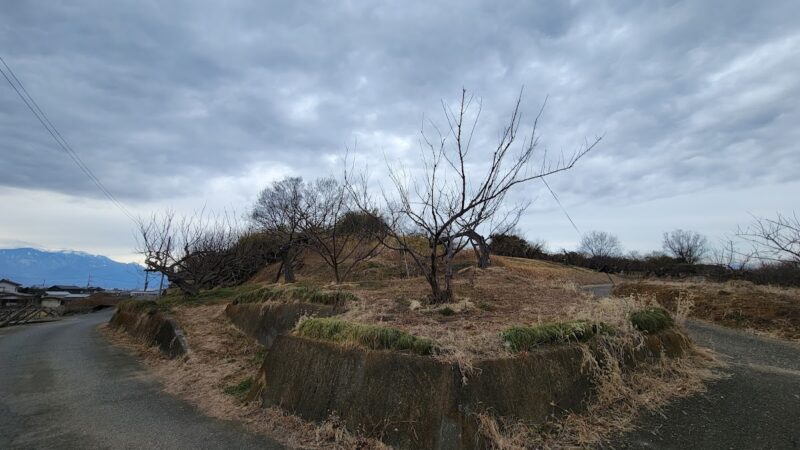
The main enclosure (honmaru) is thought to have been located at the top of the hill, surrounded by multiple smaller enclosures. Currently, the site is used as an orchard, making it difficult to confirm the remains, but the topographical features allow for inference of the original layout.
Confirmed Remains
Field surveys have confirmed the existence of the following remains:
- Enclosures: Multiple levels of flat surfaces have been identified, suggesting a hierarchical layout centered around the main enclosure.
- Earthworks: Traces of earthworks remain on the edges of the enclosures.
- Gate Entrance: Partial traces of a gate entrance to the castle have been confirmed.
- Dry Moat: Traces of a dry moat surrounding the base of the hill remain in the topography.
Due to the limited scope of the excavation, many details of the structure remain unclear. However, it undoubtedly possessed typical characteristics of a medieval mountain castle.
Regarding the Existence of Stone Walls
Some documents suggest the possibility of stone walls existing at Katsuyama Castle. While Kofu Castle in Kai Province is known as a castle entirely constructed of stone walls, there are examples of partial use of stone walls in earlier medieval castles.
However, regarding Katsuyama Castle in Kofu City, there is a possibility of confusion with the castle of the same name (Katsuyama Castle) in Tsuru City, and careful verification is necessary regarding the presence or absence of stone wall remains. While high stone walls characteristic of the Oda-Toyotomi period have been confirmed at Katsuyama Castle in Tsuru City, and are thought to be the result of renovations during the Asano clan era, there are currently few reports of clear stone wall remains at Katsuyama Castle in Kofu City.
Location and Historical Landscape
Positional Relationship in the Kofu Basin
Katsuyama Castle is located in the southern part of the Kofu Basin, in what is now Kamisone-cho, Kofu City. It is approximately 5 kilometers south of Kofu Station, north of the point where the Fuefuki River and Kamanashi River merge to form the Fuji River.
From the hill where the castle stands, one can see a panoramic view of the Kofu Basin, with the city of Kofu to the north and Mount Fuji to the south. This excellent view is thought to have been important for military surveillance.
Relationship with Surrounding Castles
Several castles related to the Takeda clan exist around Katsuyama Castle:
- Kofu Castle: A modern castle built during the Toyotomi regime, and the center of Takeda rule in Kai Province after the fall of the Takeda clan.
- Tsutsujigasaki Mansion: The base of the Takeda clan for three generations: Takeda Nobutora, Shingen, and Katsuyori.
- Yogaiyama Castle: A mountain castle that functioned as an outpost for Tsutsujigasaki Mansion.
While these castles and Katsuyama Castle differ in era and function, it is important to consider them in relation to each other in order to understand the Takeda clan’s power development in Kai Province.
Current State as an Orchard
Currently, most of the Katsuyama Castle ruins are used as an orchard. Yamanashi Prefecture is one of Japan’s leading fruit-growing regions, particularly known for its peach and grape production. The castle ruins are no exception; peach blossoms bloom in spring, and grapes are harvested in autumn.
While this land use presents challenges from the perspective of preserving the historical remains, it has also become an established part of the local agricultural landscape, forming a unique scenery where history and modernity coexist. Visitors can stroll through the orchards, imagining the castle as it once was.
How to Access Katsuyama Castle
Access by Public Transportation
To visit Katsuyama Castle ruins by public transportation, the following routes are available:
- From JR Kofu Station: Take a Yamanashi Kotsu bus and get off at the “Nakadobashi” bus stop, then walk for approximately 20 minutes.
- From the bus stop, head south along Prefectural Road 113, using Atago Daigongen as a landmark to reach the castle ruins.
Since bus services are limited, it is recommended to check the timetable in advance. Please note that the number of services may be reduced, especially on holidays.
Access by Car
If traveling by car, the following routes are convenient:
- Chuo Expressway: Approximately 10 minutes from Kofu-Minami Interchange
- National Route 140: Approximately 15 minutes from Kofu city center via Prefectural Route 113
Regarding parking, there is no dedicated parking lot for the castle ruins. Since the surrounding area consists of orchards and residential areas, please avoid street parking and use the parking lots of nearby public facilities or commercial establishments. Please be considerate of others when parking.
Points to Note When Visiting
When visiting Katsuyama Castle Ruins, please note the following:
- Respect for Private Property: Currently, the area is used as an orchard, and most of it is private property. Please refrain from entering without permission.
- Castle Site Monument near the Entrance: A castle site monument is installed at the entrance, serving as a landmark for the castle ruins.
- Confirmation of Remains: Many of the baileys are now overgrown with bushes or cultivated land, making it difficult to clearly identify any remains.
- Season and Clothing: In summer, the area is covered in vegetation, so long sleeves and long pants are recommended to avoid exposing skin.
- Heatstroke Prevention: There is little shade, so especially in summer, bring a hat and drinking water.
Research and Study of Katsuyama Castle
Records in Historical Documents
The most important historical document concerning Katsuyama Castle is the “Kai no Kuni Shi,” compiled in the late Edo period. This local history states that Katsuyama Castle was the base of the Aburakawa clan, and serves as a fundamental source of information for understanding the castle’s history.
However, the description in the “Kai no Kuni Shi” is concise, and much remains unknown about the castle’s detailed structure and changes. Records of Katsuyama Castle in primary sources from the Sengoku period are scarce, and direct mentions of it are rare even in ancient documents related to the Takeda clan.
Current State of Archaeological Investigation
Full-scale excavations at the Katsuyama Castle site are limited. Because the site is currently used as an orchard, large-scale investigations have not been conducted. Only surface surveys and partial trial excavations have confirmed the existence of basic remains such as baileys and earthworks.
Further academic investigations may yield more detailed information about the castle’s construction period, structural changes, and abandonment. In particular, investigations of Katsuyama Castle will be of significant importance in understanding the castle structure during the internal conflicts of the Takeda clan.
Confusion with Castles of the Same Name
There are several castles named “Katsuyama Castle” in Yamanashi Prefecture:
- Katsuyama Castle in Kamisone-cho, Kofu City (the castle discussed in this article): The base of Aburakawa Nobue
- Katsuyama Castle in Tsuru City: A castle associated with the Oyamada and Asano clans, with confirmed stone wall remains.
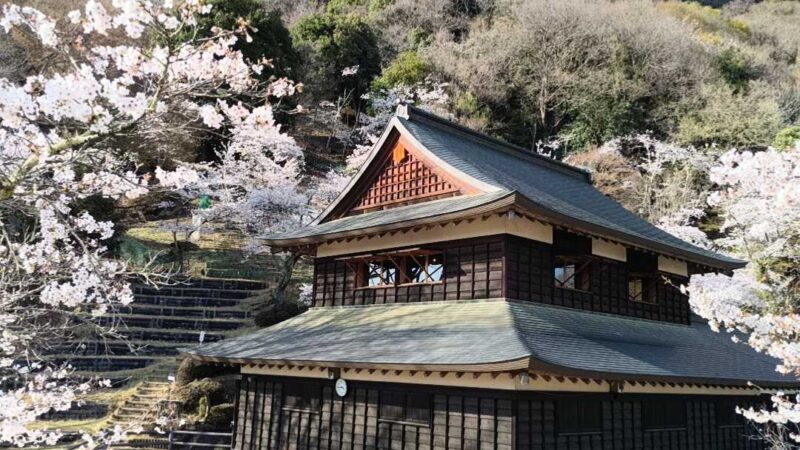
These castles are different castles, and care must be taken not to confuse them. Especially on the internet, information about both castles can be mixed up, so it is important to confirm the location (Kofu City or Tsuru City). Katsuyama Castle in Tsuru City has been developed into Shiroyama Park and is known as a famous cherry blossom viewing spot.
The Position of Katsuyama Castle in Kai Province
The Takeda Clan’s Territorial Control System
The Takeda clan is famous as a Sengoku daimyo, but its foundation was laid during the time of Takeda Nobutora. Before Nobutora, the Takeda clan, while holding the position of shugo (provincial governor), did not always have stable relationships with local lords.
The period in which Katsuyama Castle was functional coincided precisely with this transitional period. Katsuyama Castle, which served as the base of Aburakawa Nobue, influenced the political situation in Kai Province as a stronghold of an internal rivalry within the Takeda clan. Following this internal conflict, the Takeda clan would establish a centralized system of territorial control.
Transition from Medieval Mountain Castles to Early Modern Castles
Many medieval mountain castles like Katsuyama Castle were built in Kai Province throughout the Sengoku period. These castles were defensive structures that skillfully utilized the terrain, primarily consisting of earthworks and dry moats.
However, during the transition from the Toyotomi regime to the Tokugawa regime, the castle system in Kai Province underwent a major transformation. Kofu Castle was built as an early modern castle with all-stone walls, and many other medieval mountain castles were abandoned. It is believed that Katsuyama Castle also lost its military function during this period and was converted into farmland.
Significance in Local History
Katsuyama Castle forms part of the historical identity of the Kamisone-cho area of Kofu City. Although the castle ruins have few prominent remains, for local residents, it symbolizes the history of their hometown.
In recent years, with growing interest in local history, the value of such medieval castles is being re-recognized. The investigation and preservation of “little-known castles” like Katsuyama Castle is an important issue for passing on the region’s cultural heritage to future generations.
Nearby Attractions and Tourist Information
Historic Sites Related to the Takeda Clan
When visiting Katsuyama Castle, we recommend also visiting the nearby historical sites related to the Takeda clan:
- Takeda Shrine (Tsutsujigasaki Mansion Site): A shrine built on the site of the residence of three generations of the Takeda clan. It is designated as a national historic site.
- Kofu Castle Ruins (Maizuru Castle Park): A modern castle built during the Toyotomi regime. Stone walls and turrets have been restored.
- Yogaiyama Castle: A mountain castle said to be the birthplace of Takeda Shingen. Hiking trails are maintained.
- Takeda Clan Residence Ruins Historical Museum (Shingen Museum): A museum where you can learn about the history of the Takeda clan.
Tourist Facilities in Kofu City
Kofu City has a variety of tourist resources in addition to history:
- Shosenkyo Gorge: A scenic spot boasting one of the most beautiful gorges in Japan.
- Yamanashi Prefectural Museum of Art: A museum known for its collection of Millet’s works.
- Koshu Yume Koji: A tourist and commercial facility at the north exit of Kofu Station. Yamanashi’s local products are available.
- Wineries: There are many wineries around Kofu, where you can enjoy tours and tastings.
Yamanashi’s Local Products and Gourmet Food
The area around Katsuyama Castle Ruins is a fruit-growing region, and you can enjoy fresh fruit in each season:
- Peaches: In season from late June to August. Characterized by its sweet and juicy flavor
- Grapes: Various varieties are available from August to October. Kyoho and Shine Muscat are popular.
- Wine: Yamanashi Prefecture is a major wine-producing region in Japan. Please try products from local wineries.
- Hoto: A local dish of Yamanashi. A traditional flavor said to have been enjoyed by Takeda Shingen.
Preservation of Katsuyama Castle and Future Challenges
Value as a Cultural Property
Katsuyama Castle has academic value as a fortress involved in the important historical event of the Takeda clan’s internal conflict. However, it is not currently designated as a cultural property, and no legal protection measures are in place.
Many of the remains are now orchards and bushes, and the state of preservation is not necessarily good. It is hoped that the historical value of the castle ruins will be widely recognized in the future, and that appropriate preservation measures will be taken.
The Need for Further Research
Many aspects of Katsuyama Castle remain unclear:
- The exact construction date and builder
- Detailed layout and its changes
- The time and reason for its abandonment
- The castle’s use after the defeat of Aburakawa Nobue
To answer these questions, further excavation of historical documents and archaeological investigations are essential. Excavation, in particular, is the most effective means of understanding the castle’s true nature, and its future implementation is highly anticipated.
Coexistence with the Community
The Katsuyama Castle site is currently closely intertwined with the lives of the local community. Land use as an orchard is a vital industry supporting the local economy, making it difficult to simply prioritize historical site preservation.
In the future, it will be necessary to consider strategies for protecting and passing on the castle site in cooperation with local residents, while balancing the preservation of historical value with modern land use. It would be realistic to start with measures that can be implemented without significantly altering the current land use, such as installing explanatory signs and developing viewing routes.
Summary
Katsuyama Castle is a fortress connected to a significant historical event in the early Sengoku period: a succession dispute within the Takeda clan. Serving as the base of Aburakawa Nobue, this castle, strategically located along the Nakado Highway, influenced the political situation in Kai Province.
Currently, the site is an orchard, making clear structural remains difficult to ascertain. However, traces of baileys, earthworks, and dry moats remain in the topography. Limited historical documents and archaeological investigations mean many details about the castle remain unknown, but this also makes it a fortress that inspires further research.
When visiting Kofu City, why not visit this “little-known castle” along with the famous Takeda Shrine and Kofu Castle? A stroll through the orchards, reflecting on the internal conflicts within the Takeda clan during the Sengoku period, will be a valuable experience for history buffs.
The preservation and utilization of the Katsuyama Castle ruins is also a challenge in passing on the region’s historical heritage to future generations. I hope that this valuable historical site will be properly protected through the progress of academic research and the understanding and cooperation of local residents.