Katsunuma Castle Ruins Complete Guide | History and Highlights from the Mita Clan’s Residence to the Fall of the Hojo Clan
What is Katsunuma Castle?
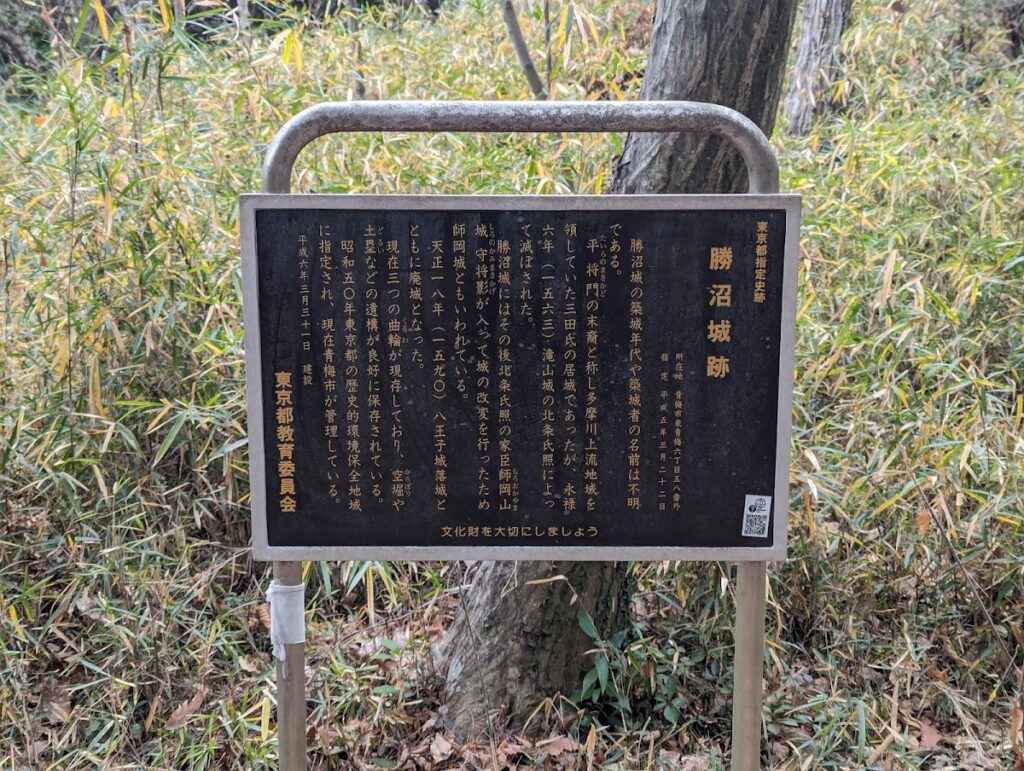
Katsunuma Castle is a medieval mountain castle located in Higashi-Ome, Ome City, Tokyo. Also known as Morooka Castle, it was designated a Tokyo Metropolitan Government Historic Site on March 31, 1993. Furthermore, in 1975, it was designated a Tokyo Metropolitan Government conservation area as the Katsunuma Castle Ruins Historical Environment Preservation Area, and the remains of the original layout, earthworks, and dry moats are still well-preserved.
Katsunuma Castle is a flatland castle built on the top of a hill extending south towards the Kasumigawa River, with the main enclosure located at an altitude of approximately 200 meters. It was used for approximately 260 years as the residence of the Mita clan, who ruled this region from the late Kamakura period to the Sengoku period.
Basic Information about the Castle
- Location: 6-chome, Higashi-Ome, Ome City, Tokyo
- Alternate Name: Morooka Castle
- Castle Structure: Hilltop Castle
- Construction Period: Late Kamakura Period (Early 14th Century)
- Builder: Mita Nagatsuna
- Main Lords: Mita clan, Morooka Masakage, subordinates of Hojo Ujiteru
- Year of Abandonment: Tensho 18 (1590)
- Designation Classification: Tokyo Metropolitan Government Designated Historic Site
- Date of Designation: March 31, 1993 (Heisei 5)
- Owner or Manager: Ome City
History of Katsunuma Castle
Late Kamakura Period to Muromachi Period | The Rise of the Mita Clan
The exact construction date of Katsunuma Castle is unknown, but it is believed to have been built around 1300, at the end of the Kamakura period, by Mita Nagatsuna, a powerful local lord. The Mita clan was a prominent family that existed since the Kamakura period, and they wielded considerable power as influential local lords (kokujin-shu) in western Musashi Province.
In the Muromachi period, the Mita clan played a key role as important retainers of the Yamanouchi Uesugi clan, the Kanto Kanrei (governor of the Kanto region). Using Katsunuma Castle as their base, the Mita clan established control over the Ome area and became the political and economic center of the region. During this period, Katsunuma Castle is thought to have functioned not only as a military base but also as the administrative center of the Mita clan.
Sengoku Period | Relationship with the Hojo Clan
With the arrival of the Sengoku period, the political situation in Kanto changed dramatically. As the Later Hojo clan, based at Odawara Castle, began to expand their power in the Kanto region, the Mita clan was also caught up in the turbulent times.
Initially, Mita Masasada chose to submit to Hojo Ujiyasu as the Yamanouchi Uesugi clan’s power declined. However, when Uesugi Masatora (later Uesugi Kenshin) invaded the Kanto region in 1561, supporting Uesugi Norimasa, Mita Tsunahide, along with other local lords, decided to pledge allegiance to the Uesugi clan.
This decision significantly altered the fate of the Mita clan. Between 1561 and 1563, the Hojo clan’s offensive in the western Tama region intensified, and the Mita clan was destroyed by the Hojo army led by Hojo Ujiteru.
After the Fall of the Mita Clan | Renaming to Morooka Castle
After the fall of the Mita clan, Katsunuma Castle came under the control of Hojo Ujiteru. Morooka Masakage was appointed as the castle lord, and the castle’s name was changed to Morooka Castle. It is believed that Morioka Masakage, as a senior retainer of Hojo Ujiteru, was entrusted with governing this region.
After Mita Tsunahide built and moved to Karagaki Castle in Futamatao in 1561, Katsunuma Castle continued to function as one of the Hojo clan’s bases for controlling western Tama. While Hojo Ujiteru’s main base was Hachioji Castle, he developed a network of castles in the western Tama region, including Katsunuma Castle, strengthening his control over western Musashi Province.
Toyotomi Hideyoshi’s Odawara Campaign and the Abandonment of the Castle
In 1590, when Toyotomi Hideyoshi launched the Odawara Campaign, the Hojo clan was destroyed. It is said that Katsunuma Castle also fell at this time and was subsequently abandoned. With the Toyotomi army’s invasion of the Kanto region, the Hojo clan’s branch castles were successively captured or abandoned, and Katsunuma Castle was no exception.
After its abandonment, Katsunuma Castle lost its function as a military base and fell into disrepair throughout the Edo period. However, the topographical features of the castle site, as well as the remains of earthworks and dry moats, have been preserved relatively well, conveying the appearance of a medieval castle to this day.
Katsunuma Castle’s Layout and Structure
Overall Structure
Katsunuma Castle is a flatland castle composed of three main enclosures. The central enclosure, located north of Komyoji Temple, is the main enclosure (honmaru), with the second enclosure to the east and the third enclosure to the northwest. The castle was built utilizing the top of a hill extending south towards the Kasumigawa River, and its layout skillfully takes advantage of the natural terrain.
The entire castle area extends approximately 300 meters north-south and 200 meters east-west, making it a medium-sized medieval mountain castle. Currently, the site is maintained as the Katsunuma Castle Ruins Historical Environment Preservation Area, and walking paths have been established, allowing visitors to observe the castle’s structure while touring each enclosure.
Main Enclosure (Honmaru)
The main enclosure is located in the center of the castle, built on the highest elevation. It measures approximately 60 meters east-west and 40 meters north-south, and was surrounded by earthen ramparts. Parts of these ramparts still remain today, offering a glimpse into the defensive structures of the time.
From the main enclosure, one can overlook the city of Ome and the surrounding mountains, suggesting it also functioned as a military lookout post. Archaeological excavations have confirmed traces of buildings within the main enclosure, making it highly probable that a building serving as the lord’s residence or administrative center existed there.
Second and Third Enclosures
The second enclosure is located to the east of the main enclosure and is the second most important enclosure after the main enclosure. A dry moat separates it from the main enclosure, demonstrating a defensive design. The second enclosure is thought to have functioned as a secondary defensive base protecting the main enclosure, and may have housed soldiers’ quarters or an armory.
The third enclosure (Sankuruwa) was located northwest of the main enclosure (Shunkuruwa) and is presumed to have served to protect the castle’s rear entrance (Karamete). Traces of earthworks and moats remain around the third enclosure, indicating a multi-layered defensive structure.
Earthworks and Dry Moats
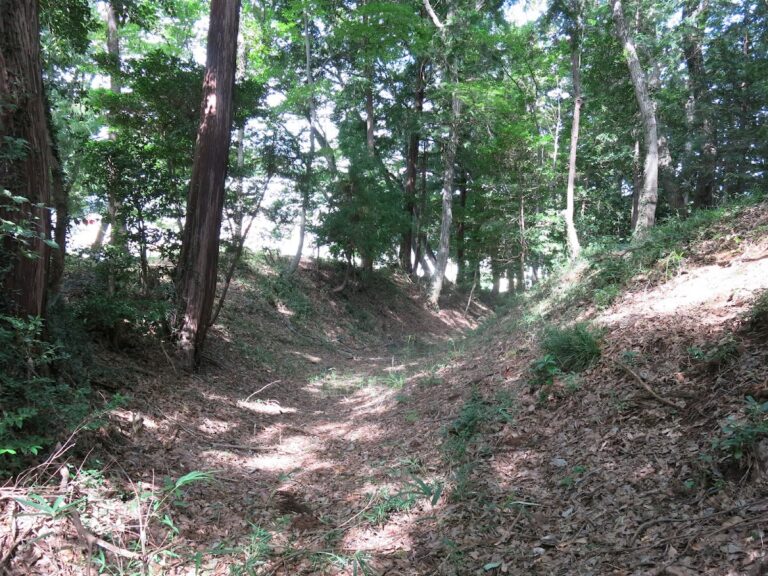
A notable feature of Katsunuma Castle’s defensive structures is its well-preserved earthworks and dry moats. The earthworks surrounding the main enclosure are approximately 2-3 meters high, and parts of them are still clearly visible. These earthworks prevented enemy intrusion and also served as firing positions for arrows and guns from within the castle.
The dry moats were constructed between the enclosures (Kankuruwa) and served to hinder enemy advances. The dry moat between the main enclosure and the second enclosure, in particular, reaches a depth of 4-5 meters in some places, demonstrating the advanced castle-building techniques of the time. It is possible that obstacles were placed at the bottom of the moats, suggesting further enhancements to their defensive capabilities.
Entrances (Koguchi)
It is presumed that the entrances to the castle, known as “koguchi,” were located on the south and east sides of the main enclosure. Around the entrances, a “staggered koguchi” structure with curved earthworks can be seen, a design intended to prevent direct enemy advances. This type of entrance structure is characteristic of castle construction techniques from the Sengoku period, and the influence of renovations by the Hojo clan is also possible.
About the Mita Clan
Origins and History of the Mita Clan
The Mita clan were local lords in the medieval period, based in western Musashi Province. While there are various theories regarding their origins, they are known as a prominent family dating back to the Kamakura period. The Mita clan expanded their power mainly around Ome, and during the Muromachi period, they held an important position as senior retainers of the Yamanouchi Uesugi clan, the Kanto Kanrei (governor of the Kanto region).
The Mita clan’s base was Katsunuma Castle, from which they controlled the surrounding area. The Mita clan not only possessed military strength but also focused on regional development and economic activities, making a significant contribution to the development of Ome.
The Mita Clan’s Territory
During the Sengoku period, the Mita clan extended their influence from Ome to the present-day Nishitama region. Besides Katsunuma Castle, they built several other castles, including Karagaki Castle (Futamatao), strengthening their control over their territory. It is believed that the Mita clan’s territory extended to present-day Ome City, Akiruno City, and Hinode Town.
As a powerful regional figure, the Mita clan engaged in a wide range of administrative activities, including managing agricultural production, controlling commercial activities, and maintaining public order. Furthermore, it is presumed that they wielded considerable influence over the political situation in the Kanto region through their relationship with the Yamanouchi Uesugi clan.
The Circumstances of the Mita Clan’s Downfall
In 1561, when Uesugi Kenshin invaded Kanto, Mita Tsunahide sided with the Uesugi. However, this choice led to a decisive conflict with the Hojo clan, and from around 1561 to 1563, they were attacked by Hojo Ujiteru.
The Mita clan is said to have resisted bravely, but ultimately succumbed to the overwhelming military power of the Hojo clan and was destroyed. After the Mita clan’s downfall, their former territory came under the control of Hojo Ujiteru, and Katsunuma Castle was incorporated into the Hojo clan’s castle network.
Hojo Ujiteru and Katsunuma Castle
Hojo Ujiteru’s Rule over Western Tama
Hojo Ujiteru was a member of the Later Hojo clan, born as the third son of Hojo Ujiyasu. Ujiteru was entrusted with the rule of western Musashi Province, with Hachioji Castle as his base. He strengthened his control over the region, moving his base from Takiyama Castle to Hachioji Castle.
After destroying the Mita clan, Ujiteru improved the castles in the Western Tama region, including Katsunuma Castle, and played a part in the Hojo clan’s control of the Kanto region. Katsunuma Castle was positioned as one of the branch castles linked to Hachioji Castle, becoming an important base in the Hojo clan’s defensive line.
Morioka Masakage’s Appointment as Castle Lord
After the fall of the Sanda clan, Morioka Masakage became the lord of Katsunuma Castle. Morioka Masakage was a senior retainer of Hojo Ujiteru, and Ujiteru entrusted him with the governance of Katsunuma Castle and the surrounding area. The castle’s name was also changed to “Morioka Castle,” establishing the Hojo clan’s rule.
As lord, Morioka Masakage was responsible for maintaining local security, collecting taxes, and mobilizing troops. It is also believed that he carried out renovation work to strengthen the castle’s defenses, following the orders of the Hojo clan.
Castle Renovations by the Hojo Clan
During the period when the Hojo clan controlled Katsunuma Castle, it is possible that renovations were carried out to enhance the castle’s defensive capabilities. The Hojo clan excelled in castle construction techniques and systematically carried out renovations to the castles under their control.
It is presumed that improvements were made to the gate structure, the earthworks were strengthened, and the moats were deepened at Katsunuma Castle. In particular, the sophisticated defensive structures, such as the staggered gate entrances, may indicate the influence of the Hojo clan’s castle-building techniques.
Current Status and Preservation of Katsunuma Castle Ruins
Protection as a Tokyo Metropolitan Government Designated Historic Site
Katsunuma Castle Ruins were designated as the Katsunuma Castle Ruins Historical Environment Preservation Area in 1975 (Showa 50), and on March 31, 1993 (Heisei 5), they were designated as a Tokyo Metropolitan Government Designated Historic Site. This legally protected the preservation and utilization of the castle ruins.
Currently, the castle ruins are managed by Ome City, and ongoing maintenance is being carried out to preserve the remains and ensure the safety of visitors. Walking paths, information boards, and explanatory signs have been installed, allowing even those unfamiliar with history to enjoy the castle ruins.
Existing Remains
At Katsunuma Castle Ruins, the following remains can still be observed:
- Enclosures: The topography of the main enclosure, second enclosure, and third enclosure remains clearly visible.
- Earthworks: Earthworks 2-3 meters high remain, mainly around the main enclosure.
- Dry Moats: Dry moats between enclosures can be observed, approximately 4-5 meters deep.
- Gate Enclosures: The structure of staggered gate entrances can be seen in some areas.
- Moat Cuts: Traces of moat cuts that cut across the ridge.
These remains are valuable resources for understanding the structure of medieval castles and serve as an important learning site for castle researchers and history enthusiasts.
Relationship with Otsukayama Park
Otsukayama Park is adjacent to the south side of Katsunuma Castle Ruins, and a walking path leads from the park to the castle ruins. Otsukayama Park is popular as a place for nature observation, with cherry blossoms and orchids blooming in the spring.
Combining a stroll through the park and castle ruins creates a short hiking course where you can enjoy flowers and history simultaneously. The walk takes about 1-2 hours, making it an easy spot to enjoy a historical stroll.
Highlights of Katsunuma Castle Ruins
View from the Main Enclosure
From the highest point of the main enclosure, you can enjoy a panoramic view of Ome city and the surrounding mountains. On clear days, you can even see the Okutama mountain range and part of the Kanto Plain, allowing you to imagine the castle lords of the time watching over their territory from this view.
Especially during the autumn foliage season and the spring lush greenery season, the surrounding nature is beautiful, making it the perfect time to explore the castle ruins. The combination of historical romance and natural beauty is a major attraction of Katsunuma Castle Ruins.
Observation of Earthworks and Dry Moats
For castle enthusiasts, the biggest highlight is the well-preserved earthworks and dry moats. The earthworks around the main enclosure, in particular, are high, allowing you to appreciate the scale of the defensive facilities at the time. Climbing the earthworks provides a clear view of the elevation difference between the castle grounds and the surrounding area, allowing you to experience its defensive advantages.
The dry moats can be observed as you walk between the baileys, revealing the advanced castle-building techniques of the time based on their depth and width. There are also places where you can descend to the bottom of the moats, offering a breathtaking view of the earthworks from below.
Bailey Arrangement and Layout
By visiting the three baileys in sequence, you can understand the overall layout of the castle. You can observe how the second and third baileys were arranged around the main bailey, and how they worked together to provide defense.
Paying particular attention to the terrain around the entrance gates and the arrangement of the earthworks reveals numerous ingenious measures to prevent enemy intrusion. Katsunuma Castle ruins serve as an excellent learning resource for studying the castle-building philosophy of the medieval period.
Nature Through the Seasons
Katsunuma Castle ruins and its surroundings are also a spot where you can enjoy nature throughout the seasons. In spring, rare wildflowers such as the golden orchid bloom, and in summer, you can enjoy a refreshing forest bath. In autumn, the autumn foliage is beautiful, and in winter, the ruins can be observed in a clear view after the leaves have fallen.
As a space where nature and history blend together, Katsunuma Castle Ruins is a beloved place of relaxation for local residents.
Access Methods
Access by Public Transportation
The nearest station to Katsunuma Castle Ruins is JR Ome Line’s Higashi-Ome Station.
Access from Higashi-Ome Station:
- Approximately 20 minutes on foot from the north exit of Higashi-Ome Station
- Head north from the station, cross the Kasumigawa River, and head towards the hilly area
- The route via Otsukayama Park to the castle ruins is easy to follow
- Signposts are installed, so even first-time visitors can reach the site without getting lost.
Higashi-Ome Station can be reached from Shinjuku Station by taking the JR Chuo Line Rapid to Tachikawa Station, then transferring to the JR Ome Line. The journey takes approximately 1 to 1.5 hours.
Access by Car
The following routes are convenient for access by car:
- Approximately 30 minutes from Hachioji IC on the Chuo Expressway via National Route 411 (Ome Kaido)
- Approximately 15 minutes from Ome IC on the Ken-O Expressway
Parking Information:
There is no dedicated parking lot for Katsunuma Castle Ruins, but there are a few parking spaces around Otsukayama Park. However, it may be crowded on holidays, so we recommend using public transportation.
Notes for Visitors
- The castle ruins are located in a forest, so please wear comfortable shoes and clothing.
- In summer, we recommend bringing insect repellent, a hat, and drinking water.
- Be careful as the ground can be slippery during and after rain.
- Please refrain from entering areas other than the designated walking paths to protect the ruins.
- Please take all your trash with you and help preserve the natural environment.
Nearby Tourist Attractions
When visiting Katsunuma Castle Ruins, you can enjoy a more fulfilling sightseeing experience by also visiting the following nearby spots:
- Ome City Local History Museum: A museum where you can learn about the history and culture of Ome City. There are also exhibits related to Katsunuma Castle.
- Mount Mitake: An ancient sacred mountain where Musashi Mitake Shrine is located. Accessible by cable car
- Ome-juku: A townscape that retains the atmosphere of an Edo-period post town
- Eiji Yoshikawa Memorial Museum: The former residence of author Eiji Yoshikawa is open to the public
Significance of Visiting Katsunuma Castle Ruins
As a Place for Historical Learning
Katsunuma Castle Ruins is a valuable historical site for learning about the history of the Kanto region from the medieval period to the Sengoku period. The rise and fall of the Mita clan, a local lord, the Hojo clan’s rule over Kanto, and Toyotomi Hideyoshi’s unification of Japan can all be glimpsed from this single castle site.
Especially for students and history enthusiasts, it is a valuable opportunity to experience history learned from textbooks through actual remains. Walking around the castle ruins and reflecting on the lives and battles of the people of that time deepens one’s understanding of history.
As a Resource for Castle Research
Katsunuma Castle Ruins is also an important resource for studying the structure and construction techniques of medieval castles. The remains of the castle, including earthworks, dry moats, and gates, are well-preserved, and much knowledge has been gained through archaeological excavations and surveys.
In particular, it is attracting attention from castle researchers as a typical example of a flatland castle in the Kanto region. It is a historical site of high value for studying the differences in castle construction techniques between the Sanda and Hojo clans, and the changes in castle structure over time.
As a Regional Cultural Heritage Site
Katsunuma Castle Ruins are an important cultural heritage site for Ome City and one of the elements that form the region’s identity. For local residents, it serves as a cornerstone for learning about and taking pride in their local history.
Ome City is committed to the preservation and utilization of historical heritage, including Katsunuma Castle Ruins, and implements educational programs and guided tours. Through these efforts, the region’s history and culture are being passed down to future generations.
Summary
Katsunuma Castle Ruins is a historical castle site that served as the residence of the Sanda clan from the late Kamakura period to the Sengoku period, and was later ruled by Hojo Ujiteru before being abandoned during Toyotomi Hideyoshi’s siege of Odawara. Protected as a Tokyo Metropolitan Government-designated historical site, the remains of earthworks and dry moats are well-preserved, making it a valuable historical site for learning about the structure of medieval castles.
It’s easily accessible, about a 20-minute walk from Higashi-Ome Station on the JR Ome Line, and you can enjoy history and nature simultaneously by strolling through it along with Otsukayama Park. The greatest appeal of Katsunuma Castle Ruins is that you can feel the grand flow of history—the rise and fall of the Mita clan, a local lord, the rule of Nishitama by Hojo Ujiteru, and the end of the Sengoku period—all from a single castle site.
It’s a recommended spot not only for castle enthusiasts, but also for those interested in history and those who enjoy nature walks. It’s also easily accessible as a day trip from central Tokyo, making it perfect for a weekend getaway. Be sure to visit Katsunuma Castle Ruins and feel the spirit of the Sengoku period!