
.png)
Karasuyama Castle (Nasu-Karasuyama City, Tochigi Prefecture) Complete Guide | History, Remains, and Highlights Explained in Detail
What is Karasuyama Castle? | Overview and Basic Information
Karasuyama Castle is a Japanese mountain castle built on Mt. Hachiko (elevation 206 meters), located northwest of the center of Nasu-Karasuyama City, Tochigi Prefecture. Designated a national historic site on March 20, 2023, this castle is also known by the alternative name “Gagyujo” (臥牛城), due to the mountain’s shape resembling a reclining ox.
It is a multi-bailey mountain castle built around the summit of an isolated hill, a branch of the Kitsuregawa Hills. The castle grounds boast a vast scale, measuring approximately 370 meters east-west, 510 meters north-south, and covering an area of approximately 88 hectares. Composed of five main enclosures known as the Five Castles and Three Enclosures (Honmaru, Furuhonmaru, Nakajo, Kitajo, Nishijo, Tokiwa Kuruwa, Wakasa Kuruwa, and Ono Kuruwa), it was known as one of the largest castles of the Sengoku period.
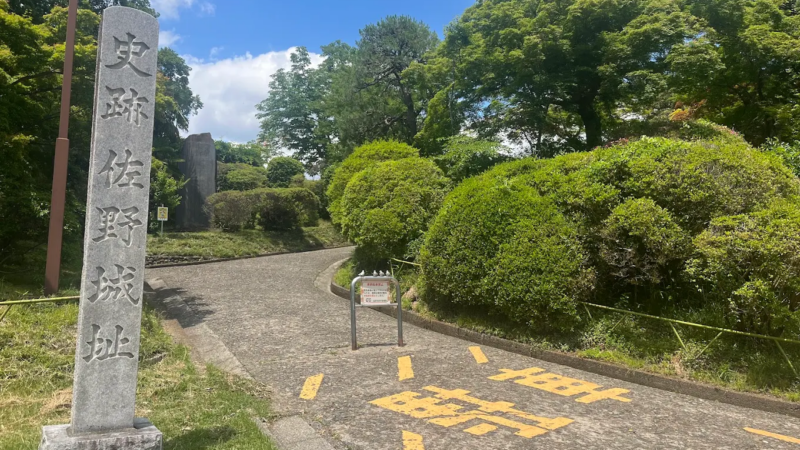
Currently, it is maintained as a prefectural natural park, and the remains such as stone walls, earthworks, and dry moats are well preserved. A walking trail of about one hour has been established from the north side of the Nasu Karasuyama City Hall Karasuyama Branch to Bishamonyama and Shiroyama.
History and Background of Karasuyama Castle
From Construction to the Nasu Clan Era (1418-1590)
The history of Karasuyama Castle begins in 1418 (Oei 25), when it was built by Sawamura Goro Sukeshige of the Nasu clan. Sukeshige, a descendant of Nasu Yoichi, fell out with his brother, Nasu Sukeyuki (of the Upper Nasu clan), and was driven from his main castle to Inazumi Castle. He then built Karasuyama Castle on what is now Hachikoyama Mountain as a new base.
This castle construction was driven by a power struggle within the Nasu clan. Sukeshige is believed to have chosen Hachikoyama Mountain, a strategically important location, to establish his own power base as the Lower Nasu clan.
During the Nasu clan’s rule, Karasuyama Castle was repeatedly attacked by the powerful Satake clan of Hitachi Province. However, the castle’s strong defenses repelled each attack. The Nasu clan used this castle as their residence for approximately 170 years, maintaining their power in Nasu County, Shimotsuke Province.
In 1590 (Tensho 18), a turning point came during the time of the clan head, Nasu Sukeharu. The Nasu clan was dispossessed of their domain due to their delayed participation in Toyotomi Hideyoshi’s siege of Odawara. This marked the end of the Nasu clan’s rule over Karasuyama Castle.
Oda Nobukatsu’s Short Reign and the Early Edo Period (1590-1725)
After the Nasu clan’s dispossession, Oda Nobukatsu, the second son of Oda Nobunaga, took up residence in Karasuyama Castle. However, his tenure was extremely short, lasting only two months. Afterward, the lords of Karasuyama Castle changed frequently within short periods.
During the Edo period, the castle lords changed rapidly, including the Narita, Matsushita, Hori, Itakura, Nasu (re-established), Nagai, shogunate officials, and Inagaki. During this period, Karasuyama Castle was positioned as a strategic point for the Tokugawa shogunate’s control of eastern Japan, and therefore tended to be occupied by trustworthy fudai daimyo and shinpan (related daimyo).
In 1659 (Manji 2), Hori Chikamasa added the third bailey to the eastern foot of the castle hill, constructing a palace and a multi-story turret. This completed a castle structure that clearly separated the military facilities on the mountaintop from the administrative functions at the foot of the mountain.
From the Okubo Clan’s Era to the Castle’s Abandonment (1725-1869)
In 1725 (Kyoho 10), Okubo Tsuneharu took control of the castle, and thereafter, the Okubo clan ruled for eight generations, for over 140 years. This period marked the most stable period of rule for Karasuyama Castle.
Under the Okubo clan’s rule, Karasuyama developed as a castle town, with commerce and culture flourishing. Samurai residences and merchant districts were established in the castle town, forming the urban infrastructure of present-day Nasu-Karasuyama City.
With the return of the domains to the Emperor in 1869 (Meiji 2), Karasuyama Castle was officially abandoned. After the Meiji Restoration, many castle structures were demolished, but the foundational structures such as stone walls and earthworks remained and continue to this day.
Layout and Structure of Karasuyama Castle
Arrangement of Five Castles and Three Enclosures
The most distinctive feature of Karasuyama Castle is its complex arrangement of enclosures known as Five Castles and Three Enclosures. The main enclosures were arranged on the mountaintop, centered around the Honmaru (main keep) and Ninomaru (second enclosure):
Gojo (Five Castles):
- Honmaru: The most important enclosure, forming the core of the castle
- Kohonmaru: The enclosure believed to be the original Honmaru
- Nakajo: A strategic point connecting the Honmaru and other enclosures
- Kitajo: An enclosure responsible for the northern defense
- Nishijo: A defensive base on the western side
Sankuru (Third Enclosure):
- Tokiwa Kuruwa: An enclosure where important defensive facilities were located
- Wakasa Kuruwa: An enclosure believed to be named after the castle lord
- Ono Kuruwa: An enclosure with a vast area
These enclosures were skillfully arranged, utilizing the topography of Mt. Hachiko, and extended over an area of approximately 350-370 meters east-west and 600-510 meters north-south. The interconnected layout of the enclosures organically linked together, enhancing their defensive capabilities.
The Third Bailey and the Foothills
The Third Bailey, added in 1659 by Hori Chikamasa, is located at the eastern foot of the castle mountain. A palace and a multi-story turret were built there to house the administrative functions. This addition strengthened Karasuyama Castle’s character as a modern castle, separating its military functions as a mountain castle from its peacetime administrative and residential functions.
The foothills were home to samurai residences and merchant districts, concentrating the urban functions of a castle town. Parts of the current Nasu-Karasuyama city area retain traces of this Edo-period castle town.
Existing Remains and Highlights
Stone Walls and Earthworks
The greatest highlight of Karasuyama Castle is its stone walls, which remain in excellent condition today. Despite being a mountain castle, stone walls are extensively used in the main areas, showing traces of renovations by successive castle lords from the Nasu clan through the Edo period.
The stone walls, particularly around the main keep, utilize the nozurazumi technique (a method of stacking natural stones), making them valuable historical remains showcasing castle construction techniques from the Sengoku period to the early modern era. The height of the stone walls varies depending on the location, but some sections reach a maximum of 5-6 meters.
Earthworks also remain throughout the castle grounds, clearly indicating the boundaries of the baileys and defensive lines. These earthworks, though covered by trees, are clearly visible and provide important clues to understanding the castle’s structure in its heyday.
Dry Moats
Karasuyama Castle had numerous dry moats separating each bailey. Even today, several-meter-deep dry moats remain in excellent condition, allowing visitors to experience the defensive structure unique to mountain castles.
The dry moats between the main baileys, in particular, are large in both width and depth, demonstrating their function as strong barriers against enemy intrusion. These dry moats can be observed up close while walking along the walking paths.
Relocated and Existing Gate (Karamete-mon Gate)
The only surviving structure from Karasuyama Castle is the Karamete-mon Gate. After the castle was abandoned, this gate was relocated to a private residence in the city and is still carefully preserved today.
The Karamete-mon Gate served as the castle’s rear gate and was also used as a general access gate during peacetime. As a valuable relic showcasing the characteristics of Edo period castle architecture, it conveys the history of Karasuyama Castle to the present day.
Walking Trails and Hiking Routes
Currently, a walking trail of approximately one hour is maintained at the Karasuyama Castle site, starting from the north side of the Nasu Karasuyama City Hall Karasuyama Branch and leading to Bishamon-yama and Shiroyama. Using this trail allows for efficient viewing of the main baileys and remains.
The trail is maintained with a moderate gradient and is a popular course not only for history enthusiasts but also for general hikers. It’s a luxurious walking route where you can enjoy the changing seasons while exploring the castle remains from the medieval to early modern periods. ## Archaeological Materials and Excavations
Multiple archaeological excavations have been conducted at the Karasuyama Castle site, yielding valuable archaeological materials. Of particular note are the ceramics known as Hizen-yaki and the unglazed earthenware plates called “kawarake”.
Hizen-yaki is a type of ceramic produced in what is now Saga and Nagasaki prefectures, and was distributed throughout Japan during the Edo period. The discovery of Hizen-yaki at Karasuyama Castle indicates that the castle possessed a certain economic power as a regional hub and was integrated into a wide-area logistics network.
Kawarake are disposable earthenware vessels used in ceremonies and banquets, providing clues to various events and daily life within the castle. These excavated artifacts are important materials that shed light on the true nature of Karasuyama Castle, which cannot be understood from written historical records alone, and research continues to this day.
Significance of National Historic Site Designation
On March 20, 2023, the Karasuyama Castle site was designated a National Historic Site. This designation signifies that Karasuyama Castle has been recognized as having high historical and academic value in the following respects:
- Castle structure during the transition from medieval to early modern periods: A valuable example showing the transition from a medieval mountain castle of the Nasu clan era to an early modern castle of the Edo period.
- Large-scale layout: One of the largest mountain castles in eastern Japan, with a complex layout of five castles and three baileys.
- Excellent state of preservation of remains: Stone walls, earthworks, and dry moats remain in good condition, conveying its appearance in its heyday.
- Importance in regional history: It functioned as the political and military center of the Nasu region from the medieval to early modern periods.
It is expected that the designation as a National Historic Site will further promote the preservation and utilization of the Karasuyama Castle ruins.
Access and Visiting Information
Transportation Access
Access by Train:
- Get off at JR Karasuyama Line “Karasuyama Station,” then walk for approximately 20 minutes to reach the castle entrance.
- It’s easiest to head towards the Nasu Karasuyama City Hall Karasuyama Branch from Karasuyama Station.
Access by Car:
- Approximately 30 minutes from Tohoku Expressway “Yaita IC” via National Route 294.
- Parking is available at Nasu Karasuyama City Hall Karasuyama Branch (free).
Visiting Points
- Estimated Time Required: Approximately 1 to 1.5 hours for a full circuit of the walking trail.
- Attire: Comfortable walking shoes and clothing are recommended as you will be walking on mountain paths.
- Season: Particularly beautiful during the fresh greenery of spring and the autumn foliage season.
- Admission Fee: Free (free to stroll around).
- Opening Hours: No specific restrictions (however, visiting during daylight hours is recommended).
Karasuyama Castle and the Culture of Nasu-Karasuyama City
Karasuyama Castle is a central part of Nasu-Karasuyama City’s identity. Beyond the castle ruins, the city boasts a wealth of historical, cultural, and tourist resources, including the “Yamaage Festival” (designated as a National Important Intangible Folk Cultural Property), Nakagawa Prefectural Natural Park, and Ryumon Falls.
The Yamaage Festival is a traditional festival dating back to the Edo period, known for its unique use of massive floats and stage equipment. The city’s history as a prosperous castle town has fostered such cultural traditions.
When visiting Nasu-Karasuyama City, combining a visit to the Karasuyama Castle ruins with an exploration of these local historical and cultural aspects will provide a deeper understanding and experience.
The Charm and Future Prospects of Karasuyama Castle
Karasuyama Castle served as the residence of the Nasu clan, descendants of Nasu Yoichi, for approximately 170 years, and continued to play a crucial role as a strategic point in eastern Japan throughout the Edo period. The large-scale layout of five castles and three baileys, the well-preserved remains such as stone fortifications, earthworks, and dry moats, and the relocated and existing rear gate, make Karasuyama Castle a valuable resource for understanding the history of Japanese castles from the medieval to early modern periods.
With its designation as a national historic site, further preservation and maintenance efforts are expected, providing more people with opportunities to experience the history and value of Karasuyama Castle. Nasu-Karasuyama City is also working to link the utilization of the castle ruins with regional development, continuing its efforts to pass on the value of this historical heritage to future generations.
When visiting Tochigi Prefecture, be sure to visit the Karasuyama Castle ruins in Nasu-Karasuyama City and experience the romance of history from the Sengoku period to the Edo period, and the charm of a mountain castle surrounded by beautiful nature. The castle ruins, which have also been developed as a prefectural natural park, are a hidden gem in eastern Tochigi Prefecture where you can enjoy historical walks and hiking simultaneously.
--765x450.png)
