
.png)
Kanuma Castle (Tochigi Prefecture) Complete Guide: A Thorough Explanation of History, Remains, and Highlights
Kanuma Castle (Kanuma-jō) was a flatland castle that once existed in Imamiya-cho and Nishikanuma-cho, Kanuma City, Tochigi Prefecture (Kanuma, Tsuga District, Shimotsuke Province). Also known as “Sakata Castle” and “Kame Castle,” it played an important role as a central castle in the Kanuma region for approximately 300 years. Currently, the site of the main keep has been developed into Gotenyama Park, a place of relaxation for citizens.
This article comprehensively explains everything about Kanuma Castle, from its detailed history and the changes in its lords to the remaining remains, a visitor’s guide, and surrounding tourist information.
Basic Information on Kanuma Castle
Location: Imamiya-cho and Nishikanuma-cho, Kanuma City, Tochigi Prefecture (formerly Tsuga District, Shimotsuke Province)
Other Names: Sakata Castle, Kame Castle, Sakatayama Castle, Sakatayama Manor
Castle Structure: Hilltop Castle
Year of Construction: Around 1292 (Shoo 5)
Builder: Kanuma Gonzaemon (Kanuma Katsutsuna)
Main Lords: Kanuma clan, Mibu clan, Kutsuki clan, Uchida clan
Year of Abandonment: 1590 (Tensho 18), subsequently used as the Kanuma Domain’s encampment
Current Status: Gotenyama Park (site of the main keep), urban area
History and Background
Kamakura Period: The Origin of Kanuma Castle and Sakatayama Manor
The origin of Kanuma Castle dates back to 1292 (Shoo 5). Records show that Kanuma Gonzaemon (also known as Kanuma Katsutsuna or Kyoa Nyudo), a branch of the Sano clan, dedicated a sacred lantern to Nikko Futarasan Shrine, confirming that the Kanuma clan held power in this region around this time.
Their first castle was built on Sakatayama, approximately 500 meters west of the current Kanuma Castle ruins. This Sakatayama Manor (Sakatayama Castle) is considered the predecessor of Kanuma Castle and is the origin of its alternative name, “Sakata Castle.” Utilizing the terrain of Sakatayama, the Kanuma clan established this mountain castle as their base of operations in the region.
Muromachi Period: Under the Control of the Utsunomiya Clan
During the Muromachi period, the Kanuma region was incorporated into the sphere of influence of the Utsunomiya clan, a powerful daimyo of Shimotsuke Province. The Utsunomiya clan was an important supporter of the Ashikaga clan in the Kanto region and extended its influence throughout Shimotsuke Province.
The Kanuma clan was incorporated as a vassal of the Utsunomiya clan and entrusted with governing the region. During the time of Utsunomiya Tadatsuna, the Utsunomiya clan’s power further strengthened, and Kanuma Castle became part of the Utsunomiya clan’s network of branch castles.
Sengoku Period: Becoming the Residence of the Mibu Clan
With the arrival of the Sengoku period, Kanuma Castle underwent a major transformation. The Mibu clan, who were important retainers of the Utsunomiya clan, became the lords of Kanuma Castle, and a large-scale renovation of the castle was carried out.
The Era of Mibu Tsunafusa
Mibu Tsunafusa, a powerful retainer of the Utsunomiya clan, made Kanuma Castle his residence. It is believed that during this period, the castle was moved and renovated from its old location on Sakatayama to its current location. The layout of the castle as a flatland castle was developed, and the formation of a castle town progressed.
The Era of Mibu Tsunashige and Mibu Yoshio
The lordship of the castle was passed down from Mibu Tsunashige, the eldest son of Mibu Tsunafusa, to his son, Mibu Yoshio. During this period, the Hojo clan rapidly rose to power in the Kanto region, and their influence began to extend to Shimotsuke Province.
Subordination and Defection from the Hojo Clan
In the latter half of the 16th century, the Later Hojo clan, based in Sagami Province, expanded its power throughout the Kanto region. The Utsunomiya clan initially showed resistance to the Hojo clan, but faced with the Hojo clan’s formidable military strength, they gradually became subordinate.
The Mibu clan, along with the Utsunomiya clan, was also subordinate to the Hojo clan for a time. However, the situation became more complex during the Tensho era (1573-1593). As Toyotomi Hideyoshi’s unification of Japan progressed, the various daimyo of Kanto were forced to choose between siding with the Hojo clan or the Toyotomi clan.
The Mibu clan ultimately defied the Hojo clan and attempted to side with the Toyotomi, but this delayed decision would determine their fate.
1590 (Tensho 18): The Siege of Odawara and the Abandonment of the Castle
In 1590 (Tensho 18), Toyotomi Hideyoshi launched the Siege of Odawara. This battle led to the downfall of the Hojo clan, drastically altering the political landscape of the Kanto region.
The Mibu clan of Kanuma Castle, due to their close ties with the Hojo clan, were dispossessed of their domain after the Siege of Odawara. The Mibu clan became extinct, and Kanuma Castle was temporarily abandoned. It is believed that the castle lost its military function and many of its structures were demolished.
Edo Period: The Establishment of the Kanuma Domain and the Jinya (Fortified Residence)
During the Edo period, Kanuma was governed as a direct territory of the shogunate and as a territory of hatamoto (direct retainers of the shogun). Later, small daimyo were appointed, and the Kanuma Domain was established.
The Era of the Kutsuki Clan
The Kutsuki clan was transferred from Omi Province and became the lords of the Kanuma Domain with a 10,000 koku (unit of rice production) stipend. The Kuchiki clan established a fortified residence (jinya) on the site of the former Kanuma Castle and conducted domain administration there.
The Uchida Clan’s Era
Later, the Uchida clan became the lords of the Kanuma Domain and ruled until the end of the Edo period. The Uchida clan also continued to use the Kanuma Jinya as their domain office.
After the Meiji Restoration: Changes in the Castle Site
After the Meiji Restoration, the Kanuma Domain was abolished due to the abolition of the feudal domains and the establishment of prefectures, and the jinya was dismantled. The castle site was sold off to private individuals or used as public land.
The site of the main keep was later developed into a park, which is now Gotenyama Park. While the sites of the second and third baileys have been urbanized and little remains of their former appearance, traces of the castle can still be seen in place names and road layouts.
Kanuma Domain Office (Kanuma Jinya)
During the Edo period, the Kanuma Domain used a “jinya” (fortified residence) rather than a formal castle as its domain office. This was due to the shogunate’s “One Castle Per Province” decree, which permitted only one castle per domain.
Structure and Function of the Jinya
The Kanuma Jinya (fortified residence) was developed as a facility specializing in administrative functions, while partially utilizing the remains of the Kanuma Castle from the Sengoku period. It housed samurai residences, government offices, and storehouses, consolidating the domain’s governing structure despite its small size.
While the Jinya lacked large-scale defensive structures such as stone walls or keeps, it is believed that basic defensive features such as moats and earthworks were maintained.
As the Center of Domain Administration
The Kanuma Jinya functioned as the center of administration for the 10,000-koku Kanuma Domain. It housed the lord’s residence, vassal offices, storehouses for storing tax rice, and offices for judicial and administrative duties, serving as the base for governing the territory.
Samurai residences were arranged around the Jinya, forming a town layout typical of a castle town. The street patterns of the current Kanuma city center still show remnants of this town layout.
Onari Goten (Imperial Palace)
It is believed that the Kanuma Jinya (fortified residence) during the Edo period had an “Onari Goten” (Imperial Palace) for use when the Shogun or high-ranking Shogunate officials visited.
Role of the Onari Goten
The Onari Goten served as a resting place for the Shogun during his visits to Nikko Toshogu Shrine (Nikko-shasan), and as a facility for entertaining high-ranking officials such as Shogunate inspectors. Due to Kanuma’s geographical location near the Nikko Kaido (Nikko Highway), it was an important lodging and resting point on the Shogun’s pilgrimage route to Nikko.
Architectural Style and Status
The Onari Goten was built in an architectural style of higher status than a typical feudal lord’s residence. It is presumed to have been a dignified building based on the Shoin-zukuri style, equipped with an upper room, an adjoining room, and other rooms. A garden was also maintained, creating a setting befitting the arrival of the Shogun.
Unfortunately, the Onari Goten building itself was lost after the Meiji era, and no remains exist today. However, its existence and scale can be understood from ancient documents and drawings.
Castle Structure and Layout
Utilization of Topography
Kanuma Castle is a flatland castle built on a hill approximately 150 meters above sea level in the urban area of Kanuma. Its alternative name, “Kamejo” (Turtle Castle), is said to originate from the castle’s shape resembling a turtle’s shell.
The north and east sides faced lowlands, providing natural fortifications. The south and west sides had relatively gentle slopes, where artificial defensive structures were built.
Layout of Major Enclosures
Honmaru
The main enclosure, located at the highest point, is now Gotenyama Park. It housed the lord’s residence and other important buildings. It was surrounded by earthen ramparts and moats, and the entrances were heavily fortified.
Ninokuruwa
It is presumed to have been located north and east of the Honmaru. It housed the residences of retainers and warehouses, and served to defend the Honmaru.
San-no-maru
This was the outer part of the castle, forming the boundary between the samurai residences and the merchant district. Currently, it is completely urbanized, and no remains exist.
Defensive Structures
Moat
A moat surrounded the main enclosure (Honmaru), but it is unclear whether it was a water moat or a dry moat. Based on the topography, it is possible that there was a moat that partially contained water.
Earthworks
Earthworks were built around each enclosure to enhance defensive capabilities. Some topographical features that appear to be traces of these earthworks still remain within Gotenyama Park.
Kuchi (Fortified Entrance)
Entrances to the main enclosure were limited and are thought to have had defensive structures such as masugata koguchi (square-shaped fortified entrances).
Current Remains and Points of Interest
Gotenyama Park (Main Enclosure Site)
The site of Kanuma Castle’s main enclosure is now developed as “Gotenyama Park,” a place of relaxation for citizens. The park is planted with cherry trees and azaleas, making it a popular spot for flower viewing in spring.
Highlights:
- Topography of the main keep: The elevated area of the park indicates the boundaries of the main keep.
- Traces of earthworks: Elevations believed to be earthworks remain along the edge of the park.
- View: From the park, you can enjoy a panoramic view of Kanuma city, allowing you to imagine the view from the castle in its heyday.
- Information board: An information board explaining the history of Kanuma Castle is located near the park entrance.
Castle Ruins Monument and Information Board
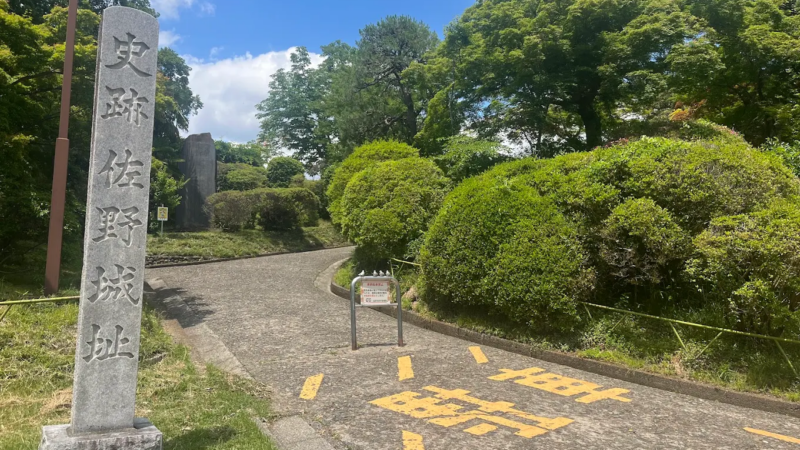
At the entrance to Gotenyama Park, there is a stone monument marking the Kanuma Castle ruins and a detailed information board. It describes the castle’s history, the changes in its lords, and an overview of its layout, aiding visitors in their understanding.
Surrounding Place Names and Town Layout
Around the castle ruins, place names remain that reflect the castle era:
- Imamiya-cho: Located in the center of the castle
- Nishikanuma-cho: The area west of the castle
- Gotenyama: Another name for the main keep
Furthermore, traces of the town layout from the castle town era can be seen in the street patterns, allowing us to understand the historical urban structure.
Traces of the Moat
Some of the roads and waterways in the city still retain topographical features that appear to be traces of the former moat. Walking around the area allows you to get a sense of the scale and extent of the castle.
Visitor Guide
Access Methods
Access by Train:
- Approximately 15 minutes on foot (approx. 1.1 km) from Shin-Kanuma Station on the Tobu Nikko Line
- Approximately 25 minutes on foot (approx. 1.8 km) from Kanuma Station on the JR Nikko Line
- Approximately 20 minutes on foot (approx. 1.6 km) from Kita-Kanuma Station on the Tobu Nikko Line
Access by Car:
- Approximately 10 minutes from Kanuma IC on the Tohoku Expressway
- Approximately 15 minutes from Tsuga IC on the Kita-Kanto Expressway
- Dedicated parking available at Gotenyama Park (free)
Access by Bus:
- 5 minutes on foot from the City Hall bus stop (Kanuma City Bus)
Parking Information
Gotenyama Park has a free parking lot. The parking space is located at the top of the slope on the south side of the park and can accommodate about 10 cars. During peak seasons such as cherry blossom season, the parking lot may be full, so please consider using public transportation.
Estimated Visiting Time
A stroll through Gotenyama Park and checking the information boards will take approximately 30-45 minutes. If you want to carefully observe the topography and explore the surrounding town layout, it’s best to allow 1-2 hours.
Points to Note During Your Visit
- Information Board at the Entrance of Gotenyama Park: Start by understanding the overall layout of the castle.
- Observing the Topography within the Park: Confirm the extent of the main keep and the traces of the earthworks.
- Viewpoint: View Kanuma city from the park’s elevated area to understand the castle’s location.
- Walking Around the Town: If time permits, explore the layout of the castle town.
Precautions During Your Visit
- The park is open 24 hours, but avoid visiting at night.
- The remains are limited, so do not have excessive expectations.
- Carefully reading the information boards and explanatory signs will deepen your understanding.
- Be careful as the ground can be slippery in rainy weather.
Nearby Tourist Attractions
Points of Interest in Kanuma City
Kanuma City Cultural Properties Museum
This facility exhibits materials related to Kanuma Castle and the history of Kanuma. It is within walking distance of the castle ruins and is a place you should definitely visit during your trip.
Yatai no Machi Chuo Park
The magnificent festival floats used in the Kanuma Autumn Festival are on permanent display. You can experience Kanuma’s traditional culture.
Kanuma Imamiya Shrine
A shrine worshipped as the guardian deity of Kanuma Castle, located near the castle ruins.
Nearby Castles
Mibu Castle (approx. 15km)
The base of the Mibu clan, lords of Kanuma Castle. Remains still exist in Mibu Town.
Utsunomiya Castle (approx. 20km)
A central castle in Shimotsuke Province. Currently, you can see restored earthworks and turrets.
Karasawayama Castle (approx. 25km)
A mountain castle in Sano City, and one of the seven famous castles of the Kanto region. Stone walls and baileys remain in good condition.
Shimonanma Castle (Kanuma City)
A mountain castle in southern Kanuma City. Remains such as earthworks and moats remain.
Kaminanma Castle (Upper Castle) (Kanuma City)
A mountain castle in southern Kanuma City. Its layout is remarkably well-preserved.
Sightseeing in the Nikko Area
Kanuma is a gateway to Nikko. It offers good access to Nikko Toshogu Shrine, Nikko Futarasan Shrine, Lake Chuzenji, and other attractions. Combining a visit to Kanuma Castle with sightseeing in Nikko is highly recommended.
Historical Significance of Kanuma Castle
Position in Shimotsuke Province
Kanuma Castle served as a central fortress in Tsuga District, Shimotsuke Province, for approximately 300 years, acting as a base for regional control. It played a vital role in the defense and governance of northern Shimotsuke Province, forming part of the Utsunomiya clan’s network of branch castles.
A Key Transportation Hub
Kanuma has long been located along the road to Nikko, making it a crucial transportation hub. During the Edo period, the Nikko Reiheishi Kaido and Nikko Nishi Kaido roads passed through Kanuma, increasing its importance as a pilgrimage route to Nikko Toshogu Shrine. Kanuma Castle (Jinya) served as a strategic base controlling this vital transportation hub.
The Rise and Fall of the Mibu Clan
The history of Kanuma Castle is closely intertwined with the rise and fall of the Mibu clan. The dramatic history of the Mibu clan, who prospered as powerful vassals of the Utsunomiya clan, only to be wiped out during the Siege of Odawara, illustrates the harshness of the Sengoku period (Warring States period).
Genealogy of the Castle Lords
Kanuma Clan Era (Kamakura to Muromachi Periods)
- Kanuma Gonzaburo (Kanuma Katsutsuna): Builder of the castle, established the first residence on Sakatayama
- Successive Kanuma Clan Members: Ruled the Kanuma region as a branch of the Sano clan
Mibu Clan Era (Sengoku Period)
- Mibu Tsunafusa: As a vassal of the Utsunomiya clan, he made Kanuma Castle his residence and carried out renovations
- Mibu Tsunashige: Tsunafusa’s eldest son, continued the castle’s maintenance
- Mibu Yoshio: Tsunashige’s son, dispossessed of his domain during the Siege of Odawara, leading to the extinction of the Mibu clan
Lords of the Edo Period
- Kutsuki Clan: Entered the domain from Omi Province, first lord of the Kanuma Domain with a 10,000 koku stipend
- Uchida Clan: Succeeded the Kutsuki Clan and ruled the Kanuma Domain until the end of the Edo period
Archaeological Excavation and Research
While large-scale archaeological excavations have not been conducted at the Kanuma Castle site, small-scale investigations related to urban development have revealed artifacts and structures associated with the Edo period’s encampment.
Further detailed investigations may shed light on the castle’s structure during the Sengoku period and the actual state of the Edo period encampment. Research by local historical research groups and historians is ongoing, and the discovery and interpretation of new historical materials are anticipated.
Summary
Kanuma Castle is a castle with a history spanning approximately 600 years, from the Kamakura period to the Edo period. Beginning as Sakatayama Manor, it developed as the residence of the Mibu clan during the Sengoku period. After being abandoned during the Siege of Odawara, it was again used as the encampment of the Kanuma Domain during the Edo period.
Although the remaining structures are limited today, visiting the site of the main keep, now developed as Gotenyama Park, allows visitors to experience the atmosphere of the castle in its heyday. The surrounding town layout and place names also retain traces of the castle town, making it a place to enjoy historical walks.
Kanuma, located on the tourist route to Nikko, is easily accessible. If you are interested in the history of Japanese castles or the Sengoku period in the Kanto region, be sure to visit the Kanuma Castle ruins. It is a valuable historical site where you can learn about various aspects of history, such as the rise and fall of the Mibu clan, the impact of the Siege of Odawara, and the Edo period’s jinya system.
--765x450.png)
.png)