Complete Guide to Kameyama Castle: History and Access Information for the Three Castles of Tanba, Ise, and Mikawa
There are several castles in Japan called “Kameyama Castle,” each with its own unique history in a different region. This article provides a detailed explanation of the history, structure, current status, and access methods for the three most famous castles: Tanba Kameyama Castle (Kameoka City, Kyoto Prefecture), Ise Kameyama Castle (Kameyama City, Mie Prefecture), and Mikawa Kameyama Castle (Shinshiro City, Aichi Prefecture).
Table of Contents
- What is Kameyama Castle? – The Three Kameyama Castles in Japan
- Tanba Kameyama Castle – Akechi Mitsuhide and the Honnoji Incident
- Ise Kameyama Castle – The History of Koncho Castle
- Mikawa Kameyama Castle – The Residence of the Okudaira Clan
- Access and Visiting Information for Each Castle
What is Kameyama Castle? – The Three Kameyama Castles in Japan
The name “Kameyama Castle” has been used for multiple castles in the history of Japanese castles. The most famous is Tanba Kameyama Castle, located in Kameoka City, Kyoto Prefecture, known for being built by Akechi Mitsuhide and serving as the departure point for the Honnoji Incident. Next, Ise Kameyama Castle in Kameyama City, Mie Prefecture, also known as “Koncho Castle,” functioned as the administrative center of the Ise Kameyama Domain during the Edo period. Furthermore, Mikawa Kameyama Castle, built by the Okudaira clan, exists in Shinshiro City, Aichi Prefecture.
These castles functioned as important military bases in their respective regions and played a significant role in Japanese history from the Sengoku period to the Edo period. This article will provide a detailed explanation of the historical background, architectural features, and current status of these three Kameyama Castles.
Tanba Kameyama Castle – Akechi Mitsuhide and the Honnoji Incident
History of Tanba Kameyama Castle
Tanba Kameyama Castle is a hilltop castle located in Aratsuka-cho, Kameoka City, Kyoto Prefecture, and is currently known as the “Tanba Kameyama Castle Ruins.” The history of this castle is closely linked to Akechi Mitsuhide’s conquest of Tanba Province, carried out under the orders of Oda Nobunaga.
Construction History
Around 1577 (Tensho 5), Akechi Mitsuhide began construction of a castle on Kameyama, the central point of the Kameoka Basin, as a base for his conquest of Tanba. Built on a small hill (Aratsukayama) overlooking the Hozugawa River and marshes to the north, the castle is believed to have been completed in 1578 (Tensho 6). Mitsuhide made this area the center of his Tanba administration and proceeded with its development as a modern castle.
During construction, Mitsuhide skillfully utilized the terrain, designing the castle to take advantage of its natural fortifications. The main keep was positioned overlooking the Kameoka Basin, and moats and stone walls were built around it to enhance its defensive capabilities. This castle was intended not only as a military base but also as a center for governing the Tanba region.
The Honnō-ji Incident and Kameyama Castle
On June 2, 1582 (Tenshō 10), the Honnō-ji Incident, the most famous rebellion in Japanese history, occurred. It was from this very Tanba Kameyama Castle that Akechi Mitsuhide set out for this historic event. Mitsuhide is said to have declared, “The enemy is at Honnō-ji Temple,” and led approximately 13,000 soldiers toward Kyoto.
This incident gave Tanba Kameyama Castle a special place in Japanese history. Even today, a memorial service for Lord Mitsuhide is held annually on May 3rd at the castle site, attracting many history enthusiasts.
Tanba Kameyama Castle in the Edo Period
After the Honnō-ji Incident, Tanba Kameyama Castle passed through the hands of various lords. During the time of Toyotomi Hideyoshi, Kobayakawa Hideaki became the lord, and after the Battle of Sekigahara, the castle was governed by samurai under Tokugawa Ieyasu. Throughout the Edo period, this castle continued to play an important role as a strategic point on the San’in Road.
During the Kan’ei era (1624-1644), the Matsudaira clan became the lords of the castle, and renovations to the castle and development of the castle town progressed. During this period, the castle also came to be known as “Kameoka Castle.” After the Meiji Restoration, many of the castle’s structures were demolished due to the castle demolition decree, but some of the stone walls and moats remain today.
Structure and Remains of Tanba Kameoka Castle
The exact full scope of Tanba Kameoka Castle is not fully understood due to the lack of detailed historical records. However, some of its structure has been revealed through archaeological excavations and research on old maps.
Layout and Stone Walls
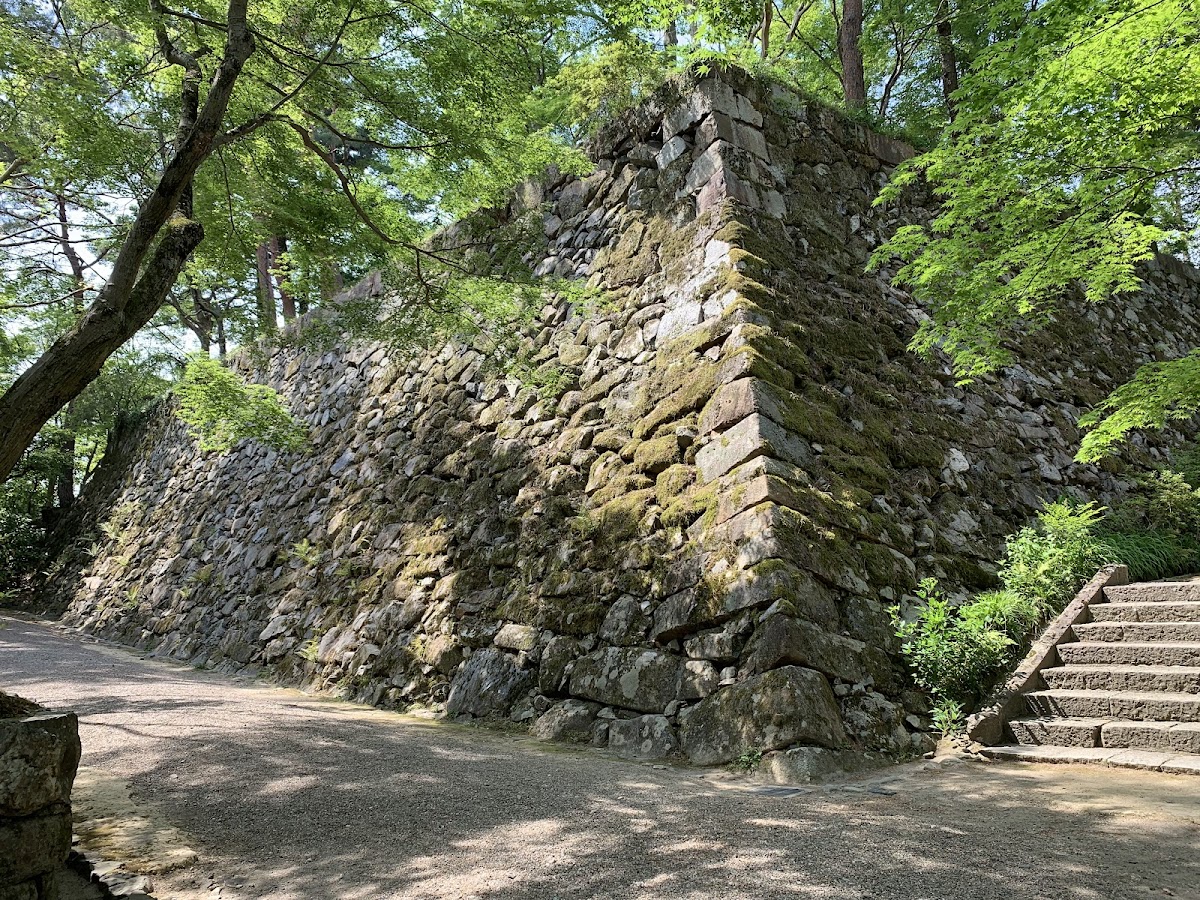
The castle is believed to have had a concentric layout consisting of the main enclosure (Honmaru), second enclosure (Ninmaru), and third enclosure (Sanmaru). A keep (Tenshu) is thought to have stood in the Honmaru, but there are various theories regarding its size and form. The stone walls utilize both the “nozurazumi” (rough-stone masonry) and “uchikomi-tsugi” (fitted stone masonry) techniques, showcasing the evolution of castle construction techniques from the time of Akechi Mitsuhide to the Edo period.
Currently, part of the castle site is located within the grounds of the religious corporation Oomoto, allowing visitors to view the remains of the stone walls and moats. In particular, the stone walls around the main keep are remarkably well-preserved, making them a valuable historical site for observing the castle construction techniques of the time up close.
Keep and Structures
The existence of the keep at Tanba Kameyama Castle is a subject of debate. One theory suggests a three-story keep existed, but detailed records are lacking. Some Edo-period drawings depict a building resembling a keep, suggesting a high probability of some kind of tall structure existing.
A palace was built in the main keep, serving as the lord’s residence and a place for conducting official business. Defensive structures such as turrets and gates were also located there, but these structures were lost after the Meiji era.
Current Status of Tanba Kameyama Castle Ruins
Currently, the central part of the Tanba Kameyama Castle ruins is located within the grounds of the headquarters of the religious corporation Oomoto. Oomoto accepts general tourists, but visits may be suspended depending on the COVID-19 situation. It is recommended to check the latest acceptance status before visiting.
Parts of the area around the castle ruins have been developed as a park, allowing visitors to stroll and explore the remains of the stone walls and moats. Kameoka City has developed a tourist route that includes the Tanba Kameyama Castle ruins and other historical sites associated with Akechi Mitsuhide, making it an attractive tourist spot for history enthusiasts.
History of Ise Kameyama Castle – Kochōjō Castle
Origins of Ise Kameyama Castle
Ise Kameyama Castle is a flatland castle located in Honmaru-cho, Kameyama City, Mie Prefecture, and has the elegant alternative name “Kochōjō (or Funchōjō)”. The history of this castle begins in 1265 (Bun’ei 2) when it was built in Wakayama (present-day Wakayama-cho, Kameyama City, Mie Prefecture) by Seki Sanetada. Later, it was moved to its current location, which was more suitable for defense.
From the Sengoku Period to the Azuchi-Momoyama Period
During the Sengoku period, Ise Province came under the influence of Oda Nobunaga, and Kameyama Castle also came under the control of the Oda clan. Seki Kazumasa served as the castle lord for a period, but in 1590 (Tensho 18), Okamoto Munenori demolished the previous castle and built a new one. The castle built during this period was a full-fledged early modern castle, a flatland castle with a three-story keep.
Okamoto Munenori’s construction was part of Toyotomi Hideyoshi’s castle development after the unification of Japan. Located at a strategic point on the Tokaido road, this castle played an important role in governing Ise Province and guarding the highway.
Ise-Kameyama Castle in the Edo Period
During the Edo period, Ise-Kameyama Castle functioned as the administrative center of the Ise-Kameyama Domain. In 1632 (Kanei 9), during the reign of Miyake Yasumori, the castle keep was demolished. An interesting anecdote is associated with this event.
It is said that Horio Tadaharu, ordered to dismantle the keep of Tanba-Kameyama Castle under the “One Castle Per Province” decree, mistakenly demolished the keep of Ise-Kameyama Castle instead. While there are various theories regarding this anecdote, and its veracity is uncertain, it is believed that the confusion stemmed from the existence of another castle with the same name, “Kameyama Castle.”
During the Shoho era (1644-1648), when Honda Toshitsugu was the lord of the castle, a multi-story turret was built on the site of the keep. This turret still remains today and is preserved as a valuable historical relic of Ise-Kameyama Castle.
Structure and Features of Ise-Kameyama Castle
Ise-Kameyama Castle, located along the Tokaido road, played a crucial role in protecting a vital transportation hub. The castle’s structure was based on a stepped layout with the main keep, second bailey, and third bailey.
Stone Walls and Moats
The castle’s stone walls utilize the techniques of uchikomi-tsugi (fitted stone joint) and kirikomi-tsugi (cut stone joint), demonstrating the high level of castle construction technology in the early Edo period. In particular, the stone walls around the main keep were high, functioning as a robust defensive structure. The moats were constructed as water moats, further enhancing the castle’s defensive capabilities.
Tamon-yagura (Multi-story Turret)
The Tamon-yagura, which still remains today, was built during the Shoho era and is the most important surviving structure of Ise-Kameyama Castle. Built on the site of the former keep, the Tamon-yagura occupies a high position within the castle, offering panoramic views. This turret served not only as a defensive structure but also as a storage place for weapons and supplies. ### Current Status of Ise-Kameyama Castle Ruins
Currently, the Ise-Kameyama Castle ruins are preserved as a historical site of Kameyama City. Visitors can see parts of the multi-story turret, stone walls, and moat. The area surrounding the castle ruins has been developed into a park, serving as a place of relaxation for citizens.
Kameyama City is committed to the preservation and utilization of the castle ruins, installing information boards and improving the remains. Regular guided tours of the castle ruins are also conducted, allowing visitors to learn about the castle’s history while listening to expert commentary.
Mikawa-Kameyama Castle – Residence of the Okudaira Clan
History of Mikawa-Kameyama Castle
Mikawa-Kameyama Castle is a mountain castle located in Shinshiro City, Aichi Prefecture, and is known as the residence of the Okudaira clan. It was built in 1424 (Oei 31) by Okudaira Sadatoshi.
The Okudaira Clan and Mikawa Kameyama Castle
Okudaira Sadatoshi moved to this area from present-day Gunma Prefecture during the Tenju era (1375-1380) and first built Kawajiri Castle. Later, he built a new castle on Kameyama, which was more suitable for defense, and made it his residence. Kameyama Castle played an important role throughout the Sengoku period as the Okudaira clan’s base in the Mikawa region.
Mikawa Kameyama Castle in the Sengoku Period
During the Sengoku period, the Mikawa region was a battleground for the Imagawa, Oda, and Tokugawa clans. The Okudaira clan adapted their relationships with these daimyo in accordance with the changing times, protecting their territory. In particular, Okudaira Nobumasa, famous for the Battle of Nagashino, served Tokugawa Ieyasu and played an active role, solidifying the Okudaira clan’s position.
Structure of Mikawa Kameyama Castle
Mikawa Kameyama Castle is a mountain castle that utilizes the mountainous terrain, characterized by defensive structures that take advantage of natural fortifications. The castle featured a series of interconnected baileys, with multiple baileys positioned along the ridgeline.
The castle’s defenses were not based on stone walls, but rather on earthen ramparts and trenches. This was a construction technique unique to mountain castles, a rational design that made maximum use of the terrain.
Current Status of Mikawa Kameyama Castle
Currently, the Mikawa Kameyama Castle ruins are preserved as a historical site in Shinshiro City, and visitors can see the remains such as baileys and trenches. As it is a mountain castle, some physical exertion is required to climb it, but the view from the summit is magnificent, allowing visitors to experience the atmosphere of a Sengoku period mountain castle.
Access and Visiting Information for Each Castle
Access to Tanba Kameyama Castle (Kameoka City, Kyoto Prefecture)
By Train
- Approximately 10 minutes on foot from the South Exit of Kameoka Station on the JR Sagano Line
- Approximately 30 minutes from Kyoto Station to Kameoka Station
By Car
- Approximately 10 minutes from Kameoka IC on the Kyoto Jukan Expressway
- Use nearby public parking lots
Visiting Information
- Visiting Hours: Varies depending on the acceptance status of the religious corporation Oomoto
- Fee: Generally free (prior confirmation is required for entry within the Oomoto grounds)
- Inquiries: Kameoka City Tourism Association TEL 0771-22-0691
Access to Ise Kameyama Castle (Kameyama City, Mie Prefecture)
By Train
- Approximately 15 minutes on foot from Kameyama Station on the JR Kansai Main Line
- Approximately 1 hour from Nagoya Station to Kameyama Station
By Car
- Approximately 10 minutes from the Tomei-Hanshin Expressway “Kameyama IC”
- Parking available near the castle ruins
Visiting Information
- Visiting Hours: Always open (Please check the interior of the Tamon-yagura tower)
- Admission Fee: Free
- Inquiries: Kameyama City Tourism Association TEL 0595-97-8877
Access to Mikawa Kameyama Castle (Shinshiro City, Aichi Prefecture)
By Train
- Approximately 10 minutes by taxi from JR Iida Line “Mikawa-Togo Station”
By Car
- Approximately 20 minutes from Shin-Tomei Expressway “Shinshiro IC”
- Parking available near the castle entrance
Visiting Information
- Visiting Hours: Always open (Daytime visits are recommended due to it being a mountain castle)
- Admission Fee: Free
- Inquiries: Shinshiro City Tourism Association TEL 0536-32-0022
Castle Stamps and Souvenirs from Kameyama Castle
In recent years, collecting “castle stamps” as souvenirs of castle tours has become popular. Both Tanba Kameyama Castle and Ise Kameyama Castle issue castle stamps, each with designs reflecting the history and characteristics of their respective castles.
The Tanba Kameyama Castle stamp features the bellflower crest, the family crest of Akechi Mitsuhide, and its design indicates its connection to the Honnoji Incident. It can be purchased at tourist information centers and souvenir shops in Kameoka City.
The Ise Kameyama Castle stamp features a butterfly design, in keeping with its alternative name, Funcho Castle (Butterfly Castle), and can be obtained at tourist information centers in Kameyama City.
Summary
The three castles bearing the name “Kameyama Castle” have each carved out their own unique histories in different regions. Tanba Kameyama Castle was involved in the crucial turning points of Japanese history: Akechi Mitsuhide and the Honnoji Incident. Ise Kameyama Castle supported transportation and governance during the Edo period as a key point on the Tokaido road. Mikawa Kameyama Castle survived the Sengoku period as the base of the Okudaira clan.
These castle ruins are still preserved today as valuable historical heritage sites, important places to learn about the castle-building techniques and historical background of the time. Each castle has its own unique charm, and visiting them will allow you to experience the depth of Japanese castle culture and history.
When planning a castle tour, it is recommended to understand the characteristics of each castle and choose one that suits your interests. Trace the footsteps of Akechi Mitsuhide at Tanba Kameyama Castle, admire Edo-period castle architecture at Ise Kameyama Castle, and experience the atmosphere of a mountain castle at Mikawa Kameyama Castle. Enjoy the different historical experiences that each castle offers.