Complete Guide to Isawa Castle (Iwate Prefecture) | An Ancient Military Base in Tohoku Built by Sakanoue no Tamuramaro
What is Isawa Castle?
Isawa Castle (Isawa-jo/Isawa-no-ki) is an ancient castle located in Mizusawa Sakuragawa Shibuta, Oshu City, Iwate Prefecture. Built in 802 AD (Enryaku 21) during the early Heian period by Sakanoue no Tamuramaro, the Shogun, it functioned as the center of governance for northern Mutsu Province for approximately 150 years. Currently designated a national historic site, it is maintained as the Isawa Castle Ruins Historical Park.
Isawa Castle was a military and administrative base established by the imperial court at the time to govern the Emishi people of the Tohoku region. With the relocation of the Chinju-fu (military headquarters) from Tagajo, it became the most important base in Mutsu Province. Its scale and function make it an extremely important historical site for understanding the ancient Japanese administration of Tohoku.
Basic Information on Izawa Castle
Common Name/Alternate Name: Hōhatchō
Location: Mizusawa, Sakuragawa, Shibuta, Ōshū City, Iwate Prefecture
Former Province: Izawa District, Mutsu Province
Classification/Structure: Ancient Fortified Residence, Government Office/Outer Enclosure Type
Builder: Sakanoue no Tamuramaro (Seii Taishogun)
Year of Construction: Enryaku 21 (802)
Year of Abandonment: Around Eihō 3 (1083) (During the Later Three Years’ War)
Keep Structure: None (As it is an ancient fortified residence, there is no keep)
Designated Cultural Property: National Historic Site (Designated in 1981)
Main Lords: Chinjufu Shogun (Successive)
History of Izawa Castle
Early Heian Period: Castle Construction and Relocation of the Chinju-fu (Northern Defense Headquarters)
In 802 (Enryaku 21), after subduing Aterui and More, powerful Emishi leaders, Sakanoue no Tamuramaro constructed a new fortification in the Izawa area. This was Izawa Castle. The purpose of this construction was to secure a strategic base to solidify the imperial court’s control over the Tohoku region.
After the construction of Izawa Castle, the Chinju-fu, the military and administrative center of Mutsu Province, was relocated from Taga Castle in Miyagi Prefecture to Izawa Castle. There are various theories regarding the exact timing of this relocation; some suggest it occurred as early as 802, simultaneously with the castle’s construction, while others suggest it occurred around 812, after being temporarily located at Shiwa Castle (Morioka City). Archaeological excavations and research into historical documents are working to clarify the exact timing of the relocation.
With the relocation of the Chinju-fu, Izawa Castle became the most important base for governing northern Mutsu Province, the area of present-day Iwate Prefecture. Numerous government offices were established around the administrative center, providing not only military but also robust administrative functions.
Mid-Heian Period: As the Center of Governance in Tohoku
From the 9th to the 11th centuries, Izawa Castle continued to function as a symbol of the imperial court’s authority in Mutsu Province. The Chinju-fu Shogun (Commander of the Northern Defense Headquarters) was permanently stationed there, handling a wide range of duties including governing the surrounding region, negotiating with the Emishi (indigenous people of northern Japan), collecting taxes, and directing military operations.
During this period, Izawa Castle was not merely a military facility, but also a cultural and economic center. Officials dispatched from Kyoto stayed there, making it a gateway for the transmission of central culture to the Tohoku region.
Archaeological excavations have unearthed numerous artifacts from this period, including green-glazed pottery, ink-inscribed earthenware, iron and copper objects, demonstrating the high level of culture at the time. These findings indicate that Izawa Castle was not merely a frontier fort, but possessed sophisticated urban functions and a refined culture.
The Later Three Years’ War and the End of its Function
From 1083 to 1087, a large-scale conflict known as the Later Three Years’ War took place in the Tohoku region. This war involved Minamoto no Yoshiie’s intervention in an internal conflict within the Kiyohara clan, and the area around Izawa Castle became a battlefield.
It is believed that from this period onward, Izawa Castle’s function as a garrison gradually declined. While the exact date of its abandonment is unknown, it is thought to have effectively lost its function by the time of the Later Three Years’ War. Subsequently, during the era of the Oshu Fujiwara clan, based in Hiraizumi, Izawa Castle disappeared from the historical stage.
Modern Times: Archaeological Excavation and Historical Site Preservation
The ruins of Izawa Castle were buried beneath rice paddies for a long time, but full-scale archaeological excavations began in the Showa era. In 1981, it was designated a national historic site, and continuous research has been conducted ever since.
Excavations have revealed numerous remains, including the site of the government office, the outer perimeter, the remains of post-and-beam buildings, and the remains of roads. Based on these findings, the site is currently being developed as the Izawa Castle Ruins Historical Park, with the restoration of the south gate of the government office and the installation of information boards.
Excavations have continued since the Heisei era, with new discoveries continuing to emerge. Detailed information on the layout of the remains, the scale of the buildings, and the technologies used has been clarified, playing a crucial role in the study of ancient Tohoku history.
Structure of Izawa Castle
Overall Layout and Scale
Izawa Castle is a large-scale ancient fortified enclosure with an irregularly shaped outer perimeter approximately 920 meters east-west and 840 meters north-south. Its total area is approximately 75 hectares, making it one of the largest ancient fortified enclosures. Its alternative name, “Hachicho” (meaning “eight square cho”), reflects its vast size.
The outer perimeter was surrounded by earthen walls and timber fences, and their foundations have been confirmed during excavations. The outer perimeter had gates on the east, west, north, and south sides, which functioned as the main entrances.
Structure of the Government Office
The government office was located at the center of Izawa Castle. The government office occupied an area of approximately 108 meters east-west and 120 meters north-south, forming an independent space surrounded by a mud wall.
Inside the government office were three main buildings: the main hall (the most important building in the center), the east side hall, and the west side hall. These were post-and-beam buildings, without the use of foundation stones. The main hall faced south and served as the central facility where ceremonies and government affairs were conducted.
To the south of the government office was the South Gate, which has been recently restored, allowing us to imagine its former appearance. Archaeological excavations have revealed that the South Gate was an eight-legged gate.
Government Offices and Road Network
Numerous government buildings were located around the government office. These facilities were responsible for various operations of the naval base, and are thought to have shared functions such as military, administrative, and financial.
Excavations have confirmed numerous neatly arranged post-and-beam building remains, indicating a planned urban design. Roads ran between the building clusters, and an efficient transportation network was formed by main roads running east-west and north-south, and branch roads connecting them.
Defensive Facilities
The outer perimeter of Izawa Castle was defended by earthen walls, timber fences, and an outer moat. Excavations have confirmed the remains of ditches dug along the outer perimeter, which are thought to have been defensive moats.
However, Izawa Castle is considered to have been a facility that prioritized administrative functions rather than a pure military fortress, and therefore its defensive facilities were relatively simple. This is thought to reflect that military tensions in the surrounding area had already eased by the time of its construction.
Architectural Techniques and Materials
The buildings of Izawa Castle were mainly constructed using the post-and-beam building technique. This method involves directly embedding pillars into the ground, which is simpler than construction using foundation stones, but less durable.
Archaeological excavations have unearthed carbonized wood and iron nails believed to have been used in the building from the pillar holes. Evidence also suggests the use of roof tiles, indicating that at least the main buildings of the government office likely had tiled roofs.
While the building materials were primarily timber sourced from the surrounding forests, some materials, such as roof tiles and iron products, are thought to have been transported from distant locations. This indicates that Izawa Castle was located within a wide-area logistics network.
Izawa Castle and Surrounding Ancient Fortifications
Relationship with Tagajo Castle
Tagajo Castle was an ancient fortification located in what is now Tagajo City, Miyagi Prefecture. From the first half of the 8th century, it housed the provincial capital and garrison of Mutsu Province. Before the construction of Izawa Castle, Tagajo was the center of imperial court rule in the Tohoku region.
The construction of Izawa Castle and the relocation of the garrison indicate a shift in the imperial court’s policy towards the Tohoku region. By relocating their base to the more northern Izawa, a strategy was adopted to govern from a location closer to the Emishi’s sphere of influence. However, Tagajo continued to maintain its important function as the provincial capital.
Relationship with Shiwa Castle
Shiwa Castle was an ancient fortified settlement located in what is now Morioka City, Iwate Prefecture, and was built around the same time as Izawa Castle. Shiwa Castle was located even further north than Izawa Castle and had a more frontline character.
One theory suggests that the Chinjufu (military headquarters) moved from Tagajo to Shiwa Castle, and then later to Izawa Castle. Because Shiwa Castle was prone to flooding and other damage, it is thought that the Chinjufu eventually settled in the more stable Izawa area.
Some studies suggest that Shiwa Castle and Izawa Castle had a complementary relationship, with Shiwa Castle in the north serving as a frontline base and Izawa Castle in the south as a rear base.
Relationship with Tokutan Castle
Tokutan Castle was an ancient fortified settlement located approximately 15 kilometers north of Izawa Castle. It is believed to have been built in the first half of the 9th century and served as a subsidiary castle of Izawa Castle.
Although smaller than Izawa Castle, Tokutan Castle possessed a well-organized structure and functioned as a base for regional control. As part of a network of fortified settlements centered around Izawa Castle, it played a crucial role in governing the surrounding area.
Archaeological Findings
Major Archaeological Findings
Izawa Castle has undergone continuous archaeological excavations from the Showa era to the present day, resulting in many important discoveries.
Excavations at the administrative office site revealed the layout of the main hall, east side hall, and west side hall, and the size and structure of the buildings were reconstructed based on the location of the post holes. The structure of the south gate of the administrative office was also determined in detail, providing the basis for its reconstruction.
In investigations of the outer perimeter, the foundations of the earthen walls, traces of wooden fences, and the location of the outer moat were confirmed, gradually revealing the overall picture of the castle.
Investigations of the government building complex uncovered numerous post-and-beam building remains, revealing a planned urban design based on their arrangement. The building’s purpose is being estimated based on excavated artifacts.
Excavated Artifacts
A wide variety of artifacts have been unearthed from Izawa Castle.
Pottery includes Sue ware, Haji ware, and green-glazed pottery, believed to have been used in daily life and rituals. Numerous inscribed pottery pieces have also been found, offering insights into the administration and religious practices of the time.
Iron artifacts include nails, arrowheads, knives, and farming tools, providing evidence of architectural, military, and agricultural activities.
Copper artifacts include belt fittings, Buddhist implements, and coins, offering evidence of official adornments, Buddhist beliefs, and economic activity.
Other artifacts such as roof tiles, inkstones, wooden objects, and animal bones have also been discovered, demonstrating the richness of life and culture in ancient Izawa Castle.
Latest Research Trends
Recent archaeological excavations have utilized digital technology for precise surveying and scientific dating methods. This has revealed detailed structural information about the remains and the timing of building reconstructions.
Furthermore, wide-area surveys exploring connections with surrounding areas are underway, gradually revealing the overall picture of the ancient regional society centered around Izawa Castle.
Highlights of Izawa Castle Ruins Historical Park
Restored South Gate of the Government Office
The greatest highlight of Izawa Castle Ruins Historical Park is the restored South Gate of the Government Office. Faithfully restored based on the results of archaeological excavations, this gate is a valuable facility where you can experience ancient architectural techniques.
Its imposing eight-legged gate structure evokes the grandeur of Izawa Castle in its heyday. The vermilion-painted pillars and white walls convey the beauty of ancient architecture to the present day.
Government Office Site
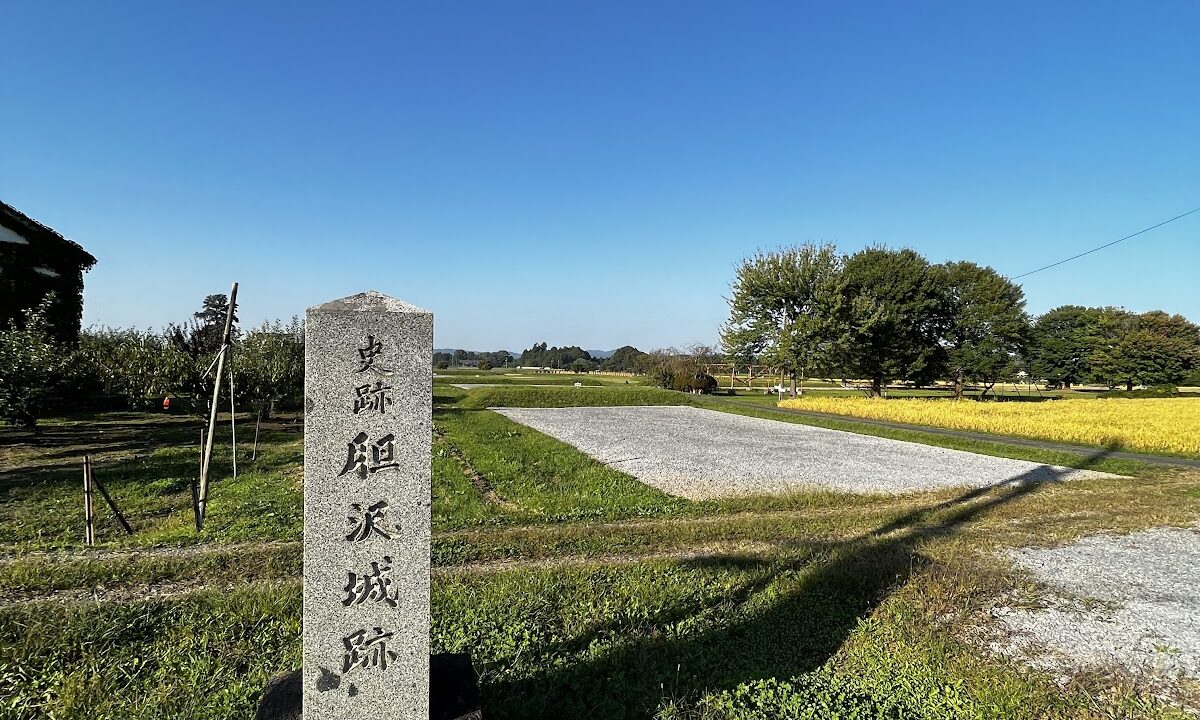
The government office site has been restored after archaeological excavations, and the locations of the buildings are marked on the ground. You can actually walk around and confirm the layout of the main hall, east side hall, and west side hall, giving you a real sense of the scale of the ancient government office.
Outer Boundary Marking
Part of the outer boundary is marked on the ground, allowing you to experience the vast area of Izawa Castle. Walking around the outer boundary will give you a real sense of the size of the ancient castle fortifications.
Information Boards and Explanation Facilities
Detailed information boards are installed within the park, allowing you to learn about the history and structure of Izawa Castle. The guidance facility also features exhibits of excavated artifacts and explanations using video materials.
Events and Experience Programs
Izawa Castle Ruins Historical Park regularly holds events. A variety of programs are available, including ancient costume experiences, tours of the excavation site, and history lectures, allowing you to learn more about Izawa Castle.
Access and Surrounding Area Information
Access by Public Transportation
Train: Approximately 4 kilometers from Mizusawa Station on the JR Tohoku Main Line.
Bus: Take the Iwate Kotsu bus bound for “Isawa Castle Ruins” from Mizusawa Station and get off at the last stop. Alternatively, get off at the “Sakuragawa” bus stop and walk for about 10 minutes.
Access by Car
Tohoku Expressway: Approximately 10 minutes from Mizusawa Interchange
Parking: Free parking available at Izawa Castle Ruins Historical Park (approximately 50 regular cars)
Opening Hours and Admission Fee
Opening Hours: Always open (Guidance facility: 9:00 AM – 5:00 PM, closed on some days)
Admission Fee: Free
Nearby Tourist Attractions
Oshu City Buried Cultural Properties Research Center: Exhibits local archaeological materials, including artifacts excavated from Izawa Castle
Shobo-ji Temple: An ancient Soto Zen temple and a representative temple of Iwate Prefecture
Esashi Fujiwara no Sato Historical Park: A theme park recreating buildings from the Heian period
Oshu City Samurai Residence Museum: Preservation and public display of samurai residences from the Edo period
Historical Significance of Izawa Castle
Role in the Administration of Ancient Tohoku
Izawa Castle played an extremely important role in the administration of Tohoku in ancient Japan. After the surrender of Aterui by Sakanoue no Tamuramaro, the imperial court needed to firmly establish control over the Tohoku region. Izawa Castle was built as its base, playing a role in bringing the region under the court’s control through both military pressure and administrative governance.
The relocation of the Chinju-fu (military headquarters) symbolized the expansion of the court’s territory northward. With Izawa Castle at its center, multiple fortifications were built around it, forming a network that established a wide-area system of control.
Contact Points between the Emishi and the Imperial Court
Izawa Castle was also a place where the Emishi and the imperial court interacted and negotiated. Beyond military conflict, trade and cultural exchange also took place, resulting in a complex and multifaceted relationship between the two.
The rule at Izawa Castle was not solely based on military force; it also employed conciliatory measures, such as integrating influential Emishi figures into the imperial court’s rank system. Through these policies, Emishi society gradually transformed and became integrated into the imperial court’s governing structure.
Archaeological Value
Izawa Castle is an extremely important site for understanding the structure and function of ancient fortifications. The detailed data obtained from excavations provides valuable resources for studying ancient Japanese urban planning, architectural technology, and administrative organization.
Furthermore, excavated artifacts offer diverse information about the material culture, economic activities, beliefs, and daily life of the time. These reveal the true picture of ancient society that cannot be understood from written historical sources alone.
References and Research Materials
Research on Izawa Castle is conducted across multiple fields, including archaeology, history, and architectural history. The main references are listed below.
- *Izawa Castle Ruins Excavation Report* (Oshu City Board of Education): This is the official report of the excavation, containing detailed diagrams of the remains and records of excavated artifacts.
- *Studies on Ancient Castles and Fortifications* (Various academic papers): These studies provide comparative and comprehensive information on ancient castles and fortifications in the Tohoku region, including Izawa Castle.
- *Sakanoue no Tamuramaro and the Management of Tohoku* (Historical research book): This book discusses the historical background of the construction of Izawa Castle and the achievements of Sakanoue no Tamuramaro in detail.
- *Ancient Castles and Fortifications in Japan* (General overview): This book provides an easy-to-understand overview of ancient castles and fortifications for the general public.
These documents can be viewed at specialized libraries, university libraries, and related facilities in Oshu City.
Summary
Izawa Castle was an ancient castle built in 802 by Sakanoue no Tamuramaro and functioned as the center of governance for northern Mutsu Province for approximately 150 years. With the relocation of the Chinjufu (military headquarters) from Tagajo, Izawa Castle became the most important base of imperial control in the Tohoku region, flourishing as a center of military, administrative, and cultural activity.
It boasted a vast outer enclosure, approximately 920 meters east-west and 840 meters north-south, with the government office at its center and numerous government buildings neatly arranged around it. Archaeological excavations have revealed its detailed structure, providing valuable information about ancient urban planning and architectural techniques.
Currently, the site is maintained as the Izawa Castle Ruins Historical Park, where visitors can imagine its former glory through the restored South Gate of the government office and markers indicating the site of the government office. It is a must-see historical site for anyone interested in the history of ancient Tohoku.
When visiting Oshu City in Iwate Prefecture, be sure to visit the Izawa Castle Ruins and experience the romance of history from over 1200 years ago.