
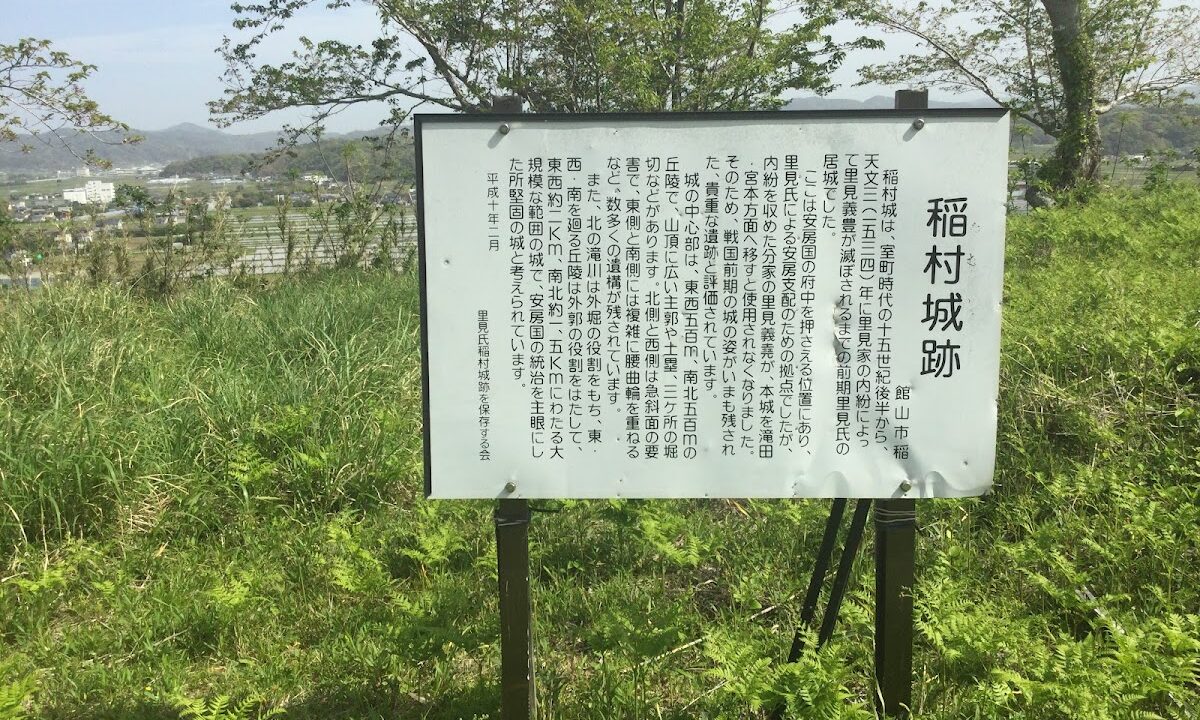
Inamura Castle (Tateyama City, Chiba Prefecture) Complete Guide | A Thorough Explanation of the Satomi Clan’s Castle Ruins and the Stage of the Tenbun Internal Conflict
What is Inamura Castle? | An Important Base of the Satomi Clan Remaining in Tateyama City, Chiba Prefecture
Inamura Castle is a medieval castle located in Ina, Tateyama City, Chiba Prefecture, and is known as the residence of the Satomi clan, who ruled Awa Province (present-day southern Boso Peninsula) during the Sengoku period. Built on a hill 64 meters above sea level, this castle is strategically located overlooking the Tateyama Plain and Kagamiura (Tateyama Bay), and is a large mountain castle with dimensions of approximately 500 meters in both east-west and north-south directions.
On January 24, 2012 (Heisei 24), along with Okamoto Castle in Minamiboso City, it was designated a national historic site as the “Satomi Clan Castle Ruins,” and is protected as a valuable historical heritage of the Sengoku period in the Boso region. Even today, the remains of the main enclosure, such as the earthworks, moats, and cuts, are well-preserved, making it a valuable place to experience the structure of a medieval castle.
History of Inamura Castle | The Rise and Fall of the Early Satomi Clan and the Tenbun Conflict
The Satomi Clan’s Expansion into Awa Province and the Construction of Inamura Castle
The history of Inamura Castle begins in the late 15th century when the Satomi clan expanded into Awa Province. It is said to have been built around 1486 (Bunmei 18) or 1489 (Entoku 1) by Satomi Yoshizane, the first head of the Satomi clan.
Yoshizane was originally based in Kozuke Province (present-day Gunma Prefecture), but moved to Awa Province at the command of the Koga Shogun. With the support of the Miura clan of Sagami Province, he first expanded his power using Shirahama Castle as his base, and eventually built Inamura Castle on a strategic location overlooking the Tateyama Plain, making it his headquarters. This location selection is believed to have been strategically intended to control the Tateyama Plain and Kagamiura, a key point for maritime traffic.
As the Early Satomi Clan’s Residence
Inamura Castle served as the Satomi clan’s base for approximately 50 years, from the first head of the Satomi clan, Yoshizane, to the fourth head, Yoshitoyo. Particularly in the first half of the 16th century, during the time of the third head, Satomi Yoshimichi, the Satomi clan’s power reached its peak, solidifying their control within Awa Province and even expanding into Kazusa Province.
During this period, Inamura Castle was not merely a military base, but also a center of political, economic, and cultural activity, serving as the administrative center of the domain. It is presumed that the castle town housed the residences of the vassals, and that it also functioned as a residence demonstrating the authority of the castle lord.
The Tenbun Internal Conflict | The Final Battle of Inamura Castle
The most important event in the history of Inamura Castle is the “Tenbun Internal Conflict,” which occurred from 1533 to 1534. This was an internal conflict within the Satomi clan, a fierce power struggle between the fourth head of the family, Satomi Yoshitoyo, and his relative, Satomi Yoshitaka.
Yoshitoyo inherited the family headship as the eldest son of Yoshimichi, but a conflict arose between him and Yoshitaka (from the lineage of Yoshizane’s second son). In 1534, Yoshitaka attacked Inamura Castle and defeated Yoshitoyo. This battle ended the main line of the Satomi clan, and Yoshitaka’s lineage (the later Satomi clan) became the head of the Satomi clan.
As a result of this internal conflict, Inamura Castle was abandoned, and Yoshitaka established Okamoto Castle (Minamiboso City) as his new base. Inamura Castle was actually used for approximately 50 years, until this Tenbun 3 (1534).
Inamura Castle After Abandonment
After its abandonment, Inamura Castle lost its function as a military base and gradually returned to nature. However, its remains were relatively well preserved and have been affectionately known locally as “Shiroyama” (Castle Mountain).
During the Edo period, this area became part of the Tateyama Domain, but the Inamura Castle site was not particularly developed and was used as farmland and forest. The fact that it avoided large-scale development even in modern times is a factor in the good preservation of the remains to this day.
Structure and Highlights of Inamura Castle
Overall Structure of the Castle
Inamura Castle is a typical medieval mountain castle built on a hill 64 meters above sea level. The castle grounds extend approximately 500 meters in both the east-west and north-south directions, and the layout is a series of interconnected enclosures (kuruma) arranged around the central main enclosure (honmaru).
The castle’s location utilizes the edge of a hill on the southern edge of the Tateyama Plain, and is protected by steep slopes on the south and east sides. Artificial moats and cuts were constructed on the north and west sides to further strengthen its defenses. This layout, which skillfully utilizes the terrain, is a valuable example of castle construction techniques from the Sengoku period.
Earthworks of the Main Enclosure (Honmaru)
The greatest highlight of Inamura Castle is the earthworks remaining in the main enclosure. Earthworks approximately 3 meters high remain well-preserved on the eastern and southern sides of the main enclosure, allowing visitors to appreciate the scale of the defensive facilities at the time.
These earthworks are not simply piles of earth, but were reinforced using a technique called rammed earth construction, and have maintained their shape even after nearly 500 years. Standing on the earthen ramparts, the difference in elevation between the inside and outside of the castle is clearly visible, allowing one to understand its function as a defensive structure.
Moats and Cut-Throughs
Several moats (horikiri) can be seen on the north and west sides of the castle. A moat is a dry moat dug to cut across a ridge, serving to prevent enemy intrusion and to demarcate the enclosure.
In particular, the large moat on the north side of the main enclosure reaches a depth of several meters, demonstrating the scale of civil engineering work at the time. Furthermore, artificial passages called “kiridoshi” (cut-throughs) were constructed as access routes to the castle, which were also important defensive structures.
Structure of the Entrance (Koguchi)
The entrance (koguchi) to the main enclosure is also an important historical structure. The entrance (koguchi) was not a simple opening, but a complex structure combining earthen ramparts and moats, making enemy intrusion difficult.
The entrance to Inamura Castle utilizes a technique called “yokoya-gakari,” designed to attack invading enemies from the flank. This technique demonstrates the development of castle construction techniques during the Sengoku period (Warring States period).
View from the Main Enclosure
From the main enclosure of Inamura Castle, a magnificent view unfolds, encompassing the Tateyama Plain and Kagamiura Bay. On a clear day, one can even see across Tokyo Bay to the Miura Peninsula, demonstrating the castle’s function as a monitoring base for maritime traffic.
During the Sengoku period, the Satomi clan possessed a navy and increased their economic power by controlling maritime traffic. The view from Inamura Castle offers not only beautiful scenery but also a valuable opportunity to experience its strategic importance at the time.
Access and Visiting Information for Inamura Castle
Access by Public Transportation
The nearest station to Inamura Castle ruins is Kujuku Station on the JR Uchibo Line. The castle ruins are approximately a 10-minute walk from Kujuku Station, making it relatively easy to access.
Leaving the station and heading south, you’ll see a sign directing you to the castle ruins after passing through a residential area. Directional signs are placed along the road, ensuring that even first-time visitors can easily find their way.
Access by Car and Parking
If traveling by car, take National Route 127 from either the Tomiura Interchange on the Tateyama Expressway or from the Tateyama city center. However, there is no parking directly at the castle ruins, so Tateyama City Hall advises using the parking lot at “Michi-no-Eki Green Farm Tateyama” (Roadside Station Green Farm Tateyama).
From the roadside station to Inamura Castle Ruins is approximately a 15-minute walk, with directional signs placed at eight locations along the route. Please note that the area around the castle ruins is residential and private property; therefore, please absolutely avoid street parking or unauthorized parking on private property. Please be considerate of the local residents during your visit.
Precautions During Visits
Inamura Castle Ruins is a nationally designated historical site, but it is always open to the public, and visits are free. However, please note the following:
- Part of the castle ruins includes private land, so do not enter restricted areas.
- Do not damage the remains or climb on the earthworks.
- Please take all your trash with you.
- In summer, the vegetation is lush, so wearing long sleeves and long pants is recommended.
- Carrying insect repellent is recommended.
- Some areas have uneven ground, so please wear comfortable shoes.
Estimated Visiting Time
If you take your time to explore the entire castle ruins, it will take approximately 1 to 1.5 hours. If you only want to see the main remains around the main enclosure, it is possible in about 30 minutes.
Including time for photography and enjoying the scenery, it is recommended to allow 1.5 to 2 hours.
Value as a Satomi Clan Castle Site | Relationship with Okamoto Castle
In 2012, Inamura Castle, along with Okamoto Castle in Minamiboso City, was designated a national historic site as a “Satomi Clan Castle Site.” This designation signifies that the two castles were evaluated as a unified entity, representing the early and late periods of the Satomi clan.
Inamura Castle of the Early Satomi Clan
Inamura Castle was the residence of the early Satomi clan (from the first lord Yoshizane to the fourth lord Yoshitoyo) from the time they advanced into Awa Province until the Tenbun Conflict. During this period, the Satomi clan unified Awa Province and attempted to expand into Kazusa Province, laying the foundation for their power expansion.
Inamura Castle’s location provided economic and military advantages, controlling the granary Tateyama Plain and the excellent harbor of Kagamiura. It can be said that the development of the early Satomi clan was largely due to their base at Inamura Castle.
Okamoto Castle of the Later Satomi Clan
After Yoshitaka’s victory in the Tenbun Conflict, the Satomi clan’s headquarters were moved to Okamoto Castle (Minamiboso City). Okamoto Castle is located even further south than Inamura Castle and functioned as a base for controlling the southern part of Awa Province.
The later Satomi clan, from Yoshitaka onward, established their position as a Sengoku daimyo (feudal lord) while repeatedly clashing with the Hojo clan. They moved their base from Okamoto Castle to Tateyama Castle, and the Satomi clan survived until the early Edo period.
Historical Significance of the Two Castles
Inamura Castle and Okamoto Castle represent important turning points that divide the history of the Satomi clan into early and late periods. Visiting both castles allows for a comprehensive understanding of the development and transformation of the Satomi clan, and the history of the Sengoku period in the Boso region.
The designation as a National Historic Site indicates that these two castles are valuable not as standalone entities, but as a series of legacies that tell the history of the Satomi clan.
Nearby Historical Spots and Tourist Information
Tateyama Castle (Shiroyama Park)
Located approximately 5 kilometers south of Inamura Castle, Tateyama Castle was the final base of operations for the Satomi clan. The site is now developed as Shiroyama Park, and a branch of the Tateyama City Museum (Hakkenden Museum), built in the style of a castle tower, stands there.
From the Tateyama Castle ruins, you can enjoy a magnificent view of Tateyama Bay, and visiting both Inamura Castle and Okamoto Castle allows you to experience the changes in the Satomi clan’s castles over time.
Okamoto Castle Ruins
Located in Minamiboso City, Okamoto Castle ruins, along with Inamura Castle, is an important castle site designated as a National Historic Site. It was the base of operations for Satomi Yoshitaka after the Tenbun internal conflict, and is an essential place for understanding the history of the later Satomi clan.
It is about a 30-minute drive from Inamura Castle, and if you have time, we recommend visiting both.
Roadside Station Green Farm Tateyama
This roadside station is recommended as a parking area when visiting Inamura Castle. It sells fresh local agricultural and marine products, making it ideal for a stop before or after your visit.
The restaurant serves dishes made with local ingredients, allowing you to experience the charm of Tateyama.
Tateyama City Museum
This museum showcases the history and culture of Tateyama City, and features extensive exhibits on the Satomi clan. It’s recommended for those who want to learn more about Inamura Castle and the history of the Satomi clan.
Gaining some background knowledge at the museum before visiting the castle ruins will deepen your understanding at the site.
Current Status of Inamura Castle Preservation and Development
Efforts After Designation as a National Historic Site
Since its designation as a National Historic Site in 2012, Tateyama City has been working towards the preservation and utilization of the Inamura Castle ruins. Surveying and archaeological excavations have been conducted, and research into the castle’s structure and historical changes is progressing.
Currently, no large-scale development work has been carried out, and the remains are basically preserved in their original state. This is due to a policy of prioritizing historical value and avoiding damage to the remains through excessive development.
Improvement of Visitor Environment
In parallel with the preservation of the historical site, Tateyama City is also working to improve the convenience for visitors. Efforts are ongoing to raise awareness of Inamura Castle’s value among a wider audience through measures such as installing directional signs, creating brochures, and disseminating information via websites.
Future plans include improving signage and developing viewing paths, aiming to create a more accessible environment for visitors without compromising the castle’s historical value.
Collaboration with the Local Community
The preservation of Inamura Castle requires the cooperation of local residents. Part of the castle site includes private land, and visits are only possible with the understanding and cooperation of the owners.
Visitors must recognize that their visit to the historical site is made possible by the goodwill of local residents and should be mindful of proper etiquette. In particular, unauthorized entry onto private land and illegal parking should be strictly avoided as they damage relations with the community.
The Significance of Visiting Inamura Castle | Experiencing the Boso Peninsula in the Sengoku Period
Inamura Castle is an important historical site that tells the story of the Boso Peninsula’s history during the Sengoku period. Visiting this castle allows you to experience the following historical value:
Understanding the History of the Satomi Clan
Inamura Castle is a place where the history of the Satomi clan during the approximately 50 years after their expansion into Awa Province is condensed. As the residence of the early Satomi clan, from the first generation Yoshizane to the fourth generation Yoshitoyo, it was the stage for the family’s development and internal conflicts.
The dramatic internal conflict of the Tenbun era reveals the reality of power struggles during the Sengoku period and conveys the human drama of the Satomi clan, a powerful daimyo family of the Sengoku period.
Learning About the Structure of Medieval Castles
Inamura Castle retains well-preserved typical remains of medieval castles, such as earthworks, moats, cut-throughs, and gatehouses. By actually viewing these remains, one can gain a concrete understanding of the castle-building techniques and defensive concepts of the time.
In particular, the layout, which skillfully utilizes the terrain, demonstrates the wisdom of castle architecture during the Sengoku period and is a valuable resource for castle research.
Considering the Sengoku Period in Boso
The history of Inamura Castle reflects the political situation in the Boso region during the Sengoku period. The Satomi clan, surrounded by powerful forces such as the Hojo, Uesugi, and Takeda clans, maintained their own independent power.
Visiting Inamura Castle provides an opportunity to consider the position of the Boso region during the Sengoku period and how local daimyo survived.
Summary | Inamura Castle: A Valuable Historical Site Telling the History of Boso
Inamura Castle, located in Tateyama City, Chiba Prefecture, played an important role for approximately 50 years as the early residence of the Satomi clan, who ruled Awa Province during the Sengoku period. This castle, the stage for the dramatic Tenbun War, was designated a national historic site in 2012, and its remains are still well-preserved.
From the castle, built on a hill 64 meters above sea level, one can enjoy a panoramic view of the Tateyama Plain and Kagamiura Bay, appreciating its strategic importance at the time. The remains of the main enclosure’s earthworks, moats, and gates serve as valuable teaching materials for learning about the structure of medieval castles.
Inamura Castle boasts excellent accessibility, being just a 10-minute walk from JR Kujuku Station. Those arriving by car can use the parking lot at the Green Farm Tateyama roadside station. While visits are free, respectful and courteous behavior towards local residents is expected.
Visiting Inamura Castle offers a multifaceted historical learning experience, covering the history of the Satomi clan, the Boso Peninsula during the Sengoku period, and the structure of medieval castles. Visiting it in conjunction with other nearby historical sites such as Okamoto Castle and Tateyama Castle will deepen your understanding of the Satomi clan’s history.
For those interested in the history of the Boso Peninsula, castle enthusiasts, and those wanting to learn about the Sengoku period, Inamura Castle is a must-see historical site. Be sure to visit and experience the stage of history from 500 years ago.
References and Related Links
For more detailed information about Inamura Castle, please refer to the following resources and facilities.
- Tateyama City Hall Official Website “National Historic Site: Satomi Clan Castle Ruins”
- Tateyama City Museum (Satomi Clan related exhibits)
- Chiba Prefectural Board of Education “Medieval Castles of Chiba Prefecture”
- Japan Castle Association “Comprehensive Guide to Japanese Castles”
- Inamura Castle entries in various castle-related books
Before visiting the site, we recommend checking the latest visiting information on the Tateyama City Hall website. Additionally, the Tateyama City Museum has a permanent exhibition on the Satomi clan where you can learn about the historical background of Inamura Castle.


