Iino Castle (Ebino City, Miyazaki Prefecture) Complete Guide: Shimazu Yoshihiro’s Residence and the Battle of Kizakihara
What is Iino Castle?
Iino Castle (Iino-jo) is a Japanese mountain castle located in Iino, Ebino City, Miyazaki Prefecture. It is also known as Kijo or Tsurukame-jo. Currently, it is maintained as Kijo Park and designated as a historical site by Ebino City.
This castle is known as the residence of the famous Sengoku period general Shimazu Yoshihiro, where he spent the longest period of his life—26 years—from age 30 to 56. It was an important military base for the Shimazu clan in Hyuga Province. Built on a river terrace approximately 50 meters high, it faces the Sendai River to the south, and tributaries flow to the east and west, forming a natural stronghold.
The castle grounds extend approximately 390 meters east-west and 300 meters north-south, and it is a cluster-style mountain castle composed of various enclosures including the main keep, second enclosure, third enclosure, archery range, and watchtower.
History of Iino Castle
From Construction to the Kitahara Clan Era
It is said that Iino Castle was constructed in Eiryaku 1 (1160) by Kusakabe Shigesada. Later, in Koei 4 (1345), Kitahara Kaneyuki became the lord of the castle, and the Kitahara clan established it as a base to control the area known as Masakiin.
The Kitahara clan ruled this area for a long time, but with the arrival of the Sengoku period (Warring States period), they began to suffer from invasions from surrounding forces. In particular, the Kitahara clan, caught between powerful forces such as the Ito and Shimazu clans, gradually found it difficult to protect their territory.
Shimazu Yoshihiro’s Entry into Iino Castle and its Golden Age
In 1564 (Eiroku 7), when Kitahara Kanechika could no longer maintain his territory due to invasions from surrounding areas, Shimazu Takahisa moved the Kitahara clan to Ijuin in Satsuma Province and, as a defense against the Ito clan, placed his second son, Shimazu Yoshihiro, in Iino Castle. Yoshihiro had previously resided at Hiramatsu Castle, but moved his base to the more strategically important Iino Castle.
Shimazu Yoshihiro entered this castle at the age of 30 and spent 26 years there until he moved to Tomikuma Castle (later Kagoshima Castle) in Kagoshima at the age of 56. This period coincided with the most active period of Yoshihiro’s life, and Iino Castle served as the starting point for numerous historical battles.
The Battle of Kizakihara (1572)
The most famous event in the history of Iino Castle is the Battle of Kizakihara in 1572.
A large army, estimated to be between 3,000 and 5,000 men, led by Ito Yoshisuke (Ito Sukenobu), invaded Masakiin. While they were resting at Kizakihara, Shimazu Yoshihiro sallied forth from Iino Castle with only about 300 cavalrymen. Overcoming the overwhelming numerical disadvantage, he defeated the Ito army and achieved a great victory, killing Ito Sukenobu.
This battle is also known as the “Okehazama of Kyushu” and became a turning point that made Shimazu Yoshihiro’s military fame known throughout the land. It is still recounted today as a representative battle demonstrating Yoshihiro’s tactical talent and bravery.
Other Important Battles
Besides the Battle of Kizakihara, numerous other important battles were fought from Iino Castle.
- Battle of Mimikawa and the Bungo Campaign (1578): This battle against the Otomo clan paved the way for the Shimazu clan’s conquest of Kyushu.
- Battle of Nebirozaka (1590): A resistance battle against Toyotomi Hideyoshi’s Kyushu campaign.
Through these battles, Iino Castle continued to play an important role as a military base for Shimazu Yoshihiro and as the center of Masakiin’s rule.
Abandonment of the Castle
In 1615 (Genna 1), when the Edo Shogunate issued the One Castle Per Province Decree, Iino Castle was abandoned. This marked the end of its approximately 450-year history as a castle.
Structure and Layout of Iino Castle
Overall Structure
Iino Castle is a multi-castle mountain castle utilizing the Shirasu Plateau. Shirasu is a geological layer unique to southern Kyushu, formed from accumulated volcanic ejecta. It easily forms nearly vertical cliffs, creating a terrain suitable for castle defense.
The castle consisted of the following main enclosures:
- Honmaru: The central and most important enclosure of the castle
- Ninokuruwa: Located east of Honmaru
- Sannomaru: Long and narrow, running east-west, north of Honmaru
- Ichiba: Currently used as a parking lot
- Monomikuruwa: Enclosure for surveillance and reconnaissance
Topographical Features
Iino Castle’s location provided excellent natural fortifications:
- South: Facing the Sendai River, forming steep cliffs
- East/West: Tributaries of the Sendai River flow, also forming steep cliffs
- North: Oshitateyama Mountain acts as a natural wall
- Elevation Relative: Located on a river terrace approximately 50 meters high
This topography made it an impregnable fortress, protected on three sides by rivers and cliffs.
Existing Remains
Currently, the following remains are preserved at the Iino Castle site:
- Kuruwa: Flat areas such as the main keep and watchtower can be seen.
- Dorui: Defensive earthen walls built around the kuruwa.
- Koguchi: Remains of entrances to the castle.
- Monato: Traces of the location of the castle gate.
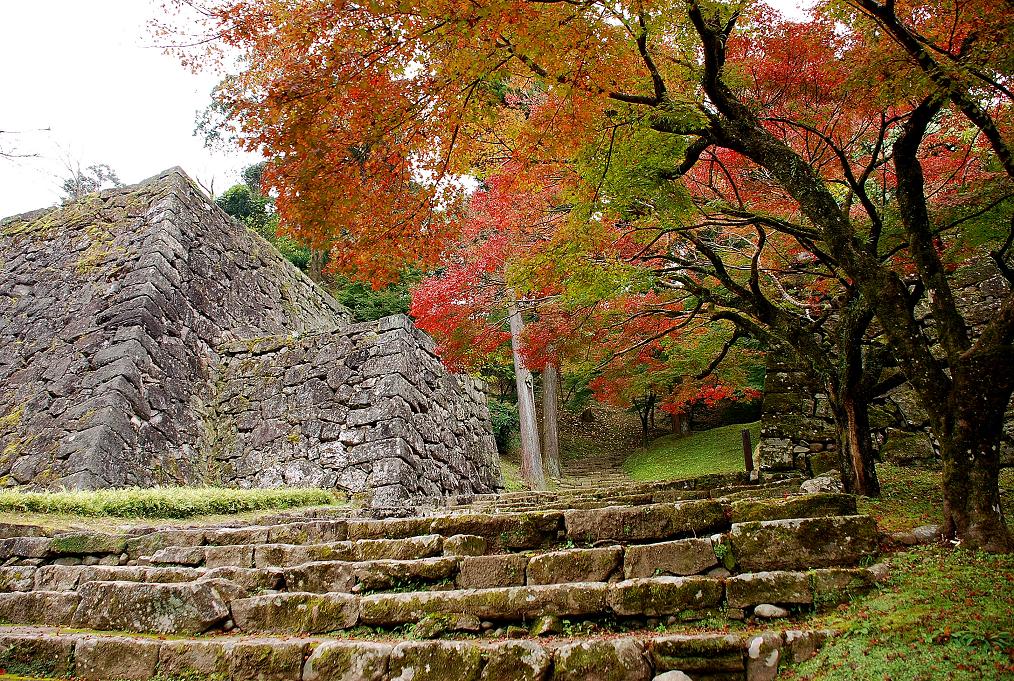
- Ishigaki: Remains of some stone walls.
- Tatebori: Defensive moats dug vertically into the slope.
These remains allow us to imagine the scale and defensive system of the castle at that time.
Current Status as Kamejo Park
Park Development
The Iino Castle site is currently developed as Kamejo Park, a place of relaxation for citizens. The area around the main keep and watchtower has been particularly well-maintained, with walking paths making it easy to stroll around.
Information boards and layout maps are installed within the park, allowing visitors to learn about the history and structure of the castle. In spring, cherry blossoms bloom, creating a beautiful landscape with the castle ruins and cherry blossoms.
View
From the main keep ruins, a magnificent view of the Ebino Basin unfolds. It is likely that Shimazu Yoshihiro once surveyed the surrounding area and devised his strategies from this spot. On clear days, the majestic Kirishima mountain range can also be seen.
Access to Iino Castle
Location
〒889-4301 Harada, Ebino City, Miyazaki Prefecture
Located north of the Ebino City Hall Iino Branch Office, it is visible across the Sendai River.
Access by Car
- From Ebino IC on the Kyushu Expressway: Approximately 10 minutes
- From the center of Ebino City: Approximately 5 minutes
- Parking: The archery range site has been developed into a parking lot and is available free of charge.
Access by Public Transportation
- From Ebino-Iino Station on the JR Kitto Line: Approximately 15 minutes on foot
- Bus: Ebino City Community Bus is available (prior confirmation is recommended as the number of buses is limited).
Visiting Information
- Visiting Hours: Open to the public (the park is always open)
- Admission Fee: Free
- Estimated Time Required: Approximately 30 minutes to 1 hour
Highlights of Iino Castle
1. Main Enclosure Site
The main enclosure site, which was the center of the castle, remains today as a large, flat area. This is believed to be the location of Shimazu Yoshihiro’s residence, where he conducted daily administrative affairs and military councils. Parts of the surrounding earthworks can also be seen, allowing us to imagine the defensive structure of the time.
2. Watchtower
The watchtower, built to monitor enemy movements, has been developed as a park along with the main keep. The view from here is particularly excellent, offering a panoramic view of the Masakiin area. Since the Kizakihara area is also visible, it’s possible that Yoshihiro observed the movements of the Ito army from here.
3. Entrance and Gate Remains
The remains of the entrance and gate, which were the entrances to the castle, are still preserved. This is a must-see point for castle enthusiasts, offering observations of the defensive structure characteristic of castles from the Sengoku period.
4. Earthworks
The earthworks built around the enclosure remain in good condition. These are valuable remains that allow us to observe the characteristics of earthworks due to the unique soil type of the Shirasu plateau.
5. Stone Walls
Small remnants of stone walls also remain. These are valuable historical materials demonstrating the stone wall construction techniques of the Sengoku period.
Related Historical Sites in the Surrounding Area
Kizakihara Battlefield
Located approximately 5 kilometers from Iino Castle, the Kizakihara Battlefield was the site of the Battle of Kizakihara in 1572. It is now a battlefield park with monuments and information boards. Visiting it in conjunction with Iino Castle allows for a deeper understanding of Shimazu Yoshihiro’s strategies and tactics.
Kakuto Castle
Kakuto Castle, located near Iino Castle, was also an important fortress in Masakiin. It was under the control of the Kitahara and Shimazu clans at various times, forming a regional defense network alongside Iino Castle.
Shimazu Kubo
As a historical site related to the Shimazu clan, there is an area called Shimazu Kubo nearby. The place name still conveys traces of the Shimazu clan’s rule.
Shimazu Yoshihiro and Iino Castle
Yoshihiro’s Time at Iino Castle
For Shimazu Yoshihiro, the 26 years he spent at Iino Castle were the golden age of his life. Entering Iino Castle at the prime of his life at the age of 30, Yoshihiro spent his time there until the age of 56, achieving numerous military feats and earning the nickname “Oni Shimazu” (Demon Shimazu).
Iino Castle was not merely a military base, but also Yoshihiro’s residence, where he lived with his family. Here, he conducted government affairs, led his retainers, and governed Masakiin.
Yoshihiro’s Military Record
Based at Iino Castle, Shimazu Yoshihiro participated in the following major battles:
- Battle of Kizakihara (1572): Against the Ito clan, a small force defeated a much larger army.
- Battle of Mimikawa (1578): Against the Otomo clan, a turning point in the Shimazu clan’s conquest of Kyushu.
- Battle of Okitanawate (1584): Against the Ryuzoji clan.
- Battle of Nebirozaka (1590): Against the Toyotomi army.
In many of these battles, Yoshihiro sallied forth from Iino Castle. Iino Castle can be considered the starting point of Yoshihiro’s military success and the place where he built his reputation.
Yoshihiro’s Character
During his time at Iino Castle, Yoshihiro was not only a brave and daring warrior, but also a benevolent ruler beloved by his people. It is said that in his rule of Masakiin, he prioritized the lives of his people and strived to promote industry.
His decisiveness and courage in the “Shimazu retreat” he later demonstrated at the Battle of Sekigahara are thought to have stemmed from the experience and fortitude cultivated during his time at Iino Castle.
The Cultural Value of Iino Castle
Ebino City Designated Historic Site
The Iino Castle ruins are protected as an Ebino City Designated Historic Site. It retains the structure of a Sengoku period mountain castle in good condition, and its historical value is recognized as a historical site associated with the famous warlord Shimazu Yoshihiro.
Academic Value
Iino Castle is academically significant for the following reasons:
- A typical example of a Southern Kyushu-type mountain castle: A castle structure utilizing a Shirasu plateau
- A regional power base during the Sengoku period: The political and military center of Masakiin
- A residence of a famous warlord: Closely related to the life of Shimazu Yoshihiro
- An important stage in Sengoku history: Related to historical events such as the Battle of Kizakihara
Preservation and Utilization
Ebino City is working on the preservation and utilization of the Iino Castle ruins. While developing it as a park has made it a familiar place for citizens, the installation of information boards and protection of the remains have preserved its value as a historical heritage site.
It is hoped that this valuable historical site will be passed on to future generations while maintaining a balance between appropriate preservation and management and utilization as a tourist resource.
Points to Note When Visiting Iino Castle
Clothing and Equipment
- Comfortable Walking Shoes: While the walking paths are well-maintained, some sections are sloped.
- Hat and Sunscreen: Some areas have little shade, so be especially careful in summer.
- Insect Repellent: As the area is rich in nature, insect repellent spray is recommended.
- Drinks: Remember to stay hydrated, especially in summer.
Recommended Time to Visit
- Spring (Late March to Early April): The cherry blossoms are in bloom, making it the most beautiful season.
- Autumn (October to November): Enjoy the autumn foliage, and the weather is pleasant.
- Winter (December to February): The air is clear, offering excellent views, including the snow-covered Kirishima mountain range.
Summer is extremely hot, so early morning or evening visits are recommended.
Tips for Visiting
- Pre-visit Study: Studying about the Battle of Kizakihara and Shimazu Yoshihiro beforehand will enhance your enjoyment.
- Check the Castle Layout: Understand the castle’s structure using the layout map on the information board before exploring.
- Visit Together with the Kizakihara Battlefield: They are only about a 10-minute drive apart, so visiting both together will deepen your understanding.
- Photography: The view from the main keep is an excellent photo opportunity.
Local Cuisine
When visiting Ebino City, be sure to enjoy the local cuisine:
- Ebino Highland Beef: High-quality beef, a specialty of Ebino City.
- Ebino Rice: Delicious rice grown with the pure water of the Kirishima mountain range.
- Local Chicken Dishes: Miyazaki Prefecture is a famous production area for local chicken.
Summary
Iino Castle (Ebino City, Miyazaki Prefecture) is a mountain castle that served as the residence of Shimazu Yoshihiro, a renowned general of the Sengoku period, for the longest period of his life—26 years. It played a crucial role as a departure point for numerous historical battles, including the Battle of Kizakihara, and as the center of the Masakiin domain.
Also known as Kamejo Castle and Tsurukame Castle, this castle was a formidable fortress that skillfully utilized the topography of the Shirasu plateau and the Sendai River. It was a multi-bailey castle consisting of the main keep, second bailey, third bailey, archery range, and watchtower. Currently, it is maintained as Kamejo Park, where remnants such as baileys, earthworks, gates, and stone walls can be seen.
Protected as a designated historical site by Ebino City, the Iino Castle ruins are a valuable historical site that conveys the history of southern Kyushu during the Sengoku period. For history buffs, this is a must-see spot, allowing you to trace the footsteps of Shimazu Yoshihiro, one of Japan’s greatest generals, and experience the dramatic historical setting of the Battle of Kizakihara.
When you visit Ebino City, be sure to stop by Iino Castle Ruins and feel the spirit of the Sengoku period. Enjoy the view from the main keep and imagine the scenery that Shimazu Yoshihiro must have seen.