Hitoyoshi Castle: A Complete Guide to the History and Highlights of the 700-Year Residence of the Sagara Clan, Selected as One of Japan’s Top 100 Castles
Overview of Hitoyoshi Castle
Hitoyoshi Castle is a Japanese castle (hilltop castle) located in Fumoto-cho, Hitoyoshi City, Kumamoto Prefecture. Built utilizing the natural fortifications of the confluence of the Kuma River and Munegawa River, this castle is a historically extremely important fortress, serving as the residence of the Sagara clan for approximately 670 years, from the Kamakura period to the Meiji Restoration.
The castle covers a total area of approximately 216,000 square meters and is designated as a national historic site. It is also selected as one of Japan’s Top 100 Castles (No. 93), and continues to fascinate many castle enthusiasts and history lovers as an important historical heritage site representing Kumamoto Prefecture.
Also known as “Sengetsu-jo” (Crescent Moon Castle), it was named for its beautiful appearance, resembling the moon reflected on the surface of the Kuma River. Even today, the remains of the stone walls and baileys are well-preserved, allowing visitors to imagine its former glory.
History and Development of Hitoyoshi Castle
Kamakura Period: The Arrival of the Sagara Clan and the Beginning of Castle Construction
The history of Hitoyoshi Castle dates back to 1198 (Kenkyu 9). In that year, by order of Minamoto no Yoritomo, Sagara Nagayori was appointed as the jitō (land steward) of Hitoyoshi Manor in the Kuma region. At that time, Yase Shuma-no-suke, who was a deputy of Taira no Yorimori, had built a mountain castle in this area, but Sagara Nagayori destroyed it and became the lord of the castle.
This marked the beginning of the long relationship between the Sagara clan and Hitoyoshi Castle. The early Hitoyoshi Castle was a simple mountain castle, not the full-fledged fortress seen today. The Sagara clan chose this location as their base of operations in the Kuma region, laying the foundation for their rule that would last for 670 years.
Muromachi Period: Development into a Full-Fledged Fortress
Hitoyoshi Castle is believed to have been developed into a full-fledged mountain castle around 1470 (Bunmei 2), during the time of the 12th head of the Sagara clan, Sagara Tamesugu. During this period, the Sagara clan had established their power in the Kuma region, and stronger defensive structures were needed.
There is a theory that the castle was renovated during the time of the 11th head of the Sagara clan, Sagara Nagatsugu, in Bun’an 5 (1448), suggesting that the castle developed gradually throughout the Muromachi period. At this time, Hitoyoshi Castle adopted the typical multi-castle castle structure of southern Kyushu, consisting of a group of baileys centered around Uehara Castle, including Nakahara Castle, Shimohara Castle, and Uchijo Castle.
Sengoku Period: Unification of Kuma District and Major Castle Renovation
With the start of the Sengoku period, the Sagara clan proceeded to unify Kuma District, and Hitoyoshi Castle increased in importance as a base of control. In Tensho 17 (1589), a large-scale renovation was carried out by Sagara Nagatsune.
The center of Hitoyoshi Castle at this time was located in the area called Uehara Castle, across the valley south of the current main keep. The main gate was located on the east side, and its defenses were enhanced by the complex arrangement of baileys. The Sagara clan maintained their relationship with the Shimazu clan while continuing to maintain their own sphere of influence.
Edo Period: As the Domain Capital of Hitoyoshi
In the Edo period, the Sagara clan continued to exist as the daimyo of the Hitoyoshi Domain with a 22,000 koku (unit of rice production) yield, and Hitoyoshi Castle functioned as the domain capital. During this period, the castle took on the form of a flatland castle, and baileys such as the main keep, second bailey, and third bailey were constructed.
In the Battle of Sekigahara in 1600, the Sagara clan initially sided with the Western Army, but later switched allegiance to the Eastern Army, and their territory was secured. From then until the Meiji Restoration, the Sagara clan continued to rule this area for 35 generations. This is an extremely rare example among Japanese daimyo families and speaks to the stability of the Sagara clan’s rule.
Late Edo Period: Great Fire and Final Renovation
A significant event occurred at Hitoyoshi Castle during the late Edo period. A large-scale fire broke out, destroying many of the castle’s buildings. During the reconstruction after this fire, a rare type of stone wall, known as a “cantilevered stone wall” (or “warrior-repelling wall”), was constructed.
This stone wall applied the cantilevered construction method, a European fortification technique, and served not only to prevent enemy intrusion but also to prevent the spread of fire. It can be said that this was an advanced attempt to incorporate Western technology during the late Edo period.
After the Meiji Era: Abolition of the Castle and Designation as a Historic Site
With the abolition of the feudal domains in 1871 (Meiji 4), the Hitoyoshi Domain was abolished, and Hitoyoshi Castle was also abandoned. The wave of modernization brought about by the Meiji Restoration put an end to the 670-year rule of the Sagara clan and the history of Hitoyoshi Castle.
After the castle was abandoned, many of the castle’s buildings were demolished, but the remains such as the stone walls and baileys were well preserved. Recognized for their historical value, they were designated as a national historic site. Currently, they are preserved and utilized as a symbol of Hitoyoshi City and an important tourist resource.
Structure and Characteristics of Hitoyoshi Castle
Location and Layout
Hitoyoshi Castle is a flatland castle located at the confluence of the Kuma River and Munegawa River, utilizing these rivers as natural moats. It made the most of the terrain—a sheer cliff facing the Kuma River—making it a stronghold that was difficult to attack but easy to defend.
The castle’s layout consists of the main keep (Honmaru), the second and third baileys (Ninmaru and Sanomaru), and a group of baileys to the south, including Uehara Castle, Nakahara Castle, and Shimohara Castle. With a vast area of 216,000 square meters, it was one of the largest castles in southern Kyushu.
Main Keep and Major Baileys
The main keep (Honmaru) is located in the center of the castle and housed the lord’s residence and administrative offices. Currently, it is a plaza offering a spectacular view of Hitoyoshi city and the Kuma River.
The second and third baileys (Ninmaru and Sanomaru) served to strengthen the defenses of the main keep, and each housed samurai residences and warehouses. The baileys were separated by stone walls and earthen ramparts, and the complex movement patterns enhanced its defensive capabilities.
Characteristics of the Stone Walls
The stone walls of Hitoyoshi Castle were built using different techniques depending on the era, making them valuable resources for understanding the development of the castle. From the Sengoku period to the early Edo period, many walls are constructed using the nozurazumi (rough-stone masonry) and uchikomi-tsugi (fitted stone masonry) methods.
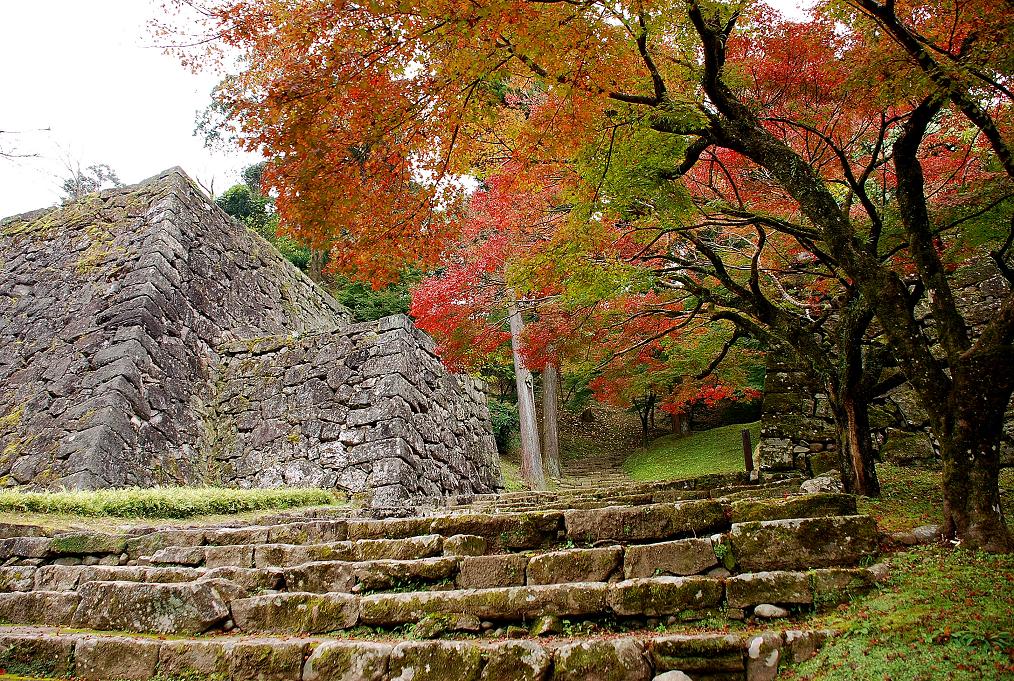
Most noteworthy is the “hanedashi-ishigaki” (cantilevered stone wall/warrior-repelling wall) built at the end of the Edo period. This stone wall has a unique shape where the upper part of the wall juts outwards, designed to cause enemy soldiers to slip and fall if they tried to climb it. It is believed to have been inspired by European castle construction techniques and is an extremely rare structure in Japanese castles.
Highlights of Hitoyoshi Castle
Hanedashi-ishigaki (Warrior-Repelling Wall)
The greatest highlight of Hitoyoshi Castle is this “hanedashi-ishigaki.” Built after a major fire at the end of the Edo period, this stone wall has a unique shape unlike any other in Japan. The upper part of the stone wall juts out significantly, and its angle and shape are designed to effectively prevent enemy intrusion.
This stone wall was not merely a defensive structure, but also served to prevent the spread of fire. It is a testament to advanced castle construction techniques, combining practicality and defensiveness, drawing on experience from major fires. It remains well-preserved today and can be observed up close.
Mizunote Gate Ruins
The Mizunote Gate Ruins, located facing the Kuma River, are another important point of interest at Hitoyoshi Castle. This gate was a crucial point for water transport connecting the castle to the Kuma River, serving as a route for transporting supplies and as an escape route in emergencies.
Currently, the remains of the stone wall are preserved, and it is possible to descend close to the water’s surface. The view of the castle’s stone walls from here is breathtaking, allowing one to truly appreciate the ingenious location of Hitoyoshi Castle as a natural fortress. You can also view these gate ruins from a boat on the Kuma River, enjoying the scenery from the water.
Sites of the Otemon and Otemon Gates
The Otemon Gate and the Otemon Gate, the castle’s main entrance, are must-see points of interest. Stone walls and foundation stones remain at these gate sites, allowing visitors to imagine the castle’s former scale.
The stone walls near the Otemon Gate are particularly well-preserved, allowing for close observation of Edo period stonework techniques. The gate layout and the flow of movement to the baileys reveal the ingenuity of the castle’s defensive plan.
Crescent Moon Pond and the Site of Sagara Seibei’s Residence
To the north of the main keep is a pond called “Crescent Moon Pond,” which played an important role as a water source for the castle. Remains such as the site of Sagara Seibei’s residence remain around this pond, offering insights into life within the castle.
Hitoyoshi Castle History Museum
Adjacent to the castle ruins is the Hitoyoshi Castle History Museum, which features detailed exhibits on the history of Hitoyoshi Castle and the Sagara clan. The museum displays artifacts unearthed during archaeological excavations, a reconstructed model of the castle, and materials related to the Sagara clan. Visiting before or after a visit to the castle ruins will deepen your understanding.
The underground area preserves the remains of a samurai residence’s basement, making it a valuable facility where you can actually see the living space of the Edo period.
The History of the Sagara Clan and Their Governance in Hitoyoshi
Origins of the Sagara Clan
The Sagara clan was originally a powerful family in Shinano Province. Having gained the trust of Minamoto no Yoritomo, Sagara Nagayori moved to the Kuma region in 1198 (Kenkyu 9) as the jitō (land steward) of Hitoyoshi Manor. From then until the Meiji Restoration, they continued to rule this region for 35 generations and 670 years.
Such a long period of continuous rule by the same family in a single region is extremely rare in Japanese history. This demonstrates the stability of the Sagara clan’s rule and their deep connection to the region.
Governance of the Kuma Region
The Sagara clan established their own unique system of governance in the Kuma region. From the Muromachi period to the Sengoku period, the Sagara clan unified Kuma County by subjugating surrounding local lords. Despite the presence of the powerful Shimazu clan, they maintained their independence through skillful diplomacy.
During the Edo period, although a small domain of 22,000 koku, the Sagara clan strived for domain reform, contributing to regional industrial development through initiatives such as encouraging Kuma shochu production and promoting forestry. Many of the foundations of present-day Hitoyoshi-Kuma culture and industry were laid during the Sagara clan’s rule.
The Sagara Clan and Regional Culture
The long rule of the Sagara clan fostered a unique culture in the Hitoyoshi-Kuma region. Cultural assets and forms of faith specific to this region, such as Kuma Kagura and the Sagara Thirty-Three Kannon Pilgrimage, developed under the patronage of the Sagara clan.
Furthermore, the Sagara clan was dedicated to education, establishing the domain school “Jishukan” and striving to cultivate talent. This tradition continues to this day, and Hitoyoshi City is known as a city of education and culture.
Hitoyoshi Castle and the 2020 Heavy Rain Disaster
In July 2020, the Hitoyoshi-Kuma region was hit by heavy rains, causing significant damage to the Hitoyoshi Castle ruins. The Kuma River overflowed, causing part of the stone walls to collapse, and the access road to the castle ruins was also damaged.
The Hitoyoshi Castle History Museum was also flooded, and some of its valuable exhibits were damaged. This disaster caused immense damage not only to Hitoyoshi Castle but to the entire city of Hitoyoshi.
Currently, restoration work is underway, with the repair of the stone walls and the maintenance of the castle ruins being carried out in stages. For the local people, Hitoyoshi Castle is not merely a historical site, but a symbol of their identity and also holds significance as a symbol of recovery.
Access
Access by Train
The nearest stations to Hitoyoshi Castle are JR Hisatsu Line “Hitoyoshi Station” or Kumagawa Railway “Hitoyoshi Onsen Station.” The castle ruins are approximately a 20-minute walk (about 1.3 km) from the station. From Hitoyoshi Station, the recommended route is to walk along the promenade beside the Kuma River, which offers beautiful scenery.
It’s approximately a 2-hour journey from Kumamoto Station via the JR Kagoshima Main Line and Hisatsu Line, and about a 2.5-hour journey from Kagoshima-Chuo Station via the Hisatsu Line.
Access by Car
It’s about a 10-minute drive from the Hitoyoshi Interchange on the Kyushu Expressway. There is free parking available near the Hitoyoshi Castle ruins, accommodating approximately 50 regular-sized cars. However, due to the effects of heavy rain disasters, some parking areas may be unusable, so it’s recommended to check in advance.
From Kumamoto City, it’s about a 1.5-hour journey via National Route 219, and from Kagoshima City, it’s about a 2-hour journey.
Getting Around the Castle Grounds
The castle ruins cover a vast area, so it takes about 1.5 to 2 hours to see everything. There are many stone steps and slopes, so comfortable walking shoes are recommended. The view from the main keep is magnificent, so be sure to climb to the top.
Nearby Tourist Attractions
Hitoyoshi Onsen
Below Hitoyoshi Castle lies the Hitoyoshi Onsen hot spring resort. Many hot spring inns and public baths line the Kuma River, allowing visitors to relax in the hot springs after visiting the castle ruins. Hitoyoshi Onsen is known for its skin-beautifying properties and features a mildly alkaline water quality.
Aoi Aso Shrine
Aoi Aso Shrine, designated a National Treasure, is located about a 15-minute walk from Hitoyoshi Castle. This shrine, revered by the Sagara clan, has five buildings designated as National Treasures: the thatched-roof main hall, corridor, offering hall, worship hall, and gate tower.
Kuma River Rafting
Rafting down the Kuma River, one of Japan’s three major rapids, is a popular activity for Hitoyoshi tourists. Enjoy the exhilarating experience of navigating the rapids with the skillful boatmanship, and admire the stone walls of Hitoyoshi Castle from the water.
Kuma Shochu Distillery Tour
The Hitoyoshi-Kuma region is known as a production area for Kuma Shochu (a type of distilled spirit). There are 28 distilleries in the region, many of which offer tours and tastings. You can experience the tradition of shochu making that has continued since the time of the Sagara clan.
Cultural Value of Hitoyoshi Castle
Designation as a National Historic Site
The Hitoyoshi Castle ruins have been designated as a National Historic Site due to their historical value and the excellent state of preservation of their remains. It is valued as a castle site that was consistently ruled by the same clan from the Kamakura period to the Meiji period, and as an important site for understanding the history of castles in southern Kyushu.
One of Japan’s Top 100 Castles
It has been selected as the 93rd of the “Top 100 Castles of Japan” selected by the Japan Castle Association. This selection is based on a comprehensive evaluation of the castle’s historical importance, the state of preservation of its remains, and its value as a regional symbol. The Top 100 Castles stamp can be obtained at the Hitoyoshi Castle History Museum.
Components of the Japan Heritage Site
Hitoyoshi Castle Ruins are one of the important cultural properties that make up the story of the Japan Heritage site, “The Culture of Conservatism and Innovation Born from 700 Years of Sagara Rule – Hitoyoshi Kuma, Japan’s Richest Hidden Village.” It is positioned as a symbol of the unique regional culture brought about by the long rule of the Sagara clan.
Points to Note When Visiting Hitoyoshi Castle
Estimated Visiting Time
To thoroughly explore the entire Hitoyoshi Castle Ruins, allow approximately two hours. Including a visit to the Hitoyoshi Castle History Museum, you will need an additional 30 minutes to an hour. We recommend planning your visit with ample time.
Best Time to Visit
Hitoyoshi Castle displays different expressions throughout the seasons. In spring, it is known as a famous cherry blossom viewing spot, with cherry trees planted within the castle grounds adorning the stone walls. In summer, the fresh greenery is beautiful, and in autumn, the autumn leaves are magnificent. In winter, the air is clear, allowing for expansive views, and the snow-covered castle ruins also have a unique charm.
During the rainy season and typhoon season, the Kuma River may flood, making it impossible to visit sites such as the Mizunotemon Gate ruins. Also, the summer sun is strong, so heatstroke prevention is necessary.
Clothing and Items to Bring
The castle ruins have many stone steps and slopes, and some areas have unstable footing. We recommend wearing comfortable shoes such as sneakers. In summer, be sure to bring a hat, parasol, and drinking water; in winter, bring warm clothing.
A camera is a must. There are many photo opportunities, such as the cantilevered stone walls and the view from the main keep.
Using the Hitoyoshi Castle History Museum
When visiting Hitoyoshi Castle, it is recommended to first gain some background knowledge at the Hitoyoshi Castle History Museum before exploring the castle ruins for a deeper understanding. The exhibits are comprehensive, allowing you to learn in detail about the history of the Sagara clan and the changes in the castle.
Opening hours are from 9:00 AM to 5:00 PM (last entry at 4:30 PM), and the museum is closed on Mondays (or the following day if Monday is a public holiday). Admission is reasonably priced at 200 yen for adults and 100 yen for elementary and junior high school students.
Summary
Hitoyoshi Castle is a historical site where the Sagara clan ruled for 670 years, and it is a noteworthy presence in the history of Japanese castles. Its location, utilizing the natural fortifications of the Kuma River and Munegawa River, its unique cantilevered stone walls, and its long history of rule make this castle truly one of a kind.
Although it suffered damage from the heavy rains of 2020, reconstruction efforts are underway, and it is being reborn as a symbol of the region. With abundant surrounding tourist resources such as Hitoyoshi Onsen (hot springs), Aoi Aso Shrine, and Kuma River boating, it is an attractive tourist destination where you can enjoy history, nature, and hot springs.
As one of Japan’s 100 Famous Castles, and as an important historical site for understanding the history of southern Kyushu, Hitoyoshi Castle is a place worth visiting. By experiencing the long history of the Sagara clan’s rule and the unique culture it fostered, you can truly appreciate the richness of Japan’s regional history.