Hosono Castle (Toki City, Gifu Prefecture) Complete Guide: A Thorough Explanation of the Tensho Period Camp Fortress Ruins and Highlights
What is Hosono Castle?
Hosono Castle is a mountain castle from the late Sengoku period located in Hosono, Tsurusato-cho, Toki City, Gifu Prefecture. Built on the tip of the ridge of Tsuruokayama (elevation 712.4m), at an altitude of approximately 640m, the relative height difference is about 150-190m. This castle is believed to have been built not as a permanent residence, but as a camp fortress during wartime. Although small in scale, it is a valuable historical site with clearly defined defensive structures, attracting attention from castle enthusiasts.
Toki City is known as a pottery town and a production center for Mino ware, but during the Sengoku period, it was a strategic point in Mino Province, and numerous castles were built there. Among them, Hosono Castle has a relatively clear construction period and is an important historical site that conveys the history of warfare from the Tensho to Keicho periods.
History and Construction Background of Hosono Castle
Construction Period and Purpose
Regarding the construction period of Hosono Castle, due to limited historical records, it is impossible to say anything definitively, but two main theories are considered most likely.
The 1584 (Tensho 12) theory** is considered the most likely. This theory suggests that it was built as a fortified camp for Tokugawa Ieyasu’s side during the Battle of Komaki and Nagakute, which took place in that year. It is presumed that Ishikawa Kazumasa, who was serving as the castellan of Okazaki Castle at the time, mobilized local residents to construct it as a hastily built fortified camp. In this battle, Toyotomi Hideyoshi and Tokugawa Ieyasu were in conflict, and fierce battles raged from Mino Province to Owari Province. Hosono Castle’s location is a strategic point controlling a key route from eastern Mino to Mikawa.
The 1600 (Keicho 5) theory also exists. It is believed that Hosono Castle was built during the Battle of Sekigahara, and it is suggested that either the Eastern or Western Army may have used it as a military base. The area around Toki City is not far from the Sekigahara battlefield, making it a crucial location for troop movement and securing supply lines.
In any case, Hosono Castle is thought not to have been a permanent residence, but rather a temporary military facility built for a short period during a specific campaign. Therefore, it lacks large structures such as keeps and stone walls, and instead features a simple yet practical layout centered on earthworks and moats.
Lord and Related Figures
While there are no clear records regarding the lord of Hosono Castle, as mentioned above, a connection to Ishikawa Kazumasa has been suggested. Ishikawa Kazumasa was a senior retainer of Tokugawa Ieyasu and held the important position of Okazaki Castle Deputy. He played a crucial role in Ieyasu’s military actions during the Battle of Komaki and Nagakute in 1584, and it is quite possible that he built Hosono Castle during his advance into Mino Province.
However, Ishikawa Kazumasa suddenly defected to Toyotomi Hideyoshi in 1585, suggesting his connection to Hosono Castle was short-lived.
Abandonment and Aftermath
There are no clear records of when Hosono Castle was abandoned. Given its nature as a fortified camp, it’s natural to assume it was abandoned at the end of the campaign. After the Battle of Komaki-Nagakute, or perhaps after the Battle of Sekigahara, it would have already lost its military role and been abandoned.
From the Edo period onward, it was left as a forest, untouched by human hands, and gradually became buried in nature. This, conversely, resulted in the preservation of the fortified camp from the Sengoku period almost entirely intact, making it a valuable historical site today.
Layout and Structure of Hosono Castle
Location and Topographical Characteristics
Hosono Castle is built on the tip of the ridge of Tsuruoka Mountain. Located at an altitude of approximately 640m, with a relative height of 150-190m from the base, it is a medium-sized mountain castle. Its layout cleverly utilizes the ridge terrain, showcasing a typical example of a medieval mountain castle that transformed the natural ruggedness into defensive strength.
The castle’s location overlooks the Toki River basin, making it ideal for monitoring and controlling the surrounding roads. Against enemies climbing along the ridge, multiple trenches provide cover, while vertical trenches allow for attacks from the flanks.
Layout of the Main Enclosure and Baileys
The main enclosure, the heart of Hosono Castle, is situated at the highest point of the ridge. While not particularly large, it offers sufficient space for a fortified camp and is thought to have functioned as a command post and supply depot.
Several baileys (enclosures) are arranged around the main enclosure. These baileys are arranged in a stepped pattern along the ridge terrain, creating a multi-layered defensive structure. Each enclosure is demarcated by earthen ramparts, a structure designed to prevent enemy intrusion.
The earthen ramparts remain clearly visible today, and although they are about 1-2 meters high, they may have been even higher in the past. It is presumed that fences or walls were built on top of the ramparts, functioning as a simple yet effective defensive structure.
Moats and Earthen Bridges
The greatest highlight of Hosono Castle is the clearly visible moats. Moats are dry moats dug to cut across ridges, serving as important defensive structures to prevent enemy intrusion. Multiple moats can be identified at Hosono Castle, and the moat behind the main enclosure (on the mountain side) is particularly large and sufficiently deep.
The moat is estimated to be about 5-10 meters wide and 3-5 meters deep, a sufficient size for a small-scale fortified camp. The bottom of the moat still retains its V-shaped cross-section, giving a glimpse into its appearance at the time of construction.
An earthen bridge for crossing the moat also remains. The earthen bridge was created by leaving a portion of the moat unexcavated, serving both as a passageway and a strategically important defensive point. The structure allowed for attacks from both sides as the enemy crossed, demonstrating a clever tactical design.
Vertical Moats and Flanking Defenses
Vertical moats were dug along the sides of the ridge. These moats, dug vertically along the slope, were designed to prevent enemies from climbing the slope and attacking from the flanks. Several vertical moats can be seen at Hosono Castle, extending from the main enclosure towards the foot of the hill, forming a defensive layout covering the entire slope.
The vertical moats also prevented soil erosion, playing a role in preserving the castle’s structure over the long term. The vertical moats, still clearly visible today, are important remains for understanding Hosono Castle’s defensive philosophy.
Staggered Gate
Hosono Castle also retains the remains of a staggered gate. A “koguchi” is the entrance to a castle, and a “kuichigai koguchi” is a design that makes it difficult for enemies to enter by curving the passageway. By creating a structure that prevents a straight advance, it prevents enemy charges and gives the defenders an advantage.
The kuichigai koguchi at Hosono Castle combines earthworks and moats, demonstrating the high level of castle-building technology of the time. It is noteworthy that a castle intended for short-term use as a temporary encampment possesses such advanced defensive features.
Highlights and Remains of Hosono Castle
Well-Preserved Moats
The most noteworthy feature for castle enthusiasts visiting Hosono Castle is the well-preserved moats. Located on the north and south sides of the main enclosure, the moats are clearly defined in both depth and width, making them popular photography spots. In particular, the large moat behind the main enclosure clearly shows a V-shaped cross-section, a relic that allows one to appreciate the civil engineering technology of the Sengoku period.
Walking along the bottom of the moats gives one a sense of the effort the soldiers of that time put into digging them. The skill and organizational ability to excavate a moat of this scale in such a short time using only human power, in an era without heavy machinery, is astonishing.
Clear Earthworks and Enclosures
Earthworks remain in various places within the castle grounds, and the earthworks around the main enclosure, in particular, have retained their height. Walking along the top of the earthworks allows you to experience the perspective of the lookouts of the time and confirm the surrounding terrain and view. The flat surfaces of the enclosures are also well-preserved, making it easy to understand the scale and structure of the fortified camp.
Observation Points for Vertical Moats
The vertical moats carved into the slopes can be seen by walking around the perimeter of the castle. Especially when viewed from a position slightly below the main enclosure, you can observe multiple vertical moats running parallel to each other, giving you a real sense of the multi-layered defenses. The depth and width of the vertical moats vary depending on the location, and it is clear that larger vertical moats are positioned in directions of higher importance.
Views and Surrounding Environment
The views from Hosono Castle are also one of its highlights. From an elevation of 640 meters, you can enjoy a panoramic view of Toki city and the Toki River basin, and on clear days, you can even see Mount Ena and Mount Byobu in the distance. This excellent view was also important for military surveillance, indicating its strategic location for early detection of road movements and enemy approaches.
The area surrounding the castle ruins is rich in nature, offering beautiful scenery throughout the seasons. The fresh greenery in spring and the vibrant autumn foliage make it a spot where you can enjoy both castle exploration and nature walks simultaneously.
Access and Visiting Information for Hosono Castle
Location and Basic Information
Location: Around 783-1 Hosono, Tsurusato-cho, Toki City, Gifu Prefecture
Castle Classification: Mountain Castle
Elevation: Approximately 640m
Relative Height: Approximately 150-190m
Construction Period: Estimated to be 1584 (Tensho 12) or 1600 (Keicho 5)
Remains: Moats, vertical moats, earthworks, baileys, staggered gate entrances
Access by Car
Hosono Castle is easily accessible by car.
From the Chuo Expressway:
- Approximately 15 minutes from Toki Interchange
- Approximately 20 minutes from Mizunami Interchange
From Toki city center, take the prefectural road towards Hosono, Tsurusato-cho. Using Shofuku-ji Temple as a landmark will make it easier to find. There are a few parking spaces around Shofuku-ji Temple, but due to the narrow mountain road, it’s best to avoid visiting in a large vehicle.
Access by Public Transportation
Access by public transportation is inconvenient. The nearest stations are Toki-shi Station or Tajimi Station on the JR Chuo Main Line, but bus services from there are limited, making taxis the most practical option. If your purpose is to explore the castle, renting a car is recommended.
Ascent Route and Time Required
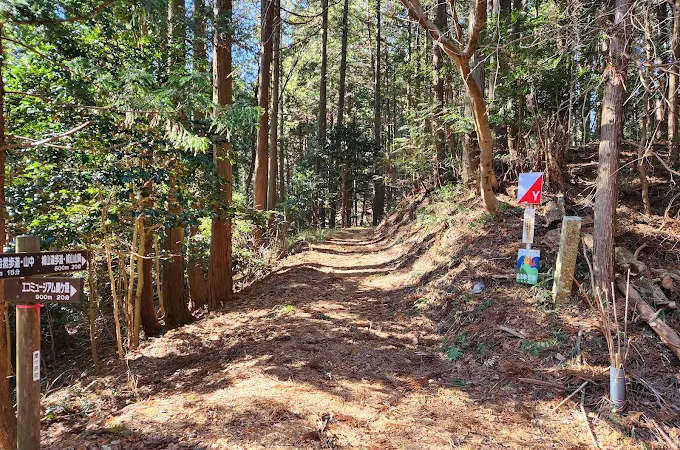
A hiking trail is maintained from near Shofuku-ji Temple, and guide signs are installed. The ascent route is a relatively clear path along the ridge, but as it is a mountain trail, appropriate clothing and shoes for hiking are necessary.
Time Required for Ascent: Approximately 30-40 minutes uphill, approximately 20-30 minutes downhill
Total Time Required Round Trip: Approximately 1 hour to 1 hour 30 minutes (including time spent visiting the castle)
While there are some steep sections on the ascent route, it is well-maintained, so it should be manageable for those with average physical fitness. However, caution is advised as the ground can become slippery during rainy weather and winter.
Notes for Visitors
- Clothing: Long-sleeved shirt and long pants, trekking shoes or athletic shoes are recommended.
- Items to Bring: Drinking water, towel, insect repellent (summer), bear bell (just in case).
- Season: Spring to autumn is the best time to visit. Snow is possible in winter.
- Time: Please allow ample time to descend before sunset.
- Manners: Since you may pass through private property, please be considerate of local residents.
Best Season for Visiting
The best seasons to visit Hosono Castle are spring (April-May) and autumn (October-November). The weather is mild, and you can enjoy the fresh greenery and autumn foliage. In summer, the vegetation is overgrown, making observation of the ruins somewhat difficult. Also, there are many insects, so insect repellent is essential.
Nearby Tourist Attractions and Castles
Mino Ware Culture of Toki City
Toki City is one of Japan’s largest ceramic production areas, boasting the highest production volume of Mino ware in Japan. Visiting Toki City’s ceramic culture in conjunction with a visit to Hosono Castle is highly recommended.
Toki Premium Outlets: A large outlet mall where you can enjoy shopping for ceramics.
Mino Ware Museum: A facility where you can learn about the history and techniques of Mino ware.
Kiln Tour: There are numerous kilns in the city, and pottery making experiences are also available.
The “Toki Mino Ware Festival,” held annually, is a major event that attracts many ceramics enthusiasts from all over Japan.
Nearby Castles
Besides Hosono Castle, many other castle ruins remain in Toki City and the surrounding areas.
Toki Takayama Castle (Toki City): A mountain castle known as the main castle of the Toki clan. Designated as a National Historic Site:
Tsumaki Castle (Toki City): The residence of the Tsumaki clan, a mountain castle with remaining stone walls.
Akechi Castle (Kani City): A castle said to be the birthplace of Akechi Mitsuhide.
Iwamura Castle (Ena City): One of Japan’s three great mountain castles, with magnificent remaining stone walls.
Naegi Castle (Nakatsugawa City): A mountain castle with a unique layout utilizing large rocks.
The “Tono Castle Tour,” which visits these castles, is a popular route for castle enthusiasts.
Sato Nobuo Art Museum
At the foot of Mt. Tsuruoka, at the base of Hosono Castle, is the Sato Nobuo Art Museum. This distinctive octagonal building exhibits works by local artists. It’s a good place to stop before or after exploring the castles.
Cherry Blossom Trees along the Toki River
In spring, the cherry blossom trees along the Toki River are magnificent. Planning a visit to Hosono Castle in spring allows you to enjoy a cherry blossom viewing tour as well. The cherry blossoms at Takayama Park are also famous and a spring tradition in Toki City.
Historical Value and Research of Hosono Castle
Importance in the Study of Encampment Castles
Hosono Castle is an important historical site for understanding the reality of encampment castles from the late Sengoku period. Unlike permanent residences, encampment castles, built for short periods for specific campaigns, were rarely renovated after construction and often retain their original appearance.
The layout of Hosono Castle is ingenious, designed to maximize defensive capabilities with limited time and manpower, making it a valuable sample for studying Sengoku period castle construction techniques. In particular, the defensive system combining moats and vertical trenches reflects the military thinking of the time and is attracting academic attention.
The Battle of Komaki-Nagakute and Castles of Mino Province
The Battle of Komaki-Nagakute in 1584 was a crucial battle in which two major forces, Toyotomi Hideyoshi and Tokugawa Ieyasu, directly confronted each other. In this battle, numerous encampments were built across Owari, Mino, and Ise provinces, and both sides engaged in fierce battles.
If Hosono Castle was built as a Tokugawa encampment, it would provide an important clue to understanding Ieyasu’s military actions in eastern Mino. While Mino Province was under Hideyoshi’s influence, the eastern part was also under Tokugawa influence, creating a tense border region between the two powers.
Hosono Castle’s location is thought to have had strategic value in securing an advance route from Mikawa to Mino and monitoring Hideyoshi’s movements.
Position in Local History
In the history of Toki City, Hosono Castle is a relic symbolizing the turmoil of the Sengoku period. The Toki clan was a prosperous family as the governors of Mino, but they were destroyed by Saito Dosan during the Sengoku period. Afterward, the rulers changed successively, from Oda Nobunaga and Toyotomi Hideyoshi to Tokugawa Ieyasu.
Hosono Castle was built during such a turbulent era, and it serves as evidence that the region was embroiled in nationwide warfare. Hosono Castle also holds an important position in regional history research.
Evaluation by Castle Enthusiasts
Evaluation on Kojodan
Hosono Castle is registered as a castle in Gifu Prefecture on the castle information website “Kojodan,” and reports from visitors have been received. It is also included in the 100 Castle Lords System, indicating a high level of interest from castle enthusiasts.
Visitor evaluations frequently mention comments such as “Small but with clearly defined remains,” “Magnificent moats,” and “Easy to climb, recommended for beginners.” On the other hand, there are also criticisms such as “Few information signs” and “Overgrown vegetation in summer,” suggesting the importance of choosing the right time to visit and gathering information beforehand.
Photography Tips
Hosono Castle is an attractive subject for castle photography enthusiasts. The following points are particularly popular as photography spots.
- Large moat behind the main enclosure: The V-shaped cross-section is beautiful; the angle looking up from the bottom of the moat is recommended.
- Earth bridge: You can photograph the combination of the moat and the earth bridge.
- Group of vertical moats: From a position where you can see multiple vertical moats carved into the slope.
- View from the main enclosure: With Toki city and the surrounding mountains in the background.
The slanted light in the early morning or evening emphasizes the undulations of the earthworks and moats, allowing you to take dramatic photographs.
Model Itinerary for Visiting Hosono Castle
Half-Day Course (Hosono Castle Only)
9:00 Depart from Toki city center and travel to the entrance to Hosono Castle (approx. 15 minutes by car)
9:30 Park near Shofuku-ji Temple and begin climbing
10:00 Arrive at the castle ruins and view the remains
11:00 Begin descending
11:30 Arrive at the parking lot
12:00 Lunch in Toki city center (enjoy your meal in Mino ware)
Full-Day Course (Visiting Surrounding Castles)
9:00 Climb Hosono Castle
11:00 Finish visiting Hosono Castle
12:00 Lunch in Toki city center
13:30 Visit Toki Takayama Castle
15:00 Visit Tsumaki Castle
16:30 Mino Ware Museum or Kiln Visit
18:00 Shopping at Toki Premium Outlets
This course allows you to enjoy both Toki City’s castles and ceramic culture.
Summary: The Charm of Hosono Castle
Although not large in scale, Hosono Castle is a valuable historical site that well conveys the reality of a fortified camp from the late Sengoku period. The clearly defined moats, vertical trenches, earthworks, and staggered gate structures convey the castle-building techniques and defensive philosophies of the time, and it occupies an important position in castle research.
The view from the mountaintop at an altitude of 640m is magnificent, offering a panoramic view of Toki city and the surrounding mountains. This excellent view was also important for military surveillance, making it clear that Hosono Castle was built in a strategically important location.
The climbing route is well-maintained, making it relatively easy to visit, which is another attractive feature. It can be said that this castle site can be enjoyed by a wide range of castle enthusiasts, from beginners to advanced visitors. Visiting Hosono Castle in conjunction with exploring Toki City’s Mino ware pottery culture and surrounding castles will make for a more fulfilling historical exploration.
Hosono Castle may not be flashy, but it quietly tells the story of the Sengoku period. Standing on the earthen ramparts, walking along the bottom of the moats, and experiencing the ruggedness of the vertical trenches allows you to relive the hardships and tensions of the soldiers of that time. When you visit Toki City in Gifu Prefecture, be sure to stop by Hosono Castle. It will be a valuable experience where you can feel the breath of history.