Hongō Castle (Uda City, Nara Prefecture) Complete Guide: History, Remains, and Access Explained in Detail
Located in Hongō, Ōuda-ku, Uda City, Nara Prefecture, Hongō Castle is a mountain castle that tells the story of the turbulent Sengoku period. Also known as “Yamato Hongō Castle” and “Mountain God’s Castle,” it is a historically significant castle site that served as the stage for battles between Matsunaga Hisahide and the Uda Three. This article comprehensively explains the history of Hongō Castle, details of its remains, highlights, and access methods, providing all the information you need for a visit.
Basic Information on Hongō Castle
Hongō Castle is a medieval mountain castle located in Hongō, Ōuda-ku, Uda City, Nara Prefecture, built on a mountaintop approximately 400 meters above sea level. Currently, remnants such as earthworks and dry moats are well-preserved, making it a valuable historical site for understanding the structure of Sengoku period mountain castles.
Location: Hongō, Ōuda-ku, Uda City, Nara Prefecture
Other Names: Yamato Hongō Castle, Yamagami Castle
Castle Structure: Mountain Castle
Construction Period: Mid-16th Century (Estimated)
Main Lords: Matsunaga Hisahide (Estimated), Akiyama Clan (Traditional Theory)
Remains: Earthworks, Dry Moats, Enclosures
Designated Cultural Property: Not Designated
Uda City is located in the northeastern part of Nara Prefecture and was formed in 2006 through the merger of four towns and villages in Uda District: the former Ōuda Town, Utano Town, Haibara Town, and Murō Village. It is a historical region mentioned in the “Kojiki” and “Nihon Shoki” since ancient times and is also known as the setting for the legend of Emperor Jimmu.
History and Construction Background of Hongō Castle
Traditional Theory: Akiyama Clan’s Residence Theory
For many years, several theories have existed regarding the history of Hongō Castle. According to the conventional theory, Hongō Castle was the residence of the Akiyama clan, one of the “Uda Three,” before they established Akiyama Castle.
The Uda Three are a collective term for three local lords who ruled Uda County in Yamato Province during the Sengoku period. These were the Akiyama, Sawa, and Yoshino clans, who initially served the Kitabatake clan, who were descendants of the Southern Court. The Kitabatake clan was a powerful Sengoku daimyo based in Ise Province and also wielded influence in Yamato Province.
The Akiyama clan was a local lord with considerable power in the Uda region, and it was believed they controlled the area from their castle in Hongō. Later, it was thought that the Akiyama clan moved their base to the more fortified Akiyama Castle (the predecessor of Uda Matsuyama Castle).
Recent Research: The Theory of Matsunaga Hisahide’s Siege Base
Recent advances in castle research have significantly altered the understanding of Hongō Castle’s significance. Currently, the prevailing theory is that Hongō Castle was a siege base (an auxiliary castle or outpost) built by Matsunaga Hisahide to capture Akiyama Castle.
Matsunaga Hisahide was one of the most prominent warlords of the Sengoku period, serving Miyoshi Nagayoshi and reigning as the ruler of Yamato Province. In 1559, he established Shigisan Castle as his base and was working to unify Yamato Province. To establish control over the Uda region, Hisahide launched an attack on the Uda Three, who were loyal to the Kitabatake clan.
Akiyama Castle was a particularly strong fortress among the Uda Three’s castles, making direct attack difficult. Therefore, it is speculated that Matsunaga Hisahide built Hongō Castle as a base to besiege Akiyama Castle and prolong the siege. Hongō Castle’s location, overlooking Akiyama Castle, was ideal for functioning as a siege base.
The Situation in the Uda Region During the Sengoku Period
During the Eiroku era (1558-1570), the Uda region was a fierce battleground with multiple factions clashing. Matsunaga Hisahide’s ambition to unify Yamato Province, the Kitabatake clan’s efforts to maintain their power, and the Uda Three, local lords fighting for survival, all intersected.
Matsunaga Hisahide is believed to have succeeded in subjugating the Uda Three by around Eiroku 11 (1568). The Akiyama clan also surrendered to Hisahide around this time and subsequently served under him. If Hongō Castle was built by Matsunaga Hisahide, its construction is estimated to have occurred in the first half of the Eiroku era, probably the early 1560s.
Afterward, Matsunaga Hisahide rebelled against Oda Nobunaga twice and committed suicide at Shigisan Castle in Tenshō 5 (1577). After Hisahide’s death, Yamato Province became a direct territory of Oda Nobunaga, and the situation in the Uda region changed significantly.
Layout and Structure of Hongō Castle
Location and Utilization of Topography
Hongō Castle is a typical mountain castle built on a mountaintop approximately 400 meters above sea level. The castle’s location overlooks the Uda Basin, offering particularly open views towards Akiyama Castle (later Uda Matsuyama Castle). This topographical feature supports the possibility that Hongō Castle functioned as a base for attacking Akiyama Castle.
As a mountain castle, Hongō Castle utilizes the steep slopes as a natural defensive line. The main enclosure is located on the flat area of the mountaintop, surrounded by multiple baileys. The defense of a mountain castle is fundamentally based on maximizing the use of the terrain, and Hongō Castle was built faithfully according to this principle.
Arrangement of the Main Enclosure and Baileys
The main enclosure of Hongō Castle, the central feature, is located on the mountaintop, providing a relatively large, flat area. The main enclosure is estimated to be approximately 30 meters east-west and 40 meters north-south, a standard size for a medium-sized mountain castle.
Several baileys are arranged in a stepped pattern around the main enclosure. These baileys are thought to have functioned as defensive belts protecting the main enclosure. The arrangement of the baileys maintains a natural shape, following the terrain, suggesting that no large-scale construction work was carried out.
This structure suggests that Hongō Castle was not a full-fledged residence intended for long-term living, but rather a siege base built quickly for a specific military purpose.
Structure and Characteristics of Earthworks
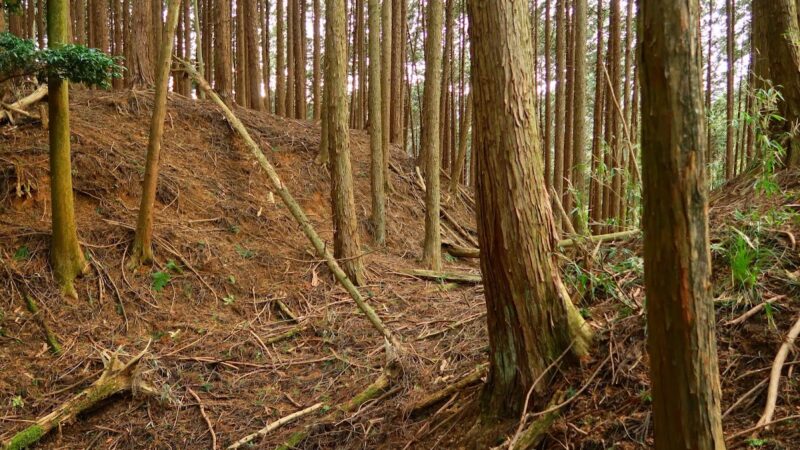
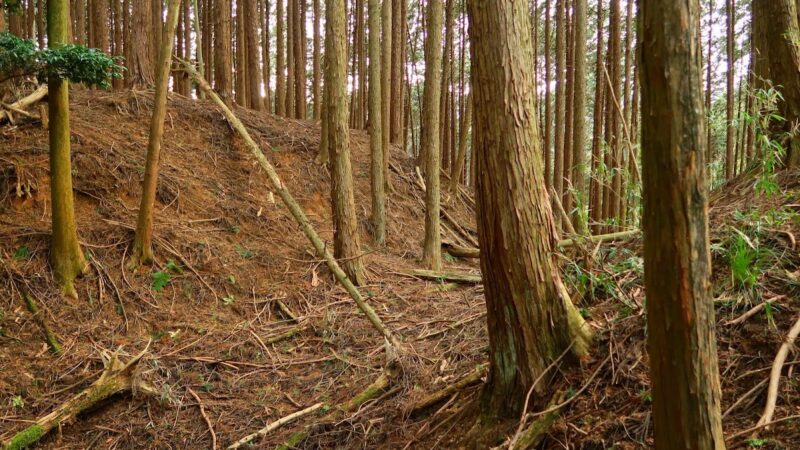
The most prominent remains of Hongō Castle are the earthworks. Clear earthworks remain around the main enclosure, reaching a maximum height of approximately 2 meters in some places. These earthworks strengthened the defenses of the main enclosure and functioned as a barrier to prevent enemy intrusion.
The earthworks are believed to have been constructed using a technique called “rammed earth,” where local soil was piled up. Observing the cross-section of the earthworks reveals multiple layers, indicating that the soil was built up in stages.
The earthworks are not positioned to surround the entire perimeter of the main enclosure, but rather concentrated in areas where defense was particularly needed. This suggests a strategy to efficiently enhance defensive capabilities with limited personnel and time.
Function and Placement of Dry Moats
Another important structure of Hongō Castle is the dry moats. These moats functioned as boundaries between enclosures and as obstacles to prevent enemy intrusion. Several dry moats remain in good condition today, with depths ranging from 1.5 to 3 meters.
The dry moats exhibit a V-shaped or U-shaped cross-section, a typical form for mountain castles of the Sengoku period. The narrow bottom of the moats suggests that it would have been extremely difficult for enemy soldiers to pass through.
Of particular note is the dry moat separating the main enclosure and the second enclosure, which functioned as the castle’s main defensive line. This dry moat is relatively large, suggesting its importance as a key defensive point.
Structure of the Entrance (Koguchi)
In a castle, the entrance (koguchi) is not only the entrance but also the place requiring the most defense. While the koguchi of Hongō Castle is difficult to confirm as a clear structure, judging from the layout of the enclosures and the topography, it is thought that the access route to the main enclosure was on the south or east side.
While it is common to fortify the area around a koguchi with earthworks and dry moats, no large-scale koguchi structures have been confirmed at Hongō Castle. This is another element suggesting that Hongō Castle was a siege base intended for short-term use.
Highlights and State of Remains at Hongō Castle
Remains that can be confirmed on-site
The main highlights when visiting Hongō Castle are the following remains:
Earthworks: The earthworks surrounding the main enclosure are the most clearly visible remains of Hongō Castle. The earthworks, approximately 1.5 to 2 meters high, are partially preserved in good condition, allowing for direct observation of Sengoku period castle construction techniques. The earthworks on the north and west sides are particularly well-preserved, making it easy to imagine their original appearance.
Dry Moats: Multiple dry moats can be identified, and the moat separating the main enclosure from the second enclosure is particularly large and impressive. The depth and width of the dry moats demonstrate their function as defensive structures.
Enclosures: Multiple enclosures arranged in a stepped pattern can be identified. The flat surfaces of each enclosure are relatively clear, providing clues to understanding the overall structure of the castle.
Cut Slopes: Artificially carved steep slopes (cut slopes) remain around the enclosures. Cut slopes are important defensive structures that made enemy intrusion difficult.
Preservation Status and Challenges of the Remains
The remains of Hongō Castle are generally in good condition. This is because the castle ruins escaped later development and were maintained as a forest. Major remains such as earthworks and dry moats are clearly preserved, making them valuable resources for castle research and historical education.
However, some parts of the remains are obscured by overgrown trees. Also, the access path to the castle is not clearly maintained, so caution is advised when visiting.
Currently, Hongō Castle is not designated as a cultural property, but its value is being recognized by local history enthusiasts and castle researchers. It is a historical site where appropriate preservation and utilization are expected in the future.
View from the Castle Ruins
From the summit of Hongō Castle, you can enjoy a panoramic view of the Uda Basin. The view towards Akiyama Castle (Uda Matsuyama Castle) is particularly unobstructed, and this view suggests that Hongō Castle may have been a base for attacking Akiyama Castle.
On clear days, you can see the city of Uda and the surrounding mountains, understanding how important a strategic location this area was during the Sengoku period. The area boasts beautiful natural scenery throughout the seasons, making it a place where you can enjoy both historical exploration and nature observation.
Access to Hongō Castle
Access by Public Transportation
Nearest Station: Kintetsu Osaka Line “Haibara Station”
Direct access from Haibara Station to Hongō Castle by public transportation is limited. The following methods are possible:
- By Local Bus: Take the Nara Kotsu bus bound for “Ōuda” from Haibara Station and get off at the “Ōuda” bus stop (approximately 20 minutes). From there, walk to the Hongō area and then use the hiking trail to reach the castle ruins (approximately 40-50 minutes on foot).
- By Taxi: Approximately 15 minutes by taxi from Haibara Station to the Hongō area. From the Hongō area, you will need to hike to the castle.
Access by Car
Access by car is the most convenient.
From Osaka:
- Approximately 30 minutes from the Nishimeihan Expressway “Hari IC” via National Route 369
- Approximately 40 minutes from the Minami-Hanna Expressway “Katsuragi IC” via National Route 165 and National Route 370
From Nagoya:
- Approximately 30 minutes from the Meihan Expressway “Hari IC” via National Route 369
From Kyoto/Nara:
- Approximately 60 minutes south on National Route 369 towards Hongō, Ōuda-ku, Uda City (from Nara City)
Parking: There is no dedicated parking lot for Hongō Castle Ruins. You will need to use the roadside in the Hongō area or nearby public facility parking lots. However, consideration must be given to avoiding inconveniencing local residents.
Ascent Route and Time Required
The ascent route to Hongō Castle is not clearly maintained, so mountain hiking equipment and preparation are necessary.
Entrance: Enter the mountain path from the Hongō settlement. Since there are no clear signs, we recommend checking a map or GPS function beforehand.
Estimated Time Required: Approximately 20-30 minutes on foot from the entrance to the castle ruins. The mountain path includes steep slopes, so hiking boots or non-slip shoes are recommended.
Estimated Time Required for Visiting: Visiting the castle ruins takes approximately 20-30 minutes. If you wish to carefully observe the remains, allow 40-50 minutes.
Notes for Visitors
- Clothing and Equipment: As this is a mountain castle, comfortable clothing and hiking boots are essential. Insect repellent is necessary in summer, and warm clothing is required in winter.
- Drinking Water: There are no water sources or vending machines around the castle ruins. Please bring plenty of drinking water.
- Weather Check: The ground can be slippery during and after rain. Please check the weather before visiting.
- Avoiding Solo Travel: Visiting in groups is safer if possible. Checking cell phone signal strength beforehand is also recommended.
- Vipers and Wasps: Be aware of wild animals and insects in the forest. Be especially careful of vipers and wasps from summer to autumn.
Nearby Tourist Spots and Historical Heritage
When visiting Hongō Castle, we recommend also visiting other historical sites in Uda City.
Uda Matsuyama Castle (Akiyama Castle)
Uda Matsuyama Castle, which has a deep connection to Hongō Castle, is a representative mountain castle of Uda City. Built as the residence of the Akiyama clan, it was later conquered by Matsunaga Hisahide. During the Edo period, it became the residence of Oda Nobuo, and afterwards, Fukushima Takaharu served as the castle lord.
Currently designated as a national historical site, the remains such as stone walls and baileys are well-preserved. Visiting it together with Hongō Castle will provide a deeper understanding of the Sengoku period history of the Uda region.
Location: Kasuga, Ouda, Uda City, Nara Prefecture
Access: Approximately 10 minutes by car from Hongō Castle
Matsuyama District (Important Preservation District for Groups of Traditional Buildings)
The Matsuyama district, which developed as a castle town of Uda Matsuyama Castle, retains its Edo period streetscape and has been designated as a National Important Preservation District for Groups of Traditional Buildings. White-walled merchant houses and townhouses line the streets, creating an atmosphere that feels like stepping back in time.
Highlights:
- Sōyūji Temple, the family temple of the Oda family, former lords of the Uda Matsuyama Domain
- The “Yakunoya” (Medicine House), which prospered as a pharmaceutical wholesaler
- Streetscape with remaining Edo period merchant architecture
Access: Approximately 10 minutes by car from Hongō Castle
Murōji Temple
Murōji Temple, known as “Women’s Kōya,” is a representative temple of Uda City. Its national treasure, the five-story pagoda, is one of the smallest outdoor five-story pagodas in Japan, yet is renowned for its elegant form.
In spring, approximately 3,000 rhododendron bushes bloom on the temple grounds, making it famous as the “Rhododendron Temple.” It’s also a popular spot for viewing autumn foliage, attracting many visitors throughout the year.
Location: 78 Muro, Uda City, Nara Prefecture
Access: Approximately 20 minutes by car from Hongō Castle
Matabei Cherry Tree
Located in the Hongō area, the Matabei Cherry Tree is a magnificent weeping cherry tree said to be approximately 300 years old. It was named after the legend of the Sengoku period warlord, Gotō Matabei.
In spring, a utopian landscape unfolds, attracting many photographers and tourists. Since it’s in the same area as Hongō Castle, visiting during cherry blossom season is highly recommended.
Location: Hongō, Ōuda, Uda City, Nara Prefecture
Best Time to Visit: Early to Mid-April
Access: Within walking distance of Hongō Castle
Torimiyama Park
Torimiyama Park, known as a site associated with the legend of Emperor Jimmu, is a famous spot for azaleas in spring and autumn leaves in fall. The sight of approximately 3,000 azaleas in full bloom is breathtaking, and the observation deck offers a panoramic view of the Uda Basin.
Location: Hagiwara, Haibara, Uda City, Nara Prefecture
Access: Approximately 15 minutes by car from Hongō Castle
Hongō Castle and the History and Culture of Uda
Ancient Uda: The Legend of Emperor Jimmu
The Uda region is a land deeply connected to the Japanese founding myth. According to the “Kojiki” and “Nihon Shoki,” Emperor Jimmu visited Uda during his eastern expedition and pacified the local powerful clans.
Kakinomoto no Hitomaro, known for his “Kagiroi no Uta” (Song of the Shining Light), also visited Uda and left a poem in the Manyoshu anthology. This suggests that Uda had deep ties with the Yamato court from ancient times, indicating its historical importance.
Medieval Uda: The Era of Local Lords
In the medieval period, several local lords vied for power in the Uda region. The Akiyama, Sawa, and Yoshino clans, the “Uda Three,” each maintained their own spheres of influence while cooperating with external forces.
Initially, they followed the Kitabatake clan, who were affiliated with the Southern Court, but with the changing political situation during the Sengoku period, they changed their allegiance to Matsunaga Hisahide and then Oda Nobunaga. The history of Hongō Castle reflects this complex political situation in medieval Uda.
Early Modern Uda: Development of a Castle Town
In the Edo period, the Matsuyama district developed as a castle town for Uda Matsuyama Castle. After being ruled by Oda Nobuo, Fukushima Takaharu, and the Oda family, Uda became a direct territory of the Tokugawa Shogunate.
Known as a production area for medicinal herbs, Uda also flourished as a center of “Yamato medicine.” The buildings of the medicine wholesalers that remain today convey the prosperity of that time.
Modern Era: Preservation of Historical Heritage
After the Meiji Restoration, castles were abandoned and many buildings were lost. However, in the Uda region, the historical townscape and remains of mountain castles have been preserved relatively well.
Uda City, formed through the merger of municipalities in 2006, is focusing on promoting tourism that utilizes these historical legacies. Hongō Castle is also being re-evaluated as a valuable historical asset of the region.
How to Enjoy Visiting Hongō Castle
Feeling the Romance of History
The greatest charm of Hongō Castle is the opportunity to experience the romance of the Sengoku period firsthand. This castle was built by Matsunaga Hisahide, a notorious warlord of the Sengoku period, to control Uda. It was the site of battles with the Akiyama clan. Understanding this historical background before observing the remains significantly changes how you view the castle ruins.
As you observe the earthworks and dry moats, try to imagine how the warlords and soldiers of that time fought, and what their thoughts and feelings were when defending or attacking this castle.
Learning about Castle Structure
Hongo Castle possesses a typical structure for a mountain castle of the Sengoku period. Basic defensive facilities such as earthworks, dry moats, and baileys are compactly arranged, making it an ideal learning tool for understanding the fundamentals of castle architecture.
Those interested in castles can gain a deeper understanding by bringing a castle layout map and comparing it to the actual terrain during their visit.
Enjoying the Fusion of Nature and History
Hongo Castle is located in a mountain forest, allowing visitors to enjoy the changing seasons. It displays different expressions in each season: fresh greenery in spring, deep green in summer, vibrant autumn leaves, and snowscapes in winter.
The joy of visiting a mountain castle lies in enjoying both historical exploration and nature observation simultaneously. Listening to the birdsong while reflecting on the Sengoku period will be a special experience, a welcome escape from everyday life.
Photography Tips
Hongo Castle is also a suitable spot for photography. The following subjects are recommended:
- Clearly preserved cross-sections of the earthworks
- The appearance of the deeply dug dry moats
- Views of the Uda Basin from the castle ruins
- The combination of nature in each season and the ruins
Especially during the autumn foliage season and the spring lush greenery, beautiful photographs can be taken.
To Enhance Your Hongo Castle Visit
Recommended Pre-Visit Study
Learning the following before visiting Hongo Castle will enrich your experience:
- The Life of Matsunaga Hisahide: Understanding the achievements of Matsunaga Hisahide, a representative warlord of the Sengoku period, will help you understand the historical significance of Hongo Castle.
- The History of the Three Lords of Uda: Understanding the actions of the Akiyama, Sawa, and Yoshino clans provides insight into the situation in the Uda region during the Sengoku period.
- Structure and Defensive Methods of Mountain Castles: Understanding the functions of earthworks, dry moats, and baileys will make observing the remains more interesting.
Recommended Items
- Comfortable clothing (long sleeves and long pants recommended)
- Hiking boots or non-slip shoes
- Drinking water (500ml or more)
- Towel/Sweat wipes
- Insect repellent spray (spring to autumn)
- Hat/Sunscreen
- Rain gear (folding umbrella or raincoat)
- Map or smartphone with GPS functionality
- Camera
- Snacks (if needed)
Best Season for Visiting
Hongō Castle is accessible year-round, but each season offers a different charm.
Spring (March to May): The fresh greenery is beautiful, and the temperature is moderate, making it a pleasant season for walking. Visiting this castle in conjunction with the nearby Matabei Cherry Tree is highly recommended.
Summer (June-August): The greenery is lush, allowing you to fully enjoy nature. However, precautions against the heat and insects are necessary. Visiting in the early morning or evening is comfortable.
Autumn (September-November): The autumn foliage is beautiful, making this the most suitable season for visiting. The temperature is comfortable, and long visits are not a problem.
Winter (December-February): The air is clear, and the views are excellent. Caution is needed when there is snow, but the castle ruins in a snowscape also have a unique charm.
Future Prospects for Hongō Castle
Hongō Castle is not currently designated as a cultural property, but its historical value is gradually being recognized. Recent advances in castle research have led to academic attention, including the suggestion that it may have been a base for Matsunaga Hisahide’s siege.
With appropriate investigation and preservation work in the future, it has the potential to be utilized as an important historical tourist resource for Uda City. The establishment of routes such as a “Uda Mountain Castle Tour,” linking with surrounding historical sites like Uda Matsuyama Castle, is also anticipated.
Preservation activities by local residents and history enthusiasts are also crucial. Raising awareness of the value of the remains and passing it on to future generations will ensure the future of Hongō Castle.
Summary: The Charm of Hongō Castle
Hongō Castle in Uda City, Nara Prefecture, is a valuable mountain castle that conveys the turbulent events of the Sengoku period. The historical background of the battle between Matsunaga Hisahide and the Uda Three, the well-preserved remains such as earthworks and dry moats, and the panoramic view of the Uda Basin—all of these contribute to the charm of Hongō Castle.
It is not a large castle, but that is precisely why it is a valuable historical site for understanding the essence of a Sengoku period mountain castle. The surrounding area also boasts many attractive tourist spots, including Uda Matsuyama Castle, the townscape of the Matsuyama district, Murō-ji Temple, and Matabei Cherry Tree.
It is a place that we want everyone to visit—history buffs, castle fans, nature lovers, and more. A visit to Hongō Castle will allow you to experience the history and culture of the Uda region during the Sengoku period, offering new discoveries and inspiring experiences.
When you visit Uda City, be sure to stop by Hongō Castle. Nestled in the quiet mountains, this castle ruin offers a special time to feel the romance of the Sengoku period.