Hinoya Castle (Kaga City, Ishikawa Prefecture) Complete Guide | History, Highlights, Access, and Detailed Explanation of Remains
What is Hinoya Castle?
Hinoya Castle (Hinoya-jo) is a Sengoku period mountain castle located in Hinoya-cho, Kaga City, Ishikawa Prefecture. Also known by other names such as Hiya Castle, Hinokiya Castle, and Hinokinoya Castle, it was built on a hill 118m above sea level. Located east of the confluence of the Naoshimo River and the Hinoya River, and approximately 4km northwest of Daishoji Castle, it is clear that it functioned as an important subsidiary castle.
Built as a base for the Ikko-ikki rebellion in Kaga Province, it is a castle that has witnessed the turbulent history of the Sengoku period, including the invasions of the Asakura clan of Echizen and Oda Nobunaga’s invasion of Kaga. Currently, hiking trails are maintained, and it is a highly noteworthy mountain castle ruin in Ishikawa Prefecture, attracting many castle enthusiasts.
History of Hidani Castle
Construction by the Ikkō-ikki Rebellion
The exact construction date of Hidani Castle is unclear, but it is believed to have been built by the Ikkō-ikki forces in Kaga Province sometime between the late 15th and early 16th centuries. Kaga Province was so powerful under the Ikkō-ikki that it was known as “the land owned by the peasants,” and a religious and military network centered around Honganji Temple was formed.
Hidani Castle, along with Daishōji Castle, functioned as an important military base for the Ikkō-ikki in southern Kaga. Its location as a mountain castle offered excellent defensive advantages, and its terrain, sandwiched between two rivers, the Naoshimo River and the Hidani River, provided a natural stronghold.
Asakura Sōteki’s Invasion of Kaga and the Fall of the Castle
In 1555 (Tenbun 24), Asakura Sōteki, a renowned general of the Asakura clan of Echizen Province, invaded Kaga Province. This invasion centered on southern Kaga Province, near the border with Echizen Province, and Hitani Castle, along with Daishoji Castle, became a target of the Asakura army.
Asakura Sōteki is known as one of the most renowned generals of the Sengoku period, and his military talent is recorded in military chronicles such as the “Sōteki Waki.” Hitani Castle fell during this invasion, and thereafter came under the control of the Asakura clan. It has been suggested that the castle’s structure and layout may have been modified by the Asakura clan during this period.
Peace Agreement between the Asakura Clan and the Ikkō-ikki
In 1567 (Eiroku 10), a peace agreement was reached between the Asakura clan and the Kaga Ikkō-ikki through the mediation of Ashikaga Yoshiaki, the 15th Shogun of the Muromachi Shogunate. One of the conditions of this peace agreement was the demolition of some of the castles within Kaga Province that the Asakura clan had held.
Whether Hitani Castle was demolished at this point is debatable depending on the historical source, but it is generally believed to have been separated from the direct control of the Asakura clan. During this period, a reorganization of power spheres centered around Daishoji Castle was taking place in southern Kaga, and Hitani Castle was undoubtedly affected.
Oda Nobunaga’s Invasion of Kaga and the Abandonment of the Castle
Entering the Tensho era (1573-1592), Oda Nobunaga’s campaign to suppress the Kaga Ikko-ikki intensified. In 1580, a large-scale invasion of Kaga was launched with Shibata Katsuie as the commander-in-chief, and Ikko-ikki strongholds were captured one after another.
It is unclear when Hitani Castle was finally abandoned, but it is believed to have lost its military function during the process of the Oda army’s pacification of Kaga. The prevailing theory is that after Daishoji Castle became the residence of Mizoguchi Hidekatsu in 1581, Hitani Castle ceased its role as a subsidiary castle and was abandoned.
Structure and Layout of Hidani Castle
Overall Structure
Hidani Castle is a mountain castle with approximately 10 enclosures (kuruma) arranged around the summit of a mountain 118m above sea level. The relative height is approximately 100m, with steep slopes continuing from the base to the summit. Currently, hiking trails are maintained, allowing visitors to explore the main remains.
The castle’s layout skillfully utilizes the terrain, with defensive lines constructed using ridges and valleys. Defensive structures such as moats and earthworks can be seen in various places, exhibiting a typical structure of a mountain castle from the Sengoku period.
Main Enclosure (Honmaru)
The main enclosure is located on the mountaintop and has a long, east-west shape. With an area of approximately 40m on each side, it is presumed to have housed the lord’s residence and command post. Traces of earthworks can be seen around the main enclosure, indicating that it was heavily fortified.
From the main enclosure, one could see the Kaga Plain and the direction of Daishoji Castle, and it also functioned as a military observation post. On clear days, the Hakusan mountain range could be seen, and the excellent view remains a major attraction of Hidani Castle today.
Second Enclosure and Surrounding Enclosures
The second enclosure is positioned surrounding the lower part of the main enclosure. This second enclosure played an important role in defending the main enclosure and has the characteristics of a belt-type enclosure. A cliff was constructed between the second enclosure and the main enclosure, showing ingenuity to make it difficult for attackers to penetrate.
Further down from the second enclosure, several enclosures are arranged in a stepped manner, creating a multi-layered defensive structure. These enclosures are thought to have been used as troop encampments and storage areas for supplies.
Remains on the Northeast Ridge
A distinctive feature of Hidani Castle’s remains is the group of enclosures on the ridge extending to the northeast. Multiple enclosures are arranged in a series along this ridge, and they were responsible for defending the castle’s rear entrance.
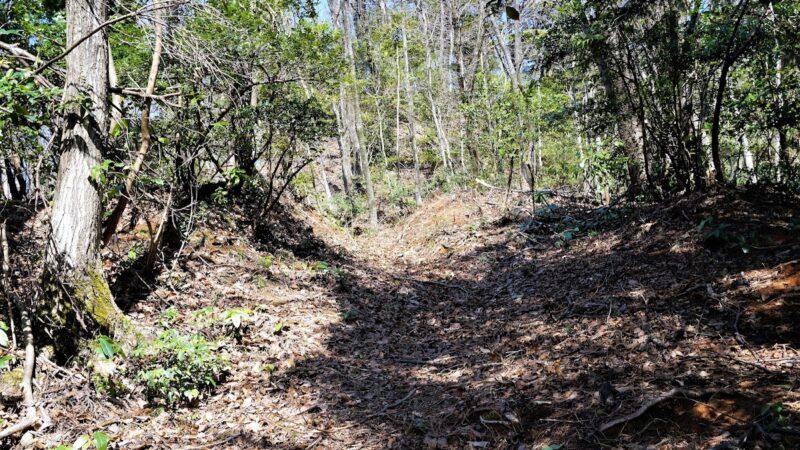
Of particular note is the combination of horizontal and vertical moats visible below this ridge. The horizontal moat was dug across the ridge, serving to hinder enemy advances. The vertical moat was dug perpendicularly along the slope, preventing lateral movement and also functioning as a rainwater drainage channel.
This combination of horizontal and vertical moats is an important historical feature demonstrating the development of mountain castle construction techniques during the Sengoku period, and it has been suggested that it may have been added during renovations by the Asakura clan.
Moats and Earthworks
Moats were constructed throughout the castle grounds, dividing the ridge and forming defensive lines. Some moats are over 3 meters deep, and in some cases, the excavated soil was piled up on both sides to form earthworks.
Earthworks were built not only around the main enclosure but also along the edges of each enclosure, serving as foundations for watchtowers and fences. Even today, earthworks approximately 1 meter high remain in good condition, allowing us to imagine the castle’s structure in its heyday.
Highlights of Hitani Castle
Well-Preserved Ruins
The greatest highlight of Hitani Castle is its well-preserved mountain castle ruins. Because it remained untouched by development, the moats, earthworks, and baileys retain much of their original form. In particular, the combination of horizontal and vertical moats on the northeast ridge is a valuable resource for learning about Sengoku period castle construction techniques.
The well-maintained hiking trails allow for safe observation of these ruins, which is another attractive feature. Signposts are also installed, ensuring that even first-time visitors won’t miss any of the main ruins.
View from the Main Enclosure
The view from the main enclosure is one of Hitani Castle’s greatest attractions. You can see the entire Kaga Plain, towards Daishoji Castle, and even the Sea of Japan. If the weather is good, you can even see the majestic Hakusan mountain range, allowing you to relive the scenery seen by the castle lords of the Sengoku period.
You can also enjoy the changing seasons, with fresh greenery in spring and vibrant autumn foliage. Especially during the autumn foliage season, you can enjoy a magnificent landscape where the mountain castle and the beauty of nature harmonize.
The Historical Romance of the Ikkō-ikki and the Asakura Clan
Hitani Castle is a place where two important forces of the Sengoku period, the Ikkō-ikki and the Asakura clan, intersected. The battle between the religiously passionate Ikkō-ikki forces and the prestigious Asakura clan of Echizen is known as a unique case in Japanese history.
Walking through the castle ruins, you can reflect on the military strategies of Asakura Sōteki and the resistance of the Ikkō-ikki, which is a great attraction for history buffs. Checking the location relative to Daishōji Castle on a map while visiting will give you a deeper understanding.
The Quiet Atmosphere of a Mountain Castle
Because Hitani Castle is not a famous tourist destination, there are relatively few visitors, allowing you to enjoy the quiet atmosphere of a mountain castle. The time spent exploring the ruins while listening to the birdsong and the sound of the wind is a luxurious experience that allows you to forget the everyday.
For castle enthusiasts, this is an ideal environment for carefully observing the ruins and enjoying photography. It’s especially recommended for those who want to enjoy a mountain castle stroll while avoiding crowds.
Access Information
Location
Address: Hitani-cho, Kaga City, Ishikawa Prefecture
Hitani Castle is located in the Daishoji district, in the southern part of Kaga City. It’s situated in a mountainous area with a mix of residential and agricultural land. Searching for “Hitani Castle” or “Hitani Castle Ruins” on a map app will show the vicinity of the trailhead.
Access by Public Transportation
Nearest Station: Daishoji Station, JR Hokuriku Main Line
The distance from Daishoji Station to the Hitani Castle trailhead is approximately 4km, about a 50-minute walk. It takes about 10 minutes by taxi. There is a taxi stand in front of the station, but the number of taxis is limited, so it’s recommended to arrange a taxi in advance using a ride-hailing app.
Bus services are limited, making access by public transportation alone somewhat inconvenient. Consider using a rental car or bicycle.
Access by Car
From Hokuriku Expressway Kaga IC: Approximately 15 minutes (approx. 8 km)
From Hokuriku Expressway Katayamazu IC: Approximately 20 minutes (approx. 10 km)
After exiting the Kaga IC, proceed along National Route 8 towards Daishoji, then take prefectural and municipal roads to Hitani-cho. Using a car navigation system or smartphone map app will ensure you arrive without getting lost.
Parking
There is no dedicated parking lot for Hitani Castle, but there is roadside parking space for 1-2 cars near the entrance. However, the road is narrow in some places, so be careful not to obstruct oncoming traffic.
As this is also a local road, please be considerate and avoid causing any inconvenience. Even on holidays, there are few visitors, so parking spaces are rarely full.
Ascent Route
The entrance is located on the east side of the castle, along the road. There are signposts, so you shouldn’t miss it. The hiking trail is well-maintained, but it’s still a mountain path, so the following equipment is recommended:
- Trekking shoes or athletic shoes (non-slip)
- Long-sleeved shirt and long pants (for protection against bushes and insects)
- Drinking water
- Towel
- Insect repellent spray (spring to autumn)
The climb from the base to the main keep takes about 20-30 minutes. There’s a steep climb of 100m in elevation, so those who aren’t confident in their physical fitness are advised to climb slowly and take breaks.
Nearby Tourist Spots
Daishoji Castle Ruins
Located approximately 4km northwest of Hitani Castle, Daishoji Castle was the main castle of Hitani Castle. It is now developed as Kinjo Park, with walking paths. You can also visit the Choryutei (a nationally designated important cultural property), so it’s recommended to visit it in conjunction with Hitani Castle.
Yamanaka Onsen
Yamanaka Onsen, a famous tourist spot in Kaga City, is about a 20-minute drive from Hitani Castle. Known for being visited by Matsuo Basho during his “Oku no Hosomichi” (Narrow Road to the Deep North), this historic hot spring resort is perfect for relaxing after a castle tour.
Katayamazu Onsen
Katayamazu Onsen, spread out on the shores of Shibayama Lagoon, is also about a 15-minute drive away. The lakeside scenery is beautiful, and strolling through the hot spring town is enjoyable. As part of the Kaga Onsenkyo (Kaga Hot Spring Village), it’s a convenient base for accommodation.
Other Castle Ruins in Kaga City
Besides Hitani Castle, Kaga City has several other castle ruins, including Yamanaka Castle and Kurotani Castle. Castle enthusiasts can enjoy a “Kaga Castle Tour” visiting these castle ruins. Each castle has connections to the Ikko-ikki rebellion, the Asakura clan, and the Oda clan, allowing visitors to feel the historical connections.
Points to Note When Visiting
Season and Time of Day
The best seasons to visit Hitani Castle are spring (April-May) and autumn (October-November). In summer, temperatures are high and the undergrowth is dense, resulting in more insects. In winter, there is a possibility of snow, and the hiking trails can be slippery, so caution is necessary.
The best time of day is from morning to early afternoon. As it is a mountain castle, it becomes pitch black after sunset, making descent difficult. Begin your descent at least two hours before sunset.
Safety Measures
Please keep the following safety measures in mind when exploring the mountain castle:
- Avoid traveling alone; visit with others if possible.
- Tell family or friends your destination and expected return time.
- Charge your smartphone (for emergency contact).
- If the weather deteriorates, do not push yourself and turn back.
- Do not get too close to the edges of the earthworks or cliffs of the ruins (risk of collapse).
Manners and Rules
Hitani Castle Ruins are a valuable cultural asset. Please observe the following manners when visiting:
- Do not damage the remains (strictly no chipping away at earthworks, taking stones, etc.)
- Always take your trash with you
- No open flames (please refrain from smoking)
- Do not trespass on private property
- Do not shout (do not disturb wild animals, be considerate of nearby residents)
Historical Value of Hidani Castle
Importance in Ikkō-ikki Research
Hidani Castle is one of the castles built as a military base for the Kaga Ikkō-ikki rebellion, and is historically important as an example of castle construction by religious forces. Since most Ikkō-ikki castles were destroyed in Oda Nobunaga’s annihilation campaign, Hidani Castle, with its remaining structures, is a valuable subject of research.
The Ikkō-ikki was not merely a peasant rebellion, but a force with advanced organizational and military capabilities. Analyzing the layout of Hidani Castle provides clues to understanding their castle-building techniques and strategic thinking.
The Asakura Clan’s Administration of Kaga
The Asakura clan is known as a powerful daimyo of Echizen Province during the Sengoku period, but they also actively expanded into southern Kaga. Hiyadani Castle was one of the important strongholds secured by the Asakura clan in Kaga, and is a crucial historical site for understanding the control system of the Echizen-Kaga border region.
As a castle directly captured by the renowned general Asakura Sōteki, it is highly valued from a military history perspective. Sōteki’s invasion of Kaga was one of his later battles and is studied as an example demonstrating his strategic vision.
Its Place in Local History
In the history of Kaga City, Hiyadani Castle, along with Daishōji Castle, symbolizes the transition from the medieval to the early modern period. It can be said to be a place that physically embodies the process of power shifting from the rule of the Ikkō-ikki to the Asakura clan, and then to the Oda clan.
From the perspective of local history education and cultural property protection, the preservation and utilization of Hiyadani Castle are important issues. In recent years, local history enthusiasts have been carrying out maintenance activities, and its value as a regional heritage site is being re-recognized.
Summary
Hitani Castle is a Sengoku period mountain castle located in Kaga City, Ishikawa Prefecture. It is a historically significant fortress where three forces—the Ikkō-ikki, the Asakura clan, and Oda Nobunaga—intersected. Approximately 10 baileys are arranged around the 118m-high mountaintop, and valuable remains showcasing Sengoku period castle construction techniques, such as the combination of horizontal and vertical moats, are well-preserved.
It functioned as a subsidiary castle of Daishoji Castle and played a crucial role as a defensive base in southern Kaga. It embodies the turbulent Sengoku period, having been captured by Asakura Sōteki in 1555, the peace agreement in 1567, and the pacification of Kaga by the Oda army during the Tenshō era.
Currently, hiking trails are well-maintained and signposts are installed, making it relatively easy to visit even for beginners. Access is also good, approximately 10 minutes by car from JR Daishoji Station and approximately 15 minutes from the Kaga Interchange on the Hokuriku Expressway. Although there is no dedicated parking facility, there is street parking available near the entrance.
The view from the main enclosure is magnificent, offering a panoramic view of the Kaga Plain and the Hakusan mountain range. This is a must-visit spot for castle enthusiasts, where you can reflect on the history of the Sengoku period in a tranquil setting. Nearby attractions include the ruins of Daishoji Castle, Yamanaka Onsen, and Katayamazu Onsen, making it an area where you can fully enjoy the history and culture of Kaga.
Hitani Castle, where the Ikko-ikki and the Asakura clan—two unique forces in Japanese history—intersected, still conveys the tension and strategic thinking of that time, even after nearly 500 years. When visiting Ishikawa Prefecture, be sure to visit Hitani Castle and experience the spirit of the Sengoku period.