History and Highlights of Oura Castle (Hirosaki City, Aomori Prefecture) | The Complete Picture of the Famous Castle that Became the Base for the Unification of Tsugaru
What is Oura Castle?
Oura Castle (Ōura-jō) was a flatland castle from the Sengoku period located in the Kata and Godai districts of Hirosaki City, Aomori Prefecture. Also known as Hachiman Castle, Ōura-Kata Castle, and Nishine Castle, it played an extremely important role in the history of the Tsugaru region.
Built on a strategically important location at the southeastern foot of Mt. Iwaki and on the south bank of the Gochōne River, this castle boasted a size of approximately 500 meters east-west and 250 meters north-south, and functioned as the base for the Tsugaru clan (Ōura clan) to unify the Tsugaru region. Currently, the site is occupied by Hirosaki Municipal Tsugaru Junior High School, and remnants and stone monuments remain, giving a glimpse of its former glory.
History of Oura Castle
Construction History and Oura Mitsunobu
Oura Castle was built in 1502 (Bunki 2) by Oura Mitsunobu (Kuji Mitsunobu), who was based at Taneri Castle. Although a member of the Nanbu clan, Mitsunobu aimed to expand into the Tsugaru region and extensively renovated and expanded the existing Nishine Castle (Furudate) to create Oura Castle.
Mitsunobu was a Sengoku period warlord revered as the founder of the Tsugaru clan. He constructed a strong fortress in this location as a defense against the Nanbu clan and as a base for controlling the Tsugaru region. Initially, it was positioned as a subsidiary castle of Taneri Castle, but by appointing his second son, Oura Morinobu, as the castle lord, it strengthened its character as a frontline base for the expansion into Tsugaru.
As the Residence of Four Generations of the Oura Clan
After its construction by Oura Mitsunobu, Oura Castle served as the residence of the Oura clan for 92 years, spanning four generations.
First Generation: Oura Mitsunobu (Residing in the castle: 1502–)
He attempted to expand into Tsugaru from Taneri Castle and built Oura Castle. He appointed his second son, Morinobu, as the castle lord, laying the foundation for the unification of Tsugaru.
Second Generation: Oura Morinobu
He was entrusted with Oura Castle by his father, Mitsunobu, and dedicated himself to expanding the Oura clan’s power in the Tsugaru region. During this period, Oura Castle developed from a mere subsidiary castle into the center of Tsugaru’s rule.
Third Generation: Oura Masanobu
He succeeded Morinobu and further expanded the territory. During this period, the castle’s fortifications were also improved, and it is believed that it took on the form of a multi-enclosure flatland castle with a main keep, second bailey, third bailey, west bailey, and south bailey.
Fourth Generation: Oura Tamenobu (Tsugaru Tamenobu)
He was the last lord of the Oura clan, and later adopted the name Tsugaru, becoming a hero who achieved the unification of Tsugaru. Tamenobu used Oura Castle as his base to unify the Tsugaru region, and it served as his headquarters until he moved his residence to Horikoshi Castle in 1594.
Unification of Tsugaru and Relocation to Horikoshi Castle
Oura Tamenobu promoted the unification of the Tsugaru region from his base at Oura Castle. He successively subjugated the surrounding forces, eventually succeeding in bringing the entire Tsugaru region under his control.
After achieving unification, in 1594, Tamenobu moved his residence to Horikoshi Castle, which was closer to the political and economic center. This was because it was necessary to move the administrative center of the Tsugaru region to a more strategically advantageous location. Oura Castle fulfilled its historical mission of unifying Tsugaru, and its role was passed on to Horikoshi Castle.
The Genna One Castle Per Province Decree and the Abolition of Oura Castle
In the Edo period, Oura Castle was officially abolished in 1615 (Genna 1) by the Tokugawa Shogunate under the “Genna One Castle Per Province Decree.” This decree ordered each domain to abolish castles other than their principal residence, resulting in the demolition of many castles nationwide.
However, Oura Castle was not completely demolished. Even after its abandonment, remnants such as earthworks remained, and it continued to serve as a fortified outpost for Hirosaki Castle. A fortified outpost is a castle that serves as the last line of defense when the main castle is under attack, and Oura Castle continued to function as a military facility for the Hirosaki domain.
Role as a Military Facility in the Edo Period
Even after its abandonment, the Oura Castle site was maintained as an important military base for the Hirosaki domain. In particular, military facilities such as a gunpowder magazine were constructed in the Nishinomaru area, and it was used as a storage place for the domain’s weapons and ammunition.
Furthermore, some of the buildings of Oura Castle were relocated and reused. Particularly well-known is the record that the castle’s kitchen was moved to Choshoji Temple in Hirosaki City. In this way, even after the castle’s abandonment, the remains and buildings of Oura Castle continued to live on in various forms within the history of the Tsugaru region.
Structure and Layout of Oura Castle
Scale and Arrangement of the Castle
Oura Castle was a multi-enclosure flatland castle measuring approximately 500 meters east-west and 250 meters north-south. The main enclosures included the Honmaru (main enclosure), Ninomaru (second enclosure), Sannomaru (third enclosure), Nishinomaru (western enclosure), and Nankaku (southern enclosure).
The Honmaru is located on the site of the current Hirosaki Municipal Tsugaru Junior High School and was the most strongly defended central part of the castle. The Ninomaru is also located within the school grounds and was an important enclosure supporting the Honmaru. The Nishinomaru was the site of a gunpowder magazine and other facilities even after the castle’s abandonment, and traces of the moat can still be seen behind it.
Defensive Structures
The main defensive structures of Oura Castle were earthworks and moats. Due to its location as a hilltop castle, the castle’s defenses were enhanced by utilizing natural elevation differences while also incorporating artificial earthworks.
The earthworks remained for a long time after the castle’s abandonment, preserved throughout the Edo period to maintain its function as an auxiliary castle to Hirosaki Castle. The moats are believed to have been a combination of a water moat utilizing the waters of the Nagane River and a dry moat.
Main Gate and Castle Gate
Oura Castle’s main gate was located on the south side. The current location of the information board along the road is estimated to be near the former main gate, and this was the main route into the castle.
While historical records are limited regarding the detailed structure of the castle gate, it is highly likely that, as a castle of the Sengoku period, it possessed defensive mechanisms such as a turret gate and a masugata (square enclosure).
Highlights and Current Status of Oura Castle
Castle Site Monument and Information Board
Currently, several stone monuments and information boards are installed at the Oura Castle site. The most prominent feature is the stone monument and explanatory sign for “Oura Castle Ruins” located at the intersection south of the Tsugaru Junior High School grounds. This location serves as the starting point for visiting the castle ruins.
Furthermore, there is another stone monument and information board facing the road on the southeast side, and the “Oura Castle Ruins Monument” is erected west of the entrance to the junior high school. These monuments are valuable historical sites that convey to the present day that this area was once a base for the unification of Tsugaru.
Remaining Structures
While the remains of Oura Castle that can be confirmed today are limited, traces of the moat can be seen near the western enclosure (Nishi-no-maru). Due to restrictions on access within the school grounds, detailed observation of the main and secondary enclosures is difficult, but it is possible to estimate the scale of the castle in its heyday from the surrounding topography.
Parts of the earthworks are also thought to remain, making it a valuable historical site for castle researchers and history enthusiasts. However, as it is a school facility, consideration is necessary when visiting.
Surrounding Historical Landscape
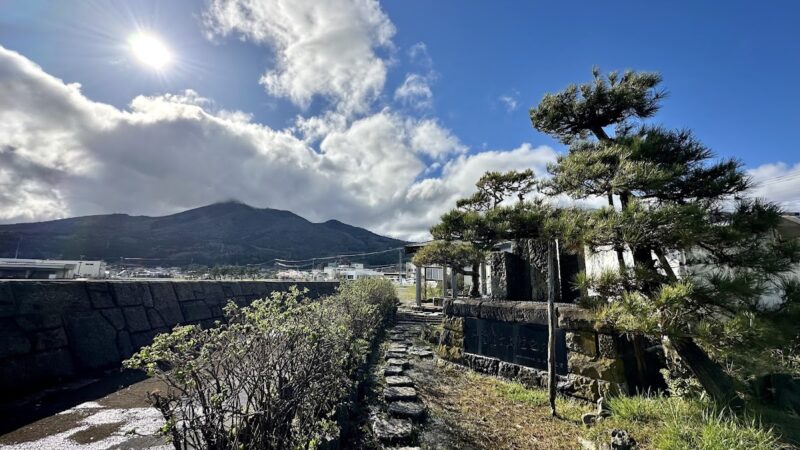
The area around Oura Castle ruins boasts a beautiful landscape with Mount Iwaki as a backdrop. One can imagine the Oura clan once overlooking the Tsugaru Plain and managing their territory from this location.
The flow of the Nagane River and the surrounding topography have remained largely unchanged since the Sengoku period, making it a valuable site where one can appreciate the ingenuity of the castle’s location at that time.
Access and Visiting Guide
Transportation Access
By Train
After alighting at JR Hirosaki Station, rent a bicycle at the tourist information center in front of the station and arrive in approximately 35 minutes. A common route is to take Prefectural Road 17, then turn right onto Prefectural Road 3, heading west for approximately 4.5 kilometers around Hirosaki Castle, before turning right towards Tsugaru Junior High School.
By Car
Approximately 20 minutes from the Tohoku Expressway Owani-Hirosaki Interchange. From Hirosaki city center, head west on Prefectural Road 3, following the signs. Parking is limited, so please be careful when parking on the street.
If using the bus:
You can take a Konan Bus from Hirosaki Station and walk from the nearest bus stop, but since the number of buses is limited, we recommend checking the timetable in advance.
Points to note when visiting
The main part of the Oura Castle ruins is located on the grounds of Hirosaki Municipal Tsugaru Junior High School, so consideration is required when visiting. You should avoid entering the grounds during school hours or on days when there are school events.
Stone monuments and information boards are located along the road or outside the school grounds, so you can freely visit these. We recommend focusing on the remains that can be seen outside the school grounds, such as the remains of the moat in the western enclosure.
When taking photographs, it is important to be considerate of school facilities and student privacy, and to limit photography to outside the grounds.
Related historical sites in the vicinity
Taneri Castle
Taneri Castle, which was the base of Oura Mitsunobu, was the residence of the Oura clan before the construction of Oura Castle. Located in present-day Ajigasawa Town, Nishitsugaru District, this is an important historical site for understanding the roots of the Oura clan.
Horikoshi Castle
This castle was moved to by Oura Tamenobu in 1594 (Bunroku 3) from Oura Castle. Located in the Horikoshi district of Hirosaki City, it functioned as the residence of the Tsugaru clan until the construction of Hirosaki Castle. It is currently maintained as a historical park.
Hirosaki Castle
Built by the Tsugaru clan in 1611 (Keicho 16), this castle is a nationally designated Important Cultural Property, with many structures, including the keep, still existing today. Due to its relationship as an auxiliary castle to Oura Castle, it is an indispensable historical site for understanding the history of castles in the Tsugaru region.
Choshoji Temple
This temple is said to have housed the kitchen of Oura Castle. Located in Nishishigemori, Hirosaki City, it is known as the Tsugaru family’s ancestral temple. It is a valuable place where you can actually see some of the buildings of Oura Castle.
Historical Significance of Oura Castle
As a Base for the Unification of Tsugaru
The greatest historical significance of Oura Castle lies in its function as a base for the unification of the Tsugaru region. For 92 years, spanning four generations from Oura Mitsunobu to Oura Tamenobu, this castle served as the headquarters of the Tsugaru clan, becoming the center of territorial expansion and governance.
Especially during the time of Oura Tamenobu, military operations to unify the entire Tsugaru region were launched from this castle, laying the foundation for the later establishment of the Hirosaki Domain. It is no exaggeration to say that the development of the Tsugaru clan would not have been possible without Oura Castle.
Relationship with the Nanbu Clan
The Oura clan, originally a branch of the Nanbu clan, built their own power and eventually became independent from the Nanbu clan, becoming the rulers of the Tsugaru region. Oura Castle is a symbolic fortress representing this independence from the Nanbu clan and the establishment of their rule over Tsugaru.
Built as a defense against the Nanbu clan, Oura Castle also functioned as a base to eliminate the Nanbu clan’s influence from the Tsugaru region, reflecting the complex political and military situation of the Sengoku period.
As a Military Base of the Hirosaki Domain
The fact that Oura Castle continued to function as an auxiliary castle to Hirosaki Castle even after its abandonment demonstrates its strategic importance. The fact that it housed the domain’s gunpowder magazine and other military facilities throughout the Edo period is proof of the castle’s superior location and structure.
Current Status and Challenges of Oura Castle Research
Archaeological Excavations and Research
Research on Oura Castle has primarily relied on historical documents, with limited full-scale archaeological excavations. Due to its use as a school facility, large-scale excavations are difficult to conduct.
However, recent advances in castle research have led to progress in research to the extent possible, including the creation of layout maps and investigations of surrounding remains. In particular, detailed surveys of moat remains and earthworks around the western enclosure have been conducted, gradually clarifying the castle’s structure.
Preservation and Utilization
The preservation and utilization of the Oura Castle ruins are important cultural property administration issues for Hirosaki City. The challenge lies in how to preserve the historical value of the site and pass it on to future generations while coexisting with school facilities.
While historical site maintenance is currently being carried out to the extent possible, such as the installation of information boards and the upkeep of stone monuments, further research and the formulation of a preservation and utilization plan are desired.
Summary
Oura Castle is a hilltop castle from the Sengoku period located in Hirosaki City, Aomori Prefecture. It was built in 1502 by Oura Mitsunobu, the founder of the Tsugaru clan. It played an important role for 92 years over four generations of the Oura clan, serving as a base for expansion into Tsugaru and as the headquarters for the unification of Tsugaru.
After Oura Tamenobu moved to Horikoshi Castle in 1594, Oura Castle was abandoned due to the “One Castle Per Province” decree of the Genna era. However, the earthworks remained, serving as an auxiliary castle to Hirosaki Castle, and it continued to function as a military facility of the domain. The castle, with its gunpowder magazine located in the western enclosure and its kitchen relocated to Choshoji Temple, continued to be deeply involved in the history of the Tsugaru region even after its abandonment.
Currently, the site is occupied by Hirosaki Municipal Tsugaru Junior High School, and a castle site monument and information board evoke memories of its former glory. Traces of the moat can be seen around the western enclosure, allowing visitors to imagine the scale and structure of the castle.
Oura Castle, which fulfilled its historical mission of unifying Tsugaru, is an important historical site indispensable to the history of Aomori Prefecture, and a valuable cultural heritage site that is expected to receive further research, preservation, and utilization in the future. When visiting Hirosaki, be sure to visit Oura Castle ruins, the origin of Hirosaki Castle, along with Hirosaki Castle.