Kurosaka Kagamiyama Castle (Hino District, Tottori Prefecture): A Complete Guide to its History and Highlights | The Phantom Early Modern Castle Built by Seki Kazumasa
What is Kurosaka Kagamiyama Castle?
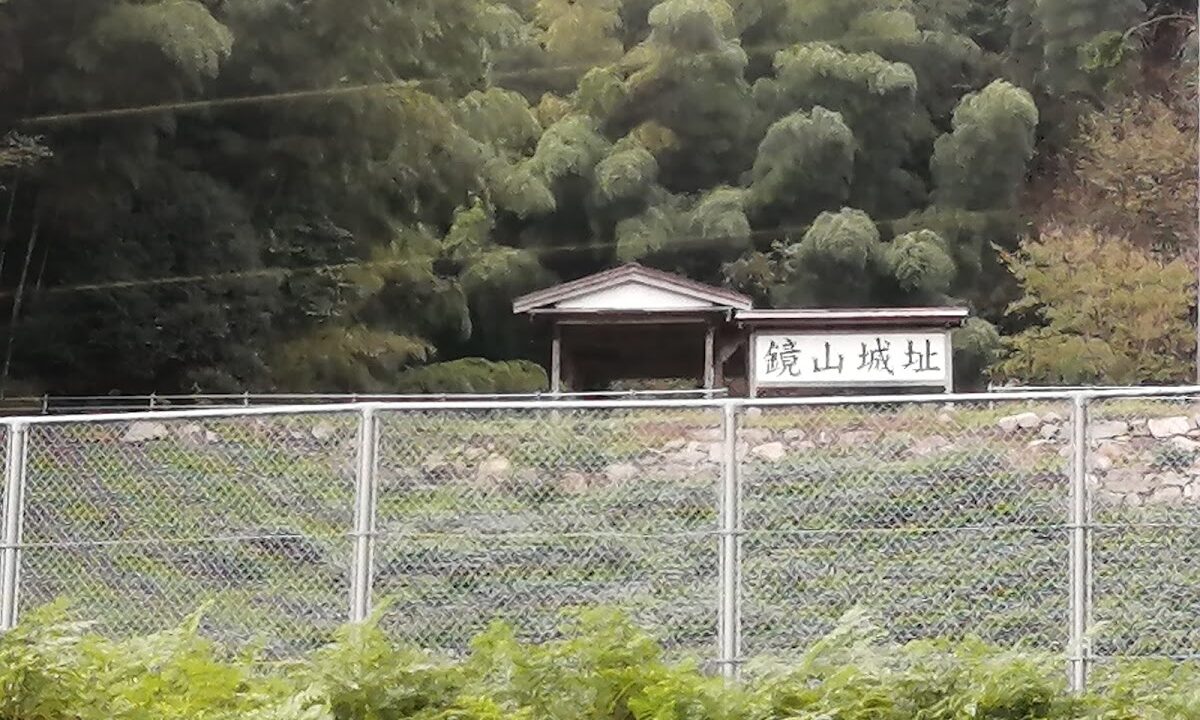
Kurosaka Kagamiyama Castle was an early Edo period hilltop castle located in Kurosaka, Hino-cho, Hino-gun, Tottori Prefecture. Also known as “Kurosaka Castle” and “Kagamiyama Castle,” the castle ruins are now located on the hillside behind the former Hino Industrial High School building.
This castle was built by Seki Kazumasa, who distinguished himself on the Eastern Army side in the Battle of Sekigahara, when he was transferred from Kameyama in Ise Province to Hino District in Hoki Province with a 50,000 koku domain. Construction began in 1610 (Keicho 15) and was completed in 1614 (Keicho 19). However, because the Seki clan was dispossessed in 1618 (Genna 4), the castle was abandoned after only nine years, and is known as a “phantom castle.” The castle ruins are located on Mt. Kagami, approximately 200 meters above sea level. Even today, remnants such as stone walls, earthworks, baileys, gates, moats, and wells remain, making it a valuable historical site that vividly conveys the traces of its destruction.
History of Kurosaka Kagamiyama Castle
The Circumstances of Seki Kazumasa’s Arrival and Castle Construction
Seki Kazumasa sided with the Eastern Army led by Tokugawa Ieyasu in the Battle of Sekigahara (1600). For his achievements, he was transferred from Kameyama in Ise Province with a 30,000 koku stipend to 50,000 koku in Hino, Aimi, and Aseiri districts of Hoki Province.
This transfer was due to the death of Nakamura Kazutada, the lord of Yonago Castle, in 1609 (Keicho 14) at a young age without an heir, resulting in the Nakamura clan being stripped of their domain due to lack of an heir. After the Nakamura clan’s downfall, Hoki Province was divided and ruled by minor daimyo, and the Hino district became the territory of Seki Kazumasa.
Initially, Seki Kazumasa used Kameiyama Castle, located in Ikuyama (present-day Ikuyama Station on the JR Hakubi Line), as his temporary residence. From a defensive standpoint, he decided to build a new castle on Kagamiyama in Kurosaka, and construction began in 1610 (Keicho 15). The castle was completed in 1614 (Keicho 19), taking approximately four years to build.
Development and Governance of the Castle Town
In parallel with the construction of the castle, Seki Kazumasa also developed the castle town. Kurosaka was located at a key point on the Izumo Road connecting the San’in and Sanyo regions, making it an important transportation hub. Samurai residences and merchant districts were established in the castle town, and commercial development was promoted.
Kagamiyama Castle possessed characteristics of a modern castle, featuring sturdy stone walls for defense, a layout with multiple enclosures, and a masugata koguchi (square-shaped gate). These are believed to reflect the castle-building techniques cultivated by Seki Kazumasa in Ise Province.
Dispossession of the Seki Clan and Abandonment of the Castle
In 1618 (Genna 4), Seki Kazumasa was suddenly dispossessed of his domain. The reason given was “disunity within the family,” specifically internal conflicts among his retainers and a succession dispute. Specifically, it is said that the shogunate viewed the internal conflict over Seki Kazumasa’s successor as a problem.
Following the dispossession, the Seki clan had their territory confiscated, and Kagamiyama Castle was demolished. Its short lifespan of only nine years after its construction is extremely unusual in the history of Japanese castles. The castle’s stone walls were intentionally demolished, and its function as a military facility was completely lost.
The Tottori Domain Era and the Kurosaka Jinya (Fortified Residence)
After the Seki clan’s downfall, the Kurosaka area became part of the Tottori Domain under the Ikeda clan. In 1631 (Kanei 8), Fukuda Hisatsugu, a senior retainer of Ikeda Mitsunaka, the lord of the Tottori Domain, was stationed in Kurosaka and established the Kurosaka Jinya at the foot of the ruins of Kagamiyama Castle.
The Fukuda clan governed Hino County from the Kurosaka Jinya for generations, starting with Fukuda Hisatsugu, followed by Fukuda Hisashige, Fukuda Hisataka, Fukuda Hisatake, Fukuda Hisashina, Fukuda Hisashige, Fukuda Hisanari, Fukuda Hisanari, Fukuda Hisanari, and Fukuda Hisanari, continuing their rule until the end of the Edo period. There was also a period when Yamagami Hantayu was dispatched as a magistrate.
The Kurosaka Jinya was an administrative facility centered around samurai residences and did not function as a castle, but it played an important role as the center of regional governance until the Meiji Restoration.
Castle Structure and Layout
Overall Layout
Kurosaka Kagamiyama Castle is a flatland castle built on Mount Kagami, approximately 200 meters above sea level. It employs a stepped layout, with the main enclosure located at the summit and multiple enclosures arranged in a tiered fashion around it.
The castle grounds extend approximately 300 meters east-west and 400 meters north-south, boasting a relatively large scale. Residences for the lord and retainers were located at the foot of the mountain, forming a castle town.
Main Enclosure and Surroundings
The main enclosure is located at the summit and measures approximately 80 meters east-west and 50 meters north-south. It is surrounded by stone walls 3-5 meters high, and their remains can still be seen today.
It is presumed that a palace was built inside the main enclosure, functioning as the lord’s living space and place for conducting official business. The remains of watchtower bases are found at the four corners of the main enclosure, indicating that watchtowers were built at strategically important defensive points.
A masugata koguchi (square-shaped gate) was provided at the entrance to the main enclosure, a clever design to prevent enemy intrusion. The stone walls around the gate were particularly strong and served as a crucial part of the castle’s defense.
Second and Third Enclosures
Below the main enclosure are the second and third enclosures. These enclosures are also surrounded by stone walls and are thought to have housed vassal quarters and warehouses.
A moat separates the second and third enclosures, indicating that each enclosure was designed to function as an independent defensive unit. The passages connecting these enclosures are winding, suggesting a design intended to slow down enemy advances.
Characteristics of the Stone Walls
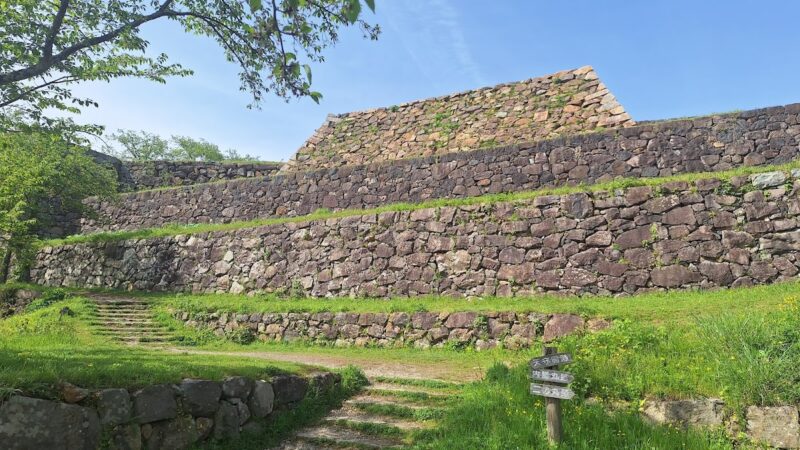
The stone walls of Kurosaka Kagamiyama Castle exhibit a mixture of nozurazumi (rough-stone masonry) and uchikomihagi (fitted stone masonry) techniques. This is a characteristic indicating that the castle was built in the early Edo period. The stonework primarily uses local granite, with some massive stones exceeding one meter in size. The height of the stone walls varies depending on the location, reaching over five meters at their highest points.
The stone walls, intentionally destroyed during the castle’s demolition, remain in their collapsed state, providing a valuable and vivid reminder of the castle’s destruction. These ruins are considered important historical documents in castle research.
Moats and Earthworks
The castle is surrounded by dry moats, with particularly strong defenses on the east and north sides. The moats are approximately 3-5 meters deep and 5-8 meters wide.
Earthworks were built outside the moats, forming a double defensive line. These earthworks are approximately 2-3 meters high, and some sections remain in good condition.
Several vertical moats have also been identified, demonstrating a defensive strategy to prevent enemies climbing the mountain slopes. These moats also served a drainage function, improving water drainage within the castle.
Entrances and Gates
The castle had multiple entrances (koguchi). The main entrances featured a masugata (square enclosure), a structure where entry into the castle was only possible by passing through a space enclosed by stone walls.
Both the hirairi (flat entrance) and masugata forms have been confirmed for the entrances, indicating that the level of defense varied depending on the location. The main gate is presumed to have been located on the south side, serving as the main access route from the castle town.
Gate foundations have also been found in some areas, suggesting the possibility of a turret gate.
Wells and Water Sources
Several well remains have been confirmed within the castle. A well was also dug within the main enclosure, indicating consideration for securing a water source during sieges.
Furthermore, traces of facilities for drawing water from a river flowing at the foot of the mountain into the castle have been found, indicating that consideration was also given to the daily supply of water.
Remains of Kurosaka Kagamiyama Castle
Existing Remains
The following remains exist at the Kurosaka Kagamiyama Castle site:
Stone Walls: Stone walls, 3-5 meters high, remain mainly around the main enclosure. While many sections have collapsed due to the castle’s destruction, these are valuable remains for understanding the castle construction techniques of the time.
Earthworks: Earthworks built around the enclosures remain in good condition. They are approximately 2-3 meters high and 3-5 meters wide.
Enclosures: Flat areas of multiple enclosures, including the main enclosure, second enclosure, and third enclosure, can be identified. The size and arrangement of each enclosure allow for an understanding of the castle’s overall layout.
Gate Entrances: Remains of square-shaped gate entrances and flat-entrance gate entrances remain, providing insight into the structure of the castle’s entrances.
Moats: Dry moats and vertical moats remain in good condition, important for understanding the castle’s defensive system.
Wells: Well remains have been confirmed within the main enclosure and the second enclosure, with some stone structures still intact.
Watchtower Bases: Traces of watchtower bases remain at the four corners of the main enclosure, indicating the presence of watchtowers.
Traces of Demolition
The most striking feature of Kurosaka Kagamiyama Castle is the vivid evidence of its demolition. Following the downfall of the Seki clan in 1618, the castle was demolished by order of the shogunate.
The stone walls were intentionally dismantled, and the traces of demolition are particularly evident around the entrance and in the main enclosure. The stones of the walls were pulled outwards, a typical technique used in castle demolition.
Such clearly preserved castle ruins are rare nationwide, making this site of extremely high academic value for understanding early Edo period castle demolition techniques.
Kurosaka Jinya Ruins
At the foot of Mount Kagamiyama, the ruins of the Kurosaka Jinya (fortified residence), established by the Fukuda clan after the Seki clan’s downfall, remain. While the Jinya was not a castle but an administrative facility centered around samurai residences, traces of earthworks and moats can be found in some areas.
The Kurosaka Jinya ruins still retain the atmosphere of the town from that time, with remnants of stone walls, gates, and waterways of the samurai residences visible. Although no buildings from the Jinya era remain, the layout of the grounds and road arrangements strongly reflect the Edo period.
Castle Town and Surrounding Historical Sites
Kurosaka Castle Town
The castle town of Kurosaka flourished as a post town on the Izumo Kaido road. The current Kurosaka district of Hino Town retains the atmosphere of the Edo period, with old merchant houses and storehouses still visible.
Especially around Honmachi Street, white-walled storehouses and townhouses with lattice windows are preserved, allowing visitors to imagine the town’s past. Many of these buildings were constructed from the late Edo period to the Meiji era, testifying to the prosperity of the Kurosaka Jinya (fortified residence) period.
Related Historical Sites
Kameiyama Castle Ruins: This castle was the residence of Seki Kazumasa before the completion of Kagamiyama Castle, and is located directly in front of Ikuyama Station. Although a small mountain castle, it holds historical significance as the first base of operations for Seki Kazumasa.
Negi Castle Ruins: This mountain castle is located approximately 10 kilometers north of Kurosaka and was a base for a branch of the Yamana clan. It is worth visiting in conjunction with Kurosaka Kagamiyama Castle.
Kanemochi Shrine: This ancient shrine in Hino Town is known for its blessings of financial fortune. It is approximately a 15-minute drive from Kurosaka.
Access and Visiting Information for Kurosaka Kagamiyama Castle
Access Methods
Access by Train:
- Get off at Kurosaka Station on the JR Hakubi Line, and the castle ruins entrance is about a 10-minute walk away.
- The path from Kurosaka Station to the castle ruins is relatively flat, and there are guide signs.
Access by Car:
- Approximately 20 minutes from Kofu IC on the Yonago Expressway via National Route 181.
- Approximately 50 minutes from Ochiai IC on the Chugoku Expressway via National Route 181.
- There is parking space near the castle ruins, but the number of spaces is limited.
Points to Note During Your Visit
Estimated Time Required: Allow approximately 1 to 1.5 hours to visit the castle ruins. If you climb to the main enclosure and carefully observe the remains, you will need about 2 hours.
Clothing and Equipment: The castle ruins are in a mountainous forest area, and while the hiking trails are well-maintained, comfortable clothing and walking shoes are essential. Particular caution is needed after rain, as the ground can become slippery. Notes for Visitors:
- In summer, vegetation can be overgrown, making the path to the castle difficult to find. Visiting in spring or autumn is recommended.
- The stone walls have unstable sections due to the castle’s destruction, so please be careful not to get too close.
- Bringing insect repellent and drinking water is recommended.
Photo Spot: From the main enclosure, you can enjoy a panoramic view of the town of Kurosaka and the Hino River. The destroyed stone walls are also impressive and a popular photo spot.
Nearby Tourist Facilities
Hino Town Historical and Folk Museum: Exhibits on the history and culture of Kurosaka, including materials related to Kagamiyama Castle. 5-minute walk from Kurosaka Station.
Kurosaka Townscape: You can stroll through a townscape that retains the atmosphere of a castle town. Old merchant houses and storehouses are scattered throughout.
Nen’u Townscape: About 10 kilometers north of Kurosaka, this area also flourished as a post town, and its old townscape is preserved. ### Best Seasons for Visiting
Spring (March-May): The fresh greenery is beautiful, and the weather is mild, making it the ideal season for visiting. You can also enjoy the cherry blossoms in the castle town during this time.
Summer (June-August): Overgrown vegetation makes it difficult to see the ruins. Also, due to the heat and numerous insects, visiting during this period is not recommended.
Autumn (September-November): The autumn foliage is beautiful, and the weather is pleasant, making it suitable for visiting. October to early November is especially recommended.
Winter (December-February): The vegetation withers, making the ruins easier to see, but caution is needed regarding snow and ice.
Historical Significance of Kurosaka Kagamiyama Castle
Position in the History of Early Modern Castles
Kurosaka Kagamiyama Castle occupies an important position in the history of castles as a typical example of an early modern castle built in the early Edo period. Built against the backdrop of the changes in the daimyo’s positions after the Battle of Sekigahara, Kurosaka Kagamiyama Castle features modern defensive structures such as stone walls and masugata koguchi (square-shaped gate).
However, because it was abandoned after only nine years, it remains largely unchanged from its original form throughout the Edo period, making it a valuable resource for understanding early Edo period castle construction techniques.
Value as Research Material for Castle Demolition
Kurosaka Kagamiyama Castle is a rare castle site nationwide where clear traces of its demolition remain. It holds extremely high academic value for understanding the reality of castle demolition by the Edo shogunate.
There are limited remains that allow for concrete observation of the techniques and methods of castle demolition, such as how the stone walls were destroyed and which parts were targeted for destruction, and Kurosaka Kagamiyama Castle is a prime example.
Importance in Regional History
Kurosaka has long been a key transportation hub as a crucial point on the Izumo Road. The construction of Kagamiyama Castle led to the development of this region as a political and economic center.
Even after the Seki clan’s downfall, the Fukuda clan, a senior retainer of the Tottori Domain, established the Kurosaka Jinya (fortified residence), thus maintaining its position as the administrative center of Hino County. Kagami-yama Castle and the Kurosaka Jinya are indispensable when discussing the history of Kurosaka.
About Seki Kazumasa and the Seki Clan
Biography of Seki Kazumasa
Seki Kazumasa was a samurai and daimyo from the Sengoku period to the early Edo period. Born in Mino Province, he served Oda Nobunaga and Toyotomi Hideyoshi, and later became a retainer of Tokugawa Ieyasu.
He distinguished himself on the Eastern Army side in the Battle of Sekigahara, and was transferred from Kameyama in Ise Province (30,000 koku) to Hino County in Hoki Province (50,000 koku). This transfer led to the commencement of construction of Kagami-yama Castle.
The Truth Behind the Seki Clan’s Dispossession
Officially, the reason for the Seki clan’s dispossession in 1618 was “internal discord,” but it is believed that there were more complex circumstances behind it.
One possibility is that there was conflict among the retainers over the succession of Seki Kazumasa. It is said that the issue of the legitimate heir and factional disputes among the retainers surfaced, which the shogunate viewed as a problem.
Furthermore, this was immediately after the Siege of Osaka (1614-1615), a period when the shogunate was strengthening its control over the various daimyo. Internal discord was seen as a lack of governing ability as a daimyo, and this is thought to have been a reason for the dispossession.
The Seki Clan After the Dispossession
After the dispossession, Seki Kazumasa and his family lost their territory and became ronin (masterless samurai). Details about the Seki clan afterward are scarce due to a lack of historical records, and many aspects remain unclear.
The confiscation of the Seki clan’s domain is positioned as part of the shogunate’s policy of controlling daimyo in the early Edo period, and like many other daimyo confiscations, it is an example of the shogunate’s strengthening of power.
Summary
Kurosaka Kagamiyama Castle is a valuable castle ruin from the early Edo period, located in Hino-cho, Hino-gun, Tottori Prefecture. Although it was a modern castle built by Seki Kazumasa for his achievements in the Battle of Sekigahara, it was abandoned after only nine years, giving it unique historical value as a “phantom castle.”
The remaining stone walls, earthworks, baileys, and moats are valuable historical materials that convey the castle-building techniques of the early Edo period, and the clear traces of its destruction are particularly rare nationwide. From the castle ruins, you can enjoy a panoramic view of the town of Kurosaka, and the remnants of the former castle town remain.
Its relatively easy access, within walking distance of JR Kurosaka Station, is also an attractive feature. This castle site is a must-visit for anyone interested in castles in the San’in region, those who want to see ruined castle remains in person, and those who wish to quietly reflect on history in a peaceful mountain castle.
Why not combine a stroll through the townscape of Kurosaka with a visit to experience the history and culture of Hino County?