Hirai Castle (Gunma Prefecture) Complete Guide | History and Highlights of the Kanto Kanrei Uesugi Clan’s Base
What is Hirai Castle?
Hirai Castle was a Japanese castle located in Nishihirai, Fujioka City, Gunma Prefecture. Built on a river terrace on the west bank of the Ayukawa River, a tributary of the Kaburagawa River, it served as the base of the prestigious Yamanouchi Uesugi clan, who held the position of Kanto Kanrei (governor of the Kanto region), and was the political and military center of the Kanto region for approximately 100 years. Currently, it is a Gunma Prefecture designated historical site, Hirai Castle Ruins Park, where visitors can see reconstructed earthworks, dry moats, and other remains.
Hirai Castle is an important fortress that tells the story of the turbulent history of the Kanto Sengoku period (Warring States period), and is also known as the place where Uesugi Norimasa fled to seek refuge with Nagao Kagetora (later Uesugi Kenshin) of Echigo Province. The rise and fall of this castle can be said to be a reflection of the rise and fall of the Uesugi clan in the Kanto region itself.
History and Background of Hirai Castle
Construction Circumstances and Two Theories
There are two leading theories among historians regarding the construction period of Hirai Castle.
The theory that it was built in Eikyo 10 (1438) is the most widely known. In this year, a serious conflict arose between Ashikaga Mochiuji, the Kamakura Shogun, and Uesugi Norizane, the Kanto Kanrei (deputy shogun of the Kanto region), leading to the so-called “Eikyo Rebellion.” Feeling his life was in danger, Uesugi Norizane fled Kamakura and moved to Hirai. It is believed that at this time, Norizane ordered his retainer, Nagao Tadafusa (of the Soja Nagao clan), to construct Hirai Castle.
On the other hand, the theory that it was built in Onin 1 (1467)** attributes its construction to Uesugi Akisada. This was the year the Onin War began, a period of continued instability in the Kanto region. This theory suggests that Akisada built the castle to strengthen the base of the Yamanouchi Uesugi clan.
Regardless of the theory, it is certain that Hirai Castle functioned as an important base for the Yamanouchi Uesugi clan in the mid-15th century.
As the Headquarters of the Kanto Kanrei
From the late 15th century to the mid-16th century, Hirai Castle functioned as the headquarters of the Yamanouchi Uesugi clan, who held the position of Kanto Kanrei. The Kanto Kanrei was an important position established by the Muromachi Shogunate to govern the Kanto region, and the Yamanouchi Uesugi clan held this position hereditarily.
Centered around Hirai Castle, the Uesugi clan represented the authority of the shogunate in Kanto and held a position of leadership over the various daimyo of Kanto. The castle town also developed, and centered around Hirai Castle, which used the Ayukawa River as a natural moat, it prospered as a center of politics, economy, and culture.
Conflict with the Hojo Clan
In the 16th century, the Later Hojo clan, based in Sagami Province (present-day Kanagawa Prefecture), rapidly expanded its power, threatening the Uesugi clan’s position in Kanto. The offensive intensified, especially during the reign of Hojo Ujiyasu.
Throughout the Tenbun era (1532-1555), the Yamanouchi Uesugi and Hojo clans clashed frequently. Uesugi Norimasa, as Kanto Kanrei (Governor of the Kanto region), resisted the Hojo, but gradually found himself at a disadvantage. In the Battle of Kawagoe in 1546, the Uesugi army suffered a crushing defeat at the hands of Hojo Ujiyasu, marking a decisive turning point in the decline of the Uesugi clan.
The Fall of Hirai Castle and the Escape of Uesugi Norimasa
In 1551, unable to withstand the Hojo offensive any longer, Uesugi Norimasa finally abandoned Hirai Castle and fled to Echigo Province (present-day Niigata Prefecture) to seek refuge with Nagao Kagetora (later Uesugi Kenshin). This signified the complete loss of his authority as Kanto Kanrei.
In 1552 (Tenbun 21), Hirai Castle was captured by forces sent by Nagao Kagetora and subsequently demolished. One theory suggests that the Nagao army recaptured Hirai Castle from the Hojo clan, while another claims it was demolished to prevent the Hojo clan from reusing it.
After this, in 1561 (Eiroku 4), Uesugi Norimasa ceded the position of Kanto Kanrei (governor of the Kanto region) and the Uesugi name to Nagao Kagetora, who then changed his name to Uesugi Masatora (later Kenshin). This effectively ended the main line of the Yamanouchi Uesugi clan, marking the complete end of Hirai Castle’s role as the Kanto Kanrei’s base.
History after the Castle’s Demolition
After its demolition in 1552 (Tenbun 21), Hirai Castle was never used as a fortress again. In subsequent periods, the region came under the influence of forces based at Maebashi Castle, and Hirai lost its function as a castle town.
During the Edo period, the land was used for farming, and the castle’s remains gradually disappeared. However, local place names such as “Shiroyama” (Castle Mountain) and “Shiro no Uchi” (Inside the Castle) remain, and stories of an important castle once standing on this site have been passed down.
Structure of Hirai Castle
Location and Layout
Hirai Castle was built on a river terrace on the west bank of the Ayukawa River, on a cliff approximately 10 meters high. This is a typical site choice for castles in Gunma Prefecture, selecting a strategically important location that was difficult to access from the river.
The Ayukawa River functioned as a natural moat, strengthening the eastern defenses. On the other hand, artificial moats and earthworks were constructed from the west to the north to prepare for attacks from land. The castle area is estimated to be approximately 300 meters east-west and 400 meters north-south, making it a considerably large flatland castle for its time.
Layout of the Main Enclosure and Baileys
At the center of Hirai Castle was the main enclosure (honmaru), surrounded by several baileys (kuruwa). Current archaeological excavations and topographical surveys suggest that at least 5 to 6 baileys existed.
The main enclosure was located at the highest point and is presumed to have been the residence of the Kanto Kanrei (governor of the Kanto region). From here, it overlooked the castle town and functioned as the political and military center.
Structure of Earthworks and Moats
Currently, reconstructed earthworks can be seen at Hirai Castle Ruins Park. The earthworks are approximately 3 to 4 meters high and served to prevent enemy intrusion and to demarcate the castle grounds.
Multiple dry moats have also been identified, and archaeological excavations have revealed that moats more than 5 meters deep were dug, particularly on the west and north sides. These moats have a V-shaped cross-section called a yagenbori, a characteristic structure of castles from the Sengoku period.
Bridges have been reconstructed in some areas, allowing visitors to imagine how people entered and exited the castle at that time. ### The Expansion of the Castle Town
A vast castle town stretched from the west to the north of Hirai Castle. As the base of the Kanto Kanrei (governor of the Kanto region), samurai residences, merchant districts, temples and shrines were systematically arranged, and it flourished as a center of politics, economy, and culture.
Even today, place names such as “Shiro no Uchi” (inside the castle), “Samurai Yashiki” (samurai residences), and “Baba” (horse riding grounds) remain, allowing us to infer the extent of the former castle town. Archaeological excavations have unearthed ceramics, roof tiles, and iron products, providing valuable clues to the lifestyle of the time.
Relationship with Kanayama Castle (Hirai Kanayama Castle)
On the mountain behind Hirai Castle was a fortified castle called Kanayama Castle. A fortified castle is a mountain castle used as a refuge when the main castle was under attack.
Kanayama Castle is located on the mountaintop approximately 500 meters west of Hirai Castle, at an altitude of approximately 200 meters. This mountain castle, utilizing the steep terrain, was designed to function as a last line of defense in case Hirai Castle fell into danger.
Some remains of Kanayama Castle still exist today, and you can see the baileys and moats. When visiting Hirai Castle, if you have time, visiting Kanayama Castle will give you a deeper understanding of medieval castle systems.
Highlights of Hirai Castle
Hirai Castle Ruins Park
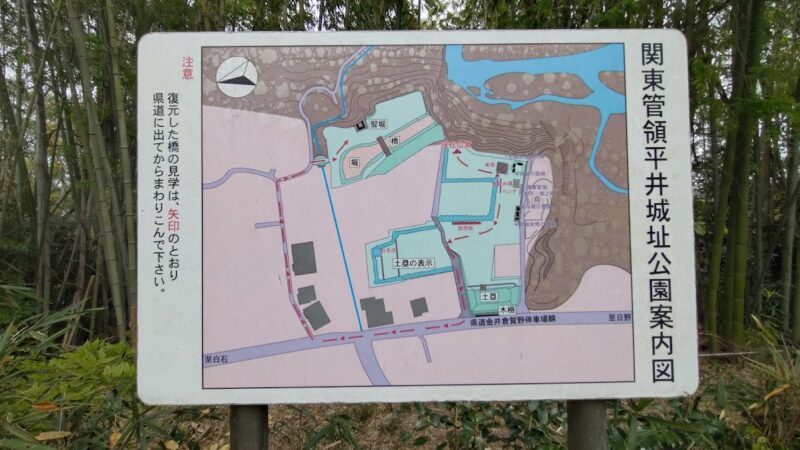
Currently, the Hirai Castle ruins have been developed into Hirai Castle Ruins Park and are open to the public. Information boards are installed within the park, allowing visitors to learn about the castle’s history and structure.
The park is also used as a place of relaxation for local residents and is bustling with cherry blossom viewers during the cherry blossom season. It is a valuable space where you can stroll through the castle ruins and reflect on the Sengoku period.
Restored Earthworks and Bridges
Within the park, earthworks have been restored based on the results of archaeological excavations. This earthen rampart is a reproduction of its original height and shape, making it a valuable historical site where you can see a real example of a castle’s defensive structure from the Sengoku period.
Furthermore, the bridge spanning the dry moat has also been restored, allowing you to experience what it was like to enter and exit the castle in those days. Crossing this bridge will give you the feeling of having traveled back in time to the Sengoku period.
Remains of the Dry Moat
One of the greatest highlights of Hirai Castle is the well-preserved remains of the dry moat. The dry moats on the west and north sides are particularly deep, allowing you to truly appreciate the high level of defense at the time.
Looking up from the bottom of the moat, the combined height of the earthen rampart and the depth of the moat reveal how difficult an obstacle it must have been for attackers. This dry moat is a valuable historical site that demonstrates the advanced castle construction techniques of the Sengoku period.
View of the Ayukawa River
From the east side of Hirai Castle, you can see the Ayukawa River, which functioned as a natural moat. Standing atop the cliffs of the river terrace, the defensive advantages of this terrain are immediately apparent.
The scenery along the Ayukawa River is beautiful in every season, especially during the fresh green season and the autumn foliage season, offering a magnificent view. Hirai Castle’s charm lies in the fact that you can enjoy the beauty of nature while learning about the castle’s history.
Stone Monuments and Information Boards
Several stone monuments and information boards explaining the history of Hirai Castle are installed within the park. By reading these, you can learn in detail about the historical events surrounding Hirai Castle, such as the escape of Uesugi Norimasa, the conflict with the Hojo clan, and the relationship with Nagao Kagetora (Uesugi Kenshin).
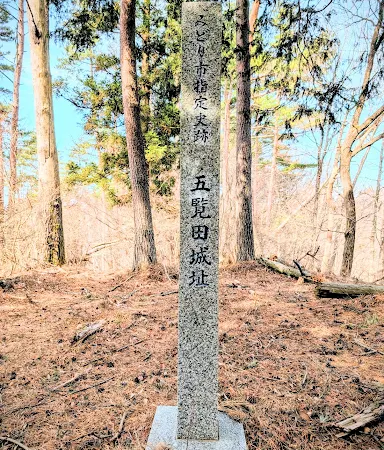
In particular, the stone monument designated as a Gunma Prefecture historical site is an important symbol demonstrating the historical value of this castle.
Related Historical Sites in the Surrounding Area
Takayama Castle (Tenya Castle, Hyakken-zukuri)
Approximately 3 kilometers north of Hirai Castle lies Takayama Castle. Also known as Amaya Castle and Hyakken-tsuiji, it functioned as a subsidiary castle of Hirai Castle.
Takayama Castle is thought to have been defended by a senior retainer of the Yamanouchi Uesugi clan and played a part in the defense network of Hirai Castle. Remains of earthworks and moats still exist today, and visiting both Hirai Castle and Takayama Castle allows for an understanding of the Uesugi clan’s castle network.
Kooyama Castle
South of Hirai Castle lies Kooyama Castle. This castle also served as a subsidiary castle of Hirai Castle, playing a role in preparing for invasions from the south.
Kooyama Castle is a mountain castle, characterized by defensive structures that utilize the steep terrain. While Hirai Castle is a flatland castle, Kooyama Castle is a purely mountain castle, allowing for a comparison of the structural differences between the two.
Relationship with Maebashi Castle
After the fall of Hirai Castle, the political and military center of Kozuke Province (Gunma Prefecture) shifted to Maebashi Castle. Maebashi Castle was built along the Tone River and flourished as the administrative center of the Maebashi Domain during the Edo period.
The shift in power from Hirai Castle to Maebashi Castle symbolizes the changing balance of power in the Kanto region. Visiting both castles will provide a comprehensive understanding of Gunma Prefecture’s history.
Visiting Guide & Access Information
Access by Train & Bus
From Gunma-Fujioka Station on the JR Hachiko Line
- Approximately 15 minutes by bus from Gunma-Fujioka Station, get off at the “Hirai” bus stop, then approximately 5 minutes on foot.
- Approximately 10 minutes by taxi.
From Yamana Station on the Joshin Electric Railway
- Approximately 30 minutes on foot from Yamana Station (approximately 2.5 kilometers).
- Approximately 5 minutes by taxi.
Since bus services are limited, it is recommended to check the timetable in advance.
Access by Car
From Fujioka IC on the Kan-Etsu Expressway
- Approximately 15 minutes (approximately 8 kilometers)
From Fujioka IC on the Joshin-Etsu Expressway
- Approximately 15 minutes (approximately 8 kilometers)
Hirai Castle Ruins Park has a dedicated parking lot, which is free to use. It can accommodate approximately 20 cars.
Visiting Information
- Location: Nishihirai, Fujioka City, Gunma Prefecture
- Visiting Hours: Always open (maintained as a park)
- Admission Fee: Free
- Estimated Time Required: Approximately 30 minutes to 1 hour
- Restrooms: Available within the park
- Accessibility: Some pathways are maintained, but there are stairs and slopes to access the earthworks and moats.
Precautions for Visiting
- Clothing: When viewing the remains of the earthworks and moats, comfortable walking shoes are recommended. Caution is advised in rainy weather as the ground can become slippery. 2. Season: Spring (cherry blossoms) and autumn (autumn foliage) are particularly recommended, but in summer, the vegetation can make it difficult to see the ruins.
- Photography: Photography is permitted, but please be considerate of the surroundings, as this is also a place of relaxation for local residents.
- Climbing to Kanayama Castle: Visiting Kanayama Castle, located behind the site, involves climbing a mountain path, so appropriate equipment and physical fitness are necessary.
Recommended Sightseeing Route
- Walk to Hirai Castle Ruins Park from the parking lot or the “Hirai” bus stop.
- Check the history at the information board at the park entrance.
- Visit the reconstructed earthworks.
- Visit the remains of the dry moat (descend to the bottom of the moat).
- Cross the reconstructed bridge.
- Enjoy the view from the cliff on the Ayukawa side.
- If you have time, visit Kanayama Castle behind the castle (round trip approximately 1 hour).
Nearby Tourist Facilities
Fujioka History Museum
- Approximately 10 minutes by car from Hirai Castle
- Exhibits materials and excavated artifacts related to Hirai Castle
- Opening hours: 9:00-17:00 (Closed on Mondays)
- Admission fee: 200 yen for adults
Michi-no-Eki Fujioka
- Approximately 15 minutes by car from Hirai Castle
- Enjoy local specialties and meals
- Ideal for taking a break or buying souvenirs
Historical Significance of Hirai Castle
Hirai Castle is not merely a regional castle; it occupies an extremely important position in the political history of the Kanto region.
Symbol of the Kanto Kanrei System
Hirai Castle served as the base of the Yamanouchi Uesugi clan, the Kanto Kanrei (governor of Kanto), and was the center of the Muromachi Shogunate’s control over Kanto. The Kanto Kanrei was a crucial position overseeing the eight Kanto provinces and Izu Province, and Hirai Castle was a symbol of that authority.
Uesugi Norimasa’s abandonment of Hirai Castle signified the complete collapse of the Muromachi Shogunate’s control system over Kanto, marking a significant turning point in Japanese history.
Relationship with Uesugi Kenshin
The history of Hirai Castle is deeply intertwined with Uesugi Kenshin’s (Nagao Kagetora’s) campaigns in Kanto. After inheriting the position of Kanto Kanrei from Norimasa, Kenshin repeatedly launched campaigns in Kanto, fighting against the Hojo clan.
Without this historical context, the Nagao clan of Echigo would never have adopted the name “Uesugi,” nor would Kenshin have intervened in the Kanto region as the Kanto Kanrei (governor of Kanto). In that sense, Hirai Castle is an indispensable location when discussing the life of Uesugi Kenshin.
Kanto Situation in the Sengoku Period
The rise and fall of Hirai Castle vividly illustrates the changing power dynamics in Kanto during the Sengoku period. Amidst the complex political situation of the conflict between the Kamakura Shogun and the Kanto Kanrei, the rise of the Koga Shogun, and the expansion of the Later Hojo clan, Hirai Castle was always at the center of Kanto politics.
The fall of Hirai Castle is a symbolic event, representing the surrender of medieval authority (the Kanto Kanrei) to the power of a Sengoku daimyo (the Hojo clan), and signifies a turning point in history.
Summary
Hirai Castle, located in Fujioka City, Gunma Prefecture, is an important castle that served as the base of the Yamanouchi Uesugi clan, the Kanto Kanrei. Built in 1438 (Eikyo 10) or 1467 (Ounin 1), Hirai Castle served as the political center of the Kanto region for approximately 100 years until its fall in 1552 (Tenbun 21).
Constructed on a strategically important river terrace on the west bank of the Ayukawa River, Hirai Castle was a formidable fortress equipped with defensive structures such as earthworks and dry moats. With Kanayama Castle, a secondary fortress, positioned behind it, and several subsidiary castles strategically located in the surrounding area, a multi-layered defensive system was established.
Currently, the site is maintained as Hirai Castle Ruins Park, where visitors can see reconstructed earthworks, dry moats, and other remains. Protected as a Gunma Prefecture designated historical site, it is a valuable place for learning about the history of the Kanto region during the Sengoku period.
By visiting Hirai Castle, you can experience the rise and fall of the Kanto Kanrei Uesugi clan, their relationship with Uesugi Kenshin, and the rise of the Hojo clan—all aspects of the Kanto political situation during the Sengoku period. It is a must-see historical site for history and castle enthusiasts.