Hinohara Castle (Hinohara Village, Tokyo) Complete Guide | The Charm of a Border Castle and Thirteen Buddha Pilgrimage
Hinohara Castle, located in Hinohara Village, Nishitama District, Tokyo, is a valuable Sengoku period mountain castle remaining within Tokyo. Built in the mountainous area of Hinohara Village, the only “village” in Tokyo excluding the islands, this castle played an important role as a defense against the Hojo clan’s threat to Kai Province. This article thoroughly explains this little-known mountain castle in Tokyo, covering its history, highlights, detailed remains, and even a guide to actually visiting.
What is Hinohara Castle? | A Border Castle Remaining in Tokyo
Hinohara Castle is a medieval mountain castle located in Honjuku, Hinohara Village, Nishitama District, Tokyo. Built on a mountaintop at an altitude of approximately 530 meters, it is strategically located near the border with Kai Province (present-day Yamanashi Prefecture).
Geographical Characteristics of Hinohara Village
Hinohara Village is located approximately 50 kilometers west of central Tokyo, about a two-hour drive away. 93% of the village area is covered in forest, and it is a mountain village situated in the headwaters of the Akigawa River. With a population of approximately 1,800, it is the smallest municipality in Tokyo (excluding the islands), and its rich natural environment is well-preserved.
Due to its location, just beyond the mountains to Yamanashi Prefecture, it has historically been an important transportation route, serving as a side route of the Koshu Kaido (highway). During the Sengoku period (Warring States period), it was a “border” where the forces of the Takeda and Hojo clans met.
Importance as a Border Castle
Hinohara Castle was located on the front line where the territories of the Hojo and Takeda clans met. It played a role in monitoring and defending the invasion route from Koshu (Takeda territory) to Musashi Province (Hojo territory), and was part of the outer defense line protecting major Hojo strongholds such as Takiyama Castle and Hachioji Castle.
History of Hinohara Castle | The Hirayama Clan and Hojo Ujiteru
As the Residence of the Hirayama Clan
Hinohara Castle was the residence of the Hirayama clan, who belonged to the Nishito clan, one of the seven Musashi clans. The Hirayama clan was a local samurai group that ruled the Hinohara area from the Kamakura period, and during the Sengoku period, they became vassals of the Hojo clan.
An Important Base under Hojo Ujiteru
From the Eiroku era (1558-1570) onward, Hinohara Castle came under the control of Hojo Ujiteru, the lord of Takiyama Castle. Ujiteru later built Hachioji Castle and moved his base there, but Hinohara Castle continued to be considered important as a defense against Koshu.
Recorded lords of the castle include Hirayama Tsunakage and Hirayama Ujishige. Hirayama Ujishige, in particular, played a crucial role during Toyotomi Hideyoshi’s siege of Odawara in 1590.
The Siege of Hachioji Castle in 1590
In 1590 (Tensho 18), when Toyotomi Hideyoshi invaded the Kanto region with a large army, the castles of the Hojo clan were attacked one after another. On June 23rd, the forces of Maeda Toshiie and Uesugi Kagekatsu attacked Hachioji Castle and captured it in just one day. The castle’s lord, Hojo Ujiteru, and his retainers scattered to various locations.
Approximately 200 men, including Yokochi Kagenobu, who had fled Hachioji Castle, joined forces at Hinohara Castle and resisted alongside Hirayama Ujishige and others. However, it is believed that Hinohara Castle was soon forced to surrender in the face of the overwhelming Toyotomi forces.
With this battle, Hinohara Castle disappeared from the historical stage.
Structure and Layout of Hinohara Castle
Location as a Mountain Castle
Hinohara Castle is built on a steep mountain ridge facing the Kita-Akigawa River, a tributary of the Akigawa River. Surrounded on three sides by rivers and valleys, it is a natural stronghold and a typical Sengoku period mountain castle that skillfully utilizes the mountain’s terrain.
The main enclosure (honmaru) is located at the mountaintop at an altitude of approximately 530 meters, and the layout is a series of interconnected enclosures (kuruma) arranged along the ridge.
Major Remains
Main Enclosure (Honmaru)
The main enclosure, located at the mountaintop, is an oval-shaped flat area approximately 30 meters east-west and 20 meters north-south. Traces of earthworks remain around it, indicating that it served as the central defensive point of the castle. Although currently covered with trees, the flat surface remains relatively well-preserved.
Moats
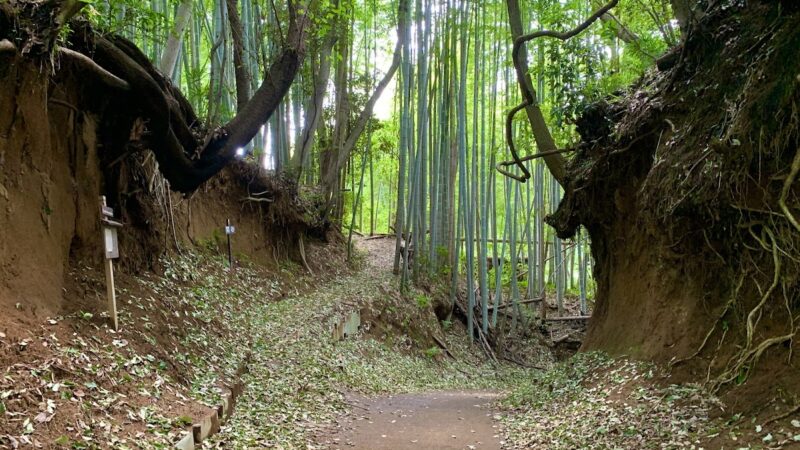
Clear moats can be seen on the north and south sides of the main enclosure. The moat, dug to cut across the ridge, played a crucial role in preventing enemy incursions. The northern moat, in particular, is large, measuring approximately 3 meters deep and 5 meters wide, and remains in excellent condition.
Vertical Moats
Multiple vertical moats have been identified, descending the slope from the main enclosure. These moats, dug vertically along the slope, prevented enemies from climbing the slope and restricted lateral movement. The vertical moats at Hinohara Castle are effectively positioned, taking advantage of the steep terrain.
Enclosures
Several large and small enclosures are arranged in a stepped pattern around the main enclosure. These enclosures are thought to have been used as troop encampments and storage areas for supplies. There are elevation differences between each enclosure, demonstrating a design intended to enhance defensive capabilities.
Earthworks
Earthworks, built by piling up earth, surrounded the main enclosure and the main enclosures. Even today, traces of the earthworks remain in some areas, allowing us to imagine what the defensive structures looked like in their heyday.
Castle Grounds
The castle grounds of Hinohara Castle extend approximately 200 meters east-west and 150 meters north-south, centered around the main enclosure. While a relatively compact mountain castle, its steep terrain and clever layout allow for effective defense even with a small force.
Highlights of Hinohara Castle | Pilgrimage to the Thirteen Buddhas and Exploration of the Ruins
Pilgrimage Route to the Thirteen Buddhas
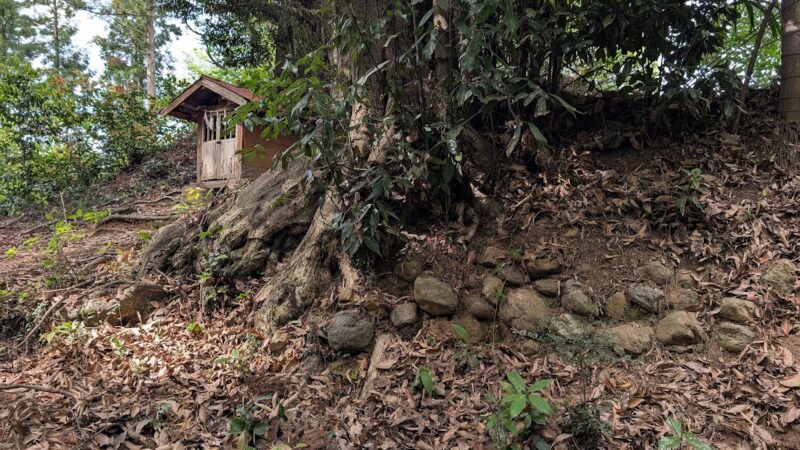
Thirteen stone Buddha statues are placed along the path leading to Hinohara Castle. This is a pilgrimage route known as the “Pilgrimage to the Thirteen Buddhas,” a sacred site where pilgrims visit thirteen Buddhas, from Fudo Myoo to Kokuzo Bosatsu, for the repose of the souls of the deceased.
The stone Buddhas are placed at approximately 10-minute intervals along the mountain trail leading to the castle ruins, making it a valuable spot where you can experience both historical exploration and a pilgrimage route simultaneously. By offering prayers before each stone Buddha statue as you ascend, you can approach the mountain castle with a peaceful heart.
Well-Preserved Remains
The remains of Hinohara Castle are relatively well-preserved for a mountain castle within Tokyo. In particular, the moats and vertical trenches are clearly visible, providing valuable information for understanding the structure of mountain castles from the Sengoku period.
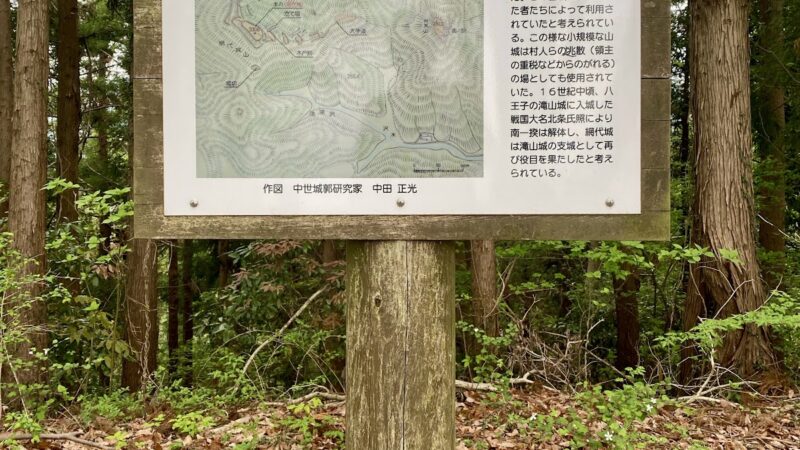
Maintenance has been kept to a minimum, offering the pleasure of discovering the remains hidden within nature. However, since information boards and explanatory signs are limited, it is recommended to check the castle layout map beforehand.
Views and Natural Environment
From the area around the main enclosure, you can see the mountains of Hinohara Village (depending on the season and the condition of the trees). The mountaintop, at an altitude of 530 meters, is enveloped in clear air and tranquility, allowing you to forget the hustle and bustle of the city.
Exploring the castle ruins while enjoying the changing seasons, such as the fresh greenery of spring and the autumn foliage, is a unique charm of Hinohara Castle.
How to Access Hinohara Castle
Access by Public Transportation
By Train and Bus
- Take the Nishi-Tokyo Bus bound for “Haraizawa-no-Taki Iriguchi” or “Fujikura” from Musashi-Itsukaichi Station on the JR Chuo Line.
- Get off at the “Honjuku Yakuba-mae” bus stop (approximately 25 minutes).
- Approximately 5 minutes’ walk from the bus stop to Kichijoji.
- Approximately 30-40 minutes’ walk from Kichijoji to the main enclosure of Hinohara Castle.
Notes
- Bus service is limited, so please check the timetable in advance.
- It can get particularly crowded with tourists on holidays.
Access by Car
From the City Center
- Approximately 50 minutes from Hachioji IC on the Chuo Expressway via National Route 16 and National Route 411 (Takiyama Kaido).
- Approximately 30 minutes from Akiruno IC on the Ken-O Expressway via National Route 411.
Parking
- Parking is available at Kichijoji Temple (limited spaces, early arrival recommended).
- According to information from the Hinohara Village Tourism Association, the use of the Kichijoji Temple parking lot is recommended.
Ascent Route
Standard Route (Via Kichijoji Temple)
- Start from Kichijoji Temple: Kichijoji Temple in Honjuku, Hinohara Village, is the starting point for the ascent to the castle.
- To the back of the cemetery: The hiking trail begins behind the cemetery of Kichijoji Temple. Signposts are limited, so caution is advised.
- Entrance to the Thirteen Buddha Pilgrimage: After passing through the cemetery, you will find a sign for the “Entrance to the Thirteen Buddha Pilgrimage.”
- Climb the hiking trail: Climb the steep hiking trail while visiting the thirteen stone Buddha statues.
- Arrival at the main enclosure: You will arrive at the main enclosure in approximately 30-40 minutes.
Precautions when Ascending the Castle
- Condition of the hiking trail: The trail is a steep mountain path and can be particularly slippery after rain. Wearing hiking boots or trekking shoes is strongly recommended.
- Information: There are few information signs on the hiking trail, so please prepare a map or GPS app in advance.
- Equipment: Bring drinking water, a towel, insect repellent (in summer), and a bear bell (just in case).
- Estimated Time: Allow approximately 1.5 to 2 hours round trip.
- Season: There are many insects in summer, and the sun sets early in winter, so visiting in spring or autumn is recommended.
About Kichijoji Temple
Kichijoji Temple, which serves as the entrance to the Hinohara Castle, is located in the heart of Honjuku, Hinohara Village. The temple grounds contain several halls, as well as maple and ginkgo trees, offering stunning autumn foliage.
When visiting Hinohara Castle, it is a good idea to first visit Kichijoji Temple and pray for a safe ascent to the castle ruins. The tranquil atmosphere of the temple heightens the anticipation for the upcoming mountain castle exploration.
Nearby Tourist Attractions
Besides Hinohara Castle, Hinohara Village boasts numerous other attractive tourist spots. Visiting them in conjunction with your castle ruins will allow you to experience Hinohara Village’s nature and history more deeply.
Hossawa Falls
A representative tourist attraction of Hinohara Village, and selected as one of Japan’s Top 100 Waterfalls. This beautiful waterfall has a drop of 60 meters and consists of four tiers. In winter, you can see the entire waterfall frozen, creating an “icefall” (weather permitting). It’s about a 10-minute drive from Hinohara Castle.
Hinohara Village Local History Museum
This facility exhibits the history, culture, and folklore of Hinohara Village. You can learn about materials related to Hinohara Castle and the history of Hinohara Village. Visiting before your castle ruins visit will provide a deeper understanding.
Kanoto-iwa (Kanoto Rock)
A scenic spot where a clear stream flows between giant rocks. It’s a popular spot known for its mystical atmosphere and the feeling of being surrounded by nature’s power.
Kazuma no Yu (Kazuma Hot Spring)
A day-trip hot spring facility located deep within Hinohara Village. Perfect for relaxing after a tiring climb to the castle. The open-air bath offers views of the Hinohara mountains.
Castles Related to Hinohara Castle
Hachioji Castle
The main castle of Hojo Ujiteru, and a higher-ranking base than Hinohara Castle. Historically, it has a connection to Hachioji Castle, as samurai who fled there after its fall in 1590 (Tensho 18) joined forces at Hinohara Castle. Currently designated a national historical site, its well-maintained remains are open to visitors.
Takiyama Castle
The base of operations for Hojo Ujiteru before he built Hachioji Castle. Hinohara Castle functioned as a subsidiary castle of Takiyama Castle for a period. Developed as Tokyo Metropolitan Takiyama Park, this is one of the Kanto region’s leading mountain castles, boasting magnificent remains.
Kozukue Castle
Also a branch castle of the Hojo clan, located in Yokohama City. Like Hinohara Castle, it played a vital role in the Hojo clan’s territorial defense network.
Best Season to Visit Hinohara Castle
Spring (April-May)
The fresh greenery is beautiful, and the temperature is ideal for hiking. The trees along the Thirteen Buddhas pilgrimage route are budding, creating a vibrant atmosphere for visiting the castle ruins.
Autumn (October-November)
The autumn foliage is magnificent, with the entire village of Hinohara changing color. The autumn leaves at Kichijoji Temple are also spectacular, allowing you to enjoy both castle ruins exploration and autumn leaf viewing simultaneously. The temperature is moderate, making it the most suitable time to visit.
Summer (June-September)
The lush greenery makes it a good season to enter the mountains seeking coolness, but there are many insects, and the steep mountain trails can be physically exhausting in the heat. Sufficient hydration and insect repellent are necessary.
Winter (December-March)
The air is clear and the views are excellent, but sunset is early, and there is a possibility of icy roads or snow. This season is for experienced hikers.
Historical Value and Preservation of Hinohara Castle
Hinohara Castle holds historical significance as a valuable Sengoku period mountain castle ruin remaining within Tokyo. It is rare to find such well-preserved mountain castle ruins in a metropolis like Tokyo.
Currently, Hinohara Castle is not officially designated as a historical site, but its value is recognized by locals and castle enthusiasts, and awareness of its preservation is growing.
Visitors are requested to observe proper etiquette, such as not damaging the ruins and taking all trash with them.
How to Enjoy Visiting Hinohara Castle
Observing Castle Remains
By carefully observing the remains such as moats, trenches, earthworks, and baileys, you can understand the castle construction techniques and defensive ingenuity of the Sengoku period. Bringing a castle layout map and comparing it to the local terrain will lead to a deeper understanding.
Experiencing Historical Romance
Walking through the castle ruins while imagining the figures of Hirayama Ujishige and others who resisted the Toyotomi army’s invasion to the very end in 1590 (Tensho 18) will evoke a sense of historical romance. Stand in the main bailey and gaze upon the view they must have seen.
Photography
Photographing the remains is another enjoyable aspect. Record the cross-sections of moats and trenches, the shapes of earthworks, and other remains unique to mountain castles. The combination of the castle remains and the changing seasons also makes for beautiful subjects.
Experiencing the Thirteen Buddha Pilgrimage
Beyond exploring the castle ruins, another appeal of Hinohara Castle is the opportunity to experience the pilgrimage of the Thirteen Buddhas. By praying before each stone Buddha and ascending in quiet contemplation, you can gain a sense of spiritual fulfillment.
History and Culture of Hinohara Village
Hinohara Village has a long history of thriving forestry, and during the Edo period, it flourished to the point of being called “Hinohara Senken” (Hinohara of a Thousand Houses). The cypress trees (hinoki), from which the village derives its name, were supplied to Edo (present-day Tokyo) as high-quality building materials, supporting the village’s economy.
Even today, 93% of the village area is covered in forest, preserving a rich natural environment. The village boasts numerous waterfalls and valleys, creating a beautiful landscape often referred to as “Tokyo’s hidden gem.”
Visiting Hinohara Castle offers a valuable opportunity to experience the nature, history, and culture of Hinohara Village.
Equipment Checklist for Visiting Hinohara Castle
For a safe and comfortable visit to the castle ruins, please prepare the following equipment. ### Essential Equipment
- Hiking boots or trekking shoes (with non-slip soles)
- Drinking water (500ml or more)
- Towel, hand towel
- Map or GPS app
- Mobile phone (for emergency contact)
- Snacks (chocolate, candy, etc.)
Recommended Equipment
- Trekking poles (effective for ascending and descending steep slopes)
- Insect repellent spray (spring to autumn)
- Hat, sunscreen
- Rainwear (in case of changing weather)
- First-aid kit (band-aids, disinfectant, etc.)
- Bear bell (just in case)
- Camera
- Territory map (print out in advance)
Useful Items
- Binoculars (for observing the ruins from a distance)
- Measuring tape (for measuring the ruins)
- Field notebook and pen (for recording)
- Garbage bag (for taking trash home)
Summary | Hinohara Castle: A Hidden Gem in Tokyo
Hinohara Castle is a valuable Sengoku period mountain castle remaining in Tokyo. Defended by the Hirayama clan, vassals of Hojo Ujiteru, it played a crucial role as a defense against invasions from Kai Province. It was also the site of the final battle during the Toyotomi army’s invasion in 1590.
The remains, such as moats, trenches, and earthworks, are relatively well-preserved, providing valuable information for understanding the structure of mountain castles. The unique atmosphere, where faith and history intersect, can be experienced through the Thirteen Buddhas Pilgrimage Route, is another charm of Hinohara Castle.
Located approximately two hours from central Tokyo, yet surrounded by abundant nature, Hinohara Village offers a fulfilling day when combined with nearby tourist attractions such as the Hozawa Falls and hot springs.
For castle enthusiasts, history buffs, and those who enjoy hiking in nature, Hinohara Castle is a worthwhile place to visit. With appropriate equipment and preparation, be sure to visit this little-known gem of Tokyo. Walking through the tranquil ruins of a mountain castle, while feeling the atmosphere of the Sengoku period, will surely become a memorable experience.