Hanakuma Castle (Hyogo Prefecture) Complete Guide | History and Highlights of Araki Murashige’s Last Stand
Hanakuma Castle (Hanakuma-jo) is a castle from the Sengoku period that once existed in Hanakuma-cho, Chuo-ku, Kobe City, Hyogo Prefecture. Also known as Hanakuma Castle or Hanasumi Castle, its name derives from the way the Rokko Mountains’ hills jut out into the sea were described as “nose” and “corner.” Built by order of Oda Nobunaga as a base for controlling Settsu Province, this castle, which holds historical significance as the site of Araki Murashige’s rebellion and his last stand, is now a public park and a place of relaxation for citizens.
History of Hanakuma Castle | From Construction to Abandonment
Construction History and Period
There are several theories regarding the construction period of Hanakuma Castle. Generally, it is believed to have been built in 1567 (Eiroku 10) by order of Araki Murashige as Oda Nobunaga sought to expand his power into Settsu Province. However, another theory suggests that Wada Koremasa built the castle when he was entrusted with the rule of Settsu Province by Oda Nobunaga.
At that time, Settsu Province was a crucial transportation hub connecting the Kinai region and western Japan. The Hanakuma area, in particular, was a narrow region sandwiched between Mount Rokko and the sea, making it difficult to travel east or west without passing through it. Due to this strategic importance, Oda Nobunaga prioritized the construction of Hanakuma Castle as a base for his control of Settsu.
Records indicate that a group of stonemasons known as the Anō-shū from Ōmi Province were mobilized during the castle’s construction, and a considerable amount of stone was used for the walls. This Anō-style stonework technique was cutting-edge fortification technology at the time, indicating that Hanakuma Castle was positioned as an important military base.
Araki Murashige and Hanakuma Castle
Araki Murashige was a Sengoku period warlord who rose to prominence as the lord of Ikeda Castle in Settsu Province and became the ruler of the entire province through gekokujō (overthrowing one’s superior). Having gained the trust of Oda Nobunaga, Murashige was entrusted with the governance of Settsu Province. Hanakuma Castle was completed under Murashige’s control, becoming one of the two major bases for controlling Settsu, along with Arioka Castle (Itami Castle).
Murashige was highly valued within the Oda clan and played a crucial role in Nobunaga’s military campaigns in the Chugoku region. However, in 1578, Murashige suddenly rebelled against Oda Nobunaga. There are various theories regarding the reasons for this rebellion, including collusion with the Mori clan, rebellion against Nobunaga’s oppressive rule, and conflicts with Akechi Mitsuhide and Hashiba Hideyoshi. Historians continue to debate this matter.
The Battle of Arioka Castle and the Retreat to Hanakuma Castle
The “Battle of Arioka Castle,” which began in October 1578, saw Oda Nobunaga himself lead an army, besieging Arioka Castle, the stronghold of Araki Murashige. This siege lasted approximately one year, and the castle’s inhabitants gradually fell into dire straits.
In September of Tensho 7 (1579), Murashige escaped from Arioka Castle, fleeing through Amagasaki Castle to Hanakuma Castle. This act meant abandoning his retainers and family, and the remaining soldiers of Arioka Castle, along with Murashige’s relatives, met a tragic end, being executed by the Oda army. This incident is recorded as one of the most brutal events of the Sengoku period.
The Battle and Fall of Hanakuma Castle
Oda Nobunaga dispatched an army led by Ikeda Tsuneoki (Ikeda Nobuteru) to subdue Araki Murashige, who was holed up in Hanakuma Castle. In Tensho 8 (1580), the siege of Hanakuma Castle intensified.
The besieging army included not only Ikeda Tsuneoki, but also Nakagawa Kiyohide, Takayama Ukon, and other generals who had previously served under Murashige. They had defected to the Oda side and were now attacking their former lord, Murashige.
On August 2nd, 1580 (Tensho 8), after a fierce battle, Hanakuma Castle finally fell. However, Murashige himself is said to have escaped the castle just before its fall and fled to the Mori clan. Afterward, Murashige became Toyotomi Hideyoshi’s tea master, taking the name “Dokun,” and spent the rest of his life as a tea master.
Ikeda Tsuneoki’s Entry and Abandonment
For his service in capturing Hanakuma Castle, Ikeda Tsuneoki was granted the castle. However, Tsuneoki began construction of a new castle, Hyogo Castle, and Hanakuma Castle was abandoned after a short period. This was because Hyogo, with its port facilities, was deemed more suitable as a base for controlling Settsu Province.
It is believed that much of the stonework and building materials from Hanakuma Castle were repurposed for the construction of Hyogo Castle and surrounding temples and shrines. Thus, Hanakuma Castle, with a history of only a little over a decade, disappeared from the stage of history.
Structure and Scale of Hanakuma Castle
Overall View of the Castle
According to the “Settsu Hanakuma Castle Map” held by Okayama University, Hanakuma Castle possessed the characteristics of a full-fledged early modern castle. According to a survey by Kobe City, its scale was vast, extending approximately 700 meters east-west and 230 meters north-south.
Specifically, it is estimated that the castle grounds extended from the vicinity of the current Kobe Municipal Kobe Ikuta Junior High School in the east to the vicinity of the west exit of Hankyu Hanakuma Station in the west, and from the Hyogo Prefectural Government building in the north to the vicinity of the JR elevated railway in the south. This scale indicates that it was not merely a military base, but a comprehensive center with urban functions including a castle town.
Arrangement of the Main Bailey, Second Bailey, and Third Bailey
The central part of Hanakuma Castle consisted of the main bailey, second bailey, and third bailey. According to the “Settsu Hanakuma Castle Map,” the keep was located in the northwest corner of the main bailey, and a turret was built in the southeast corner. This castle tower is one of the earliest castle towers built during the time of Oda Nobunaga, and may have been an important structure predating the Azuchi Castle tower.
The main enclosure (Honmaru) was at the center, with the second and third enclosures arranged in concentric circles, each separated by moats and stone walls. The stone walls, constructed by the Anō-shū, represented the latest castle-building technology of the time, indicating that Hanakuma Castle was positioned as an important base for Oda Nobunaga.
Arrangement of Samurai, Ashigaru, and Merchant Districts
In the eastern part of the castle grounds, there were two samurai districts and three ashigaru districts. This indicates that these were residential areas for the samurai class, and that samurai groups responsible for the castle’s defense were permanently stationed there.
In the western part, there were four merchant districts, forming a castle town where merchants and artisans resided. This suggests that Hanakuma Castle was not merely a military base, but a comprehensive urban center with economic functions as well. It is thought that commercial activity flourished there, taking advantage of its location as a key transportation hub in Settsu Province.
Defensive Structure Utilizing the Topography
Hanaguma Castle was built on a hill in the Rokko Mountains that juts out into the sea, and it possessed a defensive structure that skillfully utilized this natural terrain. Facing mountains to the north and the sea to the south (the coastline extended further inland at that time), it controlled the east-west roads.
Due to these topographical features, bypassing Hanaguma Castle was difficult, and anyone traveling east-west through Settsu Province inevitably had to pass under its influence. Therefore, its strategic importance in controlling Settsu was extremely high.
Hanaguma Castle Today | Hanaguma Park and Remains
Development of Hanaguma Park
Currently, the site of Hanaguma Castle has been developed into Hanaguma Park. Located midway between Hanakuma Station on the Hankyu Kobe Line and Motomachi Station on the JR Line, the park is a valuable green space in the heart of Kobe City, cherished by its residents.
A replica of the castle’s stone walls has been erected within the park, allowing visitors to experience the atmosphere of the former castle. However, these stone walls are not original to the castle, but are replicas built during the park’s development. A replica castle tower base is also installed on top of the replica walls, a visual design choice to indicate the castle site.
Interestingly, the interior of these replica walls is used as a paid parking lot. While this is a modern innovation for effectively utilizing limited space in the city center, some history enthusiasts have commented that it would have been better if it were a cultural facility such as a history museum.
Hanakuma Castle Tower Site Monument
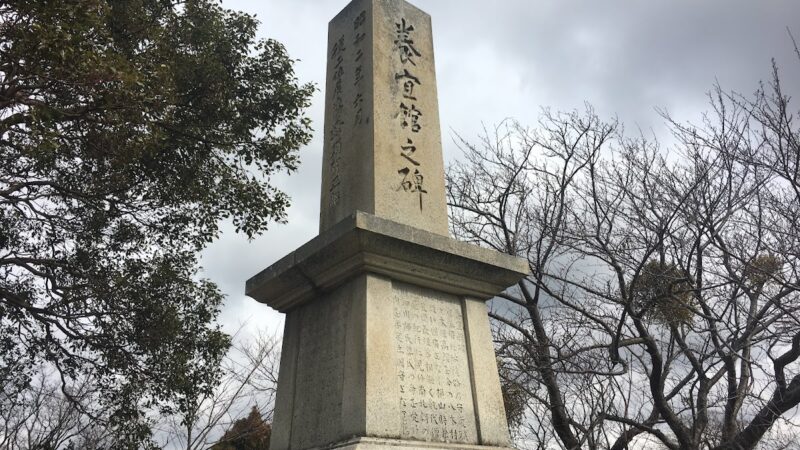
Near Hanakuma Park stands the “Hanakuma Castle Tower Site Monument.” This monument is an important memorial that conveys the existence of Hanakuma Castle to future generations and serves as a landmark for history buffs visiting the castle site.
Information boards are also installed around the monument, offering brief explanations of the history of Hanakuma Castle and Araki Murashige. These guides ensure that even visitors without prior knowledge can understand the historical significance of Hanakuma Castle.
Fukutoku-ji Temple and Traces of the Castle Ruins
Near the site of the former main keep of Hanakuma Castle is Fukutoku-ji Temple. Within the temple grounds and surrounding area, there are places where traces of the original topography can be felt.
The elevated area where Fukutoku-ji Temple is located is highly likely to have been part of the former castle, and by observing the surrounding terrain, it is possible to imagine the layout of the castle at that time. However, no clear remains are left, and most of the area has been altered by modern urban development.
Archaeological Excavations and Excavated Artifacts
During redevelopment and construction work in Kobe City, remains and artifacts related to Hanakuma Castle are sometimes discovered. Previous investigations have unearthed parts of stone walls, traces of moats, and fragments of pottery.
These excavations are gradually revealing the true nature of Hanakuma Castle, which was not clear from historical documents alone. In particular, the excavated pottery provides insights into daily life within the castle and the realities of trade at that time.
Access and Visiting Guide to Hanakuma Castle
Access by Train
Access to Hanakuma Castle Ruins (Hanakuma Park) is very convenient. The nearest stations are as follows:
- Hankyu Kobe Line “Hanakuma Station”: Approximately 3 minutes on foot
- JR Kobe Line “Motomachi Station”: Approximately 8 minutes on foot
- Kobe Municipal Subway Seishin-Yamate Line “Kencho-mae Station”: Approximately 10 minutes on foot
The easiest access is from Hankyu Hanakuma Station, where Hanakuma Park is located immediately outside the station. Located in the heart of Kobe, it’s ideal for visiting in conjunction with sightseeing in Sannomiya or Motomachi.
Access by Car and Parking
If visiting by car, it’s approximately 5 minutes from the “Kyobashi Exit” of the Hanshin Expressway Route 3 Kobe Line. There is a paid parking lot inside the simulated stone walls of Hanakuma Park, so parking is not a problem. However, since there are many one-way streets in the surrounding area, using a car navigation system is recommended.
Points to Note During Your Visit
A visit to the Hanakuma Castle ruins takes about 30 minutes to an hour. While the park itself isn’t particularly large, keeping the following points in mind will allow you to experience history more deeply:
- Hanaguma Castle Keep Site Monument: First, review the history using the monument and explanatory plaque.
- Reconstructed Stone Walls and Keep Base: Imagine the atmosphere of the castle at that time.
- Observe the Surrounding Topography: Infer the layout of the castle from the elevation differences.
- Around Fukutoku-ji Temple: Examine the topography near the main keep site.
Nearby Tourist Attractions
Near the Hanakuma Castle ruins are numerous spots where you can experience Kobe’s history and culture:
- Hyogo Prefectural Government Office: Near the site of Hyogo Castle, built after the abandonment of Hanakuma Castle.
- Nankinmachi (Chinatown): Approximately 10 minutes on foot, one of Japan’s three major Chinatowns.
- Kobe Former Foreign Settlement: Approximately 15 minutes on foot, a historical district with Western-style buildings from the Meiji period.
- Kobe Port: Approximately 20 minutes on foot, a symbol of the port city of Kobe.
Starting from the Hanakuma Castle ruins, you can create a walking course that traces Kobe’s history chronologically.
The Figure of Araki Murashige | A Ruthless Warlord of the Sengoku Period
Rise to Power Through Gekokujo (Overthrowing One’s Established Position)
Araki Murashige was a typical example of a warlord who rose from being a vassal of the Ikeda clan to become the lord of Ikeda Castle by usurping his lord’s position. He later served Oda Nobunaga and rose to the position of governing Settsu Province.
Murashige possessed exceptional military talent and played a crucial role in Nobunaga’s pacification of Settsu. He was also deeply knowledgeable in the tea ceremony and is said to have had contact with Sen no Rikyu. This cultural background would later prove useful in his survival as a tea master.
The Truth Behind the Rebellion
The reasons why Murashige rebelled against Nobunaga are still debated among historians. The main theories are:
- The theory of collusion with the Mori clan: This theory suggests a secret agreement with the Mori clan in the Chugoku region.
- The theory of rebellion against Nobunaga’s oppressive rule: This theory suggests Murashige could no longer endure Nobunaga’s harsh rule.
- The theory of slander: This theory suggests Nobunaga suspected Murashige, believing slander from other retainers.
- The theory of independence: This theory suggests Murashige aimed for independence as the ruler of Settsu Province.
None of these theories have conclusive evidence, and it is highly likely that multiple factors contributed to the outcome.
Fleeing and abandoning family
The most criticized aspect of Murashige’s actions is his abandonment of his family and retainers when fleeing from Arioka Castle to Hanakuma Castle, and then from Hanakuma Castle to Amagasaki. In particular, Murashige’s wife, children, and relatives who remained at Arioka Castle were executed by the Oda army.
This action was a major departure from the samurai spirit of the time and was condemned by his contemporaries. However, it is also true that Murashige’s survival led to the preservation of many records and anecdotes for posterity.
Later Life as a Tea Master
After fleeing to the Mori clan, Murashige was later employed as Toyotomi Hideyoshi’s tea master and lived his life as a tea master under the name “Araki Dokun.” He was also close to Sen no Rikyu, and although not counted among Rikyu’s Seven Disciples, he held a certain position in the tea ceremony culture of the time.
Murashige continued to live as a tea master until his death in 1606. He led a complex life, branded a traitor as a military commander but receiving a certain level of recognition as a cultural figure.
Battle for Hanakuma Castle | Its Place in Sengoku History
Oda Nobunaga’s Strategy for Controlling Settsu
To understand the history of Hanakuma Castle, it is necessary to understand Oda Nobunaga’s strategy for controlling Settsu. Settsu Province was a crucial transportation hub connecting the Kinai region and western Japan, and was particularly important as a base for maritime traffic.
Nobunaga, anticipating a confrontation with the Mori clan in the Chugoku region, considered secure control of Settsu essential. Therefore, he appointed Araki Murashige as the ruler of Settsu and had him develop Arioka Castle and Hanakuma Castle as his two main strongholds.
Relationship with Ishiyama Honganji
The period in which Hanakuma Castle was built coincides with the ongoing conflict between Oda Nobunaga and Ishiyama Honganji (Ikkō-ikki). Honganji’s influence was strong within Settsu Province, making stable control of the region difficult for Nobunaga.
Hanakuma Castle also functioned as part of a siege network against Ishiyama Honganji. It is believed that there was a strategic intention to cut off supply lines to Honganji by controlling sea routes.
Link to the Battle of Arioka Castle
The Battle of Hanakuma Castle was closely linked to the Battle of Arioka Castle. Murashige’s rebellion put the Oda forces in danger of losing two crucial strongholds in Settsu Province simultaneously.
While besieging Arioka Castle, Nobunaga also focused on cutting off the supply lines to Hanakuma Castle. This two-front strategy gradually cornered Murashige’s forces. After the fall of Arioka Castle, Hanakuma Castle became isolated, and its fall was only a matter of time.
The Achievements of Ikeda Tsuneoki
Ikeda Tsuneoki, who served as the commander-in-chief in the siege of Hanakuma Castle, was a veteran and important retainer of the Oda clan. Tsuneoki became the new ruler of Settsu Province by being granted Murashige’s former territory.
However, Tsuneoki chose Hyogo Castle as his new base instead of Hanakuma Castle. This was because he judged that Hyogo, with its port facilities, offered a greater commercial and military advantage. This decision led to the short lifespan of Hanakuma Castle.
Castles in Settsu Province from the Same Era as Hanakuma Castle
Arioka Castle (Itami Castle)
Arioka Castle was the base of Araki Murashige and, along with Hanakuma Castle, was a key center of his control over Settsu Province. Located in present-day Itami City, Hyogo Prefecture, the castle ruins remain around JR Itami Station. The Arioka Castle ruins are designated a national historic site, and parts of the stone walls and moats are well-preserved.
Arioka Castle was larger in scale than Hanakuma Castle, and its castle town was also developed. It is also known as the place where Kuroda Kanbei (Josui) was imprisoned during Murashige’s rebellion.
Amagasaki Castle
Amagasaki Castle was also under the control of Araki Murashige and was located midway between Arioka Castle and Hanakuma Castle. It is believed that after escaping from Arioka Castle, Murashige temporarily stopped at Amagasaki Castle before heading to Hanakuma Castle.
During the Edo period, it was extensively renovated as the residence of the Toda clan, becoming a castle with a four-story keep. The castle tower has now been restored, and the site is maintained as Amagasaki Castle Ruins Park.
Hyogo Castle
Hyogo Castle, built by Ikeda Tsuneoki after the abandonment of Hanakuma Castle, was located near the present-day Hyogo Prefectural Government building. Hyogo Castle grew in importance with the development of Hyogo as a port city and survived until the Edo period.
Although very few remains of Hyogo Castle exist today, a stone monument stands on the grounds of the Hyogo Prefectural Government building, marking the former castle site. The shift of the base from Hanakuma Castle to Hyogo Castle symbolizes the shift in the center of power for Settsu Province from military to economic.
Reference Materials for Learning About Hanakuma Castle
Recommended Books
For those who wish to learn more about Hanakuma Castle and Araki Murashige, the following books are recommended:
- *Araki Murashige* (by Nakagawa Taiko): A detailed biography tracing Murashige’s life.
- *Dictionary of Oda Nobunaga’s Retainers*: Information on the warlords involved with Hanakuma Castle.
- *Castles of Hyogo*: A comprehensive explanation of castles in Hyogo Prefecture.
- *Castles of Settsu Province*: A fundamental document for the study of castle history in the Settsu region.
Old Maps and Illustrations
The “Settsu Hanakuma Castle Map” held by Okayama University is the most important document for understanding the structure of Hanakuma Castle. Although this illustration was created during the Edo period, it is based on memories and records of the time, making it a valuable historical document for castle research.
The Kobe City Museum and the Hyogo Prefectural Museum of History hold old maps and castle-related materials of Settsu Province, which are sometimes displayed in special exhibitions.
Online Resources
In recent years, online resources for castle research have become increasingly abundant. Castle information websites such as “Kojodan” and “Shirobito” feature numerous visitor reports and photographs, allowing you to check the site’s condition beforehand.
Furthermore, the Kobe City official website publishes information on the city’s historical heritage, including basic information about Hanakuma Castle.
Summary | Historical Significance of Hanakuma Castle
Hanakuma Castle existed for only a short period of a little over a decade, but it was an important base for controlling Settsu Province during the Sengoku period. Built as part of Oda Nobunaga’s strategy for expanding westward, and the stage for the dramatic rebellion of Araki Murashige, this castle can be said to symbolize the political and military situation of the Sengoku period.
Currently, very few remains of Hanakuma Castle exist, but visiting the site, which has been developed into Hanakuma Park, allows you to reflect on the history of that time. Its convenient location in the heart of Kobe makes it a must-see during your Kobe sightseeing trip.
Standing before the monument and reflecting on the fierce battles that once took place here, and the complex life of Araki Murashige, you’ll feel a closer connection to history. In the midst of modern, urbanized Kobe, the memories of the Sengoku period quietly live on—that’s the charm of the Hanakuma Castle ruins.