Complete Guide to Hagiwara Suwa Castle (Gifu Prefecture) | The History and Highlights of a Flatland Castle that Transformed from a Branch Castle of the Kanamori Clan to a Ryokan (Japanese Inn)
Located in Hagiwara, Hagiwara-cho, Gero City, Gifu Prefecture, Hagiwara Suwa Castle is a flatland castle built by the Kanamori clan, who ruled Hida Province. Built on the site of the former Suwa Shrine, this castle has a unique history, having survived as the “Kanamori Ryokan” even after the “One Castle Per Province” decree, and is now preserved as a Gifu Prefecture designated historical site. This article provides a detailed explanation of the history, structure, highlights, and access information for Hagiwara Suwa Castle.
History of Hagiwara Suwa Castle
Background of Kanamori Nagachika’s Conquest of Hida and Castle Construction
In 1585 (Tensho 13), Kanamori Nagachika, the lord of Ono Castle in Echizen Province, invaded Hida Province at the command of Hashiba Hideyoshi (later Toyotomi Hideyoshi). Having defeated Miki Jitsuna, who ruled Hida at the time, and pacified the entire Hida region, Kanamori Nagachika was granted Hida Province by Hideyoshi.
Kanamori Nagachika established Takayama Castle as his main base for governing Hida, and adopted a strategy of placing subsidiary castles at key locations within Hida. One of these subsidiary castles was Hagiwara Suwa Castle, and another major subsidiary castle was Masujima Castle. These two subsidiary castles played a crucial role in securing the northern and southern sides of Hida Province.
Construction and Early History by Sato Hidekata
In 1586 (Tensho 14), Kanamori Nagachika ordered his brother-in-law (or possibly sworn brother) Sato Hidekata to construct Hagiwara Suwa Castle. Sato Hidekata was also the lord of Kamiuchi in Mino Province (present-day Mino City, Gifu Prefecture) and a trusted general of the Kanamori clan.
The site chosen for the construction of Hagiwara Suwa Castle was the former grounds of the Suwa Shrine. Therefore, the Suwa Shrine was relocated to Kamimura (present-day Kamimura, Hagiwara-cho, Gero City), and the castle was built on its former site. Furthermore, Sakurabora Castle, located in the same area, was abandoned, and Hagiwara Suwa Castle became the central military base of the region.
Sato Hidekata entered Hagiwara Suwa Castle as its first castellan and was entrusted with governing the area. The castle was a flatland castle built on the left bank of the Hida River, approximately 300 meters west of Hida-Hagiwara Station on the JR Takayama Main Line, strategically located at a key transportation hub.
The One Castle Per Province Decree and its Conversion to “Kanamori Ryokan”
In 1615, the Edo Shogunate issued the One Castle Per Province Decree after the Summer Siege of Osaka. This decree obligated each daimyo to possess only one castle per province, resulting in the demolition of many branch castles. Normally, Hagiwara Suwa Castle would have been abandoned, but the Kanamori clan recognized its strategic importance. Hagiwara was a key point on the road connecting Takayama and Edo, functioning as a transportation hub.
Therefore, the Kanamori clan adopted a clever strategy: renaming the castle “Kanamori Ryokan” (Kanamori Inn) to allow it to continue operating. By formally registering it as an inn rather than a castle, they avoided violating the “One Castle Per Province” decree, while effectively maintaining its function as a castle. This decision meant that Hagiwara Suwa Castle continued to exist as an inn for approximately 77 years, even after its role as a castle had ended.
The Kanamori Clan’s Transfer and the Restoration of Suwa Shrine
In 1692 (Genroku 5), the Kanamori clan, who ruled Hida Province, were transferred to Kaminoyama in Dewa Province (present-day Kaminoyama City, Yamagata Prefecture). This transfer is attributed to internal conflicts within the Kanamori clan and a deterioration of relations with the shogunate.
Following the transfer of the Kanamori clan, Hida Province became a direct territory of the shogunate (tenryo). The Kanamori Inn was demolished, and for the first time in approximately 100 years, Suwa Shrine returned to its original location on the site of the main keep. Thus, it underwent a unique historical transformation, moving from the shrine grounds to a castle, then to an inn, and finally back to the shrine grounds.
Structure of Hagiwara Suwa Castle
Characteristics as a Flatland Castle
Hagiwara Suwa Castle is a flatland castle built on the left bank of the Hida River. A flatland castle, unlike a mountain castle or hill castle, utilizes the natural terrain for defense, resulting in lower defensive capabilities. However, it is a castle style that emphasizes its function as a political and economic center.
It retains many of the structures of flatland castles that appeared in the late Sengoku period, with defensive facilities such as stone walls, moats, and earthworks. Although relatively small in scale, the castle was structured to adequately function as a subsidiary castle.
Similarities with Masujima Castle
Hagiwara Suwa Castle is considered to be on par with Masujima Castle, another branch castle of the Kanamori clan, and many similarities can be seen in their construction. Both castles are flatland castles and share the common characteristic of being located at a strategic transportation point along the Hida River.
Masujima Castle played a role in fortifying the northern part of Hida Province, while Hagiwara Suwa Castle played a role in fortifying the southern part. These two branch castles allowed the Kanamori clan to efficiently govern the entire Hida Province.
Existing Remains
The following remains are preserved at the current site of Hagiwara Suwa Castle:
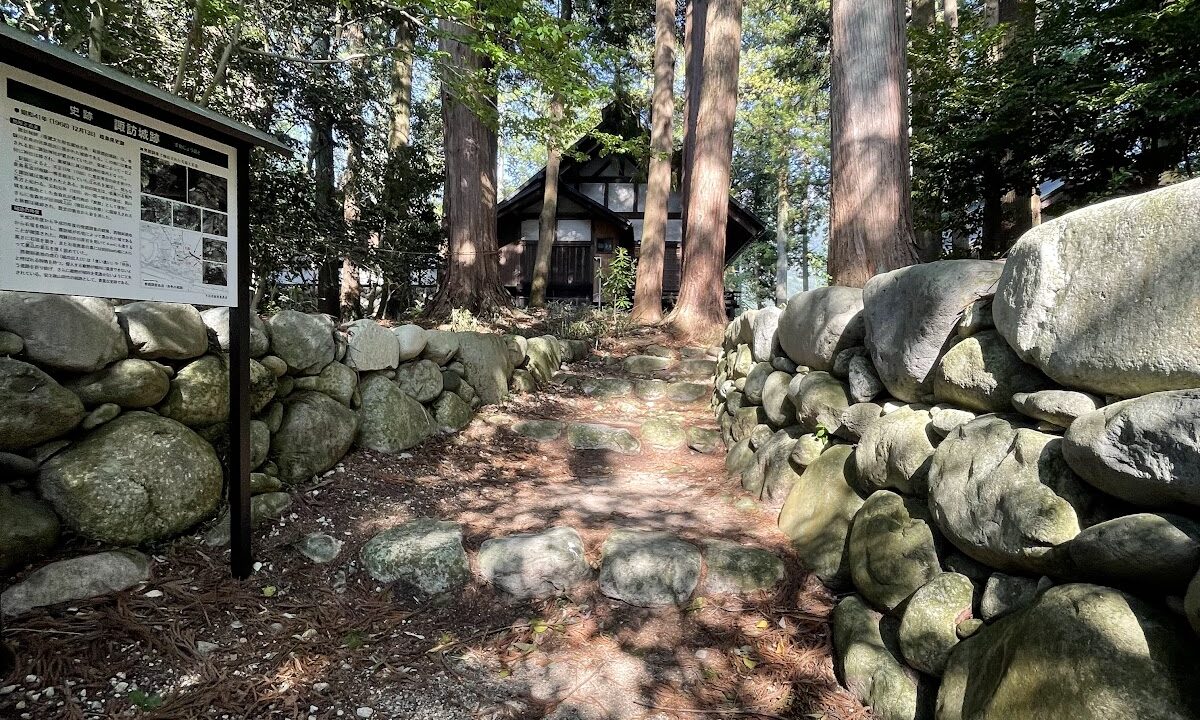
Stone Wall of the Watchtower: A stone wall remains at the site of a watchtower (yagura), which was a defensive structure of the castle. The stone wall is a defensive wall constructed by stacking stones, and is a valuable relic that reveals the castle-building techniques of the time.
Stone Wall of the Moat: Part of the stone wall of the moat that surrounded the castle remains. The moat was an important defensive structure to prevent enemy intrusion, and its stone walls still preserve its original appearance.
Earthen ramparts: Earthen ramparts, defensive walls made by piling up earth, can be seen. While older than stone walls, earthen ramparts played an important role even in flatland castles.
Stone stairs: Stone stairs, believed to have been used for movement within the castle, remain.
These remains are valued as precious cultural assets for understanding the structure of flatland castles from the late Sengoku period to the early Edo period, and were designated a Gifu Prefecture Historic Site in 1966 under the name “Suwa Castle Ruins.”
Highlights of Hagiwara Suwa Castle
Fusion of Suwa Shrine and Castle Ruins
Currently, Suwa Shrine stands on the site of the former main keep of Hagiwara Suwa Castle. You can enjoy a unique atmosphere unlike other castle ruins, exploring the remains of the former castle while walking through the shrine grounds.
Suwa Shrine remains a cherished center of local faith, offering a valuable opportunity to enjoy both worship and exploring the castle ruins. During shrine festivals, local people gather, creating a lively atmosphere befitting its historical significance.
The Atmosphere of Castle Ruins Remaining in the City
Hagiwara Suwa Castle Ruins are located in the city center of Hagiwara-cho, Gero City. The stone walls and earthworks that suddenly appear amidst the residential area tell the story of a castle that once stood here.
Even in today’s increasingly urbanized world, the preservation of such significant remains is invaluable, making it a beloved place where one can feel the history of the region firsthand. Its easy accessibility during city walks is another attractive feature.
The Landscape of the Hida River and the Castle Ruins
Hagiwara Suwa Castle is located on the left bank of the Hida River, and its relationship with the river is one of its highlights. The Hida River is a major river flowing through the Hida region and has played an important role as a transportation route since ancient times.
Looking towards the Hida River from the castle ruins, you can truly appreciate the strategic significance of why the castle was built in this location. Strolling around while imagining its function as a means of transporting supplies and as a military defensive line will deepen your understanding of history.
Observation of Stone Walls and Earthworks
The stone walls and earthworks remaining at the castle ruins are valuable resources for understanding the castle-building techniques of the time. In particular, the stonework of the watchtower ruins and the stone walls of the moat demonstrate the level of technology during the Kanamori clan era.
By observing the way the stones are stacked, their size, and their arrangement, you can understand how the castle’s defensive capabilities were enhanced and how it was built efficiently with limited resources. For castle enthusiasts and history buffs, these remains are well worth observing in detail.
Related Spots in the Surrounding Area
Sakurabora Castle Ruins
The ruins of Sakurabora Castle, which was abandoned following the construction of Hagiwara Suwa Castle, also remain in the surrounding area. Sakurabora Castle was the central castle in this region before Hagiwara Suwa Castle, and comparing the two allows us to understand the changes in the Kanamori clan’s rule over Hida.
Masujima Castle Ruins
Masujima Castle Ruins, a branch castle of the Kanamori clan that rivals Hagiwara Suwa Castle, is also a must-visit when visiting the Hida region. Located in Furukawa-cho, Hida City, Masujima Castle Ruins retains the structure of a flatland castle, similar to Hagiwara Suwa Castle, and visiting both castles allows for a deeper understanding of the Kanamori clan’s castle policy.
Takayama Castle Ruins
Takayama Castle Ruins, which served as the main castle of Kanamori Nagachika, is now maintained as Shiroyama Park. Situated on a hill overlooking Takayama city, it is a place where you can truly feel its importance as the center of Hida’s rule. Visiting it together with Hagiwara Suwa Castle will give you a comprehensive understanding of the Kanamori clan’s control over Hida.
Gero Onsen
Gero City, home to Hagiwara Suwa Castle, is famous for Gero Onsen, one of Japan’s three most renowned hot springs. Enjoying the hot springs in conjunction with exploring the castle ruins makes for a perfect blend of historical exploration and relaxation. Its relatively close proximity to the Gero Onsen hot spring resort area makes it easily accessible for sightseeing.
Access
Access by Public Transportation
Using the JR Takayama Line:
- Get off at Hida-Hagiwara Station on the JR Takayama Line, approximately 5 minutes on foot.
- Located approximately 300 meters west of the station, making it very easily accessible.
- The “Wide View Hida” limited express train is convenient from Nagoya.
- Access is also possible from Takayama by limited express or local train.
Access by Car
Via the Chuo Expressway:
- Approximately 60 minutes from Nakatsugawa IC on the Chuo Expressway via National Routes 257 and 41.
Via the Tokai-Hokuriku Expressway:
- Approximately 50 minutes from Gujo-Hachiman IC on the Tokai-Hokuriku Expressway via National Routes 256 and 41.
Parking:
- There are some parking spaces around Suwa Shrine, but they are limited due to its urban location.
- We recommend using public parking lots around Hida-Hagiwara Station.
Address/Location
Hagiwara, Hagiwara-cho, Gero City, Gifu Prefecture (within the grounds of Suwa Shrine)
Visitor Guide
Estimated Visiting Time
It is recommended to allow 30 minutes to 1 hour for a stroll around the Hagiwara Suwa Castle Ruins. We recommend taking your time to observe the remains, including a visit to Suwa Shrine.
Precautions During Visit
- As this is within the grounds of Suwa Shrine, please be considerate of other visitors.
- The stone walls and earthworks are valuable cultural assets. Please be careful not to climb on or damage them.
- As this is located in an urban area, please be mindful of the surrounding residents’ lives.
- During rainy weather, the stone steps and areas around the stone walls can become slippery, so please watch your step.
Photography
Photography of the castle ruins is generally permitted, but consideration is necessary during Suwa Shrine festivals or when there are visitors. Also, please be mindful of the privacy of surrounding residents.
Recommended Time to Visit
While Hagiwara Suwa Castle Ruins are open year-round, the following times are particularly recommended:
- Spring (April-May): The surrounding area is beautifully colored during cherry blossom season.
- Autumn (October-November): The Hida Mountains are ablaze with autumn colors, creating a magnificent landscape.
- During the Suwa Shrine Festival: A valuable opportunity to witness traditional local events.
Historical Value of Hagiwara Suwa Castle
Importance in the Study of Flatland Castles
Hagiwara Suwa Castle is a valuable example of a flatland castle that well preserves the structure of a flatland castle from the late Sengoku period to the early Edo period. Flatland castles of this period tended to prioritize their function as political and economic centers over their combat capabilities, and Hagiwara Suwa Castle exhibits this characteristic.
From the perspective of castle research, it is valued as an important historical site that shows the transitional period from mountain castles to flatland castles.
An Exception to the One Castle Per Province Decree
The fact that the “Kanamori Ryokan” continued to exist as such even after the One Castle Per Province Decree was issued is extremely rare nationwide. This fact serves as a good example showing that the Edo Shogunate’s policies were not always uniform, but were flexibly applied based on local circumstances and negotiations with daimyo.
Significance in Local History
Hagiwara Suwa Castle is an indispensable part of the history of the Kanamori clan’s rule over Hida Province. It played a part in the network of branch castles centered around Takayama Castle and functioned as a governing base for southern Hida Province.
Furthermore, its relationship with Suwa Shrine is also important for understanding the local history. The transformation of the shrine grounds from being used for a castle to being converted back into a shrine is an interesting example of the relationship between religion and politics during the transition from the Sengoku period to the Edo period.
Summary
Hagiwara Suwa Castle is the site of a branch castle of the Kanamori clan, located in Hagiwara-cho, Gero City, Gifu Prefecture. Built in 1586 by Sato Hidekata, Hagiwara Suwa Castle boasts a unique history, having survived as the Kanamori Ryokan (inn) even after the “One Castle Per Province” decree. After the Kanamori clan’s transfer in 1692, it was demolished, and Suwa Shrine was restored to its original location on the site of the main keep.
Even today, remnants such as the stone walls of the watchtower, the stone walls of the moat, the earthen embankment, and the stone steps remain, making it a valuable historical site that conveys the structure of a flatland castle from the late Sengoku period. It is designated as a Gifu Prefecture Historic Site.
Its excellent accessibility, just a 5-minute walk from JR Hida-Hagiwara Station, is also a major draw, making it easily accessible in conjunction with a visit to Gero Onsen. Located within the unique environment of the Suwa Shrine grounds, Hagiwara Suwa Castle Ruins offers a close-up experience of Hida’s history and culture, making it an attractive spot recommended not only for history buffs but also for general tourists.
When you visit the Hida region, be sure to stop by the Hagiwara Suwa Castle ruins and experience the history of the Kanamori clan’s rule over Hida, as well as the unique atmosphere of the castle ruins that underwent a distinctive transformation from a castle to an inn.