Hachioji Castle: A Complete Explanation of the History and Highlights of the Last Mountain Castle of the Sengoku Period
What is Hachioji Castle?
Hachioji Castle is a mountain castle site from the late Sengoku period, located in Moto-Hachioji-cho, Hachioji City, Tokyo. Built on Mt. Fukasawa (present-day Shiroyama), at an altitude of approximately 460m (relative height approximately 240m), it is a medieval mountain castle and is selected as one of Japan’s 100 Famous Castles. As a branch castle of Odawara Castle, the main castle of the Odawara Hojo clan, it was an important military base protecting the western part of the Kanto region.
Built by Hojo Ujiteru, the third son of Hojo Ujiyasu, it is known as a castle with a tragic history, having fallen during Toyotomi Hideyoshi’s siege of Odawara in 1590. Because it fell less than 10 years after its construction, it is easy to determine the period of the excavated remains and artifacts, making it an extremely valuable site for the study of Sengoku period mountain castles.
Currently designated as a national historic site, the Hachioji Castle ruins are maintained, allowing visitors to explore both the fortified area and the residence area. Easily accessible from central Tokyo, it’s a popular historical site where you can experience the atmosphere of a Sengoku period mountain castle.
History of Hachioji Castle
Background of Construction and Hojo Ujiteru
Hojo Ujiteru, who built Hachioji Castle, was born the third son of Hojo Ujiyasu, the third head of the Odawara Hojo clan. Initially, Ujiteru resided at Takiyama Castle (Hachioji City, Tokyo), but seeking a more robust defensive structure, he began construction of Hachioji Castle.
While there are various theories regarding the exact date of construction, the most widely accepted theory is that construction began during the Tensho era (1573-1592), and Ujiteru moved from Takiyama Castle to Hachioji Castle between 1584 (Tensho 12) and 1587 (Tensho 15). One theory suggests that construction of Hachioji Castle began around 1571.
There is a theory that the construction of Hachioji Castle was modeled after Oda Nobunaga’s Azuchi Castle. The design, which clearly separated the fortified area on the mountaintop from the residential area at the foot of the mountain, incorporated the latest castle-building techniques of the time. As the largest branch castle of the Hojo clan, it was expected to become an important base for controlling the Kanto region.
The Siege of Odawara and the Fall of Hachioji Castle
In 1590, Toyotomi Hideyoshi began his siege of Odawara. At this time, the castle lord, Hojo Ujiteru, was holed up in Odawara Castle, leaving only a few retainers such as Yokochi Kenmotsu, Hazama Zenchu, and Nakayama Kageyuzaemon Ienori, along with approximately 3,000 people including farmers, women, and children, at Hachioji Castle.
On June 23rd of the same year, a large army of approximately 15,000 Toyotomi troops, led by Maeda Toshiie and Uesugi Kagekatsu, attacked Hachioji Castle. Due to the overwhelming difference in military strength, Hachioji Castle fell in just one day. The soldiers defending the castle were killed in battle, and a tragic legend remains that many women and children threw themselves into the Goshuden Falls (present-day Goshuden Falls).
News of this fall reached Odawara Castle, significantly lowering the morale of the Hojo clan. Approximately one month after the fall of Hachioji Castle, Odawara Castle also surrendered, marking the end of the Hojo clan as a Sengoku-period daimyo.
Hachioji Castle After its Fall
After its fall, Hachioji Castle was abandoned and never used as a military facility again. Even after Tokugawa Ieyasu entered the Kanto region, the Hachioji Castle ruins were left untouched and returned to nature.
Throughout the Edo period, the Hachioji Castle ruins remained in the memories of the local people, and from the Meiji era onward, they became a subject of historical research. In 1951, it was designated a national historic site, and continuous archaeological excavations and restoration work have been carried out since then.
Since the Heisei era began, comprehensive investigations and restoration work have been carried out, and currently, the stone walls of the main palace site and the drawbridge have been restored, allowing visitors to imagine its former appearance. In 2006, it was selected as one of Japan’s Top 100 Castles, and it has become a popular spot for history and castle enthusiasts.
Structure and Characteristics of Hachioji Castle
Fortified Area (Main Castle Area)
The Fortified Area is the core of Hachioji Castle, located on the summit of Mt. Fukasawa at an altitude of approximately 460m. Several enclosures (kuruwa) are arranged around the main keep (Honmaru), including the Matsuki Kuruwa, Komiya Kuruwa, and Taiko Kuruwa.
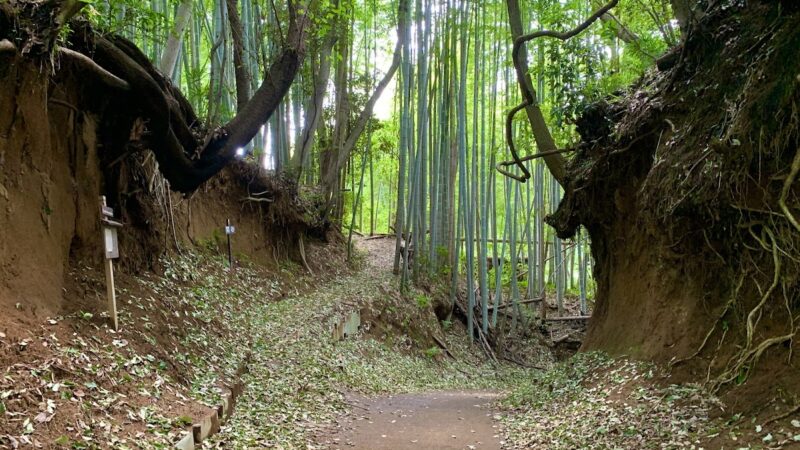
The main keep is located at the highest point of the mountaintop and is surrounded by earthen ramparts. From here, one can see a panoramic view of the Kanto Plain, making it an ideal location for military surveillance. The path leading to the main keep is lined with defensive structures such as vertical moats (tatebori) and steep slopes (kirigishi), demonstrating ingenuity to make enemy intrusion difficult. The hiking trail to the fortified area is still well-maintained, and it takes approximately 40-50 minutes to reach the main keep. Along the way, you can experience the defensive structure of a Sengoku period mountain castle and see remains such as baileys and moats. However, the trail has some steep sections, so appropriate equipment and physical fitness are necessary.
Residence Area (Site of the Main Palace)
The residence area is located at the foot of the mountain and was the site of the residence and administrative facilities of the castle lord, Hojo Ujiteru. At its center is the site of the main palace, where the remains of a vast residence surrounded by stone walls remain.
Excavations at the main palace site have uncovered foundation stone building remains, garden remains, stone walls, and stone pavements. In particular, the drawbridge that spanned the entrance has been restored, recreating its appearance at the time. The gate has also been restored, allowing visitors to experience the atmosphere of the residence in its heyday.
It is believed that the residences of retainers and warehouses were located around the main palace site. Excavations have unearthed numerous ceramics, roof tiles, and metal artifacts, which are now on display at the Hachioji Castle Ruins Guidance Facility.
A steep slope separates the residential area from the fortified area, exhibiting a typical medieval mountain castle structure where the lord lived in the residential area during peacetime and retreated to the fortified area during wartime.
Defensive Structures and Layout
Hachioji Castle’s defensive system is characterized by its skillful layout (design), which makes maximum use of the mountain castle’s terrain. The main defensive structures include the following:
Vertical Moats: These moats dug vertically into the slope prevented lateral movement of the enemy and limited their attack routes. Multiple vertical moats have been identified at Hachioji Castle, forming an important defensive line that blocked the ridgeline.
Dry Cuts: These moats cut horizontally across the ridgeline, effectively hindering enemy advances. Multiple dry cuts are found along the approach to the fortified area.
Cut Slopes: These are artificially carved steep slopes, defensive structures designed to make climbing difficult. At Hachioji Castle, cut slopes several meters high were constructed around each enclosure.
Earthworks: These are earthen walls that surrounded the enclosures, enhancing their defensive capabilities. Traces of earthworks still remain around the main keep and various enclosures.
Stone Walls: At the site of the lord’s residence, stone walls using the nozura-zumi (rough-stone masonry) technique were employed. This was the latest technology of the time, demonstrating the Hojo clan’s wealth and technical prowess.
By combining these defensive structures, Hachioji Castle functioned as an impregnable fortress. However, even these defenses were insufficient against the overwhelming military strength of the Toyotomi forces.
Relationship between Hachioji Castle and Azuchi Castle
There is a theory that Hachioji Castle was built with reference to Azuchi Castle, built by Oda Nobunaga. This is because the design philosophy of clearly separating the military facilities on the mountaintop (fortified area) from the residential facilities at the foot of the mountain (residential area) is shared with Azuchi Castle.
Azuchi Castle, completed in 1579, had an innovative structure with the keep and main enclosure located on the mountaintop, and the residences and vassal houses at the foot of the mountain. It is believed that Hojo Ujiteru adopted this cutting-edge castle design and applied it to Hachioji Castle.
Furthermore, the use of stone walls is also thought to be influenced by Azuchi Castle. While the use of stone walls was limited in previous Hojo castles, the main hall site of Hachioji Castle features full-scale stone walls, which may have been influenced by Oda-style castles, including Azuchi Castle.
However, Hachioji Castle basically follows the tradition of medieval mountain castles and is positioned as a transitional castle towards early modern castles. It lacks a magnificent keep like Azuchi Castle, and its design prioritizes its function as a mountain castle.
Highlights of Hachioji Castle
Hachioji Castle Ruins Guidance Facility
It is recommended to begin your visit to the Hachioji Castle Ruins Guidance Facility. This facility, established in 2006, provides detailed information about the history and structure of Hachioji Castle.
The facility includes a reconstructed model of Hachioji Castle, artifacts unearthed during excavations (ceramics, roof tiles, weapons, etc.), and panel displays. The reconstructed model, in particular, is helpful in understanding the overall structure of Hachioji Castle in its heyday. Video displays also provide easy-to-understand explanations of the castle’s history and its fall.
The guidance facility also offers guided tours by volunteer guides (advance reservations required). Guides with specialized knowledge will provide a deeper understanding of Hachioji Castle.
The facility is open from 9:00 to 17:00 (April to October) and from 9:00 to 16:30 (November to March). It is closed on Mondays (or the following day if Monday is a public holiday) and during the New Year holidays. Admission is free.
The Site of the Main Palace and the Drawbridge
The site of the Main Palace is the heart of the Hachioji Castle’s residential area and one of the most impressive remains. It is located about a 15-minute walk from the guidance facility.
The restored drawbridge is a wooden bridge that spanned the entrance to the Main Palace. It was designed to be raised to prevent enemy intrusion. The current drawbridge was restored based on the results of archaeological excavations and faithfully reproduces its original appearance.
Crossing the drawbridge leads to the grounds of the Main Palace, surrounded by stone walls. Here, the foundation stones of the Main Palace building and the remains of the garden can be found. Archaeological excavations have also confirmed the remains of buildings such as a meeting hall (a facility for entertaining guests), a kitchen, and a warehouse, allowing us to imagine Hojo Ujiteru conducting his duties and receiving his retainers and guests here.
The stone walls of the former main palace site are built using the Nozura-zumi technique, possessing a simple beauty that utilizes natural stones. Parts are preserved in their excavation state, while others have been restored. An explanatory sign is placed in front of the stone walls, where visitors can learn about the results of the excavation and the restoration process.
Goshuden Waterfall
Near the main palace site is a waterfall called Goshuden Waterfall. This waterfall is known for the tragic legend that many women and children threw themselves into it during the fall of Hachioji Castle.
In reality, there is no historical evidence that all the women and children inside the castle threw themselves into the waterfall, and it is considered highly likely that this is a legend created in later times. However, it is a fact that many non-combatants were killed during the fall of the castle, and this waterfall is a place of remembrance symbolizing the tragedy of Hachioji Castle.
The area around the waterfall is well-maintained, and it is possible to approach the base of the falls. While the water volume varies with the seasons, the waterfall, nestled in a quiet forest, exudes a mystical atmosphere.
Every year on June 23rd (the day the castle fell), a memorial service is held at the Hachioji Castle ruins to comfort the souls of those who died in the castle’s fall.
Ascent to the Main Keep Ruins
To reach the main keep ruins in the fortified area, you ascend a mountain trail from the site of the lord’s residence. The climb from the trailhead to the main keep takes approximately 40-50 minutes, covering an elevation difference of about 240 meters.
While the trail is well-maintained, there are steep sections and rocky areas, so it is recommended to wear appropriate footwear such as trekking shoes. Particular caution is needed during and after rain, as the trail can be slippery.
Along the trail, there are points of interest such as Hachioji Shrine, Kaneko Kuruwa, and Matsuki Kuruwa. You can also see defensive structures such as vertical moats and trenches, allowing you to experience the structure of a Sengoku period mountain castle firsthand.
The main keep ruins are located at the summit and are a flat area surrounded by earthen ramparts. The view from the main keep is magnificent; on a clear day, you can see the entire Kanto Plain. Standing here, you can truly appreciate the strategic importance of this location and why the castle was built here.
A stone monument stands at the site of the main keep, allowing you to reflect on the history of Hachioji Castle. Furthermore, the remains of other enclosures, such as the Komiya-kuruwa and Taiko-kuruwa, are also preserved nearby, and if you have time, we recommend visiting these as well.
Other Points of Interest
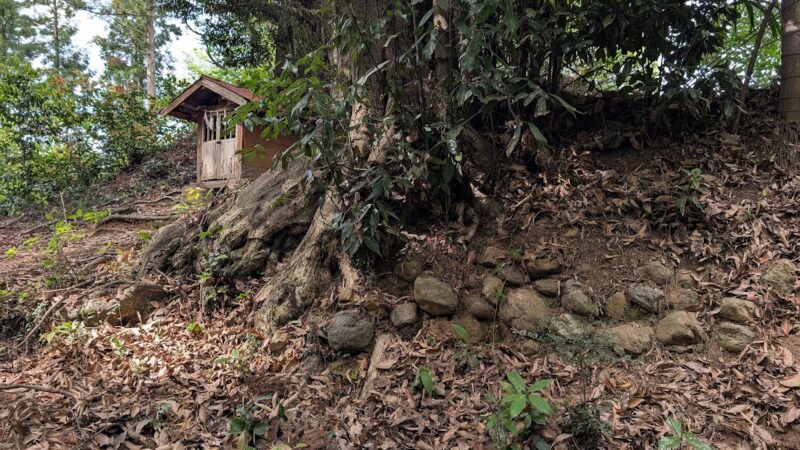
Hachioji Shrine: A shrine located along the path to the main keep, dedicated to Gozu Tenno and eight princes. It is said to be the origin of the place name Hachioji, and it is believed that Hojo Ujiteru also worshipped here.
Main Gate Site: The formal entrance to the residential area, where remnants of stone walls and earthworks remain.
Rear Gate: The castle’s back entrance, also used as an escape route in emergencies.
Main Castle: The final defensive stronghold located further beyond the main keep, serving as the last bastion during a siege. By visiting these ruins, you can gain a deeper understanding of the overall structure of Hachioji Castle and the structure of mountain castles during the Sengoku period. ## Access and Visiting Information for Hachioji Castle
Transportation Access
Access by Train and Bus:
- Take a Nishi-Tokyo Bus from the North Exit of Takao Station on the JR Chuo Line or Keio Line.
- Take a bus bound for “Takao no Mori Wakuwaku Village,” “Hoshōji Danchi,” “Ongata Terminal,” “Ōkubo,” “Green Town Takao,” or “Miyama-chō.”
- Get off at the “Reien-mae” bus stop or the “Hachioji Castle Ruins Entrance” bus stop, then walk for approximately 15-20 minutes.
- Buses run only 1-2 times per hour, so it is recommended to check the timetable in advance.
Access by Car:
- Approximately 20 minutes from Hachioji IC on the Chuo Expressway.
- Approximately 30 minutes from Akiruno IC on the Ken-Ō Expressway.
- Free parking available (approximately 40 spaces).
- Parking can be crowded on weekends and holidays, so early arrival is recommended.
Visiting Information
Hachioji Castle Ruins Guidance Facility:
- Opening Hours: 9:00 AM – 5:00 PM (April – October), 9:00 AM – 4:30 PM (November – March)
- Closed: Mondays (or the following day if Monday is a public holiday), New Year’s holidays (December 29th – January 3rd)
- Admission Fee: Free
- Address: 3-2664-2 Moto-Hachioji-cho, Hachioji City, Tokyo
Visiting the Castle Ruins:
- Free admission
- The residence area (site of the main palace) is open year-round
- Climbing to the fortified area (site of the main keep) requires physical fitness and appropriate equipment
- Estimated Time: 1-2 hours for the residence area only, 3-4 hours if climbing to the main keep
Notes for Visitors
Clothing and Equipment:
- Wear trekking shoes or athletic shoes if planning to climb to the main keep
- Bring drinking water, a towel, a hat, etc.
- Insect repellent is useful in summer
- Don’t forget to take precautions against the cold in winter.
Safety Considerations:
- The hiking trail has steep slopes and rocky areas, so watch your step.
- It can be slippery in rainy weather or after rain, so don’t push yourself too hard.
- Avoid hiking alone; it’s recommended to hike in groups.
- Plan to descend before sunset.
Manners:
- Respect the historical site and do not damage the remains.
- Always take your trash with you.
- Collecting plants and animals is prohibited.
- Using fire is strictly prohibited.
Tourist Spots Around Hachioji Castle
Mount Takao
Mount Takao, located about 15 minutes by car from the Hachioji Castle ruins, is a popular tourist destination visited by approximately 3 million people annually. It’s a mountain with an elevation of 599m, and you can easily reach the top using the cable car or chairlift. From the summit, you can enjoy views of Mount Fuji and the Kanto Plain.
Mount Takao is home to the ancient temple Yakuoin, which is also popular as a power spot. There are also several hiking trails, allowing you to enjoy nature walks.
Takao 599 Museum
This museum allows you to learn about the nature and history of Mount Takao. It features exhibits of flora and fauna inhabiting Mount Takao, as well as video displays showcasing the four seasons of Mount Takao. Admission is free, making it ideal for a visit before or after hiking Mount Takao.
Yuuyake Koyake Fureai no Sato
This nature experience facility is located about 20 minutes by car from the Hachioji Castle ruins. Built in the hometown of Nakamura Uko, the lyricist of the children’s song “Yuuyake Koyake,” it offers opportunities to interact with animals, enjoy nature walks, and camp.
Takiyama Castle Ruins
These are the ruins of the castle that Hojo Ujiteru used as his residence before building Hachioji Castle. Located about 20 minutes by car from the Hachioji Castle ruins, it is also designated as a national historic site. It is one of the Continued Top 100 Japanese Castles, and the remains of the medieval castle are well-preserved.
Visiting both Hachioji Castle and Takiyama Castle allows you to understand the changes in Hojo Ujiteru’s castle management. ## Recommended Itinerary for Visiting Hachioji Castle
Half-Day Course (Focusing on the Residence Area)
Duration: Approximately 2-3 Hours
- Learn about the history at the Hachioji Castle Ruins Guidance Facility (30 minutes)
- Visit the Main Palace Ruins and the Drawbridge (40 minutes)
- Visit the Main Palace Waterfall (20 minutes)
- Explore surrounding ruins such as the Main Gate Ruins (30 minutes)
- Return to the Guidance Facility and review the exhibits again (20 minutes)
This course is recommended for those who are not confident in their physical stamina or have limited time. You can fully experience the charm of Hachioji Castle even by visiting just the residence area.
One-Day Course (Including Climb to the Main Keep)
Duration: Approximately 4-5 hours
- Learn about the history at the Hachioji Castle Ruins Guidance Facility (30 minutes)
- Visit the Main Palace Ruins and the Drawbridge (40 minutes)
- Begin the climb to the Main Keep (approximately 50 minutes uphill)
- Visit the Main Keep Ruins, Hachioji Shrine, and various baileys (40 minutes)
- Descend the mountain (approximately 40 minutes)
- Visit the Main Palace Waterfall (20 minutes)
- Rest and view exhibits at the Guidance Facility (30 minutes)
This course is recommended for those confident in their physical fitness and who want to fully explore Hachioji Castle. You can enjoy the view from the Main Keep and experience the structure of a mountain castle firsthand.
Historical Exploration Course (Including Takiyama Castle Ruins)
Duration: 1 day (including travel time)
Morning: Visit Takiyama Castle Ruins (2-3 hours)
Lunch: Meal in Hachioji City
Afternoon: Visit Hachioji Castle Ruins (2-3 hours)
This course allows you to understand the changes in Hojo Ujiteru’s castle management by visiting his two castles. It is especially recommended for history and castle enthusiasts.
Summary
Hachioji Castle is an extremely important historical and academic site as a mountain castle from the late Sengoku period. Built by Hojo Ujiteru, it was one of the leading mountain castles in the Kanto region and has a tragic history of falling during Toyotomi Hideyoshi’s Odawara campaign.
There are many points of interest, including its structure divided into a fortified area and a residential area, the remains of stone walls and drawbridges, and the view from the main keep. It is easily accessible from central Tokyo and is a valuable historical site that can be visited on a day trip.
Visiting the Hachioji Castle ruins allows you to experience firsthand the structure of a mountain castle from the Sengoku period and feel the rise and fall of the Hojo clan. It’s a recommended spot for many, including history buffs, castle enthusiasts, and hiking lovers.
At the Hachioji Castle Ruins Guidance Facility, you can receive detailed explanations, and volunteer guide services are also available. First-time visitors should definitely take advantage of these services to gain a deeper understanding of Hachioji Castle’s charm.
The Hachioji Castle ruins display different expressions throughout the seasons: the fresh green of spring, the deep green of summer, the vibrant autumn leaves, and the tranquility of winter. It’s a profound historical site where you can discover something new with every visit. Located within Tokyo, yet offering a glimpse into the spirit of the Sengoku period, it’s a precious place you should definitely visit.