A Thorough Explanation of the History and Remains of Funaokayama Castle – From the Western Army’s Base in the Ōnin War to the Present Day
Funaokayama Castle, located in Murasakino, Kita-ku, Kyoto City, is a mountain castle that played a crucial role in the Ōnin War, a major turning point in Japanese history. Built on a small hill 112 meters above sea level, this castle existed for only a short period of one year, but it had a significant impact on the place names and history of Kyoto that followed. This article provides a detailed explanation of this legendary castle, from its historical background to its existing remains and a visitor’s guide.
What is Funaokayama Castle? – Basic Information and Overview
Funaokayama Castle is a mountain castle built on Funaokayama in 1467 (Ōnin 1) as a camp for the Western Army during the Ōnin War. It is located in Murasakino Funaoka-chō, Kita-ku, Kyoto City, Kyoto Prefecture, and is now maintained as Funaokayama Park.
The Geographical Importance of Funaokayama
Funaokayama has held special significance since the construction of Heian-kyō (Kyoto). Based on the principles of Feng Shui, Funayama Hill was positioned as the “Black Tortoise” mountain, the guardian of the north, and was a strategically important location offering a panoramic view of the Kyoto Basin. Although a relatively low hill at 112 meters above sea level, its protruding topography from the surrounding plains provided ideal conditions for a military base.
From Funayama Hill, one could see a wide expanse of Kyoto city, and it was particularly well-positioned for monitoring the Imperial Palace to the south and the east-west roads. This geographical advantage was the primary reason the Western Army built a castle here during the Ōnin War.
The Ōnin War and the Construction of Funayama Castle
The Outbreak of the Ōnin War and the Western Army’s Strategy
The Ōnin War, which began in 1467 (Ōnin 1), was a major conflict in which the succession problem of the shogun of the Muromachi shogunate and the succession disputes within the Kanrei (deputy shogun) families were intricately intertwined. The Western Army’s commander-in-chief was Yamana Sōzen (Mochitoyo), and the Eastern Army’s commander-in-chief was Hosokawa Katsumoto. A fierce battle unfolded in Kyoto.
The Western Army decided to build a castle on Funayama Hill to strengthen its defenses north of Kyoto. Yamana Sōzen was deeply involved in this construction, and figures such as Yamana Noriyuki, the governor of Bizen Province, and Isshiki Yoshinao, the governor of Tango Province, took refuge in the castle. Ōuchi Masahiro also joined the Western Army and is said to have contributed to the construction and defense of Funayama Castle.
Structure and Scale of Funayama Castle
Funayama Castle had a strong character as a temporary encampment, hastily constructed as a temporary military base rather than a permanent castle. A moat was dug on the mountainside, and earthen ramparts were built outside the moat. Even today, traces of the moat can be seen, mainly on the northern mountainside, allowing us to see some of the defensive structures from that time.
The castle’s structure was relatively simple, likely following the typical form of a medieval mountain castle with the main enclosure at the summit and multiple baileys arranged on the mountainside. The remaining moats were important defensive structures designed to prevent flanking attacks.
The Fall and Abandonment of Funayama Castle
Attack and Fall of the Eastern Army
In 1468 (Ōnin 2), the year after Funayama Castle was built, the Eastern Army, led by Hosokawa Katsumoto, attacked the castle. The Eastern Army used fire tactics, and after fierce fighting, the castle fell. Records indicate that over fifty men, including the defending commander Kogamo Akinokami, were killed in this battle.
The fighting during the castle’s fall was extremely fierce, and Funayama was engulfed in flames. This battle was a crucial turning point in the Ōnin War and a major blow to the Western Army.
Reasons for the Castle’s Abandonment
Interestingly, Funayama Castle was never reused after being captured by the Eastern Army. Neither the Eastern nor Western Army used the castle as a military base after its fall, so Funayama Castle ceased to exist and was abandoned after just over a year.
Several reasons can be considered for this. Firstly, the castle’s facilities were severely damaged by fierce fighting and fire attacks. Secondly, the strategic importance of Funayama relatively decreased due to changes in the battle lines. Thirdly, its value as a permanent base was limited because it was a hastily constructed, simple structure built as a temporary encampment.
Origin of the Place Name “Nishijin”
Funayama Castle and its surroundings were the location where the Western Army established its encampment during the Ōnin War. The Western Army used Funayama Castle as the center of their encampment and extensively utilized this area. Therefore, after the war, this region came to be called “Nishijin.”
Even today, the area stretching from Kita Ward to Kamigyo Ward in Kyoto City is known as “Nishijin” and is famous as a production center for traditional Nishijin weaving. Although Funayama Castle was short-lived, its existence has been passed down to the present day in the form of a place name.
Remains and Highlights of Funayama Castle
Existing Remains
The remains of Funayama Castle have been significantly altered by the development of a park and the construction of Kenkun Shrine since the Meiji era, but traces of the medieval mountain castle can still be seen.
Horizontal Moat
The most clearly remaining structure is the horizontal moat that runs along the northern slope of the mountain. This moat was dug across the ridge and served to prevent enemy flank movement and form a defensive line. The depth of the moat varies depending on the location, but in some places, a clear moat bottom and earthworks can be seen.
Earthworks
Earthworks are piled up on the outside (mountain side) of the horizontal moat. This earthen embankment was constructed using the excavated soil from digging the moat and served as a defensive wall.
Remains of Enclosures
Several flat areas can be seen on the mountaintop and slopes, and these are thought to be the remains of enclosures. However, many parts no longer retain their original form due to later alterations.
Development as Funayama Park
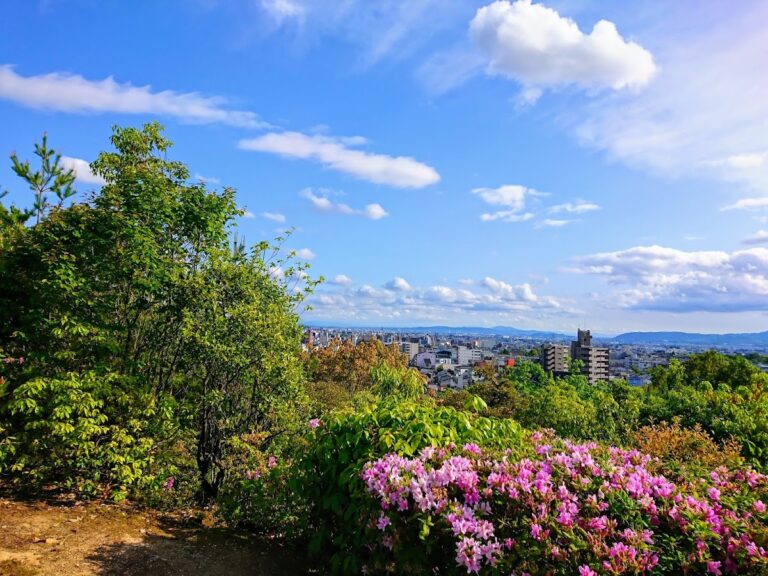
Currently, the Funayama Castle ruins have been developed into Funayama Park, a place of relaxation for citizens. Walking paths have been built within the park, and it is also known as a famous cherry blossom viewing spot in spring. From the mountaintop, you can enjoy a panoramic view of Kyoto city, allowing you to imagine the scenery seen by the former castle lords.
While the atmosphere of the castle has diminished due to the park’s development, if you step off the walking paths and carefully observe the slopes, you can discover castle remains such as moats and earthen embankments. For castle enthusiasts, there is the pleasure of searching for traces of the medieval period hidden within the urban park.
The Relationship Between Takeisao Shrine and Oda Nobunaga
Founding of Takeisao Shrine
In 1869 (Meiji 2), Takeisao Shrine (also known as Kenkun Shrine) was founded on Funaoka Hill, enshrining Oda Nobunaga as its principal deity. This was done by imperial decree of Emperor Meiji, and its purpose was to commemorate Nobunaga’s achievements.
Initially, it was planned to be built in a different location within Kyoto City, but Funaoka Hill was ultimately chosen. It is said that Nobunaga, during his lifetime, had a plan to build a new capital in Kyoto, with Funaoka Hill as its center. This tradition became one of the justifications for building a shrine dedicated to Nobunaga on Funaoka Hill.
The Relationship Between Funaoka Hill and Nobunaga
While the direct relationship between Oda Nobunaga and Funaoka Hill is not clearly documented in historical records, it is highly probable that Nobunaga recognized the historical and geographical importance of this area as he expanded his control over Kyoto.
The grounds of Kenkun Shrine occupy the summit of Funayama Hill, and climbing the approach leads to the shrine dedicated to Nobunaga. The view from the shrine is magnificent, offering a wide panorama of Kyoto city.
History of Funayama Hill after Funayama Castle
Use during the Eisho War
Even after being abandoned as a castle during the Onin War, Funayama Hill was frequently used as a military base due to its strategic location. In 1511 (Eisho 8), during the struggle for power within the Muromachi Shogunate, Hosokawa Sumimoto and Hosokawa Masakane established their camps on Funayama Hill.
Thus, Funayama Hill was repeatedly used not as a permanent castle, but as a temporary encampment during wartime. This demonstrates that its geographical conditions maintained its military value across generations.
From the Edo Period Onward
In the Edo period, Funayama Hill completely ceased its role as a military base and became a place of worship and scenic beauty. Several shrines and stone monuments were erected on the mountain, attracting the faith of the people of Kyoto.
After the Meiji era, as mentioned above, Kenkun Shrine was founded, and further development into a park resulted in its current form.
Access and Visiting Guide to Funaokayama Castle
Access Methods
Using Public Transportation
- Get off at “Kenkun Shrine-mae” bus stop (Kyoto City Bus), approximately 5 minutes on foot.
- Get off at “Funaokayama” bus stop (Kyoto City Bus), approximately 7 minutes on foot.
- Approximately 20 minutes on foot from Kitaoji Station (Kyoto Municipal Subway Karasuma Line), or transfer to a bus.
From Kyoto Station, City Bus routes 205 or 206 are convenient. The journey takes approximately 30 minutes.
Using a Car
Funaokayama Park does not have its own parking lot. We recommend using nearby coin-operated parking lots or public transportation. Kenkun Shrine has a small parking space for visitors, but the number of spaces is limited, and it may not be available during New Year’s visits or festivals.
Points to Note When Visiting
Regarding Viewing the Ruins
When viewing the ruins, such as the moat, you will need to leave the park’s walking paths. Since some areas have uneven ground, we recommend wearing comfortable walking shoes such as athletic shoes. Also, be careful as the ground can become slippery after rain.
The ruins are buried in nature, and from spring to summer, the vegetation grows thick, making them difficult to see. Late autumn to winter is the best time to observe the ruins.
Visiting Kenkun Shrine
Kenkun Shrine is open year-round. The shrine office is usually open from 9:00 AM to around 5:00 PM. Every year on October 19th, the “Funaoka Grand Festival” is held, commemorating the virtues of Nobunaga.
Estimated Time Required for Visiting
If you plan to stroll through Funaokayama Park, visit Kenkun Shrine, and observe the ruins, allow approximately 1 to 1.5 hours. A simple stroll through the park takes about 30 minutes.
Nearby Tourist Attractions
There are many historical sights around the Funayama Castle ruins.
Imamiya Shrine
Located about a 10-minute walk from Funayama, Imamiya Shrine is an ancient shrine founded in the Heian period and is known as the shrine associated with Keishoin, the origin of the phrase “tama no koshi” (marrying into wealth). The “aburi mochi” (grilled rice cakes) sold along the approach to the shrine are also a local specialty.
Daitoku-ji Temple
Located about a 15-minute walk north from Funayama, Daitoku-ji Temple is the head temple of the Rinzai sect’s Daitoku-ji branch. It boasts numerous sub-temples and is famous for its association with Sen no Rikyu.
Kinkaku-ji Temple (Rokuon-ji Temple)
Located about 2 kilometers west of Funayama, Kinkaku-ji Temple is one of Kyoto’s most representative tourist attractions. It is easily accessible by bus.
Kyoto Gyoen
Located about 2 kilometers south of Funaokayama, Kyoto Gyoen, the former Imperial Palace site that was once overseen by Funaokayama Castle, is also worth a visit.
Historical Significance of Funaokayama Castle
Role in the Ōnin War
Funaokayama Castle was a crucial military base during the Ōnin War, a period of transition from the medieval to the early modern era in Japan. Although it existed for only a little over a year, it functioned as a key point in the Western Army’s northern defense, and its battles influenced the course of the war.
After its fall, the Western Army lost its advantage north of Kyoto, and the war became prolonged and stagnant. The existence and fall of Funaokayama Castle are important elements in understanding the course of the Ōnin War.
Value in Medieval Mountain Castle Research
Funaokayama Castle is also valuable in castle research as a typical example of a medieval encampment. It is important as an example showing the structure and operation of a temporary military facility hastily constructed during wartime, rather than a permanent residence.
As one of the few remaining medieval mountain castle ruins in an urban area, it is a valuable historical site that allows us to experience the turmoil of that time firsthand.
The Significance of Visiting Funayama Castle
Today, Funayama is a peaceful park enjoyed by citizens. However, beneath it lies the memory of the turbulent era of the Ōnin War. As we trace the remains of the moat and gaze upon Kyoto city from the mountaintop, we are seeing the same view as the castle’s lords of over 550 years ago.
Funayama Castle is a precious place where you can experience the Ōnin War, a major turning point in Japanese history. Although it was a phantom castle that disappeared in just one year, its historical significance is immense. When you visit Kyoto, be sure to extend your trip and explore the traces of this little-known mountain castle.
The medieval ruins quietly remaining within the urban park evoke a sense of the layered nature of history. You will discover another side of Kyoto’s history, distinct from the famous tourist spots like Kinkaku-ji and Kiyomizu-dera.
Summary
Funaokayama Castle was a short-lived mountain castle built by the Western Army in 1467 and captured by the Eastern Army the following year. However, its existence remains in the place name “Nishijin,” commemorating a crucial turning point in Japanese history: the Onin War.
Currently, the site is maintained as Funaokayama Park, with remnants such as moats remaining on the mountainside. At the summit stands Kenkun Shrine, dedicated to Oda Nobunaga, offering panoramic views of Kyoto city.
Access is relatively easy, making it a convenient place to visit in conjunction with other Kyoto attractions. With its unique atmosphere where the remains of a medieval mountain castle coexist with an urban park, Funaokayama Castle ruins are a recommended spot not only for history buffs but for all visitors to Kyoto.