
Complete Guide to Fukui Castle Ruins | The Famous 680,000-Koku Castle Built by Yuki Hideyasu and its Remaining Historical Heritage
Located in the heart of Fukui City, just a 3-minute walk from Fukui Station, Fukui Castle Ruins is one of the most famous castles in the Hokuriku region, built in 1606 by Yuki Hideyasu, the second son of Tokugawa Ieyasu and the first lord of the Fukui Domain. This castle, which served as the stage for the prosperity of the Echizen Matsudaira family for approximately 270 years, now boasts a rare example of history and modernity coexisting, with the Fukui Prefectural Government and Prefectural Police Headquarters standing on its site.
History of Fukui Castle | Built by Yuki Hideyasu, the Second Son of Tokugawa Ieyasu
Yuki Hideyasu and the Circumstances of Fukui Castle’s Construction
Yuki Hideyasu was a warrior with an unusual background, born as the second son of Tokugawa Ieyasu, but adopted by Toyotomi Hideyoshi, and later inheriting the Yuki family. In 1601, after the Battle of Sekigahara, Ieyasu granted Hideyasu Kitano-sho in Echizen Province with a domain of 680,000 koku, entrusting him with a strategic location in the Hokuriku region.
Hideyasu began renovating the castle in 1601 and completed its full construction in 1606. Various daimyo of the Hokuriku region were ordered to assist in the construction, and surrounding daimyo, including the Maeda family of Kaga, participated in the project. The domain’s 680,000 koku was the second largest in Japan at the time, after the Kaga Domain, and a magnificent castle befitting its grandeur was constructed.
From Kitano-sho to Fukui | The Origin of the Place Name: “Fuku-no-i”
Originally called “Kitano-sho,” this area was renamed “Fukui” and then “Fukui” during the time of the second lord, Matsudaira Tadanao, because the character “Kita” (north) was considered unlucky as it sounded like “defeat.”
A well called “Fuku-no-i” (Fortune Well) still remains at the base of the castle keep, and it is said that this well is the origin of the name Fukui. Fuku-no-i is an important water source within the castle grounds and is carefully preserved as a symbol of the city’s identity.
The Magnificent Appearance at the Time of Construction | A 37-meter-tall, Four-Story, Five-Tiered Castle Keep
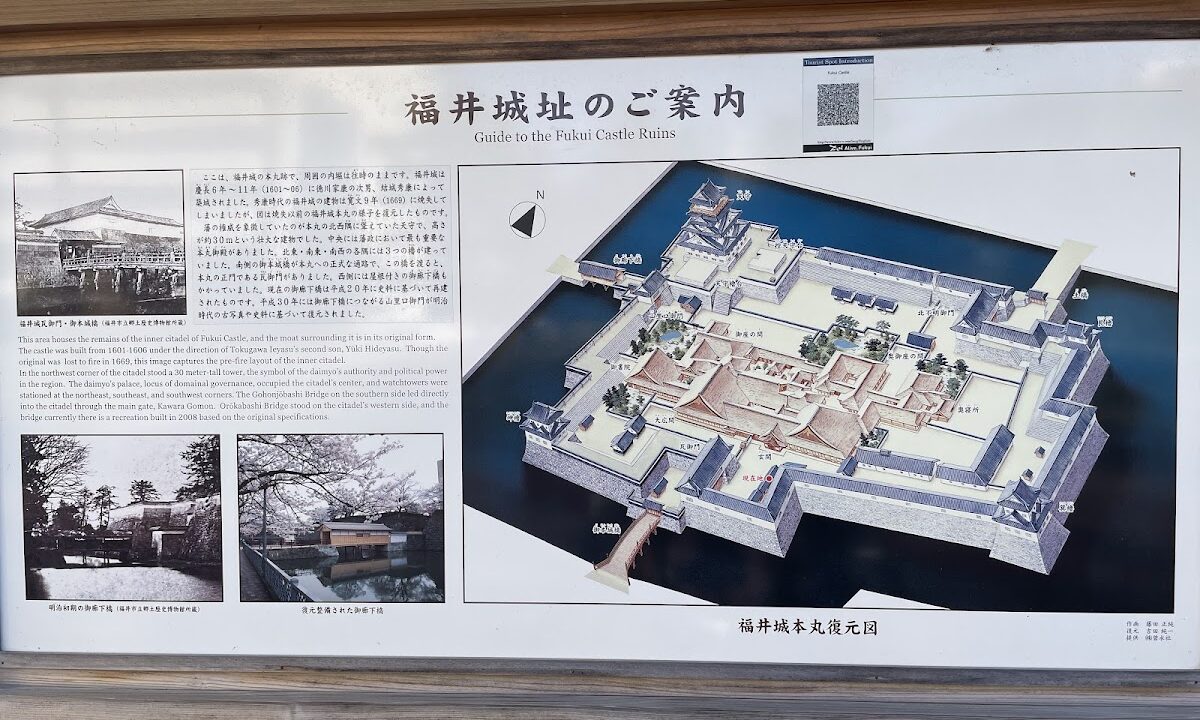
At the time of its construction, Fukui Castle was a magnificent castle boasting a 37-meter-tall, four-story, five-tiered castle keep. The main keep was surrounded by the second and third baileys, creating a vast castle complex covering approximately 480,000 square meters.
The castle keep was destroyed in a great fire in 1669 and was never rebuilt. However, defensive structures such as stone walls, moats, and turrets were maintained, and the castle continued to function as the residence of 17 generations of the Echizen Matsudaira family for approximately 270 years.
Highlights of Fukui Castle Ruins | Shakudani Stone Walls and Historical Remains
Magnificent Stone Walls Built with Shakudani Stone
The greatest highlight of Fukui Castle Ruins is the stone walls built with Shakudani stone, quarried from Mt. Asuwa near the castle town. Shakudani stone is a bluish-green tuff unique to Fukui, characterized by its ease of processing and beautiful color.
The remaining stone walls of the main keep are approximately 4.5m high and extend for approximately 600m, demonstrating the high level of technology at the time of construction. In particular, the transitional techniques from “nozurazumi” (rough-stone masonry) to “uchikomi-tsugi” (fitted stone masonry) can be seen, making it a fascinating remains for stone wall enthusiasts.
Some parts of the stone walls bear markings, allowing us to confirm the traces of the various daimyo who participated in the castle’s construction. These markings are attracting attention as valuable historical materials that reveal the reality of the system of daimyo assisting in the castle’s construction.
Castle Tower Base and “Fuku-no-i” Well
The castle tower base remains in excellent condition at the site of the main keep. Climbing to the base, one can imagine the former appearance of the 37-meter-tall castle tower. Currently, it has been developed as an observation space, offering a superb view of Fukui city.
Next to the castle tower base is the aforementioned “Fuku-no-i” well. Archaeological excavations have revealed that a hole just wide enough for one person to pass through, constructed of cut stones, extended from this well to another well discovered below the castle tower base. This is believed to have been a secret water source route during sieges.
Gohonjo Bridge and Inner Moat
The “Gohonjo Bridge” spans the entrance to the main keep. While the current bridge is a reconstruction, it is an important structure that evokes the former path to the castle. The inner moat remains beneath the bridge, offering a beautiful view of cherry blossoms reflected on the water in spring.
Although part of the inner moat has been filled in, approximately 400 meters of the moat remains around the main keep, preserving its original appearance. The moat still has abundant water, creating a refreshing space of water and greenery despite being in the heart of the city.
Yamasatoguchi Gate and Toneri Gate
Several gates were located within the main keep, and their foundation stones and gate remains can now be seen. The Yamasatoguchi Gate site, in particular, is preserved as an important relic that demonstrates the scale of the castle at the time.
Near the Toneri Gate site, there is a point where you can observe differences in the construction methods of the stone walls from that era, allowing you to learn about the evolution of castle architecture.
Fukui Prefectural Government and Fukui Prefectural Police Headquarters | Modern Architecture within the Castle Grounds
A Rare “Prefectural Government Building Within a Castle Grounds” in Japan
The most distinctive feature of Fukui Castle is that the Fukui Prefectural Government and Fukui Prefectural Police Headquarters are built on the site of the main keep. The fact that the prefectural office is located on a castle site is an extremely rare example, occurring only in Yamagata and Fukui prefectures nationwide.
After the Meiji Restoration, Fukui Castle was abandoned, and many of its buildings were demolished. During the Meiji era, the Fukui Prefectural Office was built on the site of the main keep, and it has continued to function as the central hub of Fukui Prefecture’s administration ever since. The unique landscape, where historical remains and modern administrative facilities coexist, is a distinctive charm of the Fukui Castle site.
Prefectural Office Tour and Historical Exhibition
Inside the Fukui Prefectural Office building, there is an exhibition corner dedicated to Fukui Castle and the Echizen Matsudaira family. Visitors can freely explore the exhibition during weekday opening hours and view the history of Fukui Castle and a reconstructed model free of charge.
In the entrance hall on the first floor of the prefectural office, a reconstructed model of Fukui Castle and historical panels are displayed, allowing visitors to learn about its magnificent appearance at the time of its construction. Samples of Shakutani stone are also on display, and visitors can even touch them.
Spring Cherry Blossom Viewing Spot | The Four Seasons of Fukui Castle Ruins
The Beauty of Cherry Blossom Season
Fukui Castle Ruins is a beloved cherry blossom viewing spot in Fukui City. Every year from late March to early April, approximately 200 Somei Yoshino cherry trees planted along the inner moat bloom simultaneously, creating a magnificent contrast between the stone walls and the blossoms.
Especially at night, the castle is illuminated, allowing visitors to enjoy the fantastical scenery of the cherry blossoms and stone walls reflected on the water. During cherry blossom season, many citizens and tourists visit, enjoying the arrival of spring in a space where history and nature harmonize.
Year-Round Attractions
Besides the spring cherry blossoms, Fukui Castle Ruins displays different expressions throughout the seasons. In summer, lush green trees adorn the stone walls; in autumn, the autumn leaves color the moat’s banks; and in winter, the snow-covered stone walls create a solemn atmosphere.
One of the biggest attractions of Fukui Castle Ruins is that it’s free to visit year-round and has no closing days, making it easy to visit anytime.
Access and Tourist Information for Fukui Castle Ruins
Access Methods
Access by Train
- Approximately 3 minutes on foot from JR Fukui Station (approx. 250m)
- Access from Tokyo and Osaka is now even more convenient due to the extension of the Hokuriku Shinkansen
Access by Car
- Approximately 15 minutes from the Fukui IC on the Hokuriku Expressway
- Approximately 10 minutes from the Fukui Kita IC
Parking
- Fukui Prefectural Government Underground Parking Lot (Available weekdays only, fee applies)
- Use nearby paid parking lots (recommended on weekends and holidays)
Basic Information
Location
3-17-1 Ote, Fukui City, Fukui Prefecture
Visiting Hours
24-hour viewing available (exterior, stone walls, moat)
Fukui Prefectural Government Building Exhibition: Weekdays 8:30 AM – 5:15 PM
Admission Fee
Free
Closed Days
None (Open year-round) The exhibition inside the prefectural office is closed on Saturdays, Sundays, and public holidays.
Estimated time required: Approximately 30 minutes to 1 hour
Inquiries: Fukui City Tourism Division: 0776-20-5346
Nearby Tourist Spots | Places to Visit Alongside Fukui Castle Ruins
Yohokan Garden (Former Gosen-sui Yashiki)
Located about a 5-minute walk from Fukui Castle Ruins, this is the garden of the Matsudaira family’s villa, the lords of the Fukui domain. It is a beautiful pond-centered strolling garden designated as a national scenic spot, where you can enjoy the scenery of each season. Visiting it together with Fukui Castle Ruins will give you a deeper understanding of the culture and history of the Echizen Matsudaira family.
Fukui City Local History Museum
Adjacent to the Yohokan Garden, this museum allows you to learn in detail about the history of Fukui Castle and its castle town. A reconstructed model of Fukui Castle, excavated artifacts, and items related to the Echizen Matsudaira family are on display. Visiting before or after visiting the Fukui Castle ruins will deepen your understanding.
Shibata Shrine
This shrine is dedicated to Shibata Katsuie, who built Kitano-sho Castle, the predecessor of Fukui Castle. It’s about a 10-minute walk from the Fukui Castle ruins. As a historical site that tells the tragic story of Katsuie and Oichi, you can experience the history of Fukui during the Sengoku period.
Asuwayama Park
Asuwayama, known as the quarry for Shakutani stone, the material used for the stone walls of Fukui Castle, is now a park for citizens to relax in. It’s also famous for its cherry blossoms, and from the summit you can enjoy a panoramic view of Fukui city and the Fukui Castle ruins.
Dinosaur Monuments around Fukui Station
In front of JR Fukui Station, there are life-sized dinosaur monuments, showcasing Fukui Prefecture’s pride as a dinosaur kingdom. In addition to visiting Fukui Castle Ruins, you can also enjoy the Dinosaur Square in front of the station.
Model Course for Fukui Castle Ruins Sightseeing
Half-Day Course (Approx. 3 Hours)
- JR Fukui Station (Start)
- Dinosaur Square in front of Fukui Station (15 minutes)
- Fukui Castle Ruins (60 minutes) – Visit the stone walls, castle tower base, and Fukui Well
- Fukui Prefectural Government Building Exhibition (20 minutes) – Weekdays only
- Yokokan Garden (45 minutes)
- Fukui City Local History Museum (45 minutes)
- Lunch near Fukui Station
Full-Day Course (Approx. 6 Hours)
Morning: Exploring the history around Fukui Castle Ruins
Afternoon: Asuwayama Park, Ichijodani Asakura Clan Ruins (Approx. 20 minutes by car)
Fun Facts to Deepen Your Understanding of Fukui Castle
The 17-Generation Lineage of the Echizen Matsudaira Family
The Echizen Matsudaira family, beginning with the first lord, Yuki Hideyasu, ruled the Fukui Domain for 17 generations. The 16th lord, Matsudaira Shungaku (Keiei), known as a wise ruler of the late Edo period, dedicated himself to reforming the shogunate’s administration and became one of the key figures in the Meiji Restoration.
Cultural Value of Shakutani Stone
Shakutani stone, used in the stone walls of Fukui Castle, is a stone material that symbolizes the history and culture of Fukui. Due to its beautiful blue-green color and ease of processing, it was widely used not only in castles but also in temple and shrine architecture, tombstones, and everyday objects. Currently, mining has ceased, and the Shakutani stone quarry site is preserved as a historical heritage site.
Layout and Defensive System of Fukui Castle
Fukui Castle is a flatland castle with a concentric layout, centered around the main keep, with the second and third baileys arranged around it. The castle utilized the Asuwa River and Yoshino River (present-day Arakawa River) as outer moats, creating a double-moat defense system in combination with the inner moat. The castle town was also systematically developed, with samurai residences and merchant districts neatly arranged.
Efforts to Preserve and Utilize Fukui Castle Ruins
Historical Site Development and Preservation Activities
Fukui City and Fukui Prefecture are continuously carrying out preservation and repair work on the stone walls and investigations of the remains to pass on the historical value of Fukui Castle Ruins to future generations. In recent years, efforts have been made to create a more accessible environment for tourists, including the restoration of the Gohonjo Bridge and the installation of information boards.
Historical Experiences Utilizing Digital Technology
Fukui City is considering an initiative that utilizes AR (Augmented Reality) technology, allowing visitors to view the castle tower and fortifications as they were at the time of construction by holding up their smartphones. The fusion of historical heritage and digital technology is expected to create new tourism experiences.
Summary | Experiencing the Coexistence of History and Modernity at Fukui Castle Ruins
Fukui Castle Ruins is a valuable historical site that preserves the remnants of a magnificent castle built by Yuki Hideyasu, the second son of Tokugawa Ieyasu, with a domain of 680,000 koku. The remains, such as the Shakutani stone walls, the Fukui well, and the castle tower base, convey the technology and culture of the castle’s construction approximately 400 years ago.
The unique landscape, with the Fukui Prefectural Government building standing on the site of the former main keep, is a symbol of Fukui City’s coexistence of history and modernity. It’s free to visit year-round with no closing days, making it easily accessible at any time.
Its excellent accessibility, just a 3-minute walk from Fukui Station, is another attractive feature, making it an ideal starting point for Fukui sightseeing. It’s especially beautiful during the cherry blossom season in spring, with the contrast between the stone walls and cherry blossoms captivating visitors.
Visiting nearby tourist spots such as the Yohokan Garden and the Fukui City Local History Museum in conjunction with Fukui Castle Ruins will allow you to gain a deeper understanding of the prosperity of the Echizen Matsudaira family and the history of Fukui. When you visit Fukui, be sure to experience the unique atmosphere at Fukui Castle Ruins, where the weight of history and the spirit of modernity intersect.


