
Complete Guide to the History and Highlights of Fukui Castle | A Thorough Explanation of the Famous Castle Built by Yuki Hideyasu
Fukui Castle is a flatland castle located in the present-day Ote area of Fukui City, Fukui Prefecture. It was built in 1606 by Yuki Hideyasu, the second son of Tokugawa Ieyasu. It was a famous castle that served as the residence of 17 generations of the Echizen Matsudaira family for approximately 270 years. Currently, the Fukui Prefectural Government and the Fukui Prefectural Police Headquarters are located on the site of the former main keep. This article provides a detailed explanation of Fukui Castle’s history, highlights, restoration project, and access information.
Overview and Historical Significance of Fukui Castle
What is Fukui Castle?
Fukui Castle is a flatland castle built in Kitano-sho, Asuwa District, Echizen Province (later renamed Fukui, then Fukui). After the Battle of Sekigahara, Yuki Hideyasu, the second son of Tokugawa Ieyasu, became the lord of Echizen Province with a domain of 670,000 koku, and began construction of Fukui Castle in 1601. It is said that Tokugawa Ieyasu himself designed the layout of the main keep and the second bailey, and it was a large-scale construction project involving daimyo from all over the country.
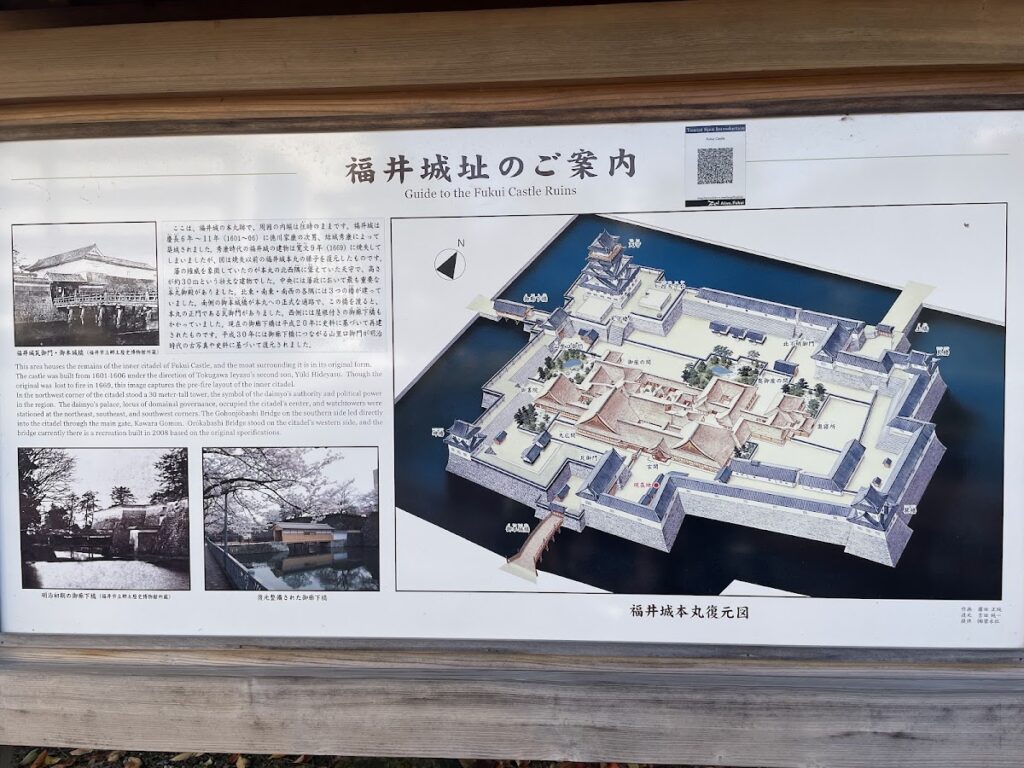
At the time of its completion, Fukui Castle boasted a magnificent four-story, five-tiered keep approximately 37 meters high (some sources say around 30 meters), and was a formidable fortress surrounded by four layers of moats. Its scale is believed to have been about 20 times larger than the remains that exist today, illustrating the imposing presence of Fukui Castle at that time.
Castle History and Successive Lords
The history of Fukui Castle actually predates Yuki Hideyasu. This site was once home to Kitano-sho Castle, built by Shibata Katsuie.
Shibata Clan and Kitano-Sho Castle Era
In 1575 (Tensho 3), Shibata Katsuie, a retainer of Oda Nobunaga, quelled the Echizen Ikko-ikki rebellion and built Kitano-Sho Castle. However, in 1583 (Tensho 11), Katsuie was defeated by Toyotomi Hideyoshi at the Battle of Shizugatake and committed suicide at Kitano-Sho Castle along with his wife, Oichi-no-kata, and the castle was burned down.
Niwa and Hori Clan Era
After the Shibata clan, Niwa Nagashige, son of Niwa Nagahide, took control of the castle, but was later dispossessed. Hori Hidemasa, and then Hori Hideharu, became the castle lords. After the Battle of Sekigahara in 1600 (Keicho 5), the Hori clan was transferred to Echigo Province.
Aoki Clan (Relatives of the Toyotomi Family) Era
For a short period, Aoki Kazunori served as the castle lord.
Yuki Clan and Kitano-Sho Castle (Fukui Castle) Era
In 1601 (Keicho 6), Yuki Hideyasu took control of the area and expanded the existing Kitano-Sho Castle ruins surrounding Shibata Katsuie’s castle, beginning construction of a new Kitano-Sho Castle (later Fukui Castle). Completed in 1606 (Keicho 11) after six years of construction, the castle was a large-scale flatland castle consisting of a main keep, second bailey, and third bailey.
After Yuki Hideyasu’s death, his son Matsudaira Tadanao succeeded him, but was later dispossessed of his domain, and a branch family of the Echizen Matsudaira clan took control. In 1624 (Kanei 1), during the reign of the third shogun Tokugawa Iemitsu, the place name was changed from “Kitano-Sho” to “Fukui,” and the castle name also became Fukui Castle. This was because the character “Kita” (北) was considered unlucky as it sounded like “defeat.”
For approximately 270 years thereafter, 17 generations of the Echizen Matsudaira family served as lords of the Fukui Domain, and the castle town of Fukui flourished. Matsudaira Shungaku (Keiei), known as a wise ruler of the late Edo period, also resided at Fukui Castle.
Architecture and Structure of Fukui Castle
Keep and Honmaru
The keep of Fukui Castle at the time of its construction was a magnificent structure, approximately 37 meters tall with four stories and five floors. However, it was destroyed in a great fire in 1669 and was never rebuilt. The keep’s foundation still remains, allowing us to imagine its original scale.
The Honmaru (main enclosure) is said to have been laid out by Tokugawa Ieyasu and boasts a strategically excellent design. Currently, public facilities such as the Fukui Prefectural Government Office, the Fukui Prefectural Assembly, and the Fukui Prefectural Police Headquarters are built on the site of the Honmaru.
Features of the Stone Walls: Shakudani Stone
The most distinctive feature of Fukui Castle’s stone walls is that they are constructed solely from a single type of stone: “Shakudani stone.” This is considered the largest single-stone wall in Japan.
Shakudani stone is a type of tuff quarried from Mt. Asuwa in Fukui City. It takes on a bluish tint when wet, earning it the nickname “Fukui Blue.” This beautiful blue stone is a symbol of Fukui Castle, and even today, parts of the main keep’s stone walls and moats retain their original appearance.
The stone walls are constructed using a cut-and-fitted masonry technique, resulting in a precise and beautiful finish. This high level of skill is evidence of the fact that many renowned daimyo from across Japan participated in the construction as part of a nationwide construction project.
Moats and Layout
Fukui Castle was a flatland castle surrounded by four layers of moats, making it highly defensible. Currently, a portion of the inner moat remains, surrounding the main keep. The moats of the second and third baileys have almost completely disappeared, replaced by urbanization.
The moat water was drawn from the Asuwa River, demonstrating the advanced civil engineering techniques of the time. In the remaining moat, you can enjoy the beautiful scenery of the Shakutani stone walls reflected in the water.
Highlights of Fukui Castle Ruins
Main Bailey Stone Walls and Inner Moat
When visiting Fukui Castle Ruins, first explore the main bailey’s stone walls and inner moat. The stone walls, built with Shakutani stone, display a particularly beautiful blue color on rainy days. The height of the walls and the intricate construction techniques demonstrate the high level of castle-building technology of the time.
Walking along the moat allows you to imagine what Fukui Castle looked like approximately 400 years ago, evoking a sense of historical romance.
Castle Tower Base
The castle tower base remains within the main bailey. Currently located on the grounds of the Fukui Prefectural Government Office, it is open for viewing (during weekday office hours). Climbing to the castle tower base allows you to imagine the magnificent castle tower that once stood here.
Gohonjo Bridge
The Gohonjo Bridge, which serves as the entrance to the main keep, spans the inner moat. Crossing this bridge and entering the main keep truly gives you the feeling of visiting a castle. From the bridge, you can enjoy a beautiful view of the moat and stone walls.
Fukui Castle Yamasato-guchi Gate
The Yamasato-guchi Gate is one of the important remains of Fukui Castle. As a valuable historical site that preserves the characteristics of castle architecture, it is well worth a visit.
Sakae-no-yashiro Shrine
In a corner of the Fukui Castle site is the Sakae-no-yashiro Shrine, dedicated to Yuki Hideyasu. As the ancestor of the Echizen Matsudaira family and a shrine commemorating Hideyasu, who laid the foundation for the development of Fukui, it is cherished by the local people.
Fukui Castle Hitsujisaru Yagura (Southwest Turret) Restoration Project
Project Overview
Fukui Prefecture is undertaking a restoration project of the Hitsujisaru Yagura (Southwest Turret), located at the southwest corner of the main keep, and the earthen wall on the west side of the main keep, with the aim of enhancing the appeal of Fukui Castle.
The Hitsujisaru Yagura is a two-story turret approximately 16 meters high, and the earthen wall extends approximately 106 meters in length. The total project cost is approximately 3.96 billion yen, with restoration work starting in fiscal year 2023 and aiming for completion in fiscal year 2029.
Significance of Restoration
The restoration of the Hitsujisaru Yagura and earthen wall will more vividly revive the appearance of Fukui Castle in its heyday. Currently, only the stone walls and moat remain of the Fukui Castle site, but the restoration of the turret and earthen wall is expected to significantly improve the castle’s landscape and increase its value as a tourist resource.
The restoration aims to recreate the castle as faithfully as possible to historical facts, based on Edo period drawings and archaeological excavations. The restoration work, which combines traditional construction methods with modern technology, is attracting attention from the perspective of cultural property preservation.
Basic Information and Access to Fukui Castle
Basic Information
- Location: 3-17-1 Ote, Fukui City, Fukui Prefecture
- Castle Classification: Flatland Castle
- Year of Construction: Keicho 11 (1606)
- Builder: Yuki Hideyasu
- Main Lords: Yuki clan, Echizen Matsudaira family
- Remains: Stone walls, moats, castle tower base
- Visiting Hours: Exterior is accessible 24 hours. The prefectural government grounds (including the castle tower base) are open during weekday opening hours.
- Admission Fee: Free
- Parking: Fukui Prefectural Government visitor parking is available (available on holidays, weekdays require confirmation).
Access Methods
Public Transportation
- From JR Fukui Station: Approximately 5 minutes on foot
- From Echizen Railway Fukui Station: Approximately 5 minutes on foot
Exit the west exit of JR Fukui Station, head west along the main street in front of the station, and then head north along Phoenix Street to reach the Fukui Castle ruins. It’s very easily accessible and ideal as a starting point for sightseeing in Fukui.
By Car
- From Hokuriku Expressway Fukui IC: Approximately 15 minutes
- From Fukui Kita IC: Approximately 15 minutes
While you can use the Fukui Prefectural Government visitor parking, it may be crowded on weekdays due to government operations, so using public transportation is recommended.
Tourist Attractions Around Fukui Castle
Yōkōkan Garden (Former Imperial Household Agency Residence)
Located about a 10-minute walk from Fukui Castle, Yōkōkan Garden was the villa of the Matsudaira family, the lords of the Fukui domain. It is a beautiful pond-centered strolling garden designated as a national scenic spot, and a must-visit tourist attraction in conjunction with Fukui Castle.
Fukui City Local History Museum
Adjacent to Yōkōkan Garden, this museum offers a chance to learn about Fukui’s history and culture. It boasts extensive exhibits on Fukui Castle, Yuki Hideyasu, and the Echizen Matsudaira family, making a visit before or after a tour of Fukui Castle a valuable experience.
Shibata Shrine
This shrine, dedicated to Shibata Katsuie and Oichi, is built on part of the Kitano-shō Castle ruins. It is an important spot for learning about the history of Kitano-shō Castle, the predecessor of Fukui Castle.
Asuwayama Park
Asuwayama, also a quarry for Shakutani stone, is a popular recreational spot for Fukui citizens. From the mountaintop, you can enjoy a panoramic view of Fukui city, and it’s also known as a famous cherry blossom viewing spot in spring. Visiting Mt. Asuwa allows you to see the actual source of the Shakutani stone used in the stone walls of Fukui Castle.
Around Fukui Station
The west exit of Fukui Station features a dinosaur monument and a “Dinosaur Plaza,” highlighting Fukui Prefecture’s status as a source of dinosaur fossils. The area around the station also boasts numerous restaurants and souvenir shops, making it convenient to stop by before or after visiting Fukui Castle.
Points to Note When Visiting Fukui Castle
Best Season for Visiting
Fukui Castle ruins are open year-round, but the following seasons are particularly recommended:
- Spring (late March to early April): Cherry blossom season, with cherry trees lining the moat creating a beautiful landscape.
- Autumn (October to November): Autumn foliage season, offering a stunning contrast between the stone walls and the changing leaves.
- Rainy Days: To see the “Fukui Blue” – the shimmering blue of the Shakutani stone when wet – rainy days or after rain are ideal.
Estimated Time Required
Please allow 30 minutes to 1 hour for a visit to the Fukui Castle ruins. A leisurely stroll around the stone walls and moat, climbing to the castle tower base, and exploring the surrounding historical sites will take approximately 1 hour.
Photography Tips
- Inner Moat and Stone Walls: The view of the moat and stone walls from the Gohonjo Bridge is an excellent photo opportunity.
- The Blue of Shakutani Stone: On rainy days or after rain, you can photograph the stone walls shimmering blue.
- View from the Castle Tower Base: The view from the castle tower base, overlooking the main keep, is also highly recommended.
Precautions
- The main keep site is within the grounds of the Fukui Prefectural Government Office. Please be considerate of the prefectural government’s operations during weekday visits.
- Some areas, such as the castle keep base, are only accessible during the prefectural office’s opening hours.
- Please be careful not to climb on the stone walls or get too close to the moat.
Fukui Castle and Other Famous Castles of Fukui
Besides Fukui Castle, Fukui Prefecture has many other attractive castles.
Maruoka Castle (Kasumiga Castle)
Maruoka Castle, which boasts the oldest existing castle keep in Japan, is designated as a National Important Cultural Property. Located about 30 minutes by car from Fukui Castle, it is a flatland castle built by Shibata Katsutoyo. It is selected as one of Japan’s 100 Famous Castles.
Echizen Ono Castle
Known as the “Castle in the Sky,” Echizen Ono Castle is a mountain castle built on Mt. Kameyama. Its appearance floating above a sea of clouds is fantastical, and it has become increasingly popular in recent years. It is about 1 hour by car from Fukui Castle.
Ichijōdani Asakura Clan Ruins
This site is the remains of the castle town of the Asakura clan, a powerful daimyo family during the Sengoku period, and is designated as a National Special Historic Site. The restored samurai residences and townscape retain a strong atmosphere of the Sengoku period. It’s about a 30-minute drive from Fukui Castle.
A “Fukui Castle Tour” visiting these castles is an attractive travel plan for history buffs.
Historical Value and Future Prospects of Fukui Castle
Fukui Castle, built by Yuki Hideyasu, the second son of Tokugawa Ieyasu, holds an important position in the history of the Edo Shogunate. The Echizen Matsudaira family held a rank second only to the Tokugawa Three Houses and played a significant role in Japanese history, producing figures such as Matsudaira Shungaku, a renowned ruler of the late Edo period.
Currently, Fukui Castle is in a unique situation nationwide, with the Fukui Prefectural Government located on the site of the former main keep. However, with the progress of the Kon-yagura (southwest turret) restoration project, it is gradually regaining its appearance as a castle. Following the completion of the Kon-yagura (southwest turret) in 2029, the tourist value of Fukui Castle is expected to increase even further, and it is anticipated that it will attract attention as an important tourist resource for Fukui Prefecture.
The beautiful stone walls and moats made of Shakutani stone, and the restored Kon-yagura and earthen walls will become a valuable legacy that will pass on Fukui’s history and culture to future generations. Fukui Castle ruins are not merely a historical site; they still function as the administrative center of Fukui Prefecture, forming a unique space where history and modernity coexist.
Summary
Fukui Castle is a famous castle built in 1606 by Yuki Hideyasu, the second son of Tokugawa Ieyasu. For approximately 270 years, it served as the residence of 17 generations of the Echizen Matsudaira family, watching over the history of Fukui. Currently, the beautiful stone walls and moats made of Shakutani stone remain, and the site of the former main keep is now occupied by the Fukui Prefectural Government, creating a unique landscape.
Fukui Castle boasts numerous attractions, including its excellent accessibility (just a 5-minute walk from JR Fukui Station), its stone walls constructed using the largest single type of stone (Shakutani stone) in Japan, and the planned restoration project of the Kon-yagura turret, scheduled for completion in 2029.
When visiting Fukui, be sure to visit the Fukui Castle ruins and experience the history of this magnificent castle built by Yuki Hideyasu, as well as the beauty of the Shakutani stone, which shines blue when wet. Visiting the nearby Yohokan Garden and the Fukui City Local History Museum in conjunction with the castle will allow you to gain a deeper understanding of Fukui’s history and culture.
