Complete Guide to Etchu Miyazaki Castle (Asahi Town, Toyama Prefecture) | History, Highlights, and Access Information for the Oldest Mountain Castle in the Prefecture
What is Etchu Miyazaki Castle?
Etchu Miyazaki Castle (Miyazaki-jo) is a mountain castle located in Asahi Town, Shimoshinkawa District, Toyama Prefecture, and is known as one of the oldest mountain castles in Toyama Prefecture. Built on the mountainside from the summit of Shiroyama Mountain, which is 249 meters above sea level, this castle functioned as an important defensive base protecting the border between Etchu Province and Echigo Province for approximately 400 years, from the late Heian period to the Sengoku period.
It is also known by other names such as Sakai Castle, Arayama Castle, Tomari Castle, and Sakai Castle, and is also called “Etchu Miyazaki Castle” to distinguish it from Miyazaki Castle in Hyuga Province (present-day Miyazaki Prefecture). Currently, it is designated as a historical site of Toyama Prefecture and is carefully preserved as a regional historical heritage site, as No. 1 of the “Toyama Castle Cards”. ### The Importance of Location
The most distinctive feature of Etchu Miyazaki Castle lies in its strategic location. To the east lies the rugged terrain of Oyashirazu, to the west the Kurobe River alluvial fan, and to the north, across Toyama Bay, the Noto Peninsula can be seen. Furthermore, the Hokuriku Road (Hokuriku Hama-Okan), a major transportation route on the Sea of Japan side, runs directly below the castle, making it a natural fortress controlling this crucial transportation hub.
The castle was built with the clear purpose of monitoring and defending against invasions from Echigo Province, and its alternative name, “Sakai-jo” (Border Castle), given its location on the border between Etchu and Echigo, is understandable.
History of Etchu Miyazaki Castle
Late Heian Period: Castle Construction and Kiso Yoshinaka
The history of Miyazaki Castle dates back to the late Heian period, to the second year of Juei (1183). According to tradition, Kiso (Minamoto) Yoshinaka, who received an imperial decree from Prince Mochihito to defeat the Taira clan, built Miyazaki Castle with Miyazaki Taro and Sami Taro, the leaders of the Miyazaki clan, and with Prince Hokuriku-no-miya, Prince Mochihito’s son, as their banner-bearer.
During this period, Kiso Yoshinaka was expanding his power in the Hokuriku region, and Etchu Province was one of his important bases. Miyazaki Castle is thought to have been positioned as a strategically important point in Yoshinaka’s management of the Hokuriku region.
Sengoku Period: Conflicts between the Uesugi and Oda Clans
With the start of the Sengoku period, Miyazaki Castle became the stage for fierce battles between the Uesugi clan of Echigo Province and various forces vying for control of Etchu Province.
Uesugi Kenshin of Echigo repeatedly invaded Etchu Province, and Miyazaki Castle was frequently targeted. During the Eiroku era (1558-1570), Kakizaki Kageie, a senior retainer of the Uesugi clan, is said to have been involved in the capture of Miyazaki Castle. As a border castle, it played a vital role in preventing invasions from Echigo forces.
During the Tensho era (1573-1592), Oda Nobunaga’s influence extended to the Hokuriku region, and Etchu came under Oda control. After the Honnoji Incident in 1582, Etchu was ruled by Sassa Narimasa, but fierce conflicts continued between Narimasa and Uesugi Kagekatsu. Miyazaki Castle continued to play an important role as a border castle during this period.
The Maeda Clan Era: Establishment of the Sakai Barrier
In 1585, when Sassa Narimasa was dispossessed of his domain by order of Toyotomi Hideyoshi, Etchu became the territory of Maeda Toshiie. Even after the Maeda clan came to rule Niikawa District, Miyazaki Castle continued to function as an important base for monitoring the border with Echigo Province.
The Maeda clan established a border checkpoint near Miyazaki Castle, strictly controlling the movement of people and goods from Echigo Province. With the establishment of this checkpoint, Miyazaki Castle took on the role not only as a military defense base but also as a central administrative center for border control.
In the Edo period, with the unification of Japan, the military importance of Miyazaki Castle declined, but the border checkpoint continued to function, remaining a vital hub for transportation and security between Etchu and Echigo Provinces.
Castle Structure and Layout
Characteristics as a Mountain Castle
Etchu Miyazaki Castle is a typical mountain castle built on the mountaintop and slopes of the 249-meter-high Shiroyama mountain massif. The layout, utilizing the entire mountain, is a defensive system that skillfully takes advantage of the natural terrain.
The steep terrain of Shiroyama itself acts as a natural barrier, making enemy intrusion difficult. The main enclosure (honmaru) was located at the mountaintop, and smaller enclosures (kuruwa) were arranged in a stepped pattern from there.
Arrangement of Enclosures
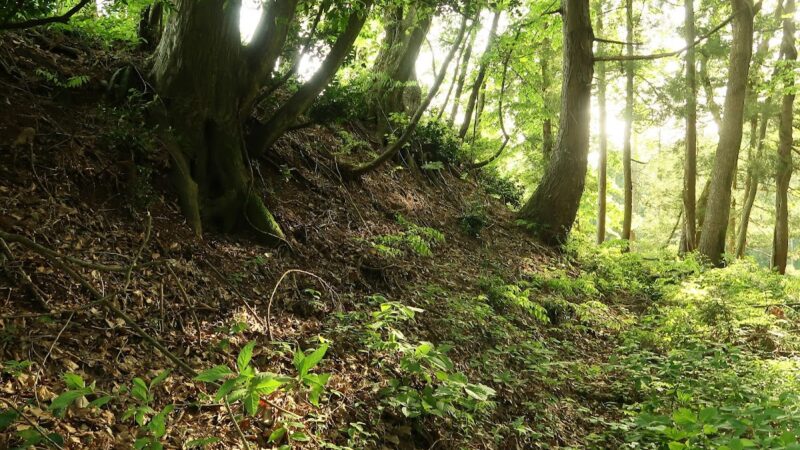
Miyazaki Castle’s layout consists of multiple enclosures arranged in a stepped pattern, centered around the main enclosure at the mountaintop. Even today, observing the terrain reveals traces of flat enclosures and artificial steep slopes (kirigi) that separated the enclosures.
While the main enclosures are concentrated at the mountaintop, smaller enclosures and flat areas resembling watchtowers are scattered along the mountainside, indicating that the entire mountain was fortified.
Presence or Absence of Stone Walls and an Earthen Castle
Etchu Miyazaki Castle is fundamentally an “earthen castle,” and no large-scale stone walls have been confirmed. This is likely due to its ancient construction date and the difficulty of transporting stone materials given its mountain castle nature.
Defenses were primarily constructed using civil engineering works such as earthworks, moats, and kirigi, employing a defensive system that combined natural terrain with civil engineering techniques. This type of structure is typical of medieval mountain castles.
Moats and Vertical Moats
Moats (ditches cutting across ridges) and vertical moats (ditches dug vertically into slopes) play a crucial role in the defense of mountain castles. These remains have been confirmed at Miyazaki Castle, demonstrating ingenuity in limiting enemy incursions and strengthening defenses.
In particular, clear moats remain along the ridges, indicating their function as both boundary lines for the castle’s layout and defensive lines.
Highlights of Etchu Miyazaki Castle
Spectacular Views from the Summit
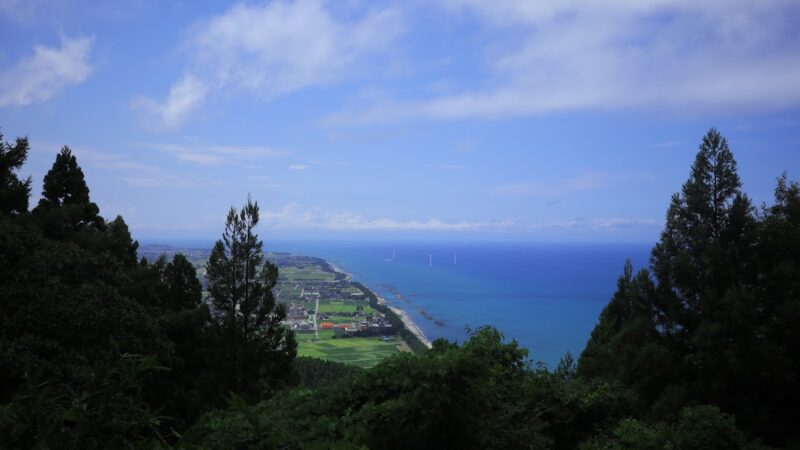
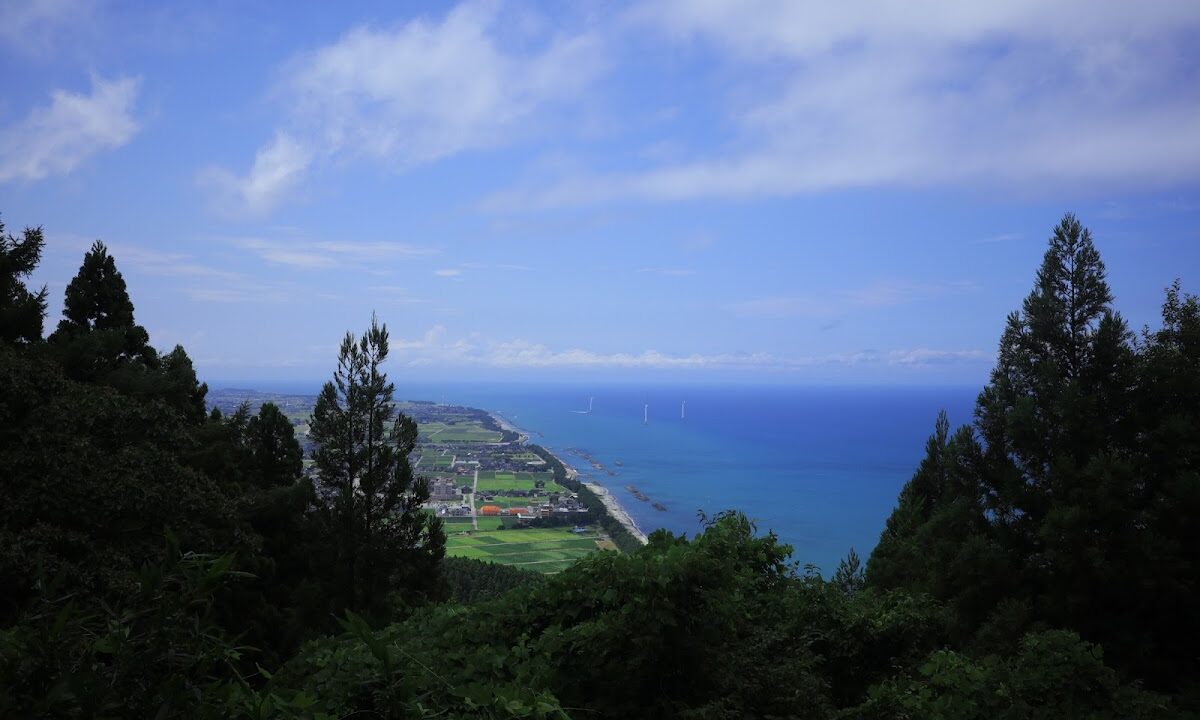
The greatest highlight of Miyazaki Castle is undoubtedly the view from the summit. From the 249-meter-high summit, a 360-degree panoramic view unfolds.
To the north lies Toyama Bay, and on clear days, the Noto Peninsula can be seen. To the west, the vast plains of the Kurobe River alluvial fan stretch out, offering magnificent views of the Tateyama mountain range. To the east lies the rugged coastline of Oyashirazu, giving a real sense of the difficulty of the road to Echigo.
This view makes it immediately clear why a castle was built in this location and its strategic importance. The castle lords also monitored the Echigo region from this vantage point, protecting the safety of their territory.
Exploring the Fortifications
The castle ruins still retain clear traces of the fortifications, allowing visitors to learn about the structure of a medieval castle while exploring. The group of fortifications, centered around the main enclosure, are arranged in a stepped pattern like terraced fields, allowing visitors to imagine the layout of the castle at the time.
Walking on the flat surfaces of each fortification allows you to imagine the time when buildings stood there, evoking a sense of historical romance.
Defensive Remains such as Moats
For mountain castle enthusiasts, defensive remains such as moats and steep slopes are a must-see. Miyazaki Castle has several clearly defined moats, demonstrating the high level of civil engineering technology of the medieval period.
The trenches, particularly those along the main ridges, are deep and wide, demonstrating their practical defensive capabilities. Observing these remains allows us to learn about the castle’s defensive system and how it prevented enemy incursions.
Development as Shiroyama Park
Currently, Miyazaki Castle ruins are developed as Shiroyama Park, making it a comfortable place for visitors to stroll. The hiking trails are well-maintained, and guide signs are installed, making it easy for first-time visitors to explore.
A parking lot is also available near the summit, allowing access by car. This is a prime example of how park development and historical heritage preservation can be successfully combined.
Toyama Castle Card No. 1
Miyazaki Castle is designated as No. 1 of the “Toyama Castle Card” series, making it a symbolic landmark among castle enthusiasts, often considered the starting point for castle tours in Toyama. Castle cards can be obtained at tourist facilities in Asahi Town, making collecting them a fun souvenir.
Access Information
Access by Car
The most convenient way to access Etchu Miyazaki Castle is by car.
From the Hokuriku Expressway:
- Approximately 10 minutes from Asahi IC
- Turn east at the Yokoo-Nishi intersection on National Route 8
- Head east on Prefectural Road 103
- After passing under the Hokuriku Expressway overpass, you will see a road leading uphill to the left, where a signpost is located.
- Continue along the road and you will arrive at the parking lot near the summit.
Parking:
A parking lot is available near the summit and is free to use. Since the number of parking spaces is limited, it is recommended to visit early, especially on holidays.
Access by Public Transportation
Train:
- Get off at Etchu Miyazaki Station on the Ainokaze Toyama Railway
- Approximately 40-50 minutes on foot from the station to the castle ruins (including hiking)
Access by public transportation is difficult due to the distance from the station; walking is only recommended for those with strong legs. Consider taking a taxi. ### Hiking Route
From the parking lot to the summit, you’ll hike along a well-maintained trail. The hike takes approximately 15-20 minutes. The path is relatively gentle, making it an easy route even for beginner hikers.
Wearing appropriate hiking boots is recommended. Particular caution is needed after rain, as the trail can become slippery.
Nearby Tourist Attractions
Highlights of Asahi Town
When visiting Miyazaki Castle, we recommend also visiting other tourist attractions in Asahi Town.
Jade Coast:
Asahi Town’s coast is famous for its jade deposits, and if you’re lucky, you might find a raw jade stone. The beautiful coastline created by the rough waves of the Sea of Japan is also a highlight.
Sakai Checkpoint Ruins:
The ruins of the Sakai Checkpoint, which had a close relationship with Miyazaki Castle, are a must-see spot for history buffs.
Asahi-machi Historical Park:
A facility where you can learn about the local history, and exhibits materials related to Miyazaki Castle are also on display.
Nearby Castle Ruins
For castle enthusiasts, it is recommended to visit other castle ruins in Toyama Prefecture as well.
Matsukura Castle:
A mountain castle located in Uozu City, with strong ties to the Uesugi clan.
Uozu Castle:
A flatland castle in Uozu City, which was an important base for the Uesugi clan.
Toyama Castle:
Located in the center of Toyama City, this castle developed as the residence of the Maeda clan.
Points to Note When Visiting
Clothing and Equipment
- Comfortable walking shoes (trekking shoes recommended)
- Comfortable clothing
- Hat (for sun protection)
- Drinks (especially in summer)
- Insect repellent (spring to autumn)
Suitable Season for Visiting
Miyazaki Castle can be visited throughout the year, but each season has its own unique characteristics.
Spring (April-May):
Beautiful fresh greenery and mild weather, ideal for hiking.
Summer (June-August):
Deep greenery and excellent views, but be aware of the heat and insects.
Autumn (September-November):
Beautiful autumn foliage, the most popular season. Clear air and superb views.
Winter (December-March):
Snowfall can make hiking trails dangerous. Winter visits are recommended for experienced hikers.
Estimated Time Required
Please allow the following time for visiting Miyazaki Castle Ruins:
- From parking lot to summit: Approximately 30-40 minutes round trip
- Visiting the castle ruins: 30 minutes to 1 hour
- Total: Approximately 1 hour to 1 hour 30 minutes
If you want to carefully observe the remains and enjoy taking photographs, allow about 2 hours.
Cultural Value of Etchu Miyazaki Castle
Designated as a Toyama Prefecture Historic Site
Etchu Miyazaki Castle is designated as a historic site of Toyama Prefecture and is protected as an important cultural property within the prefecture. As one of the oldest mountain castles in the prefecture, it is an indispensable site for understanding the medieval history of Toyama Prefecture.
Historical Significance
The historical significance of Miyazaki Castle lies in the following points:
- Role as a Border Castle: It functioned for approximately 400 years as a frontline castle protecting the border between Etchu and Echigo provinces.
- Strategic Transportation Hub: It was a strategic base controlling the important Hokuriku Road.
- Transition from Medieval to Early Modern Period: The castle’s history reflects the changing times, from the late Heian period to the early Edo period.
- Witness to Regional History: It had connections with warlords who shaped the history of the Hokuriku region, such as Kiso Yoshinaka, the Uesugi clan, the Oda clan, and the Maeda clan.
Preservation and Utilization
Asahi Town is actively working on the preservation and utilization of the Miyazaki Castle ruins. Through development as Shiroyama Park, it has become a place accessible to local residents and tourists while maintaining its value as a historical heritage site.
Utilization is progressing from both historical education and tourism promotion perspectives, including the installation of information boards, the maintenance of hiking trails, and the issuance of Toyama Castle Cards.
Summary
Etchu Miyazaki Castle, the oldest mountain castle in Toyama Prefecture, is a source of pride for Asahi Town. It has a history of approximately 400 years as an important defensive stronghold protecting the border between Etchu and Echigo provinces. The spectacular views from the 249-meter-high summit, the clearly preserved remains such as baileys and moats, and the rich historical story from Kiso Yoshinaka to the Maeda clan continue to fascinate visitors.
As its alternative names, such as Sakai Castle, Arayama Castle, and Tomari Castle, suggest, this castle, located on the border between Etchu and Echigo, constantly stood on the front lines of the tense relations between the two provinces. The history of powerful daimyo of the Sengoku period, such as the Uesugi, Oda, and Maeda clans, vying for control of this area is of great importance in understanding the medieval and Sengoku history of the Hokuriku region.
Currently maintained as Shiroyama Park and protected as a Toyama Prefecture historical site, the Miyazaki Castle ruins are popular not only with history enthusiasts but also with hikers and nature lovers. As Toyama Castle Card No. 1, this castle is a fitting starting point for a tour of Toyama’s castles.
When you visit Asahi Town, be sure to climb this historic mountain castle and, while gazing at Toyama Bay and the Tateyama mountain range from the summit, imagine the view that medieval warlords must have seen. Etchu Miyazaki Castle is a valuable historical heritage site where you can experience the charm of Toyama Prefecture’s history and nature at the same time.