Complete Guide to Einosan Castle (Ehime Prefecture): The Full Picture of an Ancient Mountain Castle that Protected the Seto Inland Sea
What is Einosan Castle?
Einosan Castle is an ancient mountain castle located in Saijo City, Ehime Prefecture, built around the late 7th century. Situated at the eastern base of the Takanawa Peninsula, it was built in a strategically important location overlooking the Kurushima Strait, a vital point in the Seto Inland Sea. As the only ancient mountain castle in Ehime Prefecture and one of only three confirmed in Shikoku, it was designated a National Historic Site in 2006.
The castle utilizes the entire independent mountain range, including Mount Einosan (132.4 meters above sea level) and Mount Io (approximately 130 meters above sea level), with an outer perimeter extending approximately 470 meters east-west, 720 meters north-south, and a total length of approximately 2.5 kilometers. Even today, the remains of the castle, such as rows of stones and earthworks lined up along the mountain ridge, can be seen, making it an extremely important historical site for understanding ancient Japan’s defense system.
Historical Background of Einosan Castle
Positioning as an Ancient Mountain Castle
Ancient mountain castles were defensive structures built during a time of tension in East Asia in the 7th century. After Japan’s defeat at the Battle of Baekgang in 663 against the combined forces of Tang China and Silla, Japan built mountain castles throughout western Japan to prepare for invasions from the continent. Currently, only 25 ancient mountain castles have been discovered, mainly in western Japan, making Einosan Castle a precious example.
Einosan Castle is one of the “Kamigoseki-type mountain castles” not mentioned in historical documents, and it has characteristics different from the “Korean-style mountain castles” recorded in documents such as the *Nihon Shoki*. The current name “Einosan Castle” is a later naming, incorporating the common name of the mountain.
A Strategic Point for the Defense of the Seto Inland Sea
The location where Einoyama Castle was built has long been considered important as a strategic point for transportation and military operations in the Seto Inland Sea. The Kurushima Strait, in particular, is known for its strong currents and difficult navigation, but it was also an important sea route for east-west travel across the Seto Inland Sea.
To the north, the Geiyo Islands stretch across the Seto Inland Sea, and these can be seen from Einoyama Castle. It is highly probable that the castle was built in this strategically important location in the late 7th century, when foreign relations were tense, with the aim of preventing invasions into the Kinai region.
History of the Discovery and Investigation of Einoyama Castle
Discovery in 1977
Einoyama Castle was discovered in 1977 (Showa 52) through a distribution survey. This ancient mountain castle, whose existence had been previously unknown, was revealed through local research. This discovery holds significant importance in the study of ancient mountain castles.
Ongoing Archaeological Excavations
Since its discovery, several archaeological excavations have been conducted at Einoyama Castle. From fiscal year 2002, the Toyo City Board of Education (now the Saijo City Board of Education) began confirmation excavations, confirming rows of granite cut stones and earthworks on the mountain massif.
The investigation is still ongoing, and the full scope of Einoyama Castle is gradually becoming clear. Based on these investigation results, historical site development is also progressing, and a walking map reflecting the results up to fiscal year 2024 has been created.
Structure and Remains of Einoyama Castle
Outer Enclosure Line Arrangement
The outer enclosure line of Einoyama Castle follows the slope of the ridge between Mount Einoyama and Mount Ioyama. It measures approximately 470 meters east-west and 720 meters north-south, with a total length of approximately 2.5 kilometers. This scale is classified as medium-sized among ancient mountain castles.
The outer enclosure line skillfully utilizes the terrain, set along ridge lines suitable for defense. This arrangement allowed for efficient defense even with a small number of troops.
Stone Rows (Cut Stone Rows)
The most distinctive feature of Einoyama Castle is the row of stones lined up along the mountain ridge. Made of processed granite cut stones, these are believed to be the foundation of the castle wall. The stone rows remain in excellent condition today, demonstrating the high level of ancient stonework technology.
These cut stones are presumed to have been made from granite quarried in the surrounding area, providing important evidence of the civil engineering technology and the scale of labor mobilization at the time.
Earthworks
Earthworks have also been identified alongside the stone rows. These defensive structures, built by piling up earth, are believed to have been constructed on top of the stone rows. While parts have been lost due to weathering and vegetation, archaeological excavations have revealed the structure of the earthworks.
The height and width of the earthworks vary depending on the location, but it has been confirmed that they were large enough to serve a defensive function.
Other Remains
Besides the stone rows and earthworks, other remains have been identified, including what are believed to be the remains of a castle gate and possibly a sluice gate. These remains indicate that Einoyama Castle was not merely a defensive structure, but a comprehensive military facility capable of withstanding a siege for a certain period.
Highlights of Einoyama Castle
View from the Summit of Einoyama
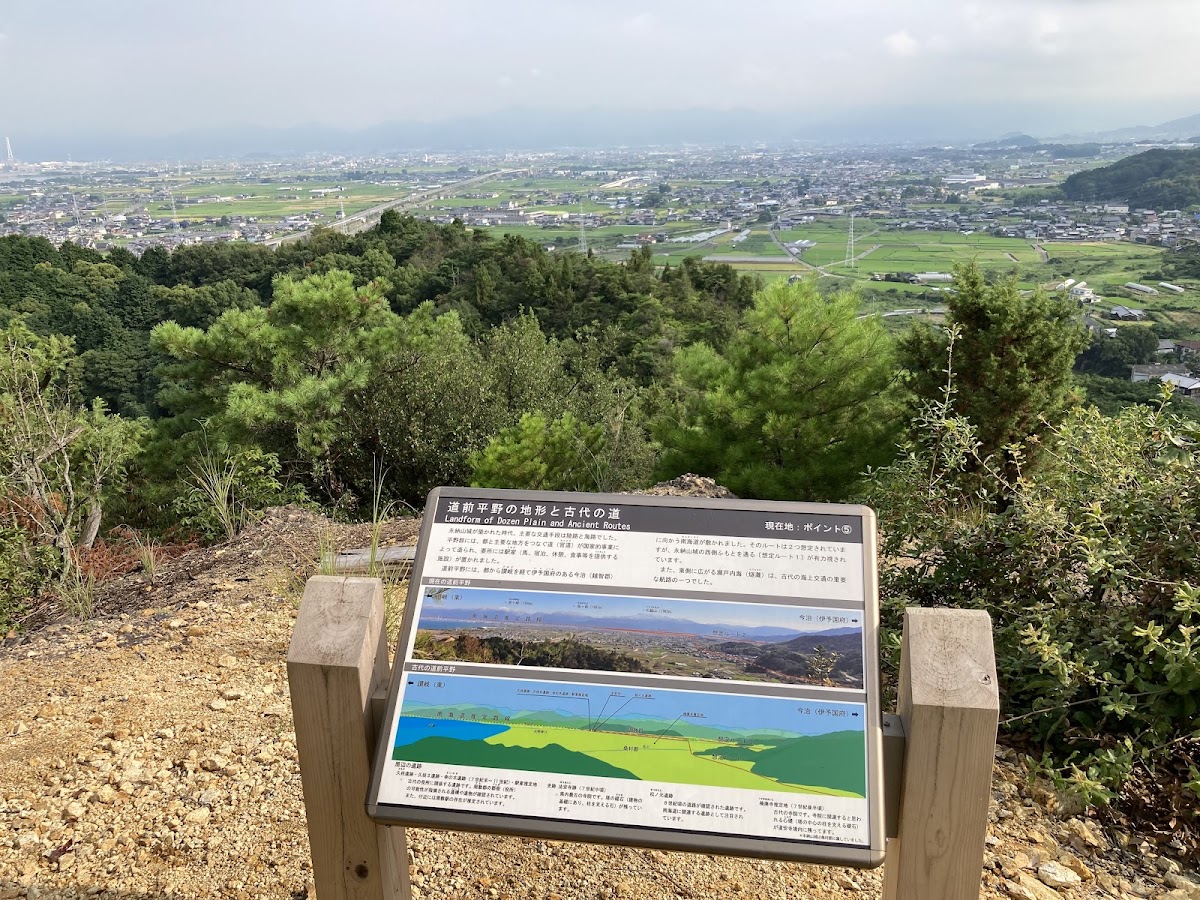
From the summit of Einoyama, at an altitude of 132.4 meters, you can enjoy a panoramic view of the Seto Inland Sea and the Kurushima Strait. On a clear day, you can see the islands of the Geiyo Islands and the ships passing by, giving you a real sense of this location’s strategic importance in the Seto Inland Sea.
Even in ancient times, this excellent view was considered militarily important and is thought to have been a decisive factor in the selection of the castle’s location. It remains one of the biggest highlights for modern visitors.
Remains of the Stone Rows
Walking along the mountain path, you can observe the stone rows lined up along the ridge up close. You can feel the romance of history as the stones, processed and arranged over 1300 years ago, still stand today.
In particularly well-preserved areas, the stone rows retain almost their original arrangement, making them valuable resources for understanding the structure of ancient mountain castles.
Iōzan Area
The Iōzan area, which, along with Einōzan, forms part of the castle complex, is another highlight. Remains of earthworks and stone rows can also be found here, giving a real sense of the scale of Einōzan Castle.
Seta Yakushi (Sendanji Temple)
Seta Yakushi (Sendanji Temple), located at the western foot of Einōzan Castle, is one of the trailheads. The temple itself has a rich history and is worth visiting before or after visiting Einōzan Castle. The Seto Inland Sea can be seen from the temple grounds.
Access and Visiting Guide
Location
Kawarazu, Saijo City, Ehime Prefecture (Einosan) and Imabari City (part of Iozan)
Access Methods
Access by Car
- Approximately 15 minutes from the Matsuyama Expressway “Iyo Saijo IC”
- Approximately 10 minutes from Saijo city center via National Route 196
- Parking: Several spaces available near Seta Yakushi
Public Transportation
- Approximately 15 minutes by taxi from JR Yosan Line “Iyo Saijo Station”
- Bus services are limited, so access by car is recommended.
Hiking Route
To visit Einosan Castle, use the well-maintained hiking trail. The main routes are as follows:
West Trailhead Route (Seta Yakushi side)
- Trailhead: Near Seta Yakushi Temple
- Time required: Approximately 30-40 minutes to the summit
- Difficulty: Beginner-friendly (well-maintained mountain trail)
East Trailhead Route
- Trailhead: East trailhead
- A traverse from the west trailhead to the east trailhead via the summit of Mt. Einoyama is also possible
- Time required for traverse: Approximately 1.5-2 hours
Points to note when visiting
- As you will be walking on mountain trails, athletic shoes or trekking shoes are essential.
- Remember to take precautions against insects in summer and warm clothing in winter.
- Be sure to bring drinking water (there are no vending machines on the mountain).
- Please refrain from touching the historical remains to protect the site.
- A walking map is available on the Saijo City Board of Education website.
Estimated time required for visit
- Round trip to the summit only: Approximately 1-1.5 hours
- If you want to thoroughly explore the ruins: Approximately 2-3 hours
- Traverse route: Approximately 2.5-3 hours
Nearby Tourist Spots
Saijo City Center
Saijo city center, about a 10-minute drive from Einosan Castle, has the following tourist spots:
- Ishizuchi Shrine: A shrine dedicated to Mt. Ishizuchi, one of Japan’s seven sacred mountains
- Saijo City’s “Uchinuki”: A natural spring selected as one of the Ministry of the Environment’s 100 Famous Waters
- Saijo Domain Jinya Ruins: The site of the administrative office of the Saijo Domain during the Edo period
Imabari City Area
To the east, towards Imabari City:
- Imabari Castle: A seaside castle built by Todo Takatora
- Kurushima Strait Observation Deck: A different view of the Kurushima Strait from the perspective of Einosan Castle
- Murakami Pirate Museum: A museum of the Murakami Suigun (Murakami Naval Force) that controlled the Kurushima Strait
Ishizuchi Mountain Range
Saijo City is also a trailhead for Mt. Ishizuchi, allowing visitors to enjoy serious mountain climbing.
Cultural Value of Einoyama Castle
Significance of National Historic Site Designation
Einoyama Castle was designated a National Historic Site in 2006 (Heisei 18). This designation was based on the following points:
- Rarity: The only ancient mountain castle in Ehime Prefecture and one of only three in Shikoku
- Preservation Status: Remains such as stone rows and earthworks are well-preserved
- Historical Importance: A valuable historical site that shows the foreign relations and defense system of the 7th century
- Importance of Location: A strategic location as a key point on the Seto Inland Sea
Progress of Academic Research
Research on Einoyama Castle is still ongoing, and new discoveries are expected. Research is particularly focused on the following points:
- More detailed identification of the castle’s construction period
- The castle’s function and operational practices
- Comparative research with other ancient mountain castles
- Its role in the Seto Inland Sea defense system at the time
These research findings provide important insights into understanding ancient Japan’s national defense system and foreign relations.
Efforts to preserve the historical site
The Saijo City Board of Education is working to preserve and utilize the Einosan Castle ruins. Efforts are being made to create an environment that makes the historical site easier for visitors to understand, including the development of hiking trails, the installation of explanatory signs, and the creation of walking maps.
An updated walking map reflecting the research results up to fiscal year 2024 has also been created, allowing for the provision of more detailed information.
Einosan Castle and the ancient Japanese defense system
Tensions after the Battle of Baekgang
After its defeat by the Tang-Silla allied forces in the Battle of Baekgang in 663, Japan strengthened its defense system in preparation for invasions from the continent. Einosan Castle is thought to be one of a series of defensive facilities built during this period.
Defense of the Seto Inland Sea Route
The route through the Seto Inland Sea was considered a strategic point for invasions from the continent to the Kinai region. Einoyama Castle is believed to have been located at a key point along this route and functioned as a base for monitoring and intercepting enemy ships.
Coordination with Other Ancient Mountain Castles
Einoyama Castle is thought not to have functioned in isolation, but rather as part of a defense network coordinating with other ancient mountain castles throughout western Japan. Its relationship with other ancient mountain castles in Shikoku (such as Yashima Castle in Sanuki Province and the Ishii Temple Ruins in Awa Province) has also been studied.
How to Enjoy Your Visit to Einosan Castle
For History Enthusiasts
Those interested in ancient mountain castles should pay attention to the following points during their visit:
- The arrangement and processing techniques of the stone rows
- Defensive structures that utilize the terrain
- Comparison with other ancient mountain castles (visit other ancient mountain castles if possible)
- The construction techniques and scale of labor mobilization at the time
For Hiking Enthusiasts
Although it is a low mountain at an altitude of 132.4 meters, it offers the following attractions:
- Spectacular views of the Seto Inland Sea
- Moderate exercise (suitable for beginners to intermediate hikers)
- Nature in all four seasons (fresh greenery in spring, autumn leaves, etc.)
- The enjoyment of visiting multiple peaks
For Photography Enthusiasts
Einosan Castle is also an attractive photography spot:
- Panoramic views of the Seto Inland Sea from the summit
- Kurushima Strait and Geiyo Islands
- Ancient stone row remains
- Natural scenery in all four seasons
Resources and Information Sources Regarding Einoyama Castle
Official Information
- Saijo City Board of Education: Provides the latest research results and walking maps.
- Ehime Prefecture Cultural Properties Protection Division: Information on cultural properties within the prefecture.
- Cultural Heritage Online: Cultural property database by the Agency for Cultural Affairs.
Related Books
Books on Einoyama Castle and ancient mountain castles:
- Academic books related to ancient mountain castles
- Books introducing the history and cultural properties of Ehime Prefecture
- Local history materials dealing with the history of Saijo City
Research Papers
For those who want to learn more academically, it is recommended to refer to research papers on Einoyama Castle published in archaeology and history journals.
Summary: The Charm of Einoyama Castle
Einoyama Castle, as the only ancient mountain castle in Ehime Prefecture, is an extremely important historical site both historically and culturally. Built in the late 7th century amidst tense international tensions, this castle, situated in a location overlooking the strategically important Kurushima Strait in the Seto Inland Sea, is a valuable legacy that conveys the ancient Japanese defense system.
The remains, such as the rows of stones and earthworks along the mountain ridge, remain remarkably well-preserved even after more than 1300 years, demonstrating the high level of castle-building technology of the time. Furthermore, the view of the Seto Inland Sea from the mountaintop continues to captivate visitors.
Designated a National Historic Site, and currently undergoing ongoing research and restoration, Einoyama Castle is an attractive spot not only for history enthusiasts but also for hikers and nature lovers. When visiting Saijo City, be sure to visit this ancient mountain castle and reflect on the lives of the ancestors who protected the Seto Inland Sea.
Einoyama Castle, as a witness to history connecting the past and present, will continue to speak to us for many years to come.