Aoyama Castle (Ogawa Town, Saitama Prefecture) Complete Guide: A Thorough Explanation of Musashi Mountain Castle Remains and History
Aoyama Castle is a medieval mountain castle built on a 267-meter-high mountaintop in Ogawa Town, Hiki District, Saitama Prefecture. Also known as “Wariya Castle” and “Shimosato Castle,” it functioned as an important subsidiary castle of Musashi Matsuyama Castle during the Sengoku period. Even today, the remains, such as moats, earthworks, and stone-built gates, are well-preserved and highly regarded by mountain castle enthusiasts.
This article provides a comprehensive explanation of this Musashi mountain castle, from its historical background and castle structure to its notable remains, a guide to visiting, and related castles in the surrounding area.
History and Construction Background of Aoyama Castle
Transition from the Late Heian Period to the Sengoku Period
There are various theories regarding the origin of Aoyama Castle, but it is said to have been built in the late Heian period by Aoki Ujimune, who claimed to be a descendant of the Fujiwara clan. However, detailed records from this period do not exist, and reliable historical sources only begin from the Sengoku period onward.
The Chōkyō Rebellion and the Conflicts in the Hiki Region
The period most likely for the full-scale construction of Aoyama Castle is the Chōkyō Rebellion (1487-1505) in the latter half of the 15th century. During this time, Hiki County was a battleground, with important battles such as the Battle of Sugayahara and the Battle of Takamihara in 1488 (Chōkyō 2).
It is believed that Aoyama Castle was developed as a strategically important location amidst these conflicts. Its location on a ridge extending south from Sengenyama Mountain was suitable for monitoring the surrounding area and functioning as a defensive base.
The Battle for Matsuyama Castle and the Role of Aoyama Castle
Indispensable to understanding the history of Aoyama Castle is the Battle for Matsuyama Castle, which took place during the Eiroku period (1561-1564). The “Kanto Hasshu Kosenroku,” compiled during the Edo period, contains an entry for 1563 (Eiroku 6) stating, “Ueda Anrakusai and Ueda Tomohiro were brought back to Matsuyama Castle and fortified it together with the Aoyama and Koshigoe fortresses.”
This entry indicates that Aoyama Castle, along with Koshigoe Castle, played an important role as a branch castle of Musashi Matsuyama Castle and a key stronghold for the Ueda clan. In this struggle involving the Odawara Hojo clan, Ota Sanrakusai Sukemasa, and Uesugi Kenshin, Aoyama Castle played a vital role in the defense network of Matsuyama Castle.
Relationship with Sugiyama Castle
Some historical sources indicate that Aoyama Castle also functioned as a branch castle of Sugiyama Castle. Sugiyama Castle is one of the representative mountain castles of the Hiki region, and given its location relative to Aoyama Castle, it is highly likely that they were part of a interconnected castle network.
About the Aoki Clan, Lords of the Castle
The Aoki clan is said to have been the lords of Aoyama Castle. Specifically, names such as Aoki Ujihisa, Aoki Ujisato, and Aoki Ukyonosuke remain. The Aoki clan claimed descent from the Fujiwara clan, but detailed genealogies and records of their activities are limited. It is presumed that they were local lords subordinate to the Ueda clan, lords of Matsuyama Castle.
Structure and Layout of Aoyama Castle
Location and Utilization of Topography
Aoyama Castle is located on the border between Aoyama and Shimosato in Ogawa Town, built on a 267-meter-high peak south-southwest of the summit of Sengenyama Mountain. The main enclosure is located at the highest point at the northern end, with the second and third enclosures on the southern and southeastern ridges, giving it the typical structure of a multi-enclosure mountain castle.
The layout, utilizing the ridges, clearly demonstrates the characteristics of Sengoku period mountain castles, making maximum use of the natural terrain. It is connected to Kokura Castle, located a short distance away, by a ridge, suggesting that it functioned as part of a wider defensive line.
Structure of the Main Enclosure (Honmaru)
The main enclosure is a rectangular layout divided into two levels, north and south, and has a relatively large area. A U-shaped earthen rampart surrounds the northern side, enhancing its defensive capabilities. This rampart remains clearly visible even today and is one of the best-preserved parts of Aoyama Castle’s remains.
Considering the size of the main enclosure, it is clear that sufficient space was provided for the lord’s residence and troop encampment. It is also thought to have functioned as a command post during wartime.
Arrangement of the Second and Third Enclosures
The second enclosure is located south of the main enclosure, and the third enclosure is located on the southeastern ridge. Each enclosure is clearly demarcated by a moat, designed to function as an independent defensive unit.
The second enclosure is presumed to have been used as an important enclosure second only to the main enclosure, for deploying reserve troops and storing supplies. The third enclosure likely functioned as a monitoring and defensive base against incursions from the southeast.
Moat Arrangement and Defensive Function
The key to Aoyama Castle’s defense lies in the moats (hori) located between each enclosure. Three moats remain in good condition: on the north side of the main enclosure, the south side (between the second enclosure), and the southeast side (between the third enclosure).
Moats are important defensive structures that cut off ridges, preventing enemy incursions and creating a favorable fighting environment for the defenders. The moats at Aoyama Castle are sufficiently deep and wide, demonstrating the high level of castle construction technology during the Sengoku period.
Characteristics of the Stone-Walled Entrance
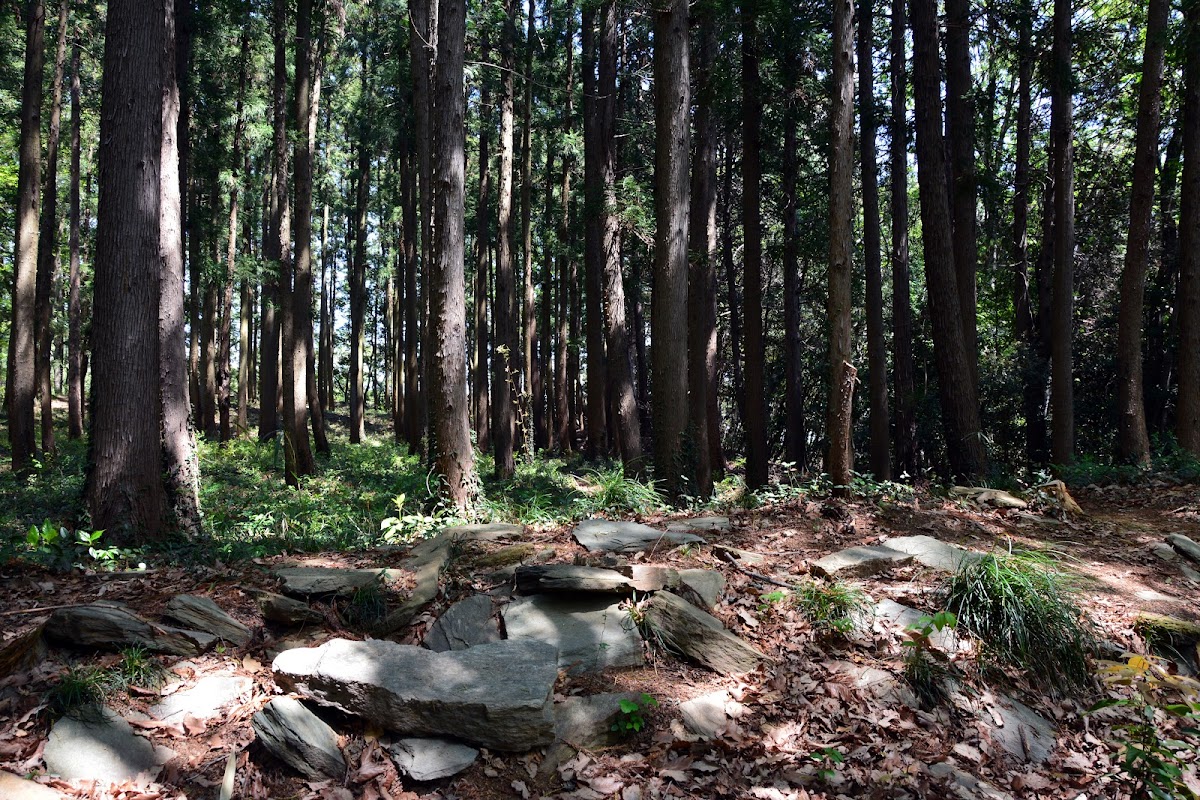
One of the greatest highlights of Aoyama Castle is the stone wall remaining at the entrance from the main enclosure to the second enclosure. This stone wall utilizes chlorite schist, a material produced in this region.
Chlorite schist is a local stone quarried around Ogawa-machi and has a distinctive bluish-green appearance. The presence of large, gravelly stonework at the castle’s entrance is important evidence that Aoyama Castle was not merely an earthen fortress, but rather one that incorporated stone fortifications.
Stone walls are rare among Sengoku period mountain castles in the Kanto region, making Aoyama Castle’s stone-built entrance a valuable historical feature.
Highlights and Remains of Aoyama Castle
Clearly Preserved Moats
The most striking feature of Aoyama Castle is the clarity of the moats remaining between each enclosure. The moat between the main enclosure and the second enclosure is particularly deep, allowing one to appreciate its defensive function at the time.
Walking along the bottom of the moat allows one to experience the height of the cliffs on both sides, illustrating the disadvantageous position the attacking forces were at. Even for those new to mountain castles, the moats are a must-see and easily understandable historical feature.
Earthworks on the North Side of the Main Enclosure
The U-shaped earthworks surrounding the north side of the main enclosure are well-preserved and retain considerable height. Walking along the earthen ramparts allows you to experience the castle’s defensive lines firsthand.
The earthen ramparts were not merely walls of earth; they also served as facilities for soldiers to conceal themselves and fire arrows and guns. The earthen ramparts of Aoyama Castle are valuable historical remains that convey the practical castle design of the Sengoku period.
Stone-Walled Gate of Chlorite Schist
The stone wall remaining at the gate between the main enclosure and the second enclosure is the most distinctive feature of Aoyama Castle. The bluish-green stone material, characteristic of chlorite schist, retains its original appearance even after hundreds of years.
While the scale of the stone wall is not large, it is a valuable point where you can directly observe the Sengoku period castle-building techniques that utilized local stone materials to reinforce the gate. It is also a popular spot for photography.
Size and Views of Each Enclosure
The main enclosure and other enclosures are relatively large for a mountain castle. From the main enclosure, one can overlook the surrounding mountains and the town of Ogawa, giving a clear sense of the castle’s function as a base for surveillance and intelligence gathering.
On a clear day, the distant mountain range is visible, a view that the castle lords of the Sengoku period may have also enjoyed.
A Simple Yet Highly Perfect Layout
Aoyama Castle is not a large-scale castle with a complex layout, but it possesses a high level of fundamental elements of Sengoku period mountain castles, such as a series of enclosures utilizing the ridge, clear divisions created by moats, and defensive reinforcements using earthworks and stone walls.
Its simple yet highly perfect layout demonstrates the Sengoku period castle-building philosophy of maximizing defensive capabilities within limited resources and terrain, and is highly valued from the perspective of castle research.
Access and Visiting Guide to Aoyama Castle
Location and Basic Information
Location: 2292 Aoyama, Ogawa-machi, Hiki-gun, Saitama Prefecture and 2787 Shimosato, Ogawa-machi
Castle Type: Mountain Castle
Construction Period: Chōkyō era (1487-1489) or Eiroku era (1558-1570)
Main Lord: Aoki clan
Remains: Moats, earthworks, stone-built gate, baileys
Designated Cultural Property: None (Designated as a town historical site)
Access by Public Transportation
Nearest Station: Ogawa-machi Station (Tobu Tojo Line/JR Hachikō Line)
The distance from Ogawa-machi Station to the Aoyama Castle ruins is approximately 4 kilometers. It takes about an hour on foot, so using a taxi or rental bicycle is more practical.
If you’re taking a taxi from Ogawamachi Station, aim for Sengenyama Miharashi-no-Oka Park. From the park’s parking lot, you can access the Aoyama Castle ruins on foot.
Access by Car
Kan-Etsu Expressway: Approximately 15 minutes from Ranzan-Ogawa IC
Ken-O Expressway: Approximately 40 minutes from Sayama-Hidaka IC
There is free parking at Sengenyama Miharashi-no-Oka Park, making it a convenient base for accessing the Aoyama Castle ruins. The park is well-maintained, and facilities such as restrooms are available.
Ascent Route and Estimated Time
From Sengenyama Miharashi-no-Oka Park to the Aoyama Castle ruins, it takes approximately 20-30 minutes using the hiking trail. The path is relatively well-maintained, but since it is a mountain trail, the following equipment and clothing are recommended.
- Footwear: Trekking shoes or athletic shoes (sneakers are acceptable)
- Clothing: Long-sleeved shirt and long pants (for protection against bushes and insects)
- Items to bring: Drinking water, towel, insect repellent spray (summer)
- Other: A walking stick is useful (especially helpful on descents)
Allow about an hour to explore the castle ruins. If you want to carefully observe each structure and enjoy taking photos, we recommend allowing even more time.
Best seasons to visit
Aoyama Castle is accessible year-round, but each season has its own characteristics.
Spring (March-May): Beautiful fresh greenery and mild weather make it ideal for visiting. However, those with hay fever should take precautions.
Summer (June-August): The greenery is dense, and the ruins may be difficult to see. There are many insects, so heat and insect repellent are essential.
Autumn (September-November): Beautiful autumn foliage and pleasant weather. The best season for visiting mountain castles.
Winter (December to February): The fallen leaves make the ruins easier to see. While cold weather precautions are necessary, conditions are ideal for observing the castle.
Points to Note When Visiting
- Aoyama Castle Ruins are not a developed tourist spot, but a natural archaeological site. Please take sufficient precautions for your safety.
- Visiting during or after rain can be slippery, so avoid visiting or exercise extreme caution.
- There are information boards on site, but understanding the castle’s structure beforehand using a layout map will enhance your enjoyment.
- To protect the ruins, please do not climb on or excavate the earthworks or stone walls.
- Please take all your trash with you.
Related Castles and Points of Interest in the Surrounding Area
Koshigoe Castle
Like Aoyama Castle, Koshigoe Castle functioned as a branch castle of Matsuyama Castle and is located in Koshigoe, Ogawa Town. The “Kanto Eight Provinces Ancient Battle Records” also mentions Aoyama Castle alongside Koshigoe Castle, indicating that the two castles worked together to form a defensive network for Matsuyama Castle.
Koshigoe Castle is also a mountain castle, and remains such as moats and earthworks still exist. Visiting it together with Aoyama Castle will provide a deeper understanding of Matsuyama Castle’s branch castle network.
Sugiyama Castle
Located in Ranzan Town, Hiki District, Sugiyama Castle is a masterpiece of Sengoku period mountain castle architecture, sometimes referred to as a “textbook of castle construction.” It is a nationally designated historical site and is characterized by its complex and sophisticated layout.
There is a theory that Aoyama Castle was a branch castle of Sugiyama Castle, making a visit while considering the relationship between the two castles particularly interesting. Sugiyama Castle is larger in scale and has more complex remains than Aoyama Castle, making it a must-see for mountain castle enthusiasts.
Musashi Matsuyama Castle
Located in Yoshimi Town, Hiki District, Matsuyama Castle is an important castle that served as the main castle of Aoyama Castle. During the Sengoku period, this strategic location was contested by the Uesugi, Takeda, and Hojo clans. Currently, it is designated as a Saitama Prefecture Historic Site, known as “Matsuyama Castle Ruins.”
Remains of the main keep, second bailey, and third bailey still exist, and earthworks and dry moats can be seen. When visiting Aoyama Castle, visiting Matsuyama Castle, its main castle, in conjunction will provide a more comprehensive understanding of the Sengoku history of this region.
Ogura Castle
Ogura Castle, located on the same ridge as Aoyama Castle, is also thought to have been a functioning mountain castle during the same period. Although smaller than Aoyama Castle, the relative positions of the two castles suggest they may have formed a coordinated defensive line.
Sengenyama Observation Hill Park
Sengenyama Observation Hill Park, a key access point to Aoyama Castle, is a park developed near the summit of Mt. Sengenyama (299 meters above sea level). From the observation deck, you can enjoy a panoramic view of the Kanto Plain, and on clear days, you can even see the Tokyo Skytree and Mt. Fuji.
The park features playground equipment and a roller slide, making it a fun place for families. It’s an ideal spot to visit before or after visiting Aoyama Castle.
Historical Value and Evaluation of Aoyama Castle
Positioning within the Hiki Region’s Castle Network
Aoyama Castle was not a standalone castle, but rather functioned as part of a broader castle network centered around Matsuyama Castle. It collaborated with castles such as Koshigoe Castle, Sugiyama Castle, and Ogura Castle to form a defensive system for the Hiki region.
This network of branch castles is an important example of how territorial rule was conducted during the Sengoku period, and Aoyama Castle holds historical value as a concrete example.
Archaeological Significance of the Stone-Walled Gate
Among Sengoku period mountain castles in the Kanto region, examples of full-fledged stone walls are limited. Although small in scale, Aoyama Castle’s stone-walled gate is a valuable example of a gate reinforced using locally sourced chlorite schist.
This stone wall is valued as important archaeological material that shows the actual use of stone materials in mountain castles in the Kanto region, and is a significant remains in the study of castle construction techniques during the Sengoku period.
Excellent State of Preservation
Aoyama Castle escaped large-scale development, and its main remains are well-preserved. The ability to observe the basic elements of a Sengoku period mountain castle, such as moats, earthworks, and stone-walled gates, on-site is of high educational value.
It is highly regarded by castle enthusiasts, and many positive comments such as “the remains are well-preserved” and “the moats are clearly visible” have been posted on castle information websites such as Kojodan.
Importance in Regional History Research
The history of Aoyama Castle is an indispensable element in understanding the Sengoku period history of the Hiki region. Considering the role this castle played in important historical events such as the Chōkyō Rebellion and the Battle for Matsuyama Castle is of great significance in regional history research.
Challenges and Future Prospects of Aoyama Castle Research
Limitations of Historical Sources and the Need for Archaeological Investigation
Historical sources concerning Aoyama Castle are limited to texts such as the “Kanto Eight Provinces Ancient Battle Record,” leaving many questions unanswered regarding its construction date, details of its lords, and the time of its abandonment.
Future archaeological methods, such as excavation surveys, could lead to detailed analysis of unearthed artifacts and remains, potentially revealing a more accurate history of the castle.
Balancing Preservation and Utilization
While Aoyama Castle is not currently designated as a cultural property, it is undoubtedly a valuable historical site. The challenge going forward will be how to balance the preservation of the remains with its utilization as a tourist and educational resource.
With proper maintenance, improved signage, and regular grass cutting, it has the potential to become a place where more people can experience the history of the Sengoku period.
Comprehensive Study with Surrounding Castles
By studying Aoyama Castle not only in isolation, but also comprehensively with surrounding castles such as Matsuyama Castle, Koshigoe Castle, Sugiyama Castle, and Ogura Castle, the overall picture of the castle network in the Hiki region will become clearer.
Using technologies such as GIS (Geographic Information System) to visualize the visual relationships and cooperative systems of each castle is also a promising research topic for the future.
Summary: The Charm of Aoyama Castle and the Significance of Visiting It
Aoyama Castle is a Sengoku period mountain castle quietly nestled in the mountains of Ogawa Town, Saitama Prefecture. While not a large-scale castle, it is a castle site that encapsulates the charm of a Sengoku period mountain castle, with its clearly defined moats, well-preserved earthworks, and valuable stone-built gate.
As a branch castle of Musashi Matsuyama Castle, Aoyama Castle, along with Koshigoe Castle, played a crucial role in the defense of the Hiki region, making it an important example of regional governance during the Sengoku period. The descriptions in the “Kanto Eight Provinces Ancient Battle Chronicle” allow us to imagine the significant role this small mountain castle played.
Even today, the well-preserved remains amidst nature are a valuable historical legacy that conveys the castle-building techniques and tactical thinking of the time. Access from Sengenyama Observation Hill Park is relatively easy, making it a castle site that can be enjoyed by a wide range of people, from beginners to advanced mountain castle enthusiasts.
Visiting Aoyama Castle is not simply about viewing ruins; it’s an experience that allows you to imagine what the warlords of the Sengoku period protected and what they fought for in this place, and to feel the romance of history. The time spent reflecting on the history of several hundred years ago amidst the rich nature of the Hiki region will surely become an unforgettable memory.
Visiting nearby castles such as Matsuyama Castle, Sugiyama Castle, and Koshigoe Castle in conjunction with Aoyama Castle will provide a more comprehensive understanding of the Hiki region during the Sengoku period. For those planning a tour of mountain castles in Saitama Prefecture, we highly recommend adding Aoyama Castle to your list.