--765x720.png)
Iono Castle (Tochigi Prefecture) Complete Guide: A Thorough Explanation of the Remains and History of the Mountain Castle of the Seven Knights of Nasu
What is Iono Castle?
Iono Castle (Iono-jo) is a medieval mountain castle located in Iono, Nasu-machi, Nasu-gun, Tochigi Prefecture. Also known as “Kasumiga-jo,” “Iono-yama-shiro,” and “Shiroyama,” it was the ancestral home of the Iono clan, a branch of the Nasu clan known for Nasu Yoichi.
Located within the confluence of the Sanzo River, Nara River, and Negishi River, this mountain castle skillfully utilized the hilly terrain extending from north to south, covering a large area of approximately 20 hectares. Currently protected as a Nasu Town designated historical site, the remains of the main keep, second bailey, third bailey, earthworks, and moats are well-preserved.
The castle’s layout, which takes advantage of the terrain with an elevation difference of approximately 130 meters, is a typical example of a mountain castle in Shimotsuke Province during the Sengoku period and holds significant value in castle research.
History of Iono Castle
Establishment of the Iono Clan and its Early Residence
The history of the Iono clan dates back to the early Kamakura period. In 1239 (En’ō 1), Sukenaga, the second son of Nasu Yoriyuki (brother of Nasu Mitsusuke, who succeeded to the headship of the Nasu clan), was granted land in Iono, built a residence there, and took the name Iono Jirozaemon-no-jō Sukenaga.
For approximately 250 years, from this first generation Sukenaga to the twelfth generation Sukeyasu, the Iono clan maintained a residence on flat land near the present-day Iono Elementary School. This residence site is called “Iono-kan” and is believed to have functioned as a government office during peacetime.
Construction of the Mountain Castle
The current mountain castle is believed to have been built around 1487 (Chōkyō 1). During the time of the 13th head of the family, Iōno Sukekiyo, a mountain castle was constructed using the hills rising behind the previous flatland residence, serving as a defensive base in times of emergency.
This period was a turbulent time, as the authority of the Muromachi Shogunate declined and the Sengoku period (Warring States period) began. In the Nasu region, conflicts between the main Nasu clan and its branch families intensified, increasing the need for stronger defensive structures.
As one of the Seven Nasu Knights (or Six Nasu Families)
The Iōno clan was one of the powerful branch families of the Nasu clan known as the “Seven Nasu Knights” (or “Six Nasu Families”). Besides the Iōno clan, the Seven Nasu Knights included the Ōzeki, Fukuhara, Senbon, and Ashino clans. Each possessed its own territory and castles, supporting the main Nasu clan while simultaneously maintaining a complex relationship of occasional conflict. Throughout the Sengoku period, the Iono clan, as a member of the Nasu clan, participated in various battles and significantly influenced the political and military situation in the Nasu region.
Trends in the Sengoku Period
During the Tensho era (1573-1592), Toyotomi Hideyoshi’s movement for national unification extended to the Nasu region. In the Siege of Odawara in 1590, the Nasu clan sided with Toyotomi, and for their service, their territories were secured and even increased.
The Iono clan also received recognition of their territory from Hideyoshi during this period, beginning their path to becoming a modern daimyo. However, in 1627, after the establishment of the Edo shogunate, Iono Castle was abandoned. This is thought to be due to the shogunate’s “One Castle Per Province” decree, bringing an end to its approximately 140-year history as a mountain castle.
Structure and Layout of Iono Castle
Overall Layout
Iono Castle is a mountain castle with a series of enclosures, utilizing the ridge of a hill extending from north to south. The main enclosure (Honmaru) is located at the northern end, with the second and third enclosures (Ninmaru and Sanomaru) extending southward.
The entire castle area covers approximately 20 hectares, and the layout is large-scale, including not only the main enclosure but also numerous subsidiary castles and outworks. The design philosophy clearly demonstrates maximizing the use of the terrain, which is surrounded by rivers on three sides, reinforcing natural fortifications with artificial defensive structures.
Main Enclosure
The main enclosure (Honmaru) is located at the highest point of the castle and measures approximately 40 meters east-west and 30 meters north-south. It is surrounded by earthen ramparts, and particularly well-preserved ramparts 2-3 meters high remain on the west and south sides.
The entrance (koguchi) to the main enclosure is located on the west side, and traces of a square-shaped defensive structure can be seen. From the main enclosure (Honmaru), a panoramic view of the Nasunogahara plain unfolded, making it an ideal location for monitoring enemy movements.
Second Enclosure (Ninokuruwa)
Located south of the main enclosure (Honmaru), the second enclosure (Ninokuruwa) is slightly larger, measuring approximately 50 meters east-west and 40 meters north-south. A moat separates it from the main enclosure, strengthening its defenses.
Earthworks surround the second enclosure, with a horizontal moat particularly on the western side. This horizontal moat is approximately 3 meters deep and 5 meters wide, and is an important historical structure that can still be clearly seen today.
Third Enclosure (Sannomaru) and Outer Enclosure
The third enclosure (Sannomaru) is located further south of the second enclosure and is the largest enclosure. It is presumed that many residences and barracks for retainers were located here.
On the slope south of the third enclosure, multiple terraced enclosures and vertical moats were constructed, forming a defensive line to prevent enemy incursions from the south. These remains, though covered in vegetation, can still be seen as part of the terrain’s undulations.
Features of Defensive Structures
A notable feature of Iono Castle’s defensive structures is the combination of moats and earthworks. A particularly long moat is constructed on the western slope, demonstrating a clever design to prevent enemy lateral movement.
Furthermore, the entrances to each enclosure are not straight but curved, enhancing their defensive capabilities. This is a characteristic that demonstrates the development of castle construction techniques in the late Sengoku period, indicating that Iono Castle was not merely an old-style mountain castle, but one that underwent modifications over time.
Highlights of Iono Castle
Earthworks and Views from the Main Enclosure
When visiting Iono Castle, first head to the main enclosure. The earthworks surrounding the main enclosure are well-preserved, allowing for close observation of Sengoku period castle construction techniques. The western earthworks, in particular, are tall, evoking the castle’s imposing presence at the time.
The view from the main enclosure is also not to be missed. On a clear day, you can enjoy a panoramic view of Nasunogahara and the magnificent scenery of the Nasu mountain range. This excellent view truly highlights the strategic advantage of this location as a military base.
Horizontal Moat on the West Side of the Second Enclosure
The horizontal moat remaining on the west side of the second enclosure is one of the most impressive remains of Iono Castle. Measuring approximately 3 meters deep and 5 meters wide, it remains clearly visible as part of the terrain.
Walking along this moat reveals the ingenuity used to effectively defend against enemy soldiers moving laterally up the slope. The defensive system, combining earthworks and horizontal moats, is an excellent learning tool for understanding the defensive philosophy of medieval mountain castles.
Moats and Vertical Moats
The moats separating each enclosure are also noteworthy. The moat between the main enclosure and the second enclosure is particularly large, highlighting the importance of this defensive line cutting off the ridgeline.
The vertical moats remaining on the southern slope were designed to stop enemies climbing the slope. Multiple parallel trenches can be observed, forming a comprehensive defensive structure.
Forest at the Castle Site (Prefectural Designated Natural Monument)
The Iono Castle ruins are designated as a Tochigi Prefecture Natural Monument as the “Iono Castle Site Forest.” Large trees such as Castanopsis sieboldii, Zelkova serrata, and Carpinus laxiflora flourish, preserving a rich natural environment.
These trees grew after the castle was abandoned, and the forest ecosystem, formed over nearly 400 years, is a valuable entity possessing both historical and natural significance.
Park Area at the Foot of the Mountain
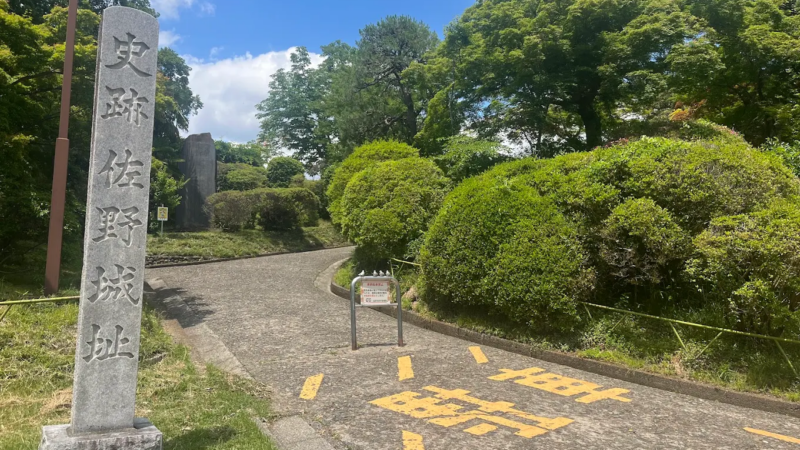
The area at the foot of the castle ruins has been developed as a park, featuring flowerbeds and walking paths. Cherry blossoms bloom in spring, and azaleas in early summer, delighting visitors.
Information boards are also installed in the park area, allowing visitors to learn about the castle’s history and structure. Gaining some background knowledge here before climbing the mountain castle will make for a more fulfilling visit.
Access and Visiting Information
Location
Iono, Nasu-machi, Nasu-gun, Tochigi Prefecture
Access by Car
From Nasu IC on the Tohoku Expressway, head north on National Route 294 for approximately 20 minutes. There is free parking near Shofuku-ji Temple, using Iono Elementary School as a landmark. It’s about a 5-minute walk from the parking lot to the castle ruins entrance.
Access by Public Transportation
From Kuroiso Station on the JR Tohoku Main Line, take a local bus (Kanto Jidosha) for approximately 30 minutes, get off at the “Iono” bus stop, and walk for about 10 minutes. However, since the number of buses is limited, it is recommended to check the timetable in advance.
Ascent Route
The mountain path begins beside Shofuku-ji Temple. There is a signpost at the Batō Kannon Hall, and from there, a walking trail is maintained leading to the San-no-maru, Ni-no-maru, and Hon-maru. The climb to Hon-maru takes approximately 20-30 minutes.
The paths are well-maintained, but there are steep slopes typical of mountain castles, so we recommend wearing comfortable shoes and clothing.
Estimated Visiting Time
If you plan to thoroughly explore the area, including the park at the foot of the mountain, allow approximately 1 hour 30 minutes to 2 hours. A round trip to the main keep will take about 1 hour.
Points to Note When Visiting
- As it is a mountain castle, the ground can become slippery during and after rain.
- Insect repellent is necessary during the summer.
- Bring your own drinking water (there are no vending machines on the mountain).
- Please be careful not to enter the earthworks or moats to protect the remains.
Nearby Tourist Attractions
Ashino Castle Ruins
Located approximately 5 kilometers north of Iono Castle, this is the site of the former residence of the Ashino clan, one of the seven Nasu warriors. Ashino Castle is also a mountain castle, and comparing it to Iono Castle will provide a better understanding of the characteristics of Nasu castles.
Iono Onsen (Hot Spring)
The Iono area has a hot spring facility, perfect for relaxing after visiting the castle. This hot spring is popular with locals, offering a peaceful and relaxing experience amidst the natural beauty of Nasu.
Former Post Town on the Oshu Kaido Road
Iono has a history as a thriving post town on the old Oshu Kaido (Tosan-do) road. Along National Route 294, traces of the old townscape remain, making it a great place for historical walks.
Yamizo Prefectural Natural Park
The Iono area is part of the Yamizo Prefectural Natural Park and boasts a rich natural environment. It’s an area where you can enjoy nature observation, such as hiking and birdwatching.
Iono Castle’s Evaluation and Features
Castle Evaluation
Iono Castle has received an average rating of ★★★ (around 3 points) in castle databases such as Kojodan. While lacking grand stone walls or a magnificent keep, this is an ideal example of an earthen castle, perfect for learning about the structure of a Sengoku period mountain castle.
The remains are well-preserved, with earthworks, moats, and trenches clearly visible, earning it a high rating of “Remains Evaluation B” from castle enthusiasts.
Historical Significance
As the base of the Iono clan, one of the seven powerful families of Nasu, this castle is indispensable for understanding the medieval history of northern Shimotsuke Province. It is a crucial historical site that tells the story of the Iono clan’s history spanning approximately 400 years, from the Kamakura period to the early Edo period.
Harmony with the Natural Environment
A major characteristic of Iono Castle is the remarkable harmony between its historical remains and natural environment, as evidenced by the prefectural-designated natural monument of the surrounding forest. It is a valuable spot where you can enjoy both historical exploration and nature walks simultaneously.
Tips for Enjoying Iono Castle
Recommended Prior Study
Before visiting Iono Castle, acquiring basic knowledge about the history of the Nasu clan and the Seven Knights of Nasu will deepen your understanding at the site. In particular, knowing the lineage of the Iono clan and the political situation in the Nasu region during the Sengoku period will reveal the castle’s strategic positioning.
Utilizing the Castle Layout Map
While a castle layout map is displayed on the information boards at the site, obtaining one beforehand from castle-related books or websites will allow for a more systematic exploration of the remains. Walking while being aware of the role each enclosure played will increase your discoveries.
Seasonal Charms
Iono Castle shows different faces depending on the season. Spring brings cherry blossoms and fresh greenery, summer brings deep green, autumn brings colorful foliage, and winter, with the leaves fallen, makes the remains easier to see. Winter, in particular, is the best season for observing the remains.
Photography Tips
There are numerous photo opportunities, including the view from the main keep, the moat on the west side of the second bailey, and the earthworks of each bailey. The morning light beautifully illuminates the ruins, so a morning visit is recommended for photography purposes.
Summary
Iono Castle is a valuable medieval mountain castle ruin remaining in Nasu Town, Tochigi Prefecture. The Iono clan, one of the seven powerful families of Nasu, resided there for approximately 140 years, playing a significant role in the history of the Nasu region.
The vast castle grounds, spanning approximately 20 hectares, feature well-preserved remains such as the main keep, second bailey, third bailey, earthworks, moats, and trenches, making it an ideal field for learning about the structure of a Sengoku period mountain castle.
The forest surrounding the castle site is a prefecturally designated natural monument, creating a fascinating historical site where historical remains and a rich natural environment harmonize. Iono Castle, where you can experience both the history and nature of Nasu simultaneously, is a recommended spot not only for castle enthusiasts but also for history buffs and nature lovers. When you visit Nasu, be sure to stop by Iono Castle and experience the history of the Seven Knights of Nasu and the charm of a medieval mountain castle.
--765x450.png)