Hirabayashi Castle Ruins (Murakami City, Niigata Prefecture) Complete Guide | Highlights and Access Information for a National Historic Site
Located in Hirabayashi, Murakami City, Niigata Prefecture, Hirabayashi Castle Ruins is a nationally designated historic site known as the residence of the Irobe clan, who ruled the Agakita region from the Nanboku-cho period to the Sengoku period. As a typical example of a Negoya-style castle, consisting of a residence at the foot of the mountain and a fortified area at the summit, the medieval castle remains are well-preserved, making it of extremely important value in the study of castle history.
This article comprehensively explains everything you need to know before visiting Hirabayashi Castle Ruins, from its historical background to specific highlights of the remains and access methods.
What is Hirabayashi Castle? | The Base of the Irobe Clan Who Ruled Echigo in the Middle Ages
Hirabayashi Castle is the site of a medieval mountain castle and residence built in Hirabayashi, Murakami City, Niigata Prefecture. It was officially designated as a national historic site on September 18, 1978, as Hirabayashi Castle Ruins.
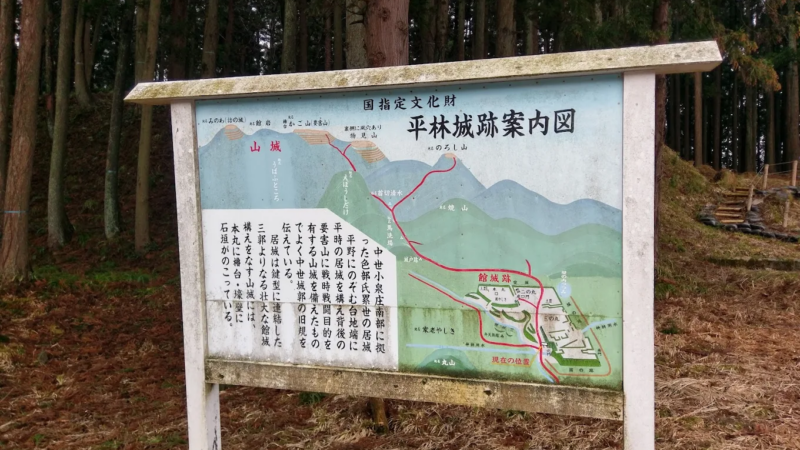
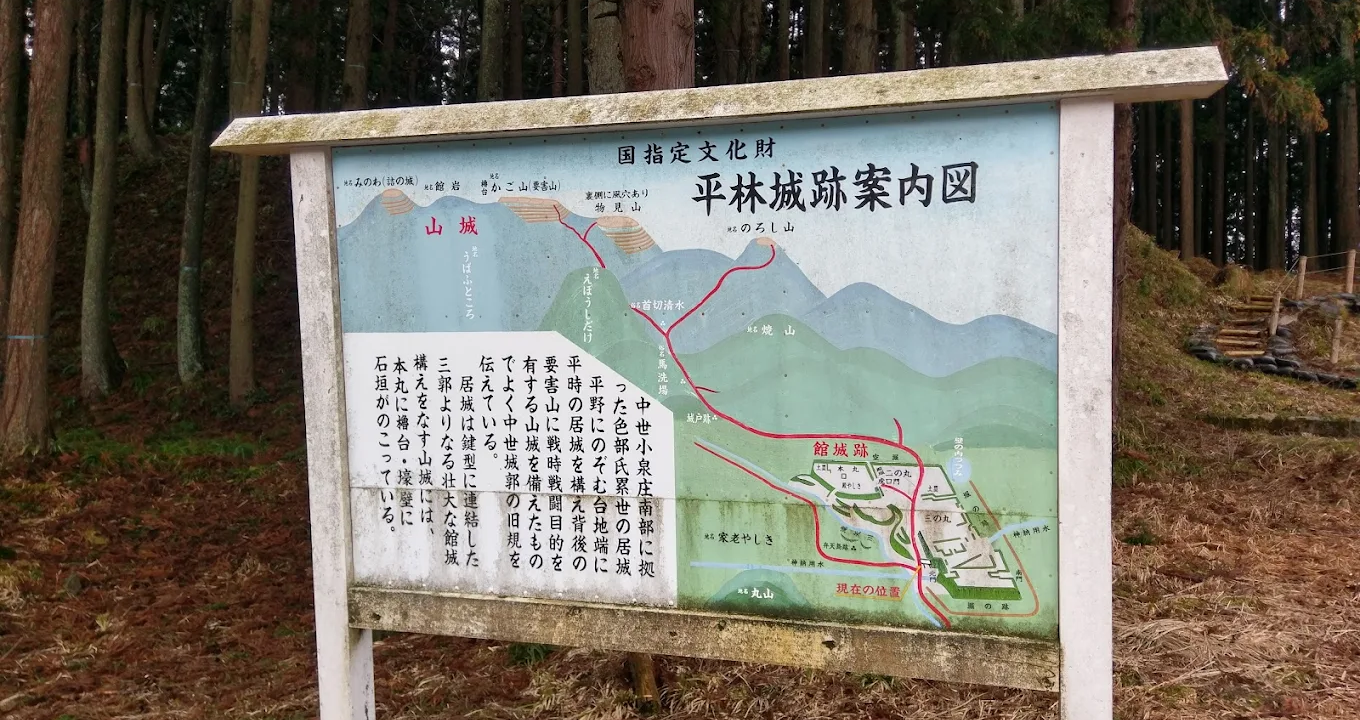
The castle is broadly composed of two parts. One is the residential area (Iwadate/Donoyashiki) built on a terrace at the foot of the mountain, which functioned as a living space during peacetime. The other is the mountain castle area (Kagoyama Castle/Kagoyama Fort) built on the rear, approximately 130 meters above sea level, which was used as a defensive base during wartime. This type of structure is called a Negoya-style castle and is a typical form of medieval mountain castle.
Characteristics of Hirabayashi Castle
The most distinctive feature of the Hirabayashi Castle ruins is that, after the Irobe clan was transferred to Kanayama Castle in Dewa Province (Nanyo City, Yamagata Prefecture) in 1598, the castle was abandoned. Therefore, the medieval remains have been preserved almost entirely intact, without undergoing any large-scale land alteration.
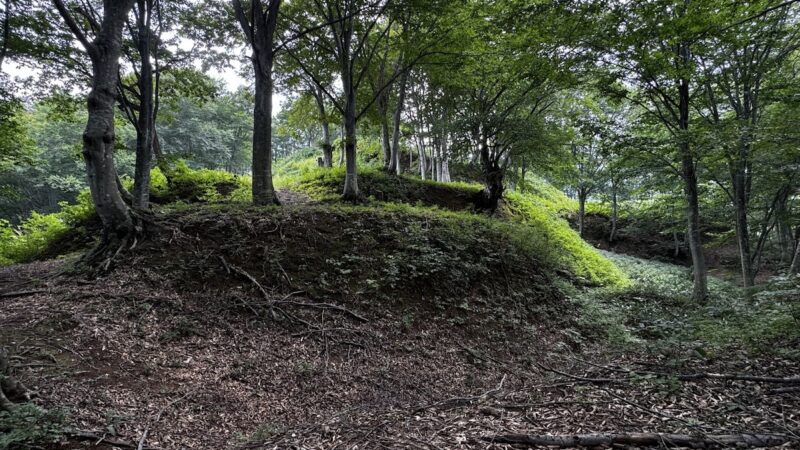
In the residential area, defensive structures such as earthworks, dry moats, and gates (koguchi) are clearly visible, while in the mountain castle area, the remains characteristic of mountain castles, such as baileys (kuruwa), trenches, and vertical moats, are well preserved. Due to this excellent state of preservation, it is a valuable resource for the study of medieval castles.
History of Hirabayashi Castle | From the Nanboku-cho Period to the Sengoku Period
From the Hirabayashi Clan to the Irobe Clan
The origins of Hirabayashi Castle date back to the Nanboku-cho period. Initially, this area was the residence of Hirabayashi Kuranosuke (Hirabayashi clan), who ruled Koizumi-sho Kano. The Hirabayashi clan sided with the Southern Court and Nitta Yoshisada, but were attacked and destroyed by the Irobe clan, a branch of the Chichibu Taira clan who had been the local stewards since the Kamakura period and supported the Northern Court. From then on, it became the residence of the Irobe clan.
Koizumi-sho was a vast manor occupying the central part of Iwafune District in northern Echigo Province. In the mid-Heian period, it was granted to the Fujiwara clan’s Nakamikado family as its lord, and consisted of two areas: Honjo and Kano. The Irobe clan expanded their power from Kano as their base.
The Rise of the Irobe Clan and Subjugation to the Uesugi Clan
Entering the Sengoku period, the Irobe clan grew into a powerful local lord in the Aga-kita region. In particular, during the time of Irobe Katsunaga, there were times of conflict with Nagao Tamekage, the deputy governor of Echigo Province. However, they were ultimately defeated by Tamekage and subsequently submitted to the Nagao clan (later the Uesugi clan).
During the time of Uesugi Kenshin, the Irobe clan played an active role as important retainers of the Uesugi family, controlling parts of Murakami City and the Aga-kita region, including Awashima Island. The Irobe clan, for generations, managed their territory from Hirabayashi Castle and remained an important force in northern Echigo throughout the Sengoku period. ### Abandoned Castle and Designation as a Historic Site
In 1598 (Keicho 3), following Uesugi Kagekatsu’s transfer to Aizu, the Irobe clan also moved to Kanayama Castle in Dewa Province, and Hirabayashi Castle was abandoned. Throughout the Edo period, the castle ruins remained untouched, resulting in the excellent preservation of medieval remains.
Recognizing this historical value, it was designated a national historic site in 1978 (Showa 53), and is now protected and utilized as an important historical site for the study of medieval castles.
Structure of Hirabayashi Castle Ruins | Details of the Residence and Fortifications
Residence (Iwadate/Donoyashiki)
Located on a terrace at the foot of the mountain, the residence was the space where the Irobe clan lived during peacetime. The residence site extends approximately 200 meters east-west and 150 meters north-south, surrounded by earthen ramparts and a dry moat.
The main remains of the residence area include the following:
- Earthworks: Defensive structures surrounding the residence, with well-preserved earthworks approximately 2-3 meters high.
- Dry Moats: Moats dug outside the earthworks, measuring 5-10 meters wide and 2-4 meters deep.
- Fortified Entrance: Entrances to the residence, showing ingenuity to enhance defensiveness.
- Level Differences: Multiple level differences within the residence indicate traces of the building’s layout.
The residence area served as both a place for daily life and a place for conducting the lord’s affairs. Excavations have unearthed artifacts such as pottery and daily necessities, providing clues to the lifestyle of the time.
Fortified Area (Kagoyama Castle/Kagoyama Fortified Area)
The fortified area is a mountain castle built on the summit of Mount Kagoyama (Fortified Mountain), approximately 130 meters above sea level, towering behind the residence. This fort was designed for siege during wartime and is also known as Kagoyama Castle or Kagoyama Fortress.
Main remains of the fortress:
- Main Enclosure: The most important enclosure located at the mountaintop, measuring approximately 40 meters east-west and 30 meters north-south.
- Moat: A moat dug to cut across the ridge, an important defensive structure to prevent enemy intrusion.
- Vertical Moat: A moat dug vertically along the slope, serving to prevent lateral movement of the enemy.
- Group of Enclosures: Multiple enclosures are arranged around the main enclosure, forming a stepped defensive line.
- Earthwork: Earthworks built along the edges of the enclosures remain in various places.
The mountain castle skillfully utilizes the steep terrain, resulting in a structure with strong characteristics as a natural fortress. It possesses typical features of mountain castles from the Sengoku period and is a valuable remains for understanding the castle-building techniques of that time.
Highlights of Hirabayashi Castle Ruins | Points to Note When Visiting
Earthworks and Dry Moats of the Residence Area
The first thing to note when visiting Hirabayashi Castle Ruins is the earthworks and dry moats of the residence area. These are typical defensive structures of a medieval residence and can be observed in remarkably good condition at the site.
In particular, the earthworks extending from the west to the north side retain their height, and their sheer size gives a real sense of the power of the Irobe clan. The dry moats are also clearly preserved, and walking along the bottom of the moats allows you to experience the reality of medieval defensive structures.
Hiking Trail to Yogaiyama Mountain
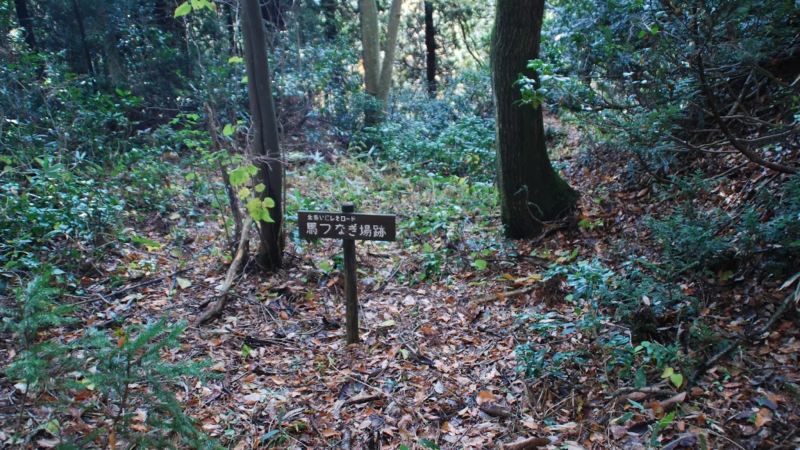
A hiking trail to Yogaiyama (Kagoyama) is maintained from the residence area, providing access to the mountain castle. The trail is relatively gentle, but it is about a 20-30 minute climb, so comfortable clothing and shoes are recommended.
Along the trail, you can observe remains unique to mountain castles, such as vertical moats and terraces. These are traces of how the castle’s defenses were enhanced through artificial modifications while utilizing the natural terrain, demonstrating the skillful castle-building techniques of the medieval period.
View from the Main Enclosure
Upon reaching the main enclosure of Yogaiyama, you can enjoy a panoramic view of the surrounding landscape. The excellent view helps explain why the Irobe clan chose this location as their base. On a clear day, you can see the Sea of Japan, the surrounding mountains, and the plains, giving a real sense of its strategic importance.
In the main enclosure, you can observe the shape of the baileys and the arrangement of the earthworks, imagining how defenses were implemented during wartime.
Preservation of the Remains
The greatest highlight of the Hirabayashi Castle ruins is undoubtedly its excellent state of preservation. Because no large-scale development took place after the castle’s abandonment, the medieval remains have been preserved almost exactly as they were.
The height of the earthworks, the depth of the dry moats, and the arrangement of the baileys—the three-dimensional structure of the castle, which is difficult to understand from drawings and photographs alone—can be directly experienced on-site, making the Hirabayashi Castle ruins a major attraction.
Progress of Archaeological Excavations and Research
At the Hirabayashi Castle ruins, archaeological excavations have been continuously conducted since the site was designated a historical site, accumulating new knowledge.
Results of Previous Excavations
Excavations have yielded numerous ceramic fragments, pottery, and metal artifacts from the residential area, providing important information about the lifestyle and trade relations of the Irobe clan. In particular, the discovery of Chinese celadon and white porcelain indicates that the Irobe clan was integrated into a wide-area trade network.
Furthermore, the layout of the buildings within the residence is gradually becoming clearer from the arrangement of building foundations and postholes. The spatial configuration of the main hall, storehouses, and vassal quarters is being reconstructed, contributing to the understanding of the actual conditions of a medieval lord’s residence.
Ongoing Preservation and Development
The Murakami City Board of Education is leading efforts to preserve and utilize the Hirabayashi Castle ruins. While prioritizing the protection of the remains, progress is being made in installing information boards and improving hiking trails to ensure the safe visit of visitors.
It is hoped that research, preservation, and maintenance work will continue in parallel, and that efforts will be made to convey the value of the Hirabayashi Castle ruins to a wider audience.
Access to Hirabayashi Castle Ruins
Location
Address: Hirabayashi, Murakami City, Niigata Prefecture
Access by Public Transportation
- Approximately 20 minutes on foot (approx. 1.6 km) from JR Uetsu Main Line “Hirabayashi Station”
- Hirabayashi Station is a small station where only local trains stop, so it is recommended to check the timetable in advance.
- If using a taxi from Murakami Station, it takes about 15 minutes.
Access by Car
- Approximately 15 minutes from Nihonkai Tohoku Expressway “Murakami Senami Onsen IC”
- Accessible via prefectural road from National Route 7
- Parking: There are several parking spaces near the entrance to the historical site.
Precautions for Visiting
- Visiting is free, but please be careful not to damage the remains in order to protect the historical site.
- When climbing Mt. Yogai, please wear comfortable clothing and non-slip shoes.
- Insect repellent is necessary in summer, and snow is a concern in winter.
- There are no facilities such as restrooms or shops, so please prepare in advance.
- While there are information boards and explanatory signs, obtaining materials beforehand will deepen your understanding.
Nearby Tourist Attractions
When visiting Hirabayashi Castle Ruins, we recommend also visiting nearby tourist attractions.
Murakami City Local History Museum
This museum introduces the history and culture of Murakami City and also has exhibits related to Hirabayashi Castle Ruins. Viewing excavated artifacts and reconstructed models will deepen your understanding of Hirabayashi Castle Ruins.
Murakami Castle Ruins
Murakami Castle Ruins, located in the center of Murakami City, is also designated as a national historic site. Visiting it together with Hirabayashi Castle Ruins allows you to learn about the changes in castles in northern Echigo from the medieval to the early modern period.
Senami Onsen
This hot spring resort faces the Sea of Japan and is about a 20-minute drive from Hirabayashi Castle Ruins. After exploring the castle ruins, you can relax and soothe your fatigue in the hot springs.
Glossary
This section explains important terms for understanding Hirabayashi Castle Ruins.
Negoya-style Castle
A castle structure where the peacetime residence (Negoya) is located at the foot of the mountain, and the wartime mountain castle (Tsume-shiro) is positioned on the mountaintop behind it. This structure is commonly seen in medieval mountain castles, and the Hirabayashi Castle ruins are a typical example.
Irobe Clan
A samurai group descended from the Chichibu Taira clan, they were local lords based in Iwafune District, Echigo Province, from the Kamakura period. During the Sengoku period, they played an active role as important retainers of the Uesugi clan.
Kuruwa (Enclosure)
A flat area within a castle enclosure where buildings were constructed and soldiers were stationed. Also called a leveled area or enclosure.
Horikiri (Moat)
A moat dug to cut across a ridge. In mountain castles, it is an important defensive structure to stop enemies attacking along the ridge.
Tatebori (Vertical Moat)
A moat dug vertically along the slope of a mountain. It serves to hinder enemy lateral movement and limit attack routes.
Earthworks
Dorui (earthen ramparts)
Dorui are defensive structures built by piling up earth. Built around the perimeter of castles and on the edges of baileys, they enhanced defensive capabilities and also served to conceal the interior.
Summary | Historical Value of Hirabayashi Castle Ruins
Hirabayashi Castle Ruins is an important historical site that has witnessed approximately 300 years of history as the residence of the Irobe clan, who ruled northern Echigo from the Nanboku-cho period to the Sengoku period.
As a typical example of a Negoya-style castle consisting of a residence area and a fortified area, and as a rare example of a medieval castle with minimal alterations after its abandonment and well-preserved remains, it has been designated a national historic site. Earthworks, dry moats, trenches, and vertical moats can be clearly observed, making it a valuable place to experience the reality of a medieval castle.
When visiting Murakami City, Niigata Prefecture, be sure to visit Hirabayashi Castle Ruins and feel the spirit of the Sengoku period when the Irobe clan was active. Standing on the site allows you to truly appreciate the importance of the castle’s three-dimensional structure and strategic location, something that cannot be obtained from history books and documents alone.
Hirabayashi Castle Ruins are an indispensable historical site for understanding Japanese medieval history, particularly the Sengoku period in Echigo Province, and are a cultural asset whose preservation and utilization are expected to continue in the future.