A Thorough Explanation of the History and Highlights of Shiizu Castle (Ichihara City, Chiba Prefecture) | Visiting a Fierce Battlefield of the Sengoku Period
Overview of Shiizu Castle
Shiizu Castle (Shiizu-jo) is a castle from the Sengoku period that once existed in Shiizu, Ichihara City, Chiba Prefecture, and is now preserved as a Chiba Prefecture designated historical site. Located on a plateau behind Yasaka Shrine in the Anesaki district, the southern gateway to Ichihara City, it boasts one of the largest scales in the city, measuring approximately 400 meters north-south, 180 meters east-west, and 28 meters above sea level.
The castle’s greatest feature lies in its location. Built on a plateau facing the mouth of the Shiizu River, it was a strategically important location that simultaneously controlled land transportation routes such as the Boso Highway and the Kururi Highway West Highway, which connected Musashi and Shimosa to Kazusa and Awa, and Shiizu Port, a key water transportation point facing Tokyo Bay. Therefore, during the Sengoku period, it was a historically important castle where fierce battles were fought numerous times by various forces vying for supremacy in the Kanto region.
Also known as “Shiroyama” (Castle Mountain), it is a medieval mountain castle that, while lacking a keep, still retains well-preserved remains such as earthworks and moats, making it a valuable historical site for studying the structure of castles during the Sengoku period.
History and Construction of Shiizu Castle
Construction Period and Builder
There are still various theories regarding the builder and construction year of Shiizu Castle, and it has not been definitively determined. Due to the limited historical materials, it is difficult to pinpoint the exact construction date, but it is believed to have functioned as a castle by the late Muromachi period at the latest.
During the Sengoku period, multiple historical sources confirm that it was under the control of Takeda Nobunaga (Kazusa Takeda clan), whose base was Mariya Castle. The Kazusa Takeda clan was a separate branch from the Kai Takeda clan and wielded considerable power in Kazusa Province. Shiizu Castle is presumed to have been an important base for maintaining the Takeda clan’s sphere of influence on the Boso Peninsula, serving as a branch castle of Mariya Castle.
The Importance of Shiizu Castle in the Sengoku Period
Shiizu Castle first appeared on the historical stage amidst the complex political situation in the Kanto region during the Sengoku period. During this time, two Ashikaga clan factions, the Koga Kubo and the Oyumi Kubo, were in conflict in the Kanto region, and various Sengoku daimyo such as the Later Hojo, Satomi, and Kazusa Takeda clans were also involved in the turmoil.
Due to its geographical location as a key point for land and water transportation, Shiizu Castle was positioned as an important base for controlling the Boso Peninsula and became a target of conflict among these various forces. The fact that its name appears in numerous historical documents demonstrates how important this castle was at the time.
Fierce Battles Surrounding Shiizu Castle
The history of Shiizu Castle is truly a history of battle. Over a period of approximately 70 years, at least five major battles were recorded at Shiizu Castle, each resulting in a turbulent era with a change of castle lord.
Battle of Eisho 16 (1519) | Ashikaga Yoshiaki (Oyumi Shogun) vs. Ashikaga Takamoto (Koga Shogun)
The first major battle at Shiizu Castle occurred in Eisho 16 (1519). This battle was part of a struggle for leadership within the Ashikaga clan in the Kanto region.
Ashikaga Yoshiaki, the Oyumi Shogun, who was in conflict with Ashikaga Takamoto, the Koga Shogun, attacked Shiizu Castle in an attempt to expand his power into Kazusa Province. While historical records are limited regarding the castle lord at the time and the detailed battle situation, this battle symbolized the division of the Shogunate in Kanto and the resulting reorganization of regional powers.
This battle marked a turning point, transforming Shiizu Castle from a mere local lord’s residence into a strategic base influencing the political situation in Kanto.
The Battle of 1534 | Takeda Nobutaka and Nobumasa vs. Ashikaga Yoshiaki and Takeda Nobuo
In 1534, a battle stemming from an internal split within the Kazusa Takeda clan unfolded at Shiizu Castle. A fierce battle took place between Takeda Nobutaka and his son Nobumasa, and Takeda Nobuo, who sided with Ashikaga Yoshiaki, the Oyumi Shogun.
This battle was not merely an internal power struggle within the Takeda clan, but also a proxy war between the two major powers of the Kanto region: the Koga Shogun faction and the Oyumi Shogun faction. Control of Shiizu Castle held significant importance in determining the balance of power on the Boso Peninsula.
As a result of the battle, the castle’s ruler changed, bringing about a major shift in the power dynamics of Kazusa Province.
The Battle of Shiizu in 1552 (Tenbun 21) | Takeda Nobumasa vs. Satomi Yoshitaka and Yoshihiro
The most famous battle in the history of Shiizu Castle is the “Battle of Shiizu,” which took place in 1552 (Tenbun 21). This battle was a crucial turning point, marking the beginning of the Satomi clan’s expansion into Kazusa Province, based in Awa Province.
At the time, Shiizu Castle was controlled by Takeda Nobumasa. The Satomi army, led by Satomi Yoshitaka and his son Yoshihiro, attacked Shiizu Castle with a large force. Takeda Nobumasa resisted and defended the castle, but it fell to the fierce attack of the Satomi army. Nobumasa committed suicide.
With this victory, the Satomi clan secured a base in Kazusa Province and established their position as the largest power on the Boso Peninsula. Shiizu Castle came under the control of the Satomi clan and became an important frontline base in their conflict with the Hojo clan.
The Battle of Shiizu was a turning point in the Sengoku period history of the Boso Peninsula, and it significantly shaped the subsequent regional situation.
Battle of 1564 | Satomi Army/Kiso Samanosuke vs. Hojo Ujimasa
In 1564, Hojo Ujimasa of Sagami Province invaded the Boso Peninsula with a large army. At this time, Shiizu Castle was defended by Kiso Samanosuke, a member of the Satomi army.
The Hojo clan, as the largest Sengoku daimyo in the Kanto region, aimed to establish control over the Boso Peninsula. Shiizu Castle’s strategic location at a key point for land and water transportation was strategically important to the Hojo clan, and it was a crucial target for driving the Satomi clan out of Boso.
While historical sources differ on which side gained control of the castle after the fierce battle, it is clear that Shiizu Castle functioned as the front line between the Satomi and Hojo clans throughout this conflict. From then on, as the conflict between the two forces continued, Shiizu Castle became the stage for numerous battles.
Battle of 1590 (Tensho 18) | Hojo Army – Shirahata Rokuro vs. Toyotomi Army – Asano Nagamasa
The last major battle at Shiizu Castle occurred in 1590 (Tensho 18) during Toyotomi Hideyoshi’s siege of Odawara.
At this time, Shiizu Castle was defended by Shirahata Rokuro of the Hojo clan. The Toyotomi army, led by Asano Nagamasa and acting on orders from Toyotomi Hideyoshi, invaded the Boso Peninsula and attacked various Hojo castles, including Shiizu Castle.
Overwhelmed by the superior numbers, Shiizu Castle fell, marking the end of Hojo rule. With the fall of the Odawara Hojo clan, the history of Shiizu Castle during the Sengoku period also came to a close.
After this battle, Shiizu Castle ceased to function as a military base and is believed to have been abandoned during the Edo period.
Structure and Layout of Shiizu Castle
Concentric Layout
Shiizu Castle is a medieval mountain castle with a concentric layout that skillfully utilizes the topography of a tongue-shaped plateau (a plateau shaped like an extended tongue). A concentric layout is a castle structure in which multiple enclosures (kuruwa) are arranged in a straight line or in a stepped pattern, maximizing the use of the plateau’s shape.
The castle grounds extend approximately 400 meters north-south and 180 meters east-west, making it one of the largest castles in Ichihara City. Built on a plateau 28 meters above sea level, it offers excellent views of the Boso Highway and Shiizu Port below, making it a strategically advantageous location for surveillance and defense.
Main Enclosure and Earthworks
The main enclosure (honmaru) is located in the center of the castle, currently situated south of Yasaka Shrine. Earthworks surround the main enclosure, and parts of them remain in good condition today.
Earthen ramparts were crucial structures that prevented enemy intrusion, ensured visibility from within the castle, and enhanced defensive capabilities. The earthen ramparts of Shiizu Castle are valued as precious relics that convey the castle-building techniques of the Sengoku period (Warring States period).
Entrance (Koguchi)
The entrance (koguchi) to the castle has also been identified. The koguchi was the most important part of a castle’s defense, and various ingenious measures were taken to stop enemy intrusion.
The koguchi of Shiizu Castle was designed to enhance defensive capabilities by combining it with earthen ramparts and moats, exhibiting a typical structure of a medieval castle.
Moat and Defensive Structures
Behind the south side of the castle, a moat remains, artificially cut through the plateau. This moat was an important defensive structure to prevent enemy intrusion from the plateau, and the deeply excavated ditch is clearly visible.
This moat is an important relic for understanding the defensive structure of Shiizu Castle and demonstrates the high level of castle-building technology of the time.
Arrangement of Enclosures
It is believed that multiple enclosures (kuruwa) were arranged around the main enclosure. These enclosures functioned as troop garrisons, storage facilities for supplies, and defensive strongholds during battles.
Currently, much of the castle site is occupied by residential areas and farmland, but the topography and elevation changes allow us to infer the original layout of the enclosures. Archaeological excavations have confirmed medieval partitioned tombs, ditch-like structures, underground pits, earth pits, and post-hole-like structures, indicating that the site was used not only as a castle but also as a living space for people.
Relationship with Land and Water Transportation
An essential aspect of understanding the structure of Shiizu Castle is its relationship with water transportation. The castle was located near the mouth of the Shiizu River and faced Tokyo Bay directly. Therefore, it was possible to transport supplies and troops by sea, and its location allowed control of both land and sea routes.
The castle’s structure is thought to have been designed to monitor and manage both land and water transportation. From the plateau, one could overlook the harbor and the sea, allowing for observation of ship movements.
Highlights and Current Status of Shiizu Castle
Preservation Status and Remains
Shiizu Castle ruins are protected as a Chiba Prefecture designated historical site, making it a valuable historical site where the remains of a Sengoku period castle can still be seen today. The earthworks, gates, and moats around the main enclosure remain in relatively good condition, allowing visitors to learn about the structure of a medieval mountain castle firsthand.
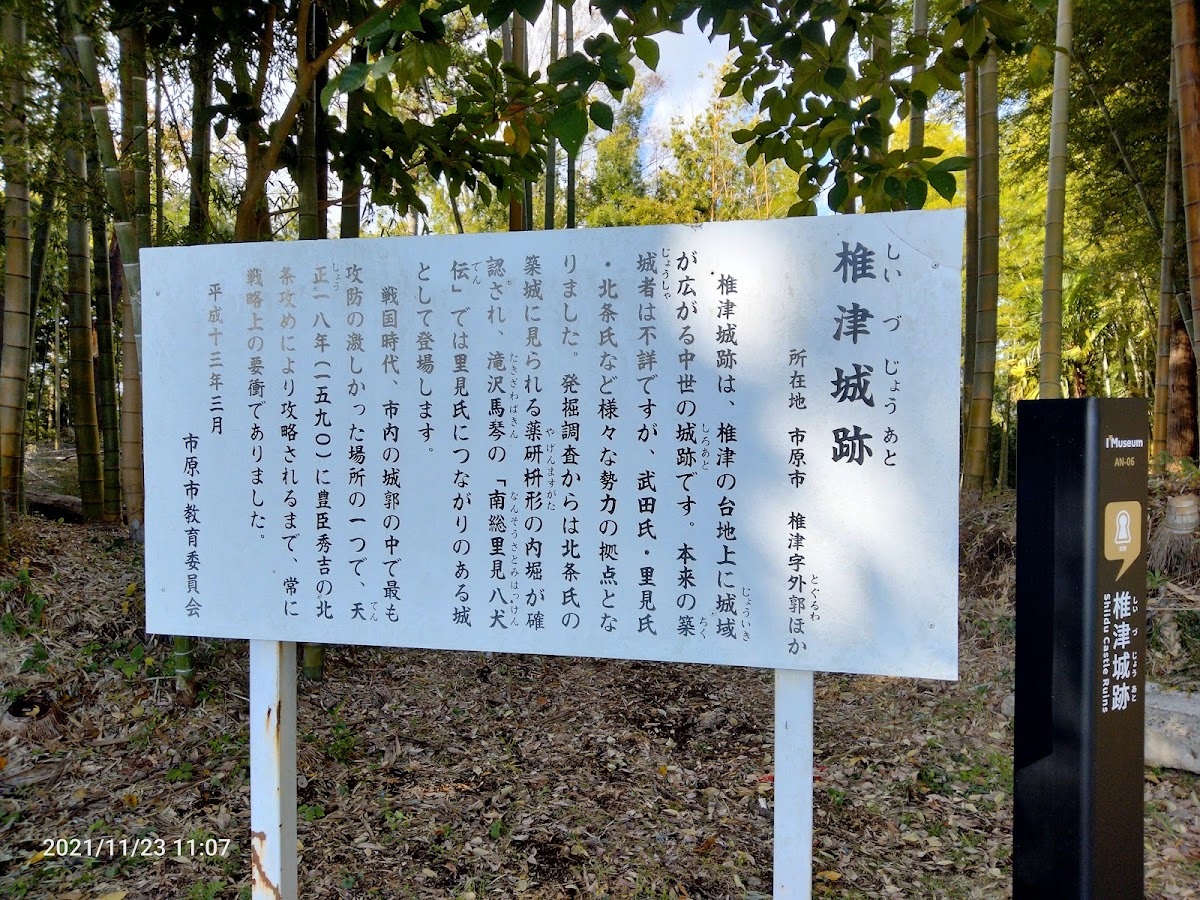
Walking paths are maintained within the castle ruins, making it safe to visit. Information boards are also installed, allowing visitors to deepen their understanding of the castle’s history and structure while strolling.
Relationship with Yasaka Shrine
Yasaka Shrine is located near the main enclosure of Shiizu Castle. The main remains of the castle are located on the hill behind the shrine, and visiting the shrine makes access to the castle ruins easier.
From the shrine grounds, one can understand the castle’s location and the surrounding topography, and truly grasp why the castle was built in this location.
Archaeological Excavation Results
At the Shiizu Castle ruins (Goreidai area), archaeological excavations have been conducted, revealing medieval partitioned burial mounds, two ditch-like structures, four underground pits, 21 earthen pits, post-hole-like structures, and numerous small pits.
These discoveries have revealed that the castle was not merely a military facility, but also a place where people lived and buried the dead. Analysis of the excavated artifacts has provided valuable information about the lifestyle and culture of the time.
Landscape and Views
Located on a plateau 28 meters above sea level, the Shiizu Castle ruins offer panoramic views of the surrounding landscape. The views of the former Boso Highway and Tokyo Bay give a real sense of the castle’s importance as a key point for land and water transportation.
Especially on clear days, the topography surrounding the castle and the layout of transportation routes become clear, making it easy to understand why warlords of the Sengoku period considered this location important.
Access and Visiting Information
Transportation Access
Access to Shiizu Castle Ruins is relatively easy. It’s conveniently located about a 10-minute walk from Anegasaki Station on the JR Uchibo Line, making it easily accessible on foot.
There are signs guiding you towards the castle ruins from the station, so even first-time visitors won’t get lost. If you’re visiting by car, parking is limited in the surrounding area, so using public transportation is recommended.
Points to Note During Your Visit
Brochures are sometimes available at the southern entrance to the castle ruins, providing detailed information about the castle’s history and highlights. The main enclosure can be reached relatively quickly, and the well-maintained walking paths make it easy to navigate.
When visiting, it’s recommended to observe the actual scale of the defensive structures, such as the height and shape of the earthworks and the depth of the moats. Also, observing the plateau’s topography and the surrounding landscape will help you understand why the castle was built in this location.
Related Historical Sites in the Surrounding Area
When visiting Shiizu Castle, visiting the related historical sites in the surrounding area will provide a deeper understanding of the Sengoku period history of Boso. Several castles from the Sengoku period (Warring States period) of Kazusa Province, such as Mariya Castle Ruins and Kururi Castle, exist around Ichihara City.
Furthermore, the Ichihara Historical Museum offers detailed materials and excavated artifacts related to Shiizu Castle, allowing visitors to learn more about the castle’s history.
Shiizu Castle Tells the Story of Boso’s Sengoku History
Strategic Importance of the Boso Peninsula
The history of Shiizu Castle vividly illustrates the strategic importance of the Boso Peninsula during the Sengoku period. Located at the easternmost tip of the Kanto region, the Boso Peninsula faced Musashi Province (present-day Tokyo and Saitama areas) across Tokyo Bay, making it a crucial hub for maritime traffic.
Controlling this area was essential for gaining hegemony over the entire Kanto region, and therefore, various forces fiercely vied for control. Shiizu Castle functioned as one of the most important strongholds on the Boso Peninsula.
The Changing Lords of Shiizu Castle Reflect the Flow of Time
The lords of Shiizu Castle changed at least five times in approximately 70 years. This frequent change of lords symbolizes the turmoil and instability of the Sengoku period (Warring States period).
From the Ashikaga clan to the Takeda clan, from the Takeda clan to the Satomi clan, from the Satomi clan to the Hojo clan, and finally to the unification under the Toyotomi regime. The history of Shiizu Castle can be said to be a condensed representation of the major currents of Japanese history, from the Sengoku period to the unification of Japan.
Impact on the Local Community
The repeated wars had a significant impact on the local community surrounding Shiizu Castle. Damage from battles, changes in the governing system due to changes in rulers, and impacts on economic activity—the battles surrounding the castle directly affected the lives of the local residents.
At the same time, it also brought about the development of the castle town and economic prosperity as a key point for land and water transportation. The history of Shiizu Castle is an important case study for understanding the realities of local communities during the Sengoku period.
Other Special Notes
Shiizu Castle in Historical Documents
Shiizu Castle appears in numerous historical documents. In addition to military chronicles and compilations such as the *Kaigen Sozu Ki* and *Kamakura Ososhi*, it is also mentioned in contemporary letters, making it a castle with relatively abundant historical evidence.
By comprehensively analyzing these documents, it is possible to reconstruct in detail the specific battles surrounding the castle and the evolving political situation in the Kanto region.
Importance of Archaeological Investigations
In addition to historical documents, archaeological findings from excavations play a crucial role in Shiizu Castle research. Analysis of the layout of the remains and excavated artifacts is revealing aspects of the castle and the lives of the people that cannot be understood from documents alone.
Continued research is expected to further deepen our understanding of Shiizu Castle.
Efforts for Preservation and Utilization
The Shiizu Castle site is legally protected as a Chiba Prefecture designated historical site and is safeguarded from development. Preservation efforts are underway by Ichihara City and local residents, including the development of walking paths and the installation of information boards, promoting its use as a historical site.
It is also used as a site for history education, attracting many visitors, including local schools for their regional studies and history enthusiasts.
Summary
Shiizu Castle is a valuable castle ruin from the Sengoku period remaining in Ichihara City, Chiba Prefecture. Due to its strategic location at a key point for land and water transportation, it was the site of fierce battles between prominent Sengoku daimyo such as the Ashikaga, Takeda, Satomi, and Hojo clans, making it an indispensable historical site for understanding the Sengoku history of the Boso Peninsula.
Boasting one of the largest scales in the city, measuring 400 meters north-south and 180 meters east-west, the remains of earthworks, gates, and moats are well-preserved, allowing visitors to learn about the structure of a medieval mountain castle firsthand. Its convenient access, approximately a 10-minute walk from Anegasaki Station, is also a major attraction.
By visiting the ruins of Shiizu Castle, which tell the story of the turbulent Sengoku period, you can experience firsthand the depth of the region’s history that you can’t learn from textbooks, and get a real feel for the lives of the people who lived there at that time. This is a historical site that we highly recommend for anyone interested in the Sengoku period history of Boso or who enjoys visiting castles.