Konpukuji Castle (Kaizuka City, Osaka Prefecture) Complete Guide: One of Izumi’s Leading Mountain Castles with a Massive Group of Ridged Vertical Moats
What is Konpukuji Castle?
Konpukuji Castle is a Sengoku period mountain castle built on a 283-meter-high mountain spanning Kibitani and Okawa in Kaizuka City, Osaka Prefecture. With a relative height of approximately 130 meters and a vast fortress spanning approximately 600 meters east-west and 350 meters north-south, it is known as one of the largest medieval mountain castles in Osaka Prefecture, alongside Iimori Castle and Akutagawayama Castle.
Of particular note are the massive group of ridged vertical moats remaining on the southwestern slope of the mountain. The starting ridges reach a height of 2 meters, and this defensive structure, extremely rare for a mountain castle in Osaka Prefecture, is preserved in excellent condition. This remains are rare and valuable nationwide, and are highly regarded by castle researchers.
History of Nefukuji Castle
Construction and the Nodayama Castle Era
According to ancient documents remaining in the Ide family, the village headmen of Mizuma Village, Nefukuji Castle was built in 1535 (Tenbun 4) by Matsura Hizen-no-kami Mamoru, the deputy governor of Izumi Province. Initially called “Nodayama Castle,” it is believed to have functioned as a defensive base for Izumi Province.
It is presumed that Matsura Hizen-no-kami, as the deputy governor of Izumi, attempted to strengthen his control over southern Izumi by building a castle on the mountain ridge along the Kikuchi River, a strategically important military location in the region.
Transition to Negoro-ji Temple’s Control
In 1543 (Tenbun 12), the castle came under the control of Negoro-ji Temple and was renamed “Nefukuji Castle.” During this period, the Negoro clan, based in Kii Province (present-day Wakayama Prefecture), was actively expanding its influence into Izumi Province, and Nefukuji Castle was positioned as a crucial base.
The Negoro clan, while a group of warrior monks, possessed advanced military capabilities and were known for their manufacture and use of firearms. By using Nefukuji Castle as their base, they gained control of the Mizuma Road running to the south, strengthening their influence in southern Izumi.
Hashiba Hideyoshi’s Conquest of Kii Province and the Castle’s Demise
In 1585 (Tensho 13), Hashiba Hideyoshi (later Toyotomi Hideyoshi) launched his conquest of Kii Province, and Negoro-ji Temple surrendered. However, interestingly, the name of Nefukuji Castle does not appear in historical records concerning Hideyoshi’s invasion of Kii Province. This suggests the possibility that Nefukuji Castle had already been abandoned before that time.
From the Eiroku period to the early Tensho period, as the conflict between the Negoro clan and the forces of Oda Nobunaga and Hideyoshi intensified, it is believed that Nefukuji Castle lost its strategic value or was abandoned for some reason.
Structure and Characteristics of Nefukuji Castle
Layout of a Single Castle with Separate Enclosures
Nefukuji Castle is a large mountain castle with a single castle and separate enclosures centered around two peaks, east and west. It is broadly divided into the “Eastern Enclosure Group” centered on the eastern peak and the “Western Enclosure Group” centered on the western peak, and it is said that the main gate was located in the central saddle.
The eastern and western enclosure groups have different characteristics. The eastern side has a castle-temple-like structure with many small terraced enclosures, and stone walls can be seen in places. On the other hand, the western side has a simpler structure centered around a vast enclosure called “Senjojiki” (Thousand Tatami Mat Area).
Characteristics of the Eastern Enclosure Group
The eastern enclosure group has a structure with relatively small enclosures arranged in a stepped pattern, and it is presumed that there was a facility where the warrior monks of Negoro-ji Temple were stationed. Traces of stone walls and stone masonry remain throughout the baileys, strongly suggesting its character as a castle-temple.
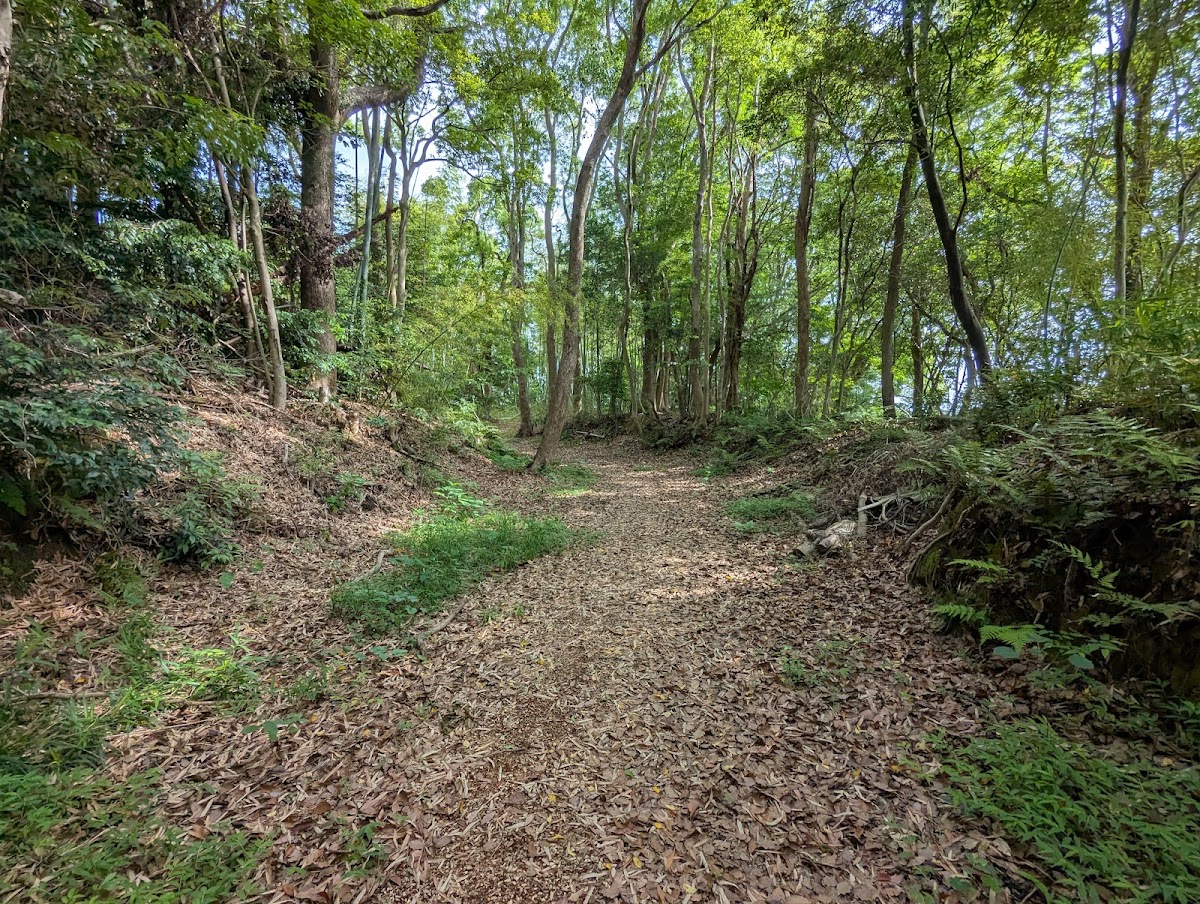
The earthworks are also well-preserved, and the moats separating the baileys can be seen. From the top of the eastern bailey group, one can see a panoramic view of the Izumi Plain, indicating its important position for surveillance.
Western Bailey Group and Senjojiki
At the heart of the western bailey group is a vast flat area called “Senjojiki.” In contrast to the eastern bailey group, this bailey was designed as a space capable of accommodating a large number of troops, suggesting a strong character as a practical military facility.
Earthworks surround Senjojiki, enhancing its defensive capabilities. From the western bailey group, one can look down on the valley of the Kikuchi River, making it a suitable location for monitoring and defending the road.
The Awe-Inspiring Group of Massive Ridge-Shaped Vertical Moats
The greatest highlight of Nefukuji Castle is the massive group of ridge-shaped vertical moats remaining on the southwestern slope. A ridged trench is a defensive structure where multiple trenches are dug parallel to a mountain slope, leaving ridges between them. This effectively hinders enemy lateral movement and makes attacks difficult.
The ridged trenches at Nefukuji Castle are particularly noteworthy; the starting ridges reach approximately 2 meters in height, and their scale and state of preservation are rare nationwide. No other castle in Osaka Prefecture retains such a clearly defined group of ridged trenches, making it a must-see for castle enthusiasts.
This group of ridged trenches is believed to have been constructed during the time the Negoro clan controlled the castle, serving as evidence of their advanced castle-building techniques.
Moats and Double Moats
Moats are located throughout the castle grounds, separating enclosures and preventing enemy intrusion. Of particular note are the double moats, which significantly enhance defensive capabilities by digging two trenches.
The depth and width of the moat are substantial, clearly reflecting the defensive thinking of the time. Combined with the steepness of the slope, it was an extremely difficult structure for an attacking force to conquer.
Stone Walls and Stone Masonry
Nefukuji Castle has a relatively large number of stone walls and stone masonry remains for a medieval mountain castle. They can be seen particularly in various locations within the eastern enclosure group, used on the edges of the enclosures and around the entrance gates.
The stone masonry technique is relatively simple, mainly consisting of rough-hewn stone masonry using natural stones, but it demonstrates the castle’s status and achieves a solidity that could not be obtained with earthworks alone.
Access to Nefukuji Castle
Location
- Address: Kikuya, Okawa, Kaizuka City, Osaka Prefecture
- Elevation: 283 meters
- Relative Height: Approximately 130 meters
Access by Public Transportation
The nearest station is Mizuma Kannon Station on the Mizuma Railway. It is approximately a 30-minute walk from the station to the castle entrance. To reach the castle, head towards the Kinotani settlement and then enter the mountain trail.
Bus services are limited, so it is recommended to check the timetable in advance.
Access by Car
It’s about 15 minutes from the Kaizuka IC on the Hanwa Expressway. There is parking space near the Kinotani settlement, but the mountain road is narrow, so careful driving is necessary. Entering “Kinotani, Kaizuka City” into your car navigation system is recommended.
It is also listed as “Nefukuji Castle Ruins” on Google Maps, so you can use your smartphone’s navigation function.
Ascent Route
The climb from the entrance to the castle grounds takes approximately 30-40 minutes. The elevation difference is 130 meters, but the path has steep sections, so appropriate clothing and shoes for hiking are essential.
The castle grounds are not well-maintained, and there are bushes and fallen trees, so it may be a bit challenging for beginners. However, for castle enthusiasts and fans of medieval castles, its untouched state is its charm, and it provides an environment where it is easy to imagine its former appearance.
Points to Note When Visiting
Equipment and Preparation
- Trekking shoes or hiking boots are essential.
- Long-sleeved shirt and long pants (for bushwhacking).
- Gloves (for rocky areas and bushes).
- Drinking water and snacks.
- Map and compass (smartphone map apps are also useful).
- Insect repellent spray (especially in spring and autumn).
Season and Time of Year
The best time to visit is from late autumn to early spring when the undergrowth is sparse. Especially from November to March, the ruins are easier to observe, and there are fewer insects, making for a comfortable walk.
In summer, the undergrowth is thick, making it difficult to see the ruins, and there is also the danger of venomous snakes such as pit vipers and wasps, so it is best to avoid visiting unless you are experienced.
Safety Precautions
There are few signs within the castle grounds, and some paths are unclear. It is recommended to avoid going alone and, if possible, visit with multiple people. It is also a good idea to obtain a topographic map and a layout map in advance and check the route. Because cell phone signals can be unstable in some areas, it’s important to submit a climbing plan or inform your family of your destination as a precaution.
The Charms and Highlights of Nefukuji Castle
One of Osaka Prefecture’s Largest Medieval Mountain Castles
Nefukuji Castle is one of the largest medieval mountain castles in Osaka Prefecture. It is a large-scale castle comparable to Iimori Castle (Shijonawate City/Daito City) and Akutagawayama Castle (Takatsuki City), and speaks to its military importance in Izumi Province during the Sengoku period.
The vast castle grounds, stretching 600 meters from east to west, require considerable time to explore on foot, allowing you to truly appreciate the scale of the castle at that time.
A Rare Group of Ridge-Shaped Vertical Moats Nationwide
The greatest attraction is undoubtedly the massive group of ridge-shaped vertical moats remaining on the southwest slope. No other castle in Osaka Prefecture retains such a clear and large-scale network of ridged vertical moats, making it an extremely valuable historical site for studying medieval castle defense techniques.
The sheer size of the ridges, reaching up to 2 meters in height, is overwhelming when viewed in person. Castle enthusiasts from all over Japan visit specifically to see these remains.
Negoro-shu’s Castle Construction Techniques
The Negoro-shu were a group of warrior monks, yet they possessed advanced military technology. The remains of Nefukuji Castle reveal the high level of their castle construction skills.
The network of ridged vertical moats, double moats, complex bailey layouts, and the use of stonework demonstrate the latest technology of the late Sengoku period, clearly indicating its character as a strategic base rather than just a local mountain castle.
Excellent Preservation of the Remains
Nefukuji Castle escaped development and lay quietly dormant in the mountains, resulting in an exceptionally well-preserved state of its remains. The main remains, such as earthworks, moats, ridged vertical trenches, and stone walls, are preserved in almost perfect condition, allowing visitors to imagine the castle’s appearance in its heyday.
The fact that it hasn’t been extensively maintained actually works to its advantage, giving it high academic value as an “unaltered historical site.”
Nearby Castles and Tourist Spots
Sengokubori Castle
Located south of Nefukuji Castle, within Kaizuka City, this is the site of a medieval castle. It may have functioned concurrently with Nefukuji Castle, and visiting both together helps understand the medieval castle network in this region.
Kishiwada Castle
Located in Kishiwada City, just north of Kaizuka City, this is a modern castle. The keep has been restored, offering a contrasting example of a modern castle compared to Nefukuji Castle. It’s conveniently located for a visit before or after a visit to Nefukuji Castle.
Mizumadera Temple
An ancient temple known as Mizuma Kannon, located on the way to Nefukuji Castle. You can enjoy the historic temple architecture and combine it with a historical walk to visit castles.
Iimori Castle and Akutagawayama Castle
Other large-scale medieval mountain castles in Osaka Prefecture include Iimori Castle in Shijonawate City and Daito City, and Akutagawayama Castle in Takatsuki City. All are castles of similar scale to Nefukuji Castle and can be combined into a route to tour medieval castles in Osaka.
Cultural Value of Nefukuji Castle
The Nefukuji Castle ruins are recognized as an important cultural property of Kaizuka City, and the city’s board of education has conducted investigations. The city’s public relations magazine, “Koho Kaizuka,” has also featured it, and efforts are underway to protect and utilize it as a local historical heritage site.
It is one of the largest medieval mountain castles in Osaka Prefecture, and its ridged trenches, in particular, have high academic value. It is an important historical site that is expected to be designated as a historical site in the future.
Summary: Nefukuji Castle is a Must-See Medieval Mountain Castle
Nefukuji Castle is a large-scale mountain castle from the Sengoku period located in Kaizuka City, Osaka Prefecture. It is a valuable historical site with a rare and massive group of ridged vertical moats. Built by Matsuura Hizen-no-kami, the deputy governor of Izumi Province, and later serving as a base for the Negoro clan’s expansion into Izumi, the castle boasts a vast area stretching 600 meters east to west, and its diverse remains, demonstrating advanced castle construction techniques, are remarkably well-preserved.
While climbing the castle requires considerable preparation and physical stamina, it is a must-see mountain castle for medieval castle enthusiasts. As one of the largest medieval mountain castles in Osaka Prefecture, alongside Iimori Castle and Akutagawayama Castle, and as a valuable legacy showcasing the military techniques of the Negoro clan, Nefukuji Castle is a historical spot well worth visiting.
This castle site is highly recommended for those interested in Osaka’s medieval history, those who enjoy visiting mountain castles, and those who want to see the rare ridged vertical moat formations firsthand.