Miyazu Castle (Miyazu City, Kyoto Prefecture) Complete Guide: The History and Existing Remains of a Famous Castle in Tango Province that Flourished as a Coastal Castle
What is Miyazu Castle?
Miyazu Castle was a Japanese castle located in Tsuruga, Miyazu City, Kyoto Prefecture. It functioned as a central coastal castle in Yosa District, Tango Province. Built in 1580 by Hosokawa Fujitaka (Yūsai), it would likely have been known as one of Japan’s representative coastal castles if it still existed. While many remains were lost due to the Meiji-era castle demolition decree, valuable remnants that evoke its former glory remain today, such as the Taiko Gate (now relocated to Miyazu Elementary School) and the stone walls along the Ōtegawa River.
Miyazu Castle was built as a flatland castle facing Miyazu Bay, strategically located to control a key point for maritime traffic. Situated at the base of the Tango Peninsula, it served as an important military base on the Sea of Japan side, playing a crucial role as a frontline base in Oda Nobunaga’s plan to conquer the Mōri clan.
Basic Information on Miyazu Castle
Location: Tsuruga, Miyazu City, Kyoto Prefecture
Former Province: Tango Province, Yosa District
Classification/Structure: Flatland Castle, Coastal Castle
Year of Construction: Tensho 8 (1580)
Builder: Hosokawa Fujitaka (Yusai)
Main Lords: Hosokawa clan, Kyogoku clan, Nagai clan, Aoyama clan, Honjo clan
Year of Abandonment: Meiji 4 (1871)
Keep Structure: Details unknown (believed to have existed during the Kyogoku clan era)
Common Name/Alternate Name: Tsuruga Castle
Remains: Relocated gate (Taiko Gate), stone walls, moat remains
Designated Cultural Property: None (mostly lost due to urbanization)
Prehistory: The Rule of the Isshiki Clan and the Unification of Tango
Before Miyazu Castle was built, Tango Province was ruled by the Isshiki clan, a powerful daimyo family. The Isshiki clan was a prestigious family, one of the four most powerful families under the Muromachi Shogunate, and a long-standing power that governed Tango Province. Their main castle was Hachimanyama Castle (also known as Miyazu Castle Mountain Castle), towering behind Miyazu, and served as the political center of Tango.
In 1579, Hosokawa Fujitaka and Akechi Mitsuhide, acting on orders from Oda Nobunaga, invaded Tango Province and destroyed the former rulers, the Isshiki clan. As a result of this invasion, Hosokawa Fujitaka was granted the entire province of Tango by Nobunaga. Initially, Fujitaka entered Hachimanyama Castle, the former residence of the Isshiki clan, but due to Oda Nobunaga’s policies, he moved his residence from the mountain castle to a flatland castle along the coast.
This move was driven by Nobunaga’s strategy for unifying Japan. At the time, securing control of the Sea of Japan was a crucial issue for Nobunaga, who was facing a confrontation with the Mori clan in the Chugoku region. Miyazu was a port town with a long history of naval development, and its strategic location as a key point for maritime traffic made it highly militarily valuable.
History: From Construction to Abandonment
Hosokawa Clan Era (1580-1600)
In 1580, Hosokawa Fujitaka, with permission from Oda Nobunaga, began construction of Miyazu Castle. Built on low-lying land facing the sea, Miyazu Castle was truly a cutting-edge fortress of the Sengoku period. Fujitaka, together with his son Hosokawa Tadaoki, continued construction, making Miyazu a base for controlling Tango Province.
Hosokawa Fujitaka was known as a warrior skilled in both military and literary arts, and later, as Hosokawa Yusai, he was a cultured man who received the Kokin Denju (secret teachings of classical Japanese poetry). Miyazu Castle functioned not only as a military base but also as a cultural center of Tango.
After the Honnō-ji Incident in 1582, Fujitaka pledged allegiance to Toyotomi Hideyoshi and maintained his position as lord of Tango Province. However, during the Battle of Sekigahara in 1600, the Hosokawa clan sided with the Eastern Army, making them vulnerable to attack from the Western Army. At this time, Fujitaka holed up in Tanabe Castle (Maizuru) and deliberately burned down Miyazu Castle. This was a strategic decision to prevent it from being used by the enemy.
The Kyōgoku Clan Era (1600-1666)
After the Battle of Sekigahara, Tango Province was given to Kyōgoku Takatomo, establishing the Miyazu Domain with a stipend of 123,000 koku. The Kyōgoku clan began the reconstruction of the burnt-down Miyazu Castle, undertaking large-scale renovations and expansions during the Kan’ei era (1624-1644).
Miyazu Castle is considered to have reached its completed form during the Kyōgoku era. The castle’s functions as a coastal fortress were enhanced by the arrangement of the second and third baileys around the main keep, and the construction of a landing stage on the seaward side. While a keep is believed to have been built, detailed records are scarce, leaving many aspects of its structure unclear.
During the time of Kyogoku Takahiro, the castle town was developed, and Miyazu prospered as the economic and cultural center of Tango Province. However, in 1666, during the time of Kyogoku Takakuni, the Kyogoku clan was transferred to the Toyooka Domain in Tajima Province, leaving Miyazu.
Edo Period: Changes in Lords and Castle Maintenance
Nagai Clan Era (1666-1669)
After the Kyogoku clan, Nagai Naonaga became the lord of Miyazu Domain, but was transferred to the Takatsuki Domain in Settsu Province after only three years. Due to the short period of rule, there were no major changes to the castle.
The Aoyama Clan Era (1669–1758)
In 1669 (Kanbun 9), Aoyama Munetoshi was appointed to the domain with a stipend of 35,000 koku, and the Aoyama clan ruled Miyazu for approximately 90 years. During the Aoyama era, the castle was maintained and the castle town continued to develop.
In 1758 (Horeki 8), the Aoyama clan was transferred to the Gujo Domain in Mino Province, leaving Miyazu.
The Honjo Clan Era (1758–1871)
From 1758 (Horeki 8) onward, Honjo Munehatsu took control, and the Honjo clan ruled the Miyazu Domain until the Meiji Restoration. As a fudai daimyo (hereditary vassal daimyo), the Honjo clan often held important positions in the shogunate, and Miyazu Castle continued to function as a base for controlling Tango Province.
Throughout the Edo period, Miyazu Castle enjoyed a peaceful era without suffering major warfare, but frequent repairs were carried out due to river improvements and natural disasters. In particular, flooding of the Otegawa River affected the castle, necessitating continuous reinforcement of the stone walls and maintenance of the moats.
With the abolition of the feudal domains in 1871 (Meiji 4), the Miyazu domain was abolished, and Miyazu Castle was also abandoned. Subsequently, during the Meiji modernization policies, much of the castle was demolished, and urbanization progressed.
Castle Structure and Layout
Main Enclosure and Central Area
The main enclosure of Miyazu Castle was located northeast of the current Miyazu Post Office, in the area of the NTT building. The main enclosure housed the keep and palace, functioning as the center of the domain’s administration. The main enclosure was surrounded by stone walls and moats, creating a strict defensive system.
The main enclosure is estimated to have measured approximately 150 meters east-west and 120 meters north-south, a standard size for a central castle in Tango Province. ### Second and Third Baileys
The second and third baileys were arranged surrounding the main bailey (Honmaru). The second bailey housed the residences of senior retainers and important facilities, while the third bailey was lined with samurai residences.
An outer moat surrounded the third bailey, forming the boundary with the castle town. The entire castle grounds extended approximately 600 meters east-west and 500 meters north-south, making it a large-scale structure for a coastal castle.
Characteristics as a Coastal Castle
The most distinctive feature of Miyazu Castle was its location on Miyazu Bay. The north side faced the sea directly, and a landing stage was provided. This allowed for the transport of supplies by sea and the entry and exit of warships, functioning as a naval base.
The stone walls facing the sea are thought to have been built particularly sturdily to prevent wave erosion. The structure allowed seawater to flow into the moat at high tide, providing a natural defensive function.
Gates and Turrets
Miyazu Castle had several gates, but the most important was the Otemon Gate. As the castle’s main entrance, the Otemon Gate had a robust structure. Inside the Otemon Gate was the Babasaki-gomon Gate, and a part of it, the Taiko-mon Gate, is still preserved today, relocated to Miyazu Elementary School.
Turrets were strategically placed in key locations within the main and second baileys, serving defensive and surveillance roles. While detailed records of the number and placement of turrets are scarce, it is presumed that many turrets were located on the seaward side.
Remains: Existing Traces of Miyazu Castle
Miyazu Castle Taiko-mon Gate (Relocated and Preserved)
The most important surviving remains of Miyazu Castle are the Taiko-mon Gate, which has been relocated and preserved as the main gate of Miyazu Municipal Miyazu Elementary School. This gate is part of the Babasaki-gomon Gate and is a valuable example of one of the few remaining structures of Miyazu Castle.
The Taiko-mon Gate is in the Koraimon style, retaining many characteristics of castle architecture. After the castle was abandoned during the Meiji era, it was sold to private hands and later relocated to Miyazu Elementary School during the Showa era. It is still used as the school’s main gate, and many children pass through this Edo-period castle gate every day on their way to school.
The name Taiko-mon (Drum Gate) is said to originate from the fact that a drum used to announce the time was installed there. Based on the gate’s structure and design, it is estimated to have been built during the Kyogoku clan’s era.
Stone Walls Along the Otegawa River
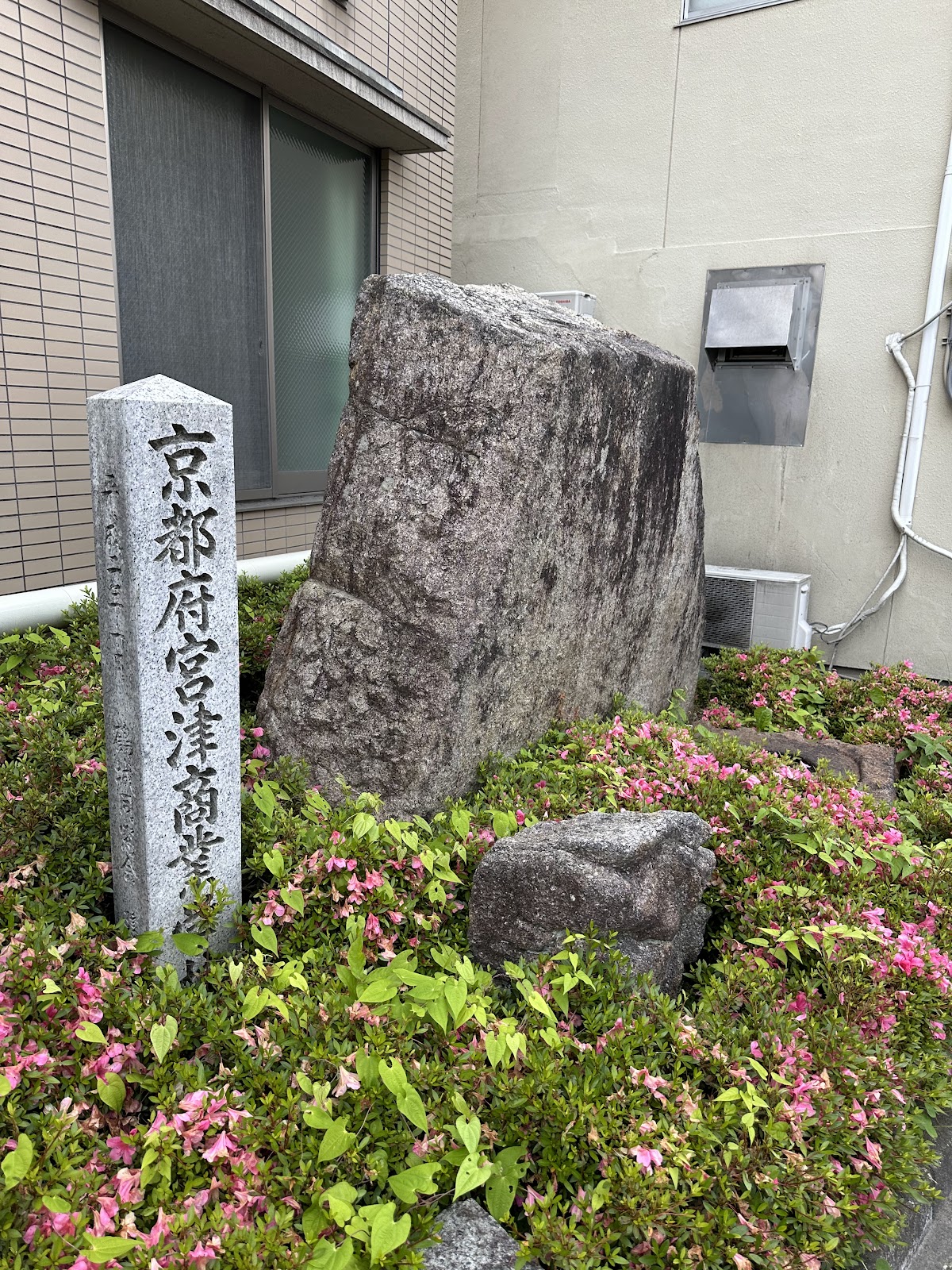
A portion of Miyazu Castle’s stone walls still exists on the east side of the Otegawa River. A particularly large boulder remains just before the Shin-Otebashi Bridge, and an information board has been erected designating it as “Miyazu Castle Stone.” This boulder is part of the castle’s stone wall, demonstrating the high level of castle-building technology of the time.
Approximately 60 meters west of the Shin-Otebashi Bridge, stone walls also remain, serving as an important relic indicating the former location of the castle walls. These stone walls were preserved during river improvement work and are valuable traces that allow us to appreciate the scale of Miyazu Castle.
The stonework of the castle walls is a mix of local and locally sourced stones, suggesting a large-scale construction project.
Moat Remains and Topography
In the current urban area, traces of the former moat remain as roads and waterways. Part of the outer moat surrounding the castle grounds still functions as a waterway, providing clues to the extent of the castle’s former boundaries.
The Otegawa River was also used for the castle’s defense, serving as a natural moat. While the current course of the Otegawa River has been altered by river improvement projects, comparing it to Edo-period maps allows us to understand the relationship between the castle and the river at that time.
Isshiki Inari Shrine and Castle Ruins Monument
A monument marking the “Miyazu Castle Ruins” stands in front of Miyazu Takeda Hospital, indicating that this area was once part of the castle grounds. Furthermore, Isshiki Inari Shrine, associated with the Isshiki clan, serves as a place to convey the history prior to Miyazu Castle.
Shirakabe no Michi (White Wall Path)
In the samurai residence district of the castle town, a section called “Shirakabe no Michi” (White Wall Path) remains, where white-walled earthen fences convey the atmosphere of the past. This area was the site of the samurai residences of the third bailey and retains remnants of the Edo period town layout.
Related Buildings and Surrounding Historical Sites
Statue of Hosokawa Gracia
Next to the Miyazu City Hall stands a statue of Hosokawa Gracia (daughter of Akechi Mitsuhide), wife of Hosokawa Tadaoki. Gracia spent a period of time at Miyazu Castle and is a symbolic figure of the relationship between Miyazu and the Hosokawa clan.
The Gracia statue is a popular tourist spot and one of the highlights when visiting the Miyazu Castle ruins.
Hachimanyama Castle (Miyazu Castle Mountain Castle)
On Hachimanyama, towering behind Miyazu Castle, the ruins of a mountain castle from the Isshiki clan era remain. This castle served as a base for controlling Tango Province before the construction of Miyazu Castle, and Hosokawa Fujitaka also used it for a period.
From Hachimanyama Castle, you can enjoy a panoramic view of Miyazu Bay, making it ideal for understanding its positional relationship to Miyazu Castle. A hiking trail is well-maintained, making it a must-see spot for mountain castle enthusiasts.
Tanabe Castle (Maizuru Castle)
Tanabe Castle, where Hosokawa Fujitaka holed up during the Battle of Sekigahara, is located in present-day Maizuru City. Miyazu Castle and Tanabe Castle were the two major bases for the Hosokawa clan’s control of Tango Province, and visiting both castles provides insight into the Hosokawa clan’s governing strategy.
Tanabe Castle still retains its stone walls and moats in good condition, and comparing it with Miyazu Castle offers interesting discoveries.
Access and Visiting Information
Access by Public Transportation
Train: Get off at Miyazu Station on the Kyoto Tango Railway Miyazu Line, and the main remains are approximately a 10-minute walk away. Miyazu Station is a major station where express trains also stop, making it conveniently accessible from Kyoto and Amanohashidate.
The path from Miyazu Station to the Miyazu Castle ruins is flat and suitable for walking. There is a tourist information center in front of the station where you can obtain maps for exploring the castle ruins.
Access by Car
By Car: Approximately 10 minutes from the Miyazu-Amanohashidate Interchange on the Kyoto Expressway.
Parking: Parking is available at the “Michi-no-Eki Umi no Kyoto Miyazu” (Roadside Station Sea of Kyoto Miyazu). From here, you can explore various parts of the castle ruins on foot, visiting the main points of interest in about 30 minutes.
The roadside station also has a tourist information center where you can obtain detailed information and brochures about Miyazu Castle.
Visiting Points
We recommend visiting Miyazu Castle Ruins in the following order:
- Gather information and park at Michi-no-Eki Umi no Kyoto Miyazu
- Confirm the castle grounds at the Castle Ruins Monument in front of Miyazu Takeda Hospital
- Visit the Stone Walls and Large Boulders along the Otegawa River
- Visit the Taiko Gate of Miyazu Elementary School (viewable from outside the school grounds)
- See the Statue of Hosokawa Gracia next to Miyazu City Hall
- Experience the atmosphere of the castle town at Shirakabe no Michi
The estimated time required is approximately 1-2 hours if you walk at a leisurely pace. Combining this with sightseeing in the surrounding area, such as Amanohashidate, will make for a fulfilling Tango sightseeing plan.
Points to Note When Visiting
- The Taiko Gate of Miyazu Elementary School is located within the school grounds, so please avoid entering the premises during class hours.
- The area around the stone walls is along a public road, so please be careful of traffic while visiting.
- Most of the castle ruins are urbanized and include private property. Please observe proper etiquette while visiting.
The Historical Significance of Miyazu Castle and Tango
Miyazu Castle is not merely a local castle, but occupies an important position in the history of Japanese castles. Built at the end of the Sengoku period, it served as a base on the Sea of Japan side in Oda Nobunaga’s strategy for unifying Japan.
As a castle built by Hosokawa Fujitaka, a renowned general skilled in both military and literary arts, it became a center of Tango not only militarily but also culturally. Because Fujitaka was a cultured man who received the Kokin Denju (secret teachings of classical Japanese poetry), Miyazu also developed as a cultural center of Tango.
During the Edo period, it continued to serve as the administrative center of the Miyazu Domain, playing a central role in the politics and economy of the Tango region. Taking advantage of its geographical advantage as a key point for maritime traffic, Miyazu flourished as a port of call for Kitamae-bune (northern route trading ships).
Currently, only limited remains of Miyazu Castle exist, but the remaining Taiko Gate and stone walls are preserved as valuable cultural heritage. Even amidst urbanization, Miyazu City is working to preserve and utilize the castle ruins, installing information boards and improving the remains.
Surrounding Sightseeing When Visiting Miyazu Castle
When visiting Miyazu, you can enjoy not only the Miyazu Castle ruins but also surrounding tourist attractions.
Amanohashidate
Amanohashidate, one of Japan’s three most scenic views, is about a 10-minute drive from Miyazu Castle ruins. Visiting this scenic spot, which was likely viewed by the Hosokawa and Kyogoku clans, allows you to experience the perspective of the castle lords of that time.
Chionji Temple
Located at the base of Amanohashidate, Chionji Temple is an ancient temple known as one of Japan’s three most important temples dedicated to Monju (Manjushri). It is a temple visited by the lords of Miyazu Castle, allowing you to feel a historical connection. ### Kongoin Temple
Kongoin Temple, located in Maizuru City, is known as a temple associated with the Hosokawa clan. It boasts many important cultural properties, and visiting it along with Miyazu Castle allows for a comprehensive understanding of the Hosokawa clan’s rule over Tango Province.
Ine Boathouses
In Ine Town on the Tango Peninsula, a unique group of boathouses remains, built facing the sea. Just as Miyazu Castle, as a seaside castle, had a deep connection with the sea, this is a place where you can experience the history of the Tango people’s coexistence with the sea.
Summary: The Charm and Value of Miyazu Castle
Although many remains of Miyazu Castle were lost due to its demolition during the Meiji era, the remaining Taiko Gate and stone walls are valuable cultural heritage that convey the history of Tango from the Sengoku period to the Edo period.
As a seaside castle built by the renowned general Hosokawa Fujitaka at the command of Oda Nobunaga, it occupies an important position in the history of Japanese castles. The distinctive structure of this flatland castle facing the sea showcased the most advanced castle-building technology of the time, and if it still existed, it would likely have been one of Japan’s most representative coastal castles.
Walking through the present-day Miyazu city center and imagining the castle’s former appearance is a valuable experience that evokes a sense of historical romance. Although the remains are limited, one can feel the weight of history each one tells.
Visiting the Miyazu Castle ruins will be a journey into the history of Tango, built by the Hosokawa Fujitaka and Tadaoki father and son, the Kyogoku clan, and successive feudal lords during the Edo period. Combining a visit to nearby tourist attractions such as Amanohashidate will allow you to discover the charm of Tango even more deeply.